

18+ | Affiliate link | Terms apply | Please gamble responsibly.
Last Updated on August 9, 2026 by Maurya
The FIFA World Cup 2014 delivered almost everything football supporters could have hoped for: spectacular goals, major upsets, emerging superstars, unforgettable drama and one of the most astonishing results in the history of international football.
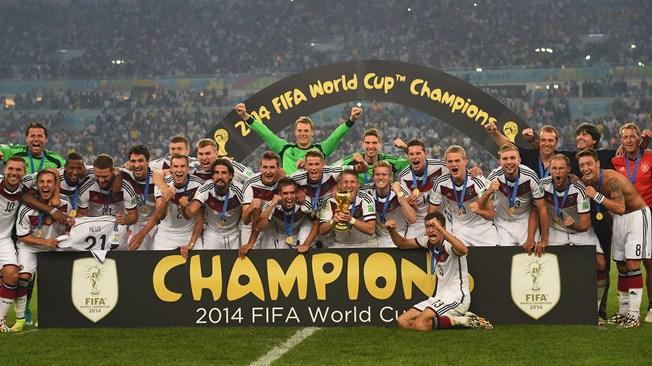
Hosted by Brazil from 12 June to 13 July 2014, the tournament brought the World Cup back to one of football’s spiritual homes. Thirty-two national teams competed across 12 venues, playing 64 matches and producing 171 goals. Germany ultimately lifted the trophy after defeating Argentina 1-0 after extra time in the final at the Maracanã in Rio de Janeiro.
Yet the final score tells only a fraction of the story.
From the Netherlands dismantling defending champions Spain to Costa Rica becoming one of the tournament’s biggest surprises, James Rodríguez announcing himself to the world and Germany inflicting a historic 7-1 defeat on Brazil, the 2014 World Cup in Brazil remains one of the defining football tournaments of the modern era.
FIFA World Cup 2014
The 2014 tournament was the 20th edition of the men’s FIFA World Cup and the second staged in Brazil after the country had previously hosted the competition in 1950. It attracted an official stadium attendance of 3,429,873 spectators across 64 matches, averaging more than 53,000 spectators per game.
| Tournament Detail | FIFA World Cup 2014 |
| Host country | Brazil |
| Dates | 12 June – 13 July 2014 |
| Teams | 32 |
| Venues | 12 |
| Matches | 64 |
| Goals | 171 |
| Champions | Germany |
| Runners-up | Argentina |
| Third place | Netherlands |
| Golden Ball | Lionel Messi |
| Golden Boot | James Rodríguez – 6 goals |
| Golden Glove | Manuel Neuer |
| Best Young Player | Paul Pogba |
Germany’s victory gave the country its fourth World Cup title, following earlier triumphs in 1954, 1974 and 1990. Joachim Löw’s side also became the first European national team to win a World Cup staged in the Americas.
Brazil Hosts the World Cup Again
Few countries are as closely connected with World Cup history as Brazil. The Seleção entered the 2014 tournament as five-time world champions, while the combination of passionate supporters, legendary stadiums and Brazil’s football culture created enormous expectations.
Those expectations also meant intense pressure.
Brazil had not won the World Cup on home soil when it hosted the competition in 1950, famously losing to Uruguay in the decisive match at the Maracanã. Sixty-four years later, supporters hoped Neymar and a new generation could finally deliver the trophy in front of a home crowd.
For much of the tournament, that possibility appeared realistic. Brazil progressed from its group and survived difficult knockout games against Chile and Colombia. Neymar was particularly important to the hosts before suffering a serious back injury during Brazil’s 2-1 quarter-final victory over Colombia, which ruled him out of the rest of the competition.
Brazil nevertheless reached the semi-finals.
What happened next became one of football’s most extraordinary nights.
A Group Stage Packed With Goals and Surprises
The FIFA World Cup 2014 established its reputation for unpredictability almost immediately.
One of the tournament’s defining early matches came when defending world champions Spain faced the Netherlands in a rematch of the 2010 World Cup final.
Spain initially took the lead, but the Netherlands responded spectacularly.
Robin van Persie’s remarkable diving header brought the Dutch level before Louis van Gaal’s team overwhelmed Spain and recorded a stunning 5-1 victory. The image of Van Persie launching himself through the air to meet Daley Blind’s pass became one of the most recognizable moments of Brazil 2014.
Spain never recovered sufficiently and were eliminated during the group stage, making their early exit one of the tournament’s first major shocks.
The Netherlands, by contrast, continued deep into the competition.
Costa Rica Become the Surprise Package
If one team embodied the unpredictable nature of the 2014 FIFA World Cup, it was Costa Rica.
Drawn alongside three former world champions—Uruguay, Italy and England—Costa Rica were widely considered outsiders in Group D. Instead, they won the group.
They opened with a memorable 3-1 victory against Uruguay, followed it by beating Italy 1-0 and then held England to a goalless draw. Keylor Navas emerged as one of the tournament’s outstanding goalkeepers, recording a 91 percent save rate according to FIFA’s retrospective statistics.
Costa Rica then defeated Greece on penalties in the Round of 16 before taking the Netherlands to another shootout in the quarter-finals.
Their eventual elimination did little to diminish the achievement. Reaching the final eight remains Costa Rica’s best-ever World Cup performance and turned the Central American side into one of Brazil 2014’s most memorable stories.
James Rodríguez Becomes a Global Star
Every World Cup seems to produce at least one player whose career changes dramatically during the tournament. In 2014, that player was James Rodríguez.
The Colombian attacking midfielder arrived in Brazil already regarded as a major talent, but his performances elevated his reputation to another level.
Colombia won all three of their Group C matches, defeating Greece 3-0, Ivory Coast 2-1 and Japan 4-1. James scored in all three games. Colombia then beat Uruguay 2-0 in the Round of 16 before losing 2-1 to host nation Brazil in the quarter-finals.
James finished the tournament with six goals, enough to win the Golden Boot.
His most famous moment came against Uruguay at the Maracanã. With his back to goal, James controlled the ball with his chest, turned and struck a superb volley that flew beneath the crossbar. FIFA later recognized the strike as the tournament’s best goal, and it also won the 2014 FIFA Puskás Award.
Brazil 2014 transformed James from an exciting young midfielder into one of football’s most recognizable stars.
Germany’s Road to the 2014 World Cup Final
Germany entered the tournament with a squad combining technical quality, tactical intelligence, experience and emerging talent.
Joachim Löw could call upon players such as Manuel Neuer, Philipp Lahm, Bastian Schweinsteiger, Toni Kroos, Mesut Özil, Thomas Müller and Miroslav Klose. Mario Götze and André Schürrle provided further attacking options.
Germany began their campaign emphatically by defeating Portugal 4-0. A 2-2 draw with Ghana followed before a 1-0 victory over the United States secured progress from Group G.
The knockout rounds became progressively more demanding.
Germany needed extra time to defeat Algeria 2-1 in the Round of 16 before Mats Hummels’ goal helped them beat France 1-0 in the quarter-finals. Their reward was a semi-final against the host nation in Belo Horizonte.
What followed went far beyond anything supporters could realistically have expected.
Brazil 1-7 Germany: The Match That Shocked Football
On 8 July 2014, Brazil and Germany walked onto the pitch at the Mineirão with a place in the World Cup final at stake.
Less than half an hour later, the contest was effectively finished.
Thomas Müller opened the scoring in the 11th minute. Miroslav Klose added Germany’s second before Toni Kroos scored twice in rapid succession. Sami Khedira made it 5-0 after just 29 minutes.
Germany added two more through André Schürrle in the second half. Oscar eventually scored a consolation goal for Brazil, leaving the final score at an extraordinary Brazil 1-7 Germany. FIFA records an attendance of 58,141 for a semi-final that became an instant part of World Cup history.
The result was remarkable not simply because Brazil lost. Heavy defeats happen in football.
The context made it extraordinary.
Brazil were the host nation, five-time world champions and playing a World Cup semi-final in front of their own supporters. Germany had scored five times before the opening half-hour had been completed.
It remains one of the most discussed and replayed matches in World Cup history.
The game also produced a major individual landmark for Miroslav Klose. His goal moved him ahead of Brazilian legend Ronaldo and made Klose the World Cup’s then all-time leading goalscorer with 16 goals.
Argentina’s Journey to the Final
While Germany reached the final with a combination of attacking firepower and tournament experience, Argentina’s path was defined to a greater extent by resilience, defensive organization and moments of brilliance from Lionel Messi.
Messi scored four goals during the tournament and repeatedly provided the attacking inspiration Argentina needed.
The knockout stage became increasingly tense. Argentina edged Switzerland after extra time, defeated Belgium 1-0 in the quarter-finals and then faced the Netherlands in the semi-finals.
After 120 goalless minutes, Argentina prevailed in a penalty shootout to reach their first World Cup final since 1990.
It set up a fascinating encounter with Germany at the Maracanã—and another chapter in one of the World Cup’s most enduring rivalries.
Germany and Argentina had previously contested the 1986 and 1990 World Cup finals, winning one each.
Germany vs Argentina: FIFA World Cup 2014 Final
The 2014 FIFA World Cup final was played at the Maracanã in Rio de Janeiro on 13 July.
Unlike Germany’s extraordinary semi-final, the championship match was tight, physical and tactically demanding.
Argentina created important opportunities, while Germany struggled to reproduce the attacking freedom they had enjoyed against Brazil. Neither side could find a goal during the 90 minutes, forcing the World Cup final into extra time.
Then came Mario Götze.
The 22-year-old had entered as a substitute. With the second period of extra time moving toward its conclusion, André Schürrle attacked down the left and delivered a cross into the penalty area.
Götze controlled the ball on his chest and, before it touched the ground, volleyed it beyond goalkeeper Sergio Romero.
Germany led 1-0.
There would be no Argentine equalizer.
Götze’s strike, recorded in the 113th minute, delivered Germany’s fourth World Cup championship and gave one of football’s biggest tournaments an appropriately dramatic finish.
Why Germany Deserved the 2014 World Cup
Germany’s victory was not based on one dominant player.
That was arguably one of the team’s greatest strengths.
Thomas Müller scored five goals, André Schürrle provided important contributions from the bench, Toni Kroos controlled key areas of midfield, Bastian Schweinsteiger offered resilience and leadership, Philipp Lahm demonstrated exceptional tactical intelligence and Manuel Neuer redefined expectations of how aggressively a goalkeeper could operate outside his penalty area.
Germany also demonstrated remarkable squad depth.
Schürrle, for example, scored twice from the bench against Brazil before creating Götze’s championship-winning goal against Argentina. FIFA notes that he averaged a goal or assist every 61 minutes during the competition.
That combination of collective quality, technical ability, tactical flexibility and depth ultimately separated Germany from the rest of the tournament.
Lionel Messi Wins the Golden Ball
Argentina may have lost the final, but Lionel Messi was named the tournament’s Golden Ball winner.
Messi scored four goals and played a central role in Argentina reaching the championship match. Thomas Müller received the Silver Ball, while Netherlands star Arjen Robben took the Bronze Ball.
Individual awards also highlighted the variety of exceptional performances seen throughout Brazil 2014.
James Rodríguez won the Golden Boot after scoring six times. Manuel Neuer was named the tournament’s leading goalkeeper and received the Golden Glove, while France midfielder Paul Pogba earned the Best Young Player award.
The Most Memorable Players of World Cup 2014
Although Germany’s collective strength defined the tournament’s final outcome, the World Cup featured outstanding individual performances across numerous teams.
James Rodríguez provided goals and creativity for Colombia. Arjen Robben was devastating for the Netherlands. Lionel Messi carried much of Argentina’s attacking responsibility. Neymar became Brazil’s focal point before injury ended his tournament prematurely, while Thomas Müller continued his remarkable record on football’s biggest stage.
Manuel Neuer was equally influential.
Germany’s goalkeeper combined traditional shot-stopping ability with exceptional positioning outside his penalty area. His performances helped popularize the modern idea of the aggressive “sweeper-keeper” at international level, and he eventually received the Golden Glove.
171 Goals and a Tournament Built on Attacking Football
One reason the Brazil World Cup 2014 is remembered so fondly is the volume and quality of its goals.
The tournament produced 171 goals across 64 matches, matching the total from France 1998 under the same 32-team format.
Some were technically exceptional. Others carried extraordinary historical significance.
Van Persie’s diving header against Spain became an instant World Cup image. James Rodríguez’s volley against Uruguay was voted the tournament’s best. Götze’s extra-time finish decided the championship.
Then there were goals that changed the record books, most notably Miroslav Klose’s strike against Brazil.
Together, those moments gave Brazil 2014 an attacking character that helps explain its enduring popularity.
The Legacy of the FIFA World Cup 2014
More than a decade later, the 2014 World Cup continues to occupy a special place in modern football history.
For Germany, it represented the culmination of years of development following major reforms to the country’s football structure and youth system. The victory gave Germany a fourth world championship and placed Joachim Löw’s generation among the nation’s greatest teams.
For Argentina, the tournament remains a story of coming painfully close. Lionel Messi reached his first World Cup final but was denied the trophy by Götze’s extra-time goal.
For Brazil, the legacy is considerably more complicated. Hosting a World Cup was intended to produce a national celebration, but the 7-1 semi-final defeat became one of the most painful moments in the country’s sporting history.
For Colombia and Costa Rica, however, Brazil 2014 represented breakthroughs. Colombia achieved what was then its best World Cup performance, reaching the quarter-finals, while James Rodríguez claimed the Golden Boot. Costa Rica also reached the final eight after unexpectedly winning a group containing Uruguay, Italy and England.
Why the 2014 World Cup Is Still Remembered
Great World Cups are rarely defined by one match.
Brazil 2014 had an abundance of memorable stories.
It had a defending champion collapsing in the group stage, an unfancied Costa Rica side upsetting established powers, James Rodríguez emerging as a superstar, Neymar carrying the hopes of a host nation, Messi leading Argentina to the final and Germany producing one of the most extraordinary performances ever witnessed at the tournament.
Then, in the final, a substitute scored an exquisite extra-time goal inside one of football’s most famous stadiums.
That combination is difficult to reproduce.
The FIFA World Cup is compelling precisely because carefully constructed expectations can disappear within minutes. The FIFA World Cup 2014 demonstrated that better than almost any modern edition.
Who Won the FIFA World Cup 2014?
Germany won the 2014 FIFA World Cup, defeating Argentina 1-0 after extra time at the Maracanã in Rio de Janeiro.
Mario Götze scored the only goal of the final with an outstanding extra-time volley from André Schürrle’s cross. The victory gave Germany its fourth men’s World Cup title.
Who Was the Top Scorer at the 2014 World Cup?
Colombia’s James Rodríguez won the Golden Boot after scoring six goals.
Thomas Müller finished with five, while Neymar, Lionel Messi and Robin van Persie were among the players who scored four. James’s performances were particularly impressive because Colombia’s tournament ended in the quarter-finals.
Who Was the Best Player at the FIFA World Cup 2014?
Lionel Messi received the Golden Ball as the tournament’s best player after helping Argentina reach the final.
Messi scored four goals during Argentina’s campaign and remained their principal creative and attacking influence. Thomas Müller received the Silver Ball and Arjen Robben the Bronze Ball.
What Was the Biggest Result of World Cup 2014?
The result that stands above all others is Brazil 1-7 Germany in the semi-finals.
Germany led 5-0 after only 29 minutes before eventually winning 7-1. Thomas Müller, Miroslav Klose, Toni Kroos, Sami Khedira and André Schürrle scored Germany’s goals, with Kroos and Schürrle each scoring twice.
Final Thoughts
The FIFA World Cup 2014 in Brazil succeeded because it produced moments that remained memorable long after the final whistle.
Germany were worthy champions, combining organization, technical quality and extraordinary depth. Argentina came within minutes of forcing the final toward penalties. Brazil experienced an unprecedented sporting collapse. Costa Rica defied expectations. James Rodríguez became a global star. Lionel Messi added another remarkable tournament to his career, even if the trophy escaped him.
Across 64 matches and 171 goals, Brazil 2014 delivered drama on a scale worthy of football’s biggest competition.
The enduring image may be Mario Götze controlling André Schürrle’s cross and volleying Germany to victory beneath the lights of the Maracanã. But the true appeal of the 2014 FIFA World Cup lies in everything that surrounded that moment: the surprises, records, heartbreak, goals and unforgettable stories that made Brazil 2014 one of the defining tournaments of its generation.
ADVERTISEMENT

18+ | Affiliate link | Terms apply | Please gamble responsibly.


