

18+ | Affiliate link | Terms apply | Please gamble responsibly.
Last Updated on October 1, 2026 by Maurya
Getting scammed through an online casino, betting website, gambling app, or supposed gambling investment scheme can be financially and emotionally overwhelming. One moment you may believe you are depositing money with a legitimate operator; the next, your withdrawal is blocked, the website disappears, unauthorized transactions appear on your account, or someone demands another payment before they will supposedly release your winnings.
If this has happened to you, acting quickly matters.
Although recovering money from an online gambling scam is never guaranteed, there are practical steps that can improve your chances of limiting further losses, securing your accounts, documenting what happened, and getting the incident in front of the appropriate financial institution or law-enforcement authority.
First, Determine Whether It Was Actually an Online Gambling Scam
Not every gambling loss or withdrawal disagreement is necessarily fraud.
If you placed a legitimate bet and lost according to the published rules, that is generally a gambling loss rather than a scam. Similarly, a regulated gambling operator may temporarily delay a withdrawal while carrying out legally required identity, anti-money-laundering, or payment checks.
A potential scam is different.
Warning signs may include:
- A casino or sportsbook taking deposits but consistently refusing legitimate withdrawals
- A website disappearing after you deposit money
- Unauthorized charges appearing on your card or bank account
- A supposed gambling platform asking for additional “tax,” “verification,” “unlocking,” or “release” fees before you can withdraw
- Being told to send cryptocurrency to a private wallet to activate your gambling account
- Fake customer-service representatives asking for passwords or one-time security codes
- An operator falsely claiming to hold a gambling licence
- A betting or gambling “investment” platform showing fake profits that cannot actually be withdrawn
- A website repeatedly inventing new fees after you request a payout
- Someone asking you to install remote-access software so they can supposedly fix your gambling account
If you are dealing with a licensed gambling company and the issue is a normal account or transaction dispute, the appropriate route may be the operator’s formal complaints procedure rather than a fraud report.
For example, Britain’s Gambling Commission tells consumers to complain directly to the gambling business first in disputes involving winnings, payments, account closures, bonus terms, verification, or cancelled bets. If the dispute remains unresolved, consumers may be able to escalate it to an approved Alternative Dispute Resolution provider.
On the other hand, suspicious activity involving an unlicensed gambling business or criminal conduct should be treated much more seriously.
Stop Sending Money Immediately
The first and most important rule is simple:
Do not send the gambling site, agent, broker, or “customer support representative” any more money.
Scammers frequently use previous payments to justify new ones.
For example, they may tell you:
- “Pay a withdrawal processing fee.”
- “Your winnings are frozen until you pay tax.”
- “You must deposit another £500 to verify your wallet.”
- “Your account needs an anti-money-laundering clearance payment.”
- “You need to upgrade to VIP status before withdrawing.”
- “Pay this insurance fee and all your money will be released.”
One payment often leads to another.
A legitimate financial or regulatory problem is not resolved simply because someone sends additional money to an unknown cryptocurrency wallet, gift card, personal bank account, or payment-app address.
The U.S. Federal Trade Commission specifically warns that scammers commonly favor payment methods such as cryptocurrency, bank transfers, wire transfers, payment apps, and gift cards because recovering the money can be difficult.
If someone claims that paying one last fee will release a large balance, stop and independently verify the situation before doing anything else.
Contact Your Bank, Card Issuer, or Payment Provider Immediately
If you have lost money, contact the company that processed the payment as soon as possible.
Speed can be important.
Tell your bank, credit-card company, payment service, cryptocurrency exchange, or other provider that you believe you were deceived by an online gambling scam.
Provide:
- The amount transferred
- Date and time of payment
- Merchant or recipient name
- Transaction reference
- Why you believe the transaction involved fraud
- Any evidence showing how the payment was obtained
Ask whether the payment can be stopped, recalled, reversed, disputed, or investigated.
The FTC recommends immediately contacting the relevant financial company after discovering a scam and asking whether the transaction can be reversed or refunded. Its guidance covers bank transfers, payment apps, wire transfers, credit cards, debit cards, gift cards, and cryptocurrency.
Do not assume that a chargeback or refund is guaranteed. Your rights can depend on factors such as the country, payment method, transaction type, authorization process, evidence available, and your bank’s rules.
However, delaying the report can make recovery more difficult.
What if You Paid by Credit or Debit Card?
Contact the issuer using the phone number on the back of your card or through its official banking app.
Explain exactly what happened.
If there are transactions you did not authorize, make that clear. Unauthorized transactions and payments that you personally authorized after being deceived may be handled differently.
Ask the bank what dispute or fraud procedure applies to your situation.
What if You Paid by Bank Transfer?
Contact your bank’s fraud department immediately.
Provide the receiving account information and ask whether the transfer can still be recalled or whether the receiving bank can be contacted.
Never communicate with your bank through a phone number or link supplied by the suspected scammer. Use the official bank website, app, card, or statement.
What if You Paid With Cryptocurrency?
Cryptocurrency cases can be particularly difficult because blockchain transactions generally cannot simply be cancelled after confirmation.
Nevertheless, you should contact the cryptocurrency exchange or service you used immediately.
Record:
- Wallet addresses
- Transaction hashes
- Cryptocurrency type
- Amount transferred
- Date and time
- Exchange used
- Screenshots of the transaction
The FBI’s Internet Crime Complaint Center states that transaction hashes, wallet addresses, cryptocurrency amounts, dates, and times can be especially valuable when reporting crypto-related scams.
Do not delete your crypto wallet or transaction history merely because the money has already moved. Those records may become important evidence.
Preserve Every Piece of Evidence
Before the scam website disappears or the scammers delete their accounts, preserve as much information as possible.
Create a folder containing:
- Screenshots of the gambling website
- Website URL and domain name
- Account username or player ID
- Deposit history
- Withdrawal requests
- Betting history where relevant
- Terms and conditions
- Promotional offers
- Emails
- Text messages
- WhatsApp or Telegram messages
- Social-media conversations
- Names used by customer-service agents
- Phone numbers
- Email addresses
- Cryptocurrency wallet addresses
- Transaction hashes
- Bank transaction references
- Receipts
- Copies of any documents you submitted
- Screenshots of your account balance
- Messages demanding additional fees
Do this before confronting the suspected scammer if possible.
Fraudulent sites can disappear without warning, and chat accounts can be deleted quickly.
Also create a simple timeline:
Example:
January 5 — Opened account after seeing advertisement.
January 6 — Deposited £250.
January 10 — Account showed £1,850 balance.
January 11 — Requested £1,000 withdrawal.
January 12 — Support demanded £300 “tax payment.”
January 12 — Paid £300.
January 13 — Support demanded another £500 “security deposit.”
January 13 — Stopped payments and contacted bank.
A clear chronology can make your report much easier for a bank, regulator, lawyer, or investigator to understand.
Check Whether the Gambling Website Is Actually Licensed
A polished website does not prove that a gambling operator is legitimate.
Fraudsters can copy logos, licence numbers, website layouts, company names, and regulatory statements from genuine businesses.
If an operator claims to be regulated, verify the claim directly with the regulator.
For consumers in Great Britain, the Gambling Commission maintains a public register where users can search licensed gambling businesses and review licence information and certain regulatory actions.
The Commission advises users to look for licensing information in a gambling website or app and independently compare it with the official register.
Do not simply click the regulator logo on the gambling website. A fraudulent operator can make that image link to a fake page.
Instead, navigate independently to the regulator’s official website.
Check:
- Legal company name
- Trading name
- Website domain
- Licence number
- Current licence status
- Jurisdictions covered
- Regulatory actions where available
A licence belonging to a real company does not automatically prove that the website you used belongs to that company. Scammers sometimes impersonate legitimate businesses.
Report the Gambling Scam to the Appropriate Authority
Reporting serves two purposes.
First, it creates an official record that may help with a bank, insurance claim, or investigation.
Second, your information can help authorities identify patterns affecting other victims.
If You Are in the UK
As of 2026, Report Fraud has replaced Action Fraud as the national fraud-reporting platform. The new service launched on December 4, 2025.
People in England, Wales, and Northern Ireland can report fraud through Report Fraud. Scotland generally uses Police Scotland for fraud reports.
Report Fraud states that reports can be made online or by phone and that victims receive a crime reference number.
If a gambling business operating in Great Britain appears unlicensed or you have information concerning suspected criminal activity connected with gambling, you can also report relevant information to the Gambling Commission. The Commission accepts information relating to suspicious activity, unlicensed gambling, money laundering concerns, and gambling-related criminality.
Remember that the Gambling Commission does not normally decide individual gambling transaction disputes for consumers. Complaints against licensed operators typically begin with the gambling company’s own complaints process.
If You Are in the United States
Victims can report scams to the Federal Trade Commission through ReportFraud.ftc.gov. The FTC says reports help authorities identify fraud trends and build cases.
Internet-enabled fraud can also be reported to the FBI’s Internet Crime Complaint Center (IC3).
For cryptocurrency scams in particular, the FBI encourages victims to include transaction details such as wallet addresses, transaction hashes, amounts, cryptocurrency types, domains, communication platforms, phone numbers, and relevant dates.
If You Live Elsewhere
Look for your country’s:
- National gambling regulator
- Consumer-protection agency
- Financial regulator
- Cybercrime reporting service
- Police fraud-reporting unit
Use official government websites rather than telephone numbers or links supplied by the gambling site.
Secure Your Gambling, Email, and Financial Accounts
Money may not be the scammer’s only target.
If you supplied your:
- Email password
- Gambling password
- Banking credentials
- Card details
- Passport
- Driving licence
- National identity document
- Security answers
- Phone number
you should consider the possibility of account takeover or identity fraud.
Change the password for the compromised account immediately.
If you reused that password anywhere else, change those passwords too.
The UK’s National Cyber Security Centre specifically advises people with compromised accounts to change the affected password and any identical passwords used on other accounts.
Enable multi-factor or two-factor authentication wherever possible.
Pay particular attention to your email account because access to email can allow a criminal to reset passwords for banking, cryptocurrency, social-media, and other accounts.
Review:
- Login history
- Connected devices
- Recovery phone numbers
- Recovery email addresses
- Email forwarding rules
- Payment information
- Active sessions
The FTC likewise recommends changing compromised passwords and enabling two-factor authentication after scammers obtain account credentials.
Monitor Your Financial Accounts
Continue monitoring your accounts even after reporting the original transaction.
Scammers may attempt additional payments days or weeks later.
Watch for:
- Small unfamiliar card transactions
- New direct debits
- Cryptocurrency withdrawals
- Password-reset emails
- New payees
- Login alerts
- Credit applications
- Unfamiliar financial accounts
If your bank card details have been compromised, ask your bank whether the card should be replaced.
If sensitive identity information has been exposed, check what identity-theft protections are available in your country.
The goal is not only to recover the original money but also to prevent the incident from becoming a larger financial or identity-fraud problem.
Be Extremely Careful With “Recovery Experts”
One of the most dangerous stages comes after the original scam.
Fraud victims are frequently targeted again by people claiming they can recover the lost money.
You may receive messages from supposed:
- Lawyers
- Blockchain investigators
- Government agents
- Asset recovery companies
- Hackers
- Regulators
- Cryptocurrency experts
- Chargeback specialists
They may claim they have located your money and can retrieve it after you pay an upfront fee.
Treat unsolicited recovery offers with extreme caution.
The FBI specifically warns cryptocurrency scam victims to be wary of people who claim they can recover lost funds because the recovery offer itself may be another scam.
A major red flag is someone guaranteeing recovery.
No legitimate professional can honestly promise in advance that stolen funds will definitely be recovered.
Be particularly cautious if the “recovery agent”:
- Contacts you unexpectedly
- Knows details of your original scam
- Demands cryptocurrency
- Requests an advance fee
- Promises a guaranteed refund
- Claims to have hacked the scammer
- Says law enforcement requires a payment
- Demands remote access to your device
Your personal information may have been sold or shared between criminal groups, which means a second scammer may already know that you lost money.
Can You Get Your Money Back After an Online Gambling Scam?
Sometimes—but there is no universal answer.
Recovery depends on factors including:
- How quickly you report the fraud
- Payment method
- Whether the payment is still pending
- Whether the receiving account can be frozen
- Whether your bank offers an applicable reimbursement process
- Whether card-dispute rules apply
- Whether the gambling operator is regulated
- Whether the transaction was authorized
- Country and consumer-protection laws
- Availability of evidence
- Whether law enforcement can identify or freeze assets
Credit- and debit-card transactions may provide dispute mechanisms that are unavailable with other payment types. Cryptocurrency transactions, by contrast, generally lack the same payment protections and may be significantly harder to recover.
That is why the safest approach is to report the transaction immediately rather than assuming the money is permanently gone—or assuming a refund is guaranteed.
What If a Legitimate Online Casino Refuses to Pay Your Winnings?
A delayed or rejected withdrawal does not automatically mean the operator is a scam.
Licensed gambling operators can impose legitimate verification and compliance requirements, although those requirements must still comply with the rules applicable in their jurisdiction.
If you believe a licensed operator has unfairly refused a withdrawal:
- Read the operator’s withdrawal rules and terms.
- Save evidence showing your account balance and withdrawal request.
- Contact customer support in writing.
- Use the company’s formal complaint process.
- Keep copies of every response.
- Escalate through the regulator-approved dispute process if appropriate.
In Great Britain, the Gambling Commission states that licensed businesses must provide a complaints procedure. If a dispute cannot be resolved through the operator’s process, the customer may be able to take the matter to an Alternative Dispute Resolution provider.
This is different from dealing with a completely fake or unlicensed website, where contacting your bank and reporting fraud may need to take priority.
How to Avoid Online Gambling Scams in the Future
Prevention starts before the first deposit.
Before using an online gambling operator:
Verify the licence independently. Search the regulator’s official database rather than trusting a logo on the casino website.
Check the exact domain. Fraudsters may copy legitimate gambling brands using similar-looking web addresses.
Read withdrawal conditions before depositing. Pay attention to verification requirements, bonus wagering terms, withdrawal limits, and fees.
Avoid gambling businesses that accept only difficult-to-reverse payment methods. Being told that you can deposit only through cryptocurrency, gift cards, or transfers to individuals should trigger additional caution.
Never share one-time security codes. Legitimate customer support should not need your banking authentication code.
Use unique passwords. A gambling-site data breach should not give criminals access to your email or banking accounts.
Enable two-factor authentication. Use it on your email, financial accounts, cryptocurrency exchange, and gambling account whenever available.
Be skeptical of guaranteed winnings. Legitimate gambling involves risk. Anyone guaranteeing profits from casino games, betting systems, fixed matches, or “AI betting algorithms” deserves careful scrutiny.
Frequently Asked Questions
What should I do first if an online casino scams me?
Stop making payments and contact your bank, card issuer, cryptocurrency exchange, or payment provider immediately. Ask whether the transaction can be stopped, recalled, disputed, or investigated. Then preserve your evidence and report the incident to the appropriate fraud or gambling authority.
Should I pay a fee to unlock my gambling winnings?
Repeated demands for additional payments to release an existing balance are a major warning sign. Do not keep paying simply because someone promises the next payment will unlock your money. Independently verify the operator and contact your financial institution if you believe you are dealing with fraud.
Can my bank recover money lost to an online gambling scam?
Possibly. Recovery depends on the payment method, applicable law, transaction circumstances, evidence, timing, and your bank’s procedures. Contact your financial institution as quickly as possible, but do not assume reimbursement is guaranteed.
Can cryptocurrency sent to a fake gambling website be recovered?
Cryptocurrency transactions are generally difficult to reverse. Contact the exchange or service you used immediately and preserve the transaction hash, wallet address, amount, currency, and date. Report the transaction to the appropriate law-enforcement authority. Be cautious of anyone guaranteeing that they can recover your cryptocurrency.
How do I know whether an online casino is licensed?
Go directly to the official website of the gambling regulator responsible for your jurisdiction and search its licence register. Verify the operator’s legal name, domain, licence number, and current status. Do not rely solely on a licence badge displayed by the gambling website.
Should I delete my account after being scammed?
Secure your accounts first and preserve your evidence before deleting anything. Screenshots, messages, transaction records, account history, and correspondence can become important if your bank, regulator, or law-enforcement agency investigates the case.
What if I gave the gambling site my passport or ID?
Change compromised account passwords, enable two-factor authentication, monitor financial accounts, and investigate the identity-theft protection or reporting options available in your country. Identity documents can potentially be misused long after the original payment scam.
Final Thoughts
Knowing what to do if you get scammed in online gambling can make a significant difference in how much further damage you prevent.
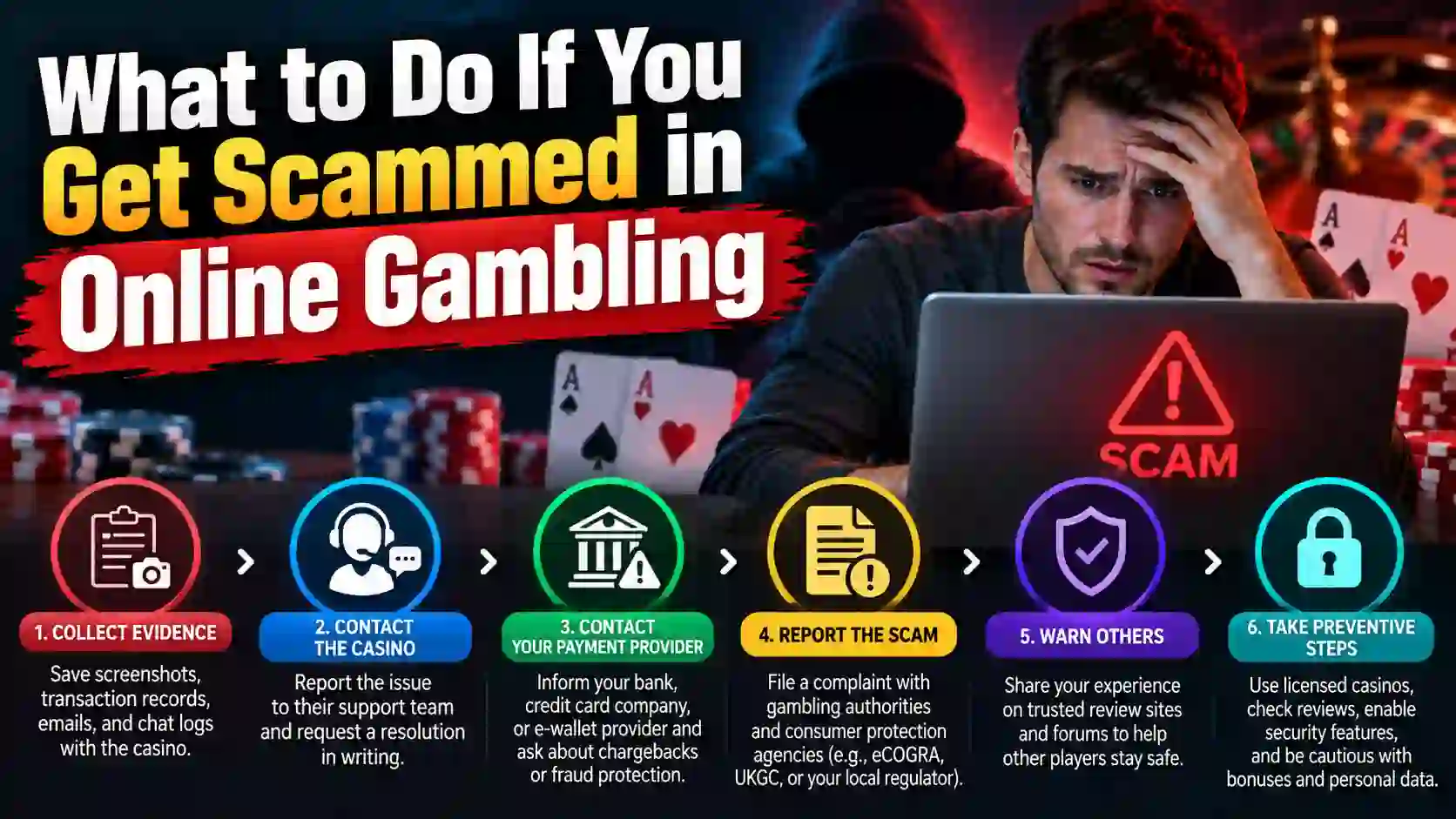
The most important steps are to stop sending money, contact your payment provider quickly, preserve evidence, secure your accounts, verify whether the gambling operator is licensed, and report suspected fraud through official channels.
Most importantly, do not allow the urgency of recovering your money to push you into another risky payment.
Online gambling scammers frequently rely on pressure, embarrassment, fear, and the hope of recovering previous losses. A legitimate bank, regulator, police service, or professional adviser should be independently verifiable.
If gambling itself is becoming difficult to control, financial recovery may only be part of the solution. In Great Britain, GamCare’s National Gambling Helpline provides free and confidential support 24 hours a day, including assistance for people affected by their own gambling or someone else’s.
Protect your accounts, document everything, report the incident promptly, and rely on verified institutions rather than anyone promising an easy or guaranteed recovery.
ADVERTISEMENT

18+ | Affiliate link | Terms apply | Please gamble responsibly.


