

18+ | Affiliate link | Terms apply | Please gamble responsibly.
Last Updated on September 28, 2026 by Maurya
Online casinos have made casino-style games easier to access than ever before. A smartphone, internet connection, and registered account can provide access to slots, table games, live dealer rooms, and other gambling products within minutes.
That convenience, however, makes informed decision-making particularly important.
A polished website, attractive welcome offer, or large game library does not automatically tell you whether an online casino is properly regulated, whether its bonus conditions are reasonable, or whether gambling there is appropriate for your circumstances.
Players also need to remember one fundamental fact: casino games are designed with a mathematical advantage for the operator. There is no reliable system that guarantees long-term profits.
The sensible approach is therefore not to look for a secret way to beat the casino. It is to understand how online casinos work, protect your personal and financial information, recognise the terms attached to promotions, and maintain strict limits around both money and time.
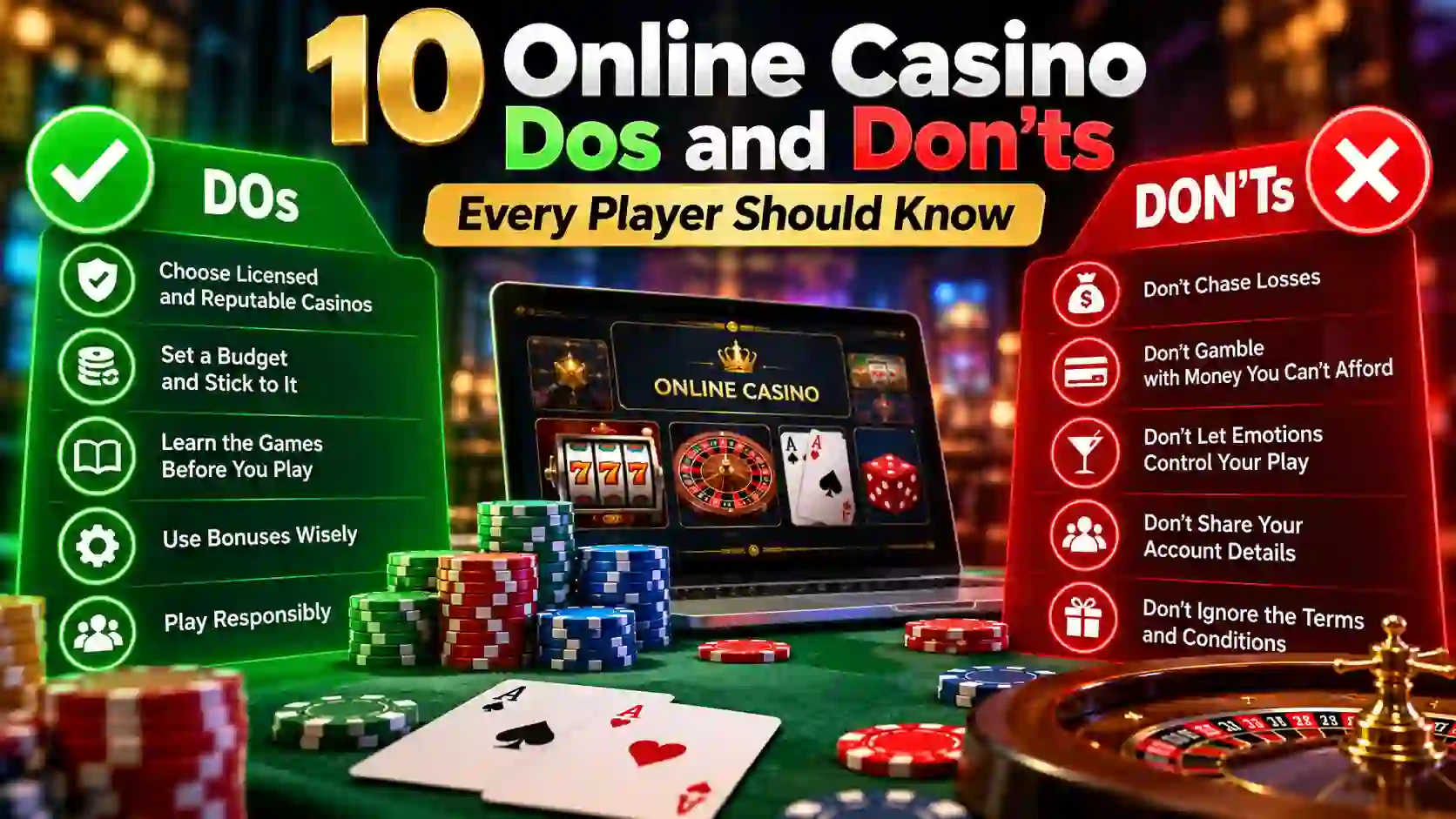
Here are 10 online casino dos and don’ts every player should know before gambling online.
Important: Gambling laws and minimum-age requirements differ between countries and regions. Only gamble where it is legal for you to do so, and use gambling products only if you meet the applicable legal-age requirements.
DO Check the Casino’s Licence — DON’T Trust a Logo Alone
One of the first checks you should make before creating an online casino account is whether the operator is legally permitted to offer gambling services in your jurisdiction.
Legitimate regulated operators generally provide licensing information in their website footer, legal pages, or terms and conditions.
However, seeing the logo of a regulator is not enough by itself.
Where possible, go directly to the relevant regulator’s public register and verify that the company, website, or trading name appears there.
For example, the UK Gambling Commission advises consumers in Great Britain to check whether a gambling business is licensed before using it. Its public register allows consumers to verify licence information and see certain regulatory actions involving licensed businesses.
For operators serving consumers in Great Britain, a Gambling Commission licence is required for relevant remote gambling activities, including where the gambling business itself is based outside Great Britain.
Do:
Verify a casino through your jurisdiction’s official gambling regulator. Look for the legal business name, licence number, permitted activities, and any relevant restrictions.
Don’t:
Assume that professional branding, celebrity advertising, social-media popularity, or a regulator’s logo automatically proves that a casino is authorised.
A licensing check takes only a few minutes and can tell you considerably more than an advertisement ever will.
DO Read the Bonus Terms — DON’T Focus Only on the Headline Amount
Casino bonuses are designed to attract attention.
You may see promotions offering deposit matches, free spins, cashback, bonus credit, loyalty rewards, or other incentives. The advertised figure may look generous, but the headline is only part of the offer.
Before accepting a promotion, check its complete terms.
Important conditions may include:
- wagering requirements;
- minimum deposits;
- maximum qualifying deposits;
- eligible games;
- contribution percentages;
- expiry periods;
- withdrawal restrictions;
- maximum-bet conditions;
- country restrictions; and
- eligibility requirements.
A bonus can therefore be very different from simply receiving unrestricted cash.
UK Gambling Commission guidance states that licensed gambling businesses opening accounts must provide information concerning free offers, bonuses, and applicable terms and conditions.
Do:
Read the promotion’s complete conditions before depositing or activating the offer.
Don’t:
Deposit money purely because a large percentage, number of free spins, or promotional countdown makes the offer appear urgent.
A good rule is simple: if you do not understand how a bonus works, do not claim it until you do.
DO Set a Spending Limit — DON’T Chase Losses
Before gambling, decide how much money you can afford to lose without affecting rent, mortgage payments, food, transport, bills, debt repayments, savings goals, or other essential commitments.
That amount should be treated as a maximum loss limit, not a spending target.
Many regulated gambling platforms offer account tools that allow customers to set financial limits. Where these tools are available, using them before you start playing can introduce an additional barrier against impulsive decisions.
GambleAware recommends deciding on a spending limit in advance and warns against chasing losses after that limit has been reached. It notes that attempts to recover previous losses can lead to even greater losses.
GamCare similarly advises players to use spending limits where appropriate.
Do:
Choose a maximum amount before the session starts and stop when that amount has been lost.
Don’t:
Increase your stakes, make another deposit, or abandon your original limit because you believe you are “due” to win your money back.
Previous losses do not make the next spin, hand, or round more likely to produce the outcome you want.
Chasing losses is one of the clearest situations in which gambling can stop being entertainment and become financially harmful.
DO Set a Time Limit — DON’T Gamble on Autopilot
Money is not the only thing worth monitoring when gambling online.
Time matters too.
Online casinos can operate around the clock, removing many of the natural stopping points associated with physical entertainment venues. A player can move immediately from one game to another without leaving their chair.
That makes it surprisingly easy for a short session to become a long one.
Both GambleAware and GamCare recommend keeping track of gambling time and setting limits or using available reality-check tools.
Do:
Decide how long your session will last before you begin. Use an alarm, casino time-limit feature, reality check, or another clear stopping point.
Don’t:
Continue gambling simply because you have lost track of time, are bored, or feel that one more round might change the result.
Pay attention to the broader impact too. If gambling is regularly replacing sleep, work, exercise, hobbies, relationships, or other responsibilities, that deserves attention even if the amount being spent initially seems manageable.
DO Understand the Game — DON’T Believe in Guaranteed Winning Systems
Different casino games operate according to different rules, probabilities, house advantages, and payout structures.
Before wagering real money, understand what determines the outcome and how the game works.
For a table game, that means learning the rules and available bets. For slots, it means understanding that features such as paylines, volatility, jackpots, and theoretical return-to-player percentages do not guarantee what will happen during an individual session.
The same principle applies to so-called betting systems.
Progressive staking plans, patterns, lucky numbers, previous outcomes, online “hacks,” and paid prediction systems cannot remove a casino game’s underlying mathematical advantage.
Do:
Learn the rules, paytable, bet structure, and relevant probabilities before committing money.
Don’t:
Assume that a losing streak guarantees an approaching win or that a winning streak proves you have discovered a repeatable system.
In independent random games, previous results generally do not make a particular future result “due.”
Understanding that distinction can help prevent emotional decisions based on patterns that are not actually predictive.
DO Protect Your Account — DON’T Reuse Weak Passwords
An online casino account contains more than a balance.
Depending on the operator, it may also contain identifying information, contact details, transaction history, payment information, identity-verification documents, and withdrawal details.
Treat the account with the same care you would give another financial service.
Do:
Use a strong, unique password. Enable multi-factor authentication when offered. Keep your email account secure, and access casino accounts only through the operator’s legitimate website or official application.
Be particularly careful with unsolicited emails, text messages, advertisements, or direct messages claiming that you must urgently “verify” your account.
Don’t:
Reuse the same password across multiple casinos, email accounts, banking services, and social-media platforms.
Never give another person your password or security codes.
You should also be cautious of anyone claiming they can access a hidden casino feature, recover losses, manipulate games, or guarantee withdrawals in exchange for login credentials or an additional payment.
Good account security may not make gambling profitable, but it can reduce avoidable risks involving fraud and unauthorised access.
DO Understand Deposits and Withdrawals — DON’T Wait Until You Win to Check the Rules
Many players carefully examine deposit options while barely looking at withdrawal conditions.
That reverses the priority.
Before depositing, investigate how withdrawals work.
Check:
- available withdrawal methods;
- identity-verification requirements;
- minimum and maximum withdrawal amounts;
- processing procedures;
- applicable fees;
- whether withdrawals must return to the original payment method;
- relevant bonus restrictions; and
- account-verification requirements.
Identity checks are a normal feature of regulated gambling markets. They can form part of age verification, customer identification, fraud prevention, anti-money-laundering requirements, and other regulatory responsibilities.
In Great Britain, current Gambling Commission licence requirements include provisions covering customer identity verification as part of the regulatory framework applying to licensed operators.
Do:
Review withdrawal and verification requirements while choosing an operator, not after requesting your first payout.
Don’t:
Assume every withdrawal will be instant simply because deposits are fast.
If a casino repeatedly introduces unexplained requirements that appear inconsistent with its published terms, document your communications and use its formal complaints procedure or the relevant dispute-resolution route available in your jurisdiction.
For consumers in Great Britain, licensed gambling businesses must maintain complaints procedures, with qualifying unresolved disputes capable of being referred to an Alternative Dispute Resolution provider under the regulatory framework.
DO Keep Gambling Money Separate — DON’T Borrow to Gamble
Casino gambling should never depend on borrowed money.
Credit, loans, overdrafts, money intended for bills, emergency savings, or funds borrowed from friends and relatives should not become a gambling bankroll.
Borrowing can make losses significantly harder to absorb because the original gambling loss may be followed by interest charges, repayment obligations, financial stress, or damaged relationships.
Do:
If you choose to gamble, restrict it to discretionary money whose loss will not affect essential expenses or financial responsibilities.
Keeping gambling transactions visible and reviewing your account history can also give you a clearer picture of how much you are actually spending.
Don’t:
Borrow money after losing because you believe another gambling session will allow you to repay the debt.
That can turn a gambling loss into a much larger financial problem.
Gambling is not an income strategy, investment plan, debt solution, or reliable method of making money.
DO Use Safer-Gambling Tools — DON’T Ignore Warning Signs
Responsible gambling tools are most useful when players know about them before they need them.
Depending on the operator and jurisdiction, available options may include:
- deposit limits;
- spending limits;
- session reminders;
- reality checks;
- time-outs;
- cooling-off periods;
- marketing controls;
- transaction blocks; and
- self-exclusion.
GamCare specifically highlights tools such as spending limits, reality checks, time-outs, and self-exclusion as ways people can create boundaries around gambling.
Do:
Use these tools proactively, particularly if you notice that it is becoming harder to stick to your own limits.
Don’t:
Treat safeguards as something only relevant to someone with a severe gambling problem.
Pay attention to behavioural changes.
Warning signs can include repeatedly exceeding intended spending, hiding gambling from other people, borrowing money, thinking constantly about recovering losses, abandoning other activities, or feeling unable to stop despite wanting to.
If gambling is no longer feeling controlled, continuing to gamble in an attempt to solve the situation is unlikely to improve it.
Taking a break can be the more appropriate choice.
For people in Great Britain seeking a longer break from online gambling, GamCare identifies GAMSTOP as a free self-exclusion service covering participating businesses licensed in Great Britain.
DO Treat Gambling as Paid Entertainment — DON’T Expect It to Produce Income
Perhaps the most important online casino rule is also the simplest:
Do not treat casino gambling as a reliable way to make money.
Casinos operate commercially because the mathematics of their games provides the operator with an advantage over time.
Individual players can win during individual sessions. Large jackpots and significant payouts can certainly occur. But the possibility of winning is different from having a dependable source of profit.
Seeing screenshots of big wins on social media can distort perception because they rarely show every deposit, losing session, abandoned bet, or previous loss behind the winning image.
Do:
If you decide to gamble, consider any money staked to be the price of entertainment that may be lost.
Don’t:
Include hoped-for casino winnings in your financial plans, attempt to cover household expenses through gambling, or continue playing because you feel you need a particular result.
The moment gambling shifts from optional entertainment to something you feel financially dependent on is a strong reason to stop.
Extra Online Casino Safety Checks Worth Making
The ten principles above cover the most important online casino dos and don’ts, but several additional checks can help you evaluate an operator more carefully.
Look for Clear Company Information
A trustworthy regulated casino should make it reasonably straightforward to identify the legal company operating the website.
Be cautious when ownership information, licensing details, contact methods, or terms are difficult to locate.
Read the Privacy Policy
Online gambling accounts may require significant personal information.
Review what information the operator collects, why it collects it, and how that information may be used.
Check Customer-Fund Information
Consumer protections differ by jurisdiction.
In Great Britain, for example, licensed gambling businesses must explain the level of protection applying to customer funds if the business becomes insolvent. The Gambling Commission specifically advises consumers to check this information.
That is a useful reminder that money held in a gambling account should not automatically be treated like money held in an ordinary bank account.
Save Important Records
Keep relevant records of deposits, withdrawals, promotional terms, customer-service conversations, and complaints.
This can be useful if a dispute later arises.
Be Cautious With Casino Reviews
Casino-review websites can provide useful information, but not every review is independent.
Some websites earn affiliate commission when readers register with operators through their links.
That does not automatically make the review inaccurate, but commercial relationships should be transparent.
Whenever possible, verify important claims—especially licensing claims—against official regulatory sources.
Common Online Casino Mistakes to Avoid
Many costly mistakes are not caused by complex casino games. They happen because players make decisions quickly.
Some of the most common include accepting a bonus without reading the terms, depositing before verifying the licence, chasing losses, increasing stakes emotionally, gambling for longer than intended, ignoring withdrawal conditions, and continuing to play when gambling is no longer enjoyable.
Another mistake is confusing short-term results with skill.
A winning evening does not guarantee another winning evening. Likewise, losing repeatedly does not mean a big win is mathematically required to arrive soon.
Randomness does not keep a personal account of what an individual player has won or lost.
FAQs
What should I check before joining an online casino?
Start with the casino’s legal status in your jurisdiction. Verify its licence directly with the appropriate regulator where possible.
Then review the casino’s terms and conditions, payment policies, identity-verification requirements, withdrawal procedures, bonus terms, responsible-gambling tools, and customer-support options.
Are online casino bonuses free money?
Not necessarily.
Bonuses frequently come with conditions concerning wagering, eligible games, bet limits, withdrawal requirements, expiry dates, or other restrictions.
Always read the complete promotional terms before accepting an offer.
Is there a strategy that guarantees online casino winnings?
No legitimate casino strategy can guarantee long-term winnings.
Understanding game rules and probabilities may help you understand what you are playing, but it does not remove the casino’s mathematical advantage.
Claims of guaranteed systems, secret algorithms, or risk-free casino methods should be treated with considerable scepticism.
How much money should I gamble?
There is no universal amount that is appropriate for everyone.
If you gamble, it should only involve discretionary money you can afford to lose without affecting essential spending, debts, savings, or financial responsibilities.
Setting a strict maximum before starting is safer than deciding how much to spend while you are already playing.
When should I stop gambling?
Stop when you reach your predetermined money or time limit.
You should also consider stopping if gambling is causing financial pressure, affecting your mood or relationships, interfering with responsibilities, leading you to borrow, encouraging you to hide your behaviour, or making you feel compelled to recover losses.
Is self-exclusion permanent?
The rules depend on the programme and jurisdiction.
Self-exclusion generally blocks access for a specified period. GamCare notes that self-exclusion arrangements in the UK can cover periods ranging from months to several years depending on the particular scheme.
Check the rules of the relevant service before registering.
Final Thoughts
The best online casino advice is rarely about finding a perfect game or discovering a betting system.
It is about maintaining control.
Check whether the casino is legally authorised. Read terms before depositing. Understand bonuses before claiming them. Protect your login information. Know how withdrawals work. Set firm financial and time boundaries. Never borrow to gamble, and never assume a future win will solve a previous loss.
Most importantly, recognise that stopping is always an option.
Online casinos are commercial entertainment products, not dependable sources of income. Approaching them with that understanding can help players make more informed decisions and recognise when gambling is no longer serving its intended purpose.
If gambling begins to affect your finances, relationships, work, wellbeing, or ability to stop, consider using a time-out or self-exclusion tool and seeking specialist support.
UK support: GamCare’s National Gambling Helpline offers free, confidential support 24 hours a day on 0808 8020 133, according to its current published guidance.
Players outside the UK should contact the recognised gambling-support service or regulator in their own country.
Responsible gambling: Gambling involves financial risk and can become harmful. Only gamble where legally permitted and if you meet the applicable age requirements. Never gamble with money needed for essential expenses, and do not chase losses.
ADVERTISEMENT

18+ | Affiliate link | Terms apply | Please gamble responsibly.


