

18+ | Affiliate link | Terms apply | Please gamble responsibly.
Last Updated on October 29, 2026 by Maurya
Choosing an online casino should involve considerably more than comparing welcome offers, looking at the number of slots available or picking the website with the most attractive design. Before depositing money, players should know who operates the casino, which authority regulates it, how withdrawals work, what happens to deposited funds and what protections are available if something goes wrong.
These checks matter because not every gambling website offers the same standard of consumer protection. A professional-looking casino can still have poor withdrawal practices, unclear terms or inadequate licensing. Conversely, a properly regulated casino should provide verifiable information about its operator, licence, rules, complaints procedure and safer gambling controls.
For players asking how to find a safe and reliable online casino, the most useful approach is to ignore marketing claims initially and verify the facts independently.
This guide explains the most important checks to make before creating an account or depositing money.
Start With the Casino’s Gambling Licence
Licensing should be the first check, not the last.
A legitimate online casino should clearly state the company that operates the website and the regulator under which it conducts gambling activities. However, seeing a regulator’s logo at the bottom of a website does not by itself prove that the casino is licensed.
Licence information should be independently verified.
For example, any remote gambling company providing gambling facilities to consumers in Great Britain needs the appropriate Gambling Commission licence, including companies whose headquarters are overseas.
The UK Gambling Commission maintains a public register that allows consumers to search by business name, trading name or domain. At the time this article was reviewed, the register was last updated on 19 September 2026.
The important detail here is the domain name.
Scammers can copy the name, branding or even licence number of a legitimate gambling company. Therefore, check whether the actual website address you are visiting appears among the authorised domains associated with the licensed operator.
The Malta Gaming Authority similarly provides a Licensee Register where users can search operators by licence information, authorisation status and URL.
The appropriate regulator depends on where you live. Gambling laws vary significantly between jurisdictions, so players should use operators legally authorised to provide gambling services in their location.
Never rely on a licensing badge alone
A logo is simply an image.
Look for the casino’s legal company name and licence details, then visit the regulator independently and confirm them. If the company name, domain or licence status cannot be verified, that is a strong reason not to deposit money.
Identify the Company That Actually Runs the Casino
Reliable casino websites should make it reasonably easy to identify the legal business responsible for operating them.
Look at the footer, Terms and Conditions, Privacy Policy and contact pages. The same legal entity should generally appear consistently throughout those documents.
Be cautious when a casino provides a brand name but makes it unusually difficult to determine the company behind that brand.
Knowing the operator is important because several casino brands can belong to one gambling group. Researching the parent or operating company may reveal more useful information than researching the casino brand alone.
You can then check the company’s regulatory history, other brands, complaints procedures and licensing information.
For Great Britain, the Gambling Commission’s public register also contains regulatory action information. The Commission says sanctions and settlements remain on its public register for three years from publication.
That makes the regulator’s own database considerably more useful than simply searching for “Is Casino X safe?” and trusting whichever review ranks first.
Understand What Regulation Actually Protects
A licence does not mean that gambling becomes risk-free, nor does it guarantee that every customer will always have a perfect experience.
What proper regulation provides is accountability.
Regulated operators must meet standards covering areas such as customer treatment, technical systems, identity checks, responsible gambling and handling customer money.
In Great Britain, for example, Gambling Commission licence conditions require gambling terms and consumer notices to be fair and transparent. Contractual terms must also be made readily accessible to customers.
That matters because the Terms and Conditions form the contract between the player and operator.
A trustworthy casino should not make fundamental information difficult to find or require customers to hunt through multiple pages to understand basic withdrawal or promotional rules.
Licensing therefore should not be viewed merely as a badge of approval. It establishes the regulatory framework that determines what obligations the operator has towards its customers.
Read the Withdrawal Rules Before Depositing
Withdrawal problems are among the most frustrating issues players can encounter, which is why withdrawal terms deserve attention before money reaches the casino account.
Find the casino’s withdrawal or banking page and look for information covering minimum and maximum withdrawals, processing procedures, supported withdrawal methods, account verification requirements and any fees that may apply.
Terms should be understandable rather than deliberately vague.
Be especially cautious if the casino appears to give itself unlimited discretion to confiscate balances or cancel withdrawals without clearly defining when such action can occur.
UK Gambling Commission guidance states that operators must comply with consumer-protection requirements and provide gambling on a fair, open and transparent basis.
The Commission has also specifically addressed terms that give operators excessive discretion over decisions affecting customer funds.
Remember that unusually fast withdrawal claims are still marketing claims until you have verified the conditions attached to them. “Instant withdrawal” may describe the casino’s internal approval time rather than the time required for a bank or payment provider to deliver funds.
Do Not Mistake Legitimate Identity Verification for a Scam
Know Your Customer, or KYC, checks can sometimes frustrate players, but verification itself is not evidence that a casino is unsafe.
For consumers in Great Britain, the opposite is true.
The Gambling Commission states that online gambling businesses must verify a customer’s age and identity before that person gambles. Verification helps confirm identity, prevent underage gambling and identify people who have self-excluded.
Casinos may request documents such as identification or proof of address when necessary.
What deserves closer attention is when and why additional information is being requested.
According to the Commission, an operator should not wait until withdrawal to request age or identity evidence that could reasonably have been requested earlier. Additional checks can still legitimately occur later for reasons such as anti-money-laundering obligations.
Therefore, a reliable casino should communicate verification procedures clearly rather than unexpectedly introducing unexplained requirements only after a substantial withdrawal request.
Check How the Casino Protects Customer Money
One of the most overlooked aspects of online casino safety is what happens to the balance in your account if the gambling company becomes insolvent.
Money held by a casino is not necessarily protected in the same way as money held in an ordinary bank account.
In Great Britain, gambling companies holding customer funds are required to disclose the level of protection provided if the company becomes insolvent. The Gambling Commission uses three categories: not protected, medium protection and high protection.
Remote operators covered by the relevant UK requirements must keep customer funds in a separate account, but the Commission explicitly warns that segregation alone does not guarantee customers will recover their money if the business fails financially.
For the highest protection category, funds are held under arrangements legally separate from the company’s ordinary affairs, with independent controls such as trustees or external auditors.
This is an excellent example of why carefully reading an operator’s financial terms can reveal information that ordinary casino reviews often overlook.
Look Beyond the Padlock When Checking Website Security
A secure connection is important when entering personal or financial information.
The casino website should use HTTPS encryption, particularly across registration, login and payment pages. Modern browsers normally display connection information beside the website address.
However, HTTPS should never be treated as proof that a casino itself is trustworthy. Scam websites can also obtain SSL certificates.
Security therefore needs to be considered together with licensing, company identity and regulatory oversight.
The UK Gambling Commission’s technical standards require licensed remote operators to meet security requirements based on relevant parts of ISO/IEC 27001:2022. The standards apply to critical systems handling information such as payment details, authentication data and customer account balances.
From a player’s perspective, additional positive signs include sensible password requirements, secure account recovery processes and two-factor authentication where available.
Never reuse the same password you use for email, banking or other important accounts.
Check Whether the Games Come From Recognisable Providers
A reliable online casino should be transparent about where its games come from.
Established gaming software companies generally have reputations and regulatory relationships to protect. Their games may also need to meet the technical requirements of the jurisdictions in which they are offered.
For British-licensed remote casinos, the Gambling Commission maintains technical standards covering areas such as game rules, likelihood of winning, result determination, random outcomes, progressive jackpots, interrupted play, cheating prevention, financial limits and live-dealer studios.
A casino filled with unfamiliar games is not automatically unsafe, but players should be more cautious when neither the casino nor the software suppliers can be independently verified.
Also remember what RTP means.
Return to Player is a theoretical long-term statistical measurement rather than a prediction of what an individual player will receive during one session. Actual results can vary substantially over shorter periods due to randomness and game volatility. The Gambling Commission’s guidance likewise distinguishes actual performance over a sample of plays from a game’s theoretical RTP.
No legitimate casino game can guarantee a player profit.
Examine Bonus Terms Instead of the Headline Number
Large bonuses attract attention, which is exactly why promotions should never be assessed by headline value alone.
A £500 offer is not necessarily better than a £100 offer.
Before accepting a casino promotion, read the terms governing wagering requirements, eligible games, minimum deposits, expiry periods, maximum qualifying stakes and any rules affecting withdrawals.
For regulated British operators, casino terms are subject to requirements around fairness and transparency. The operator is expected to make contractual conditions easily accessible and comply with the terms it gives customers.
Be cautious when important restrictions only become visible after registration or when promotional language creates a very different impression from the underlying conditions.
A reputable casino should make the essential terms reasonably clear before a customer commits money.
Evaluate Payment Methods and Banking Transparency
Trusted online casinos generally explain which payment methods they support, whether minimum transaction amounts apply and how withdrawals are handled.
Before depositing, check whether the casino supports a payment option you recognise and whether withdrawals can be returned through an appropriate verified method.
Avoid interpreting a long payment-method list as proof of safety. Licensing and operator verification remain much stronger indicators.
Similarly, cryptocurrency support neither automatically proves nor disproves that a casino is trustworthy. The critical questions remain whether the operator is legally available in your jurisdiction, whether its licence can be verified, who controls the company and what consumer protection exists.
A site that combines anonymous ownership, unverifiable licensing and unclear withdrawal conditions deserves considerably more caution regardless of which payment technology it uses.
Test Customer Support Before You Need It
Customer service is easy to ignore until there is a problem with an account.
Before depositing, try asking support a genuine question about verification, withdrawals or account limits.
You are not simply testing how quickly someone responds. Pay attention to the quality of the answer.
Does the representative address your question clearly? Can they explain the relevant policy? Do they provide a link to the appropriate terms rather than giving a vague promise?
Reliable casinos should provide clear ways of contacting support and accessing formal complaint procedures.
Repeatedly receiving scripted answers that avoid straightforward questions is not a reassuring sign.
Check the Casino’s Complaints Procedure
A trustworthy operator should explain what customers can do when a disagreement cannot be resolved through ordinary support.
For Gambling Commission-licensed businesses, customers should first complain directly to the gambling operator and follow its complaints process. Relevant complaints can include payment handling, bonus conditions, ID verification, account closures, cancelled bets, technical issues and customer service.
If the internal process does not resolve an eligible dispute, there may be an Alternative Dispute Resolution route.
Under Gambling Commission guidance, licensed businesses should complete their internal complaints process within eight weeks or sooner and provide appropriate escalation information when the process has ended.
Before registering at a casino, therefore, search its website for “Complaints”, “Dispute Resolution” or similar wording.
If you cannot determine how a formal complaint would be handled, think carefully before trusting the operator with significant amounts of money.
Use Reviews as Supporting Evidence, Not Proof
Independent reviews and player feedback can help identify recurring issues, but they should sit below licensing and regulatory evidence in your research.
Every major gambling company is likely to have some negative reviews. Individual complaints can arise from misunderstandings, verification checks, bonus rules or genuine service failures.
Patterns matter more.
For example, repeated recent complaints alleging unexplained payment delays, inaccessible support or continually changing explanations may justify further research.
Also check the dates. A casino may have changed ownership, technology, payment providers or policies since older reviews were published.
Search the legal operator name as well as the casino’s brand name. This can reveal whether complaints are spread across several websites run by the same company.
Most importantly, never substitute an affiliate site’s star rating for your own licence verification.
Responsible Gambling Tools Are a Safety Feature
A serious online casino should provide more than a responsible gambling logo in its footer.
Look for practical account controls that help customers manage both money and time.
The Gambling Commission recommends tools including limits, gambling-history information, self-exclusion and methods of blocking or restricting gambling activity.
British regulation has continued to strengthen requirements around financial controls. Existing rules require operators to make financial-limit tools readily accessible and prompt customers to consider setting limits. Further changes taking effect on 30 September 2026 require operators to offer gross deposit limits and reserve the description “deposit limit” for limits meeting that definition.
For people who want to stop gambling, self-exclusion provides a stronger intervention. The Gambling Commission identifies GAMSTOP as the multi-operator self-exclusion system covering participating online operators under the relevant British framework.
Safety tools are useful even for customers who do not currently believe their gambling is problematic. Setting a budget before playing is easier than making financial decisions after losses have occurred.
Know the Warning Signs of a Questionable Casino
No single sign proves that an online casino is fraudulent, but several problems appearing together should make you extremely cautious.
Major warning signs include an unverifiable gambling licence, a domain that does not match the regulator’s register, no identifiable operating company, contradictory terms, missing complaint information, vague withdrawal conditions, suspiciously aggressive promotions, pressure to deposit immediately, misleading claims of guaranteed winnings and poor explanations from customer support.
Another warning sign is inconsistency.
If the casino homepage names one company, its Terms and Conditions name another and its licence supposedly belongs to a third unrelated business, investigate before providing identification documents or payment details.
Trust should be based on independently verifiable information rather than branding.
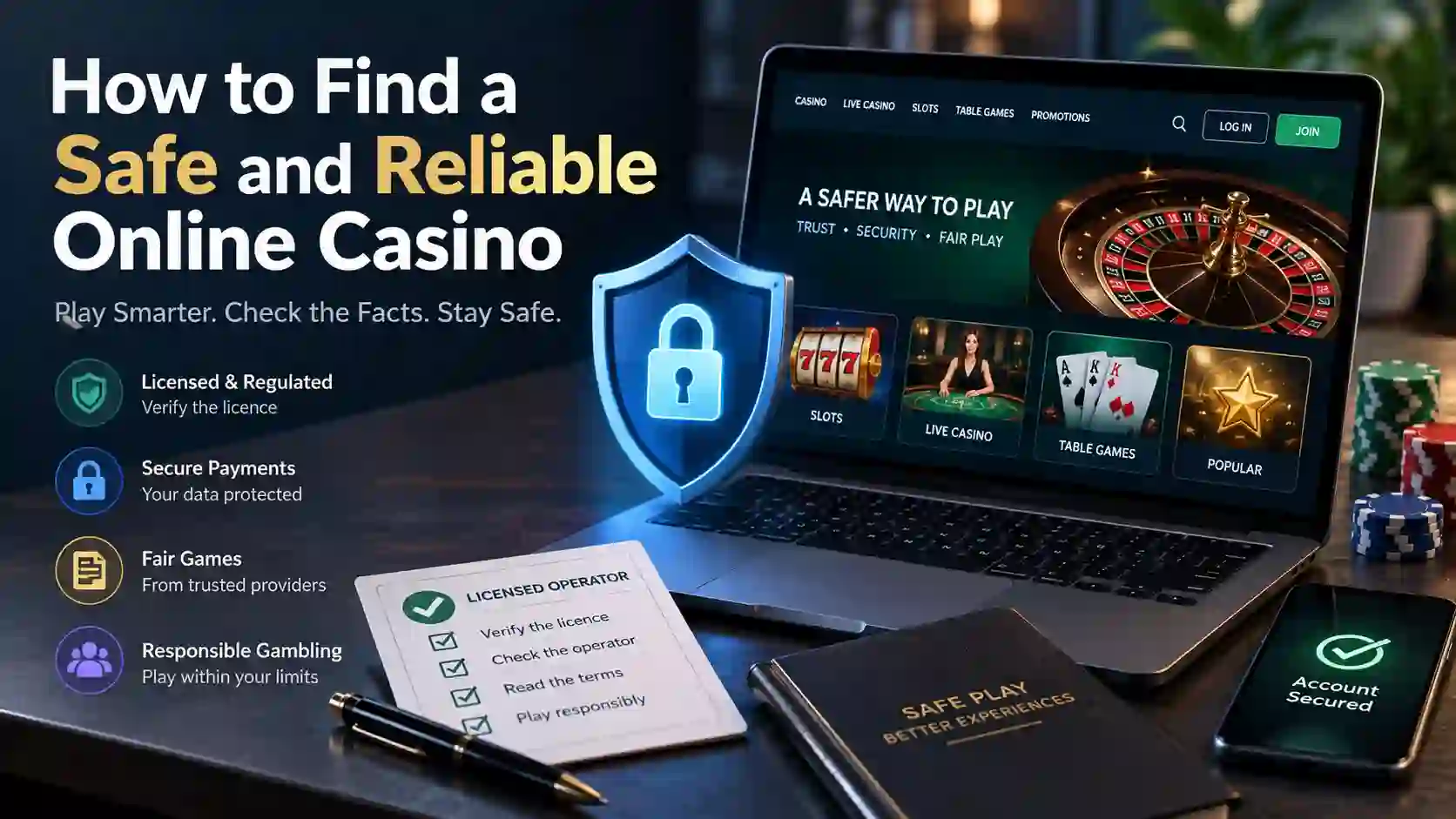
A Quick Checklist for Finding a Safe Online Casino
Before depositing at any online casino, check the following:
- Verify the casino licence directly with the relevant gambling regulator.
- Confirm that the exact casino domain is associated with the licensed operator.
- Identify the legal company operating the website.
- Read withdrawal rules before depositing.
- Review identity-verification requirements.
- Check how customer funds are protected.
- Make sure the website uses secure encrypted connections.
- Research the game’s software suppliers and applicable technical standards.
- Read important bonus conditions instead of relying on headline promotions.
- Confirm that payment, complaint, customer-support and responsible-gambling information is easy to find.
- Search for recent complaints involving both the casino brand and its operating company.
- Set affordable financial limits and never gamble with money required for essential expenses.
FAQs
How can I tell whether an online casino is legitimate?
Start by identifying the regulator claimed by the casino. Visit that regulator’s official register independently and search for the casino’s legal company and website domain. You should also investigate its withdrawal policy, Terms and Conditions, complaint procedure and responsible gambling controls.
A licence image in a website footer should never be your only evidence.
Is a licensed online casino completely safe?
No online gambling activity is risk-free.
Proper licensing provides regulatory oversight and consumer protections, but players can still lose money through gambling, and licensed businesses can still experience complaints or regulatory breaches.
Licensing should therefore be viewed as an essential minimum requirement rather than a guarantee of profits, perfect service or zero risk.
Why does an online casino ask for identification?
Regulated operators may have legal obligations to verify customers’ identity and age and conduct other appropriate checks. In Great Britain, online gambling companies must verify age and identity before customers gamble.
Requests for identification therefore are not automatically suspicious. What matters is whether the request comes from a legitimate licensed operator through a secure process and whether the reason is consistent with applicable rules.
What should I do if an online casino refuses to pay a withdrawal?
First read the withdrawal terms and determine whether verification or another stated requirement remains outstanding. Keep copies of messages, transaction records and relevant terms.
Then use the casino’s formal complaints process rather than relying only on live chat. For Gambling Commission-licensed operators, unresolved eligible disputes may subsequently be taken through the applicable ADR process.
Final Thoughts
Finding a safe and reliable online casino requires a little research, but most of the important checks can be completed before depositing a single pound, euro or dollar.
Start with licensing. Verify the licence independently rather than trusting a logo. Check the company behind the casino, read its withdrawal and verification policies, investigate how it protects customer funds and make sure its complaints procedures are transparent.
Then look at technical security, game providers, payment methods, responsible gambling tools and recent customer experiences.
Bonuses, hundreds of games and polished mobile websites can improve the user experience, but none of them replaces regulation and transparency.
The strongest indicator of a trustworthy online casino is not how attractive its advertising looks. It is how easily you can verify who operates it, who regulates it, what rules apply to your money and what options you have when something goes wrong.
Taking a few minutes to verify those details before creating an account is one of the simplest ways to reduce avoidable risks when gambling online.
Responsible gambling note: Gambling should be treated as paid entertainment rather than a way to make money. Never gamble with money needed for bills, housing, debt repayments or other essential costs. If gambling is becoming difficult to control, use available limits, self-exclusion tools and independent support services.
ADVERTISEMENT

18+ | Affiliate link | Terms apply | Please gamble responsibly.


