

18+ | Affiliate link | Terms apply | Please gamble responsibly.
Last Updated on September 28, 2026 by Maurya
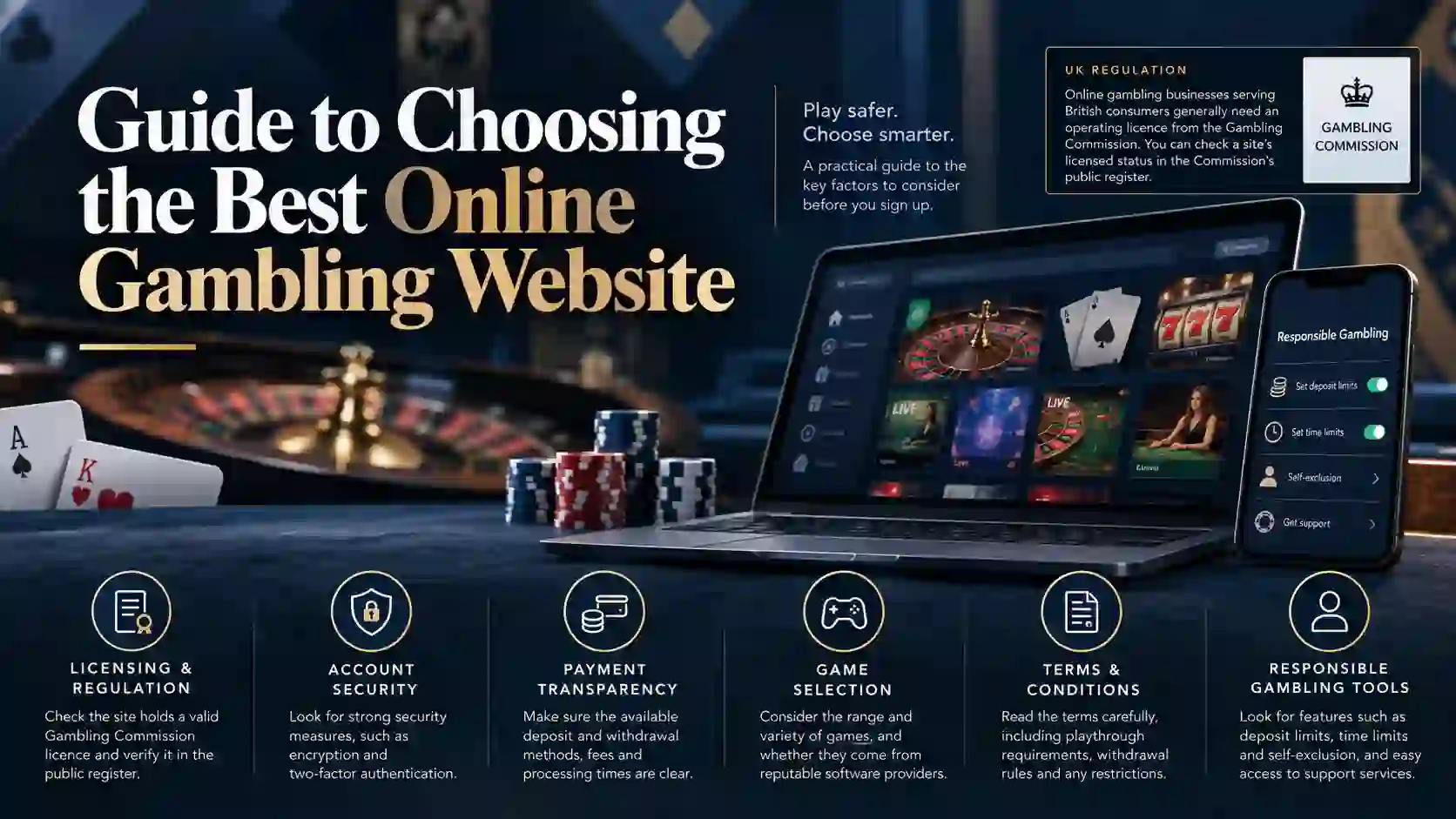
Choosing the best online gambling website involves much more than finding the platform with the biggest welcome bonus or the largest selection of casino games. A trustworthy gambling site should combine legitimate licensing, transparent terms, appropriate security measures, reliable payment systems, fair games, accessible customer support, and effective responsible gambling tools.
The online gambling industry includes casino websites, sportsbooks, poker rooms, bingo platforms, lottery products, and other forms of real-money gaming. The quality and regulatory status of these websites can vary significantly, particularly across different countries and jurisdictions.
For that reason, players should evaluate an online gambling website carefully before creating an account or depositing money.
This guide explains the most important factors to consider when comparing online gambling websites and provides a practical framework for identifying platforms that operate transparently and responsibly.
Important: Gambling should be treated as paid entertainment, not as a source of income. You can lose the money you wager. Only gamble where it is legal, meet the legal age requirement in your jurisdiction, and never gamble with money needed for essential expenses.
Start With Gambling Licensing and Regulation
The first thing to investigate when evaluating an online gambling website is its licence.
A gambling licence does not guarantee that a player will have a perfect experience. However, reputable regulatory oversight establishes rules that licensed operators are expected to follow regarding areas such as player protection, game standards, advertising, account management, complaints, and responsible gambling.
For example, online operators serving consumers in Great Britain generally require a licence from the UK Gambling Commission (UKGC). The Commission maintains a public register that allows consumers to check whether a gambling business is licensed and to see certain regulatory actions associated with an operator.
The Malta Gaming Authority (MGA) is another established gambling regulator. Its player-protection framework requires licensed operators to display licensing information, responsible-gambling information, age restrictions, and access to relevant player-protection measures.
When checking a gambling website:
- Look for licensing information in the footer.
- Identify the legal company operating the website.
- Note the licence or account number.
- Visit the regulator’s official website independently.
- Search its public licence register where available.
- Confirm that the domain you are visiting is associated with the licensed operator.
Do not rely solely on a logo claiming that a website is “licensed” or “regulated.” Logos and licence numbers displayed on websites should be independently verified.
Your own jurisdiction is especially important. A licence issued elsewhere does not automatically mean an operator is authorised to accept players where you live.
Examine the Website’s Reputation Carefully
Licensing should be the starting point, but it should not necessarily be the end of your research.
Before depositing money, search for information about the operator’s history and reputation.
Useful questions include:
How long has the company operated?
A longer operating history can provide more information to evaluate, although a newer company should not automatically be considered unreliable.
Who owns the website?
Legitimate gambling websites usually identify the operating legal entity in their terms, licensing information, or website footer.
Has the regulator taken action against the operator?
Where a regulator maintains a public database, checking its enforcement history can provide useful context.
Are there recurring customer complaints?
Occasional negative reviews are normal for almost any large company. More concerning patterns include repeated reports involving unresolved withdrawals, confusing bonus rules, unexpected account restrictions, poor complaint handling, or unresponsive support.
Review sites and online forums can provide additional information, but they should not replace regulatory verification. User reviews may be incomplete, subjective, incentivised, or difficult to verify.
The strongest approach is to consider multiple sources rather than relying on one review website.
Check Website Security and Account Protection
Online gambling websites handle personal information and financial transactions, making security an essential consideration.
At a minimum, the website should use an encrypted HTTPS connection. Modern browsers usually display a padlock or equivalent security indicator for properly encrypted connections.
However, HTTPS alone does not prove that a gambling operator is legitimate. Almost any website can obtain an SSL certificate.
Look for additional protections such as:
- Two-factor authentication where available
- Strong password requirements
- Login notifications
- Clear account-recovery procedures
- Transparent privacy policies
- Secure payment processing
- Session-management controls
Players should also protect their own accounts.
Use a unique password rather than recycling one used for email, banking, or social-media accounts. Enable two-factor authentication when the operator provides it, and never share login credentials with another person.
A legitimate operator may also require identity verification. Verification procedures can feel inconvenient, but regulated gambling businesses commonly have obligations involving customer identification and age verification. The UK Gambling Commission’s licensing rules, for example, include requirements relating to customer identity verification.
Review the Game Selection — But Focus on Quality
Game variety is one of the most visible differences between online gambling websites.
Depending on the platform, players may find:
- Online slots
- Blackjack
- Roulette
- Baccarat
- Poker
- Live dealer games
- Bingo
- Virtual sports
- Sports betting
- Esports betting
- Lotteries or instant-win games
A huge game library can be attractive, but the number of games alone does not determine whether a site is good.
More important is whether games come from established software providers and whether the platform operates under rules requiring appropriate testing.
In Great Britain, for instance, the Gambling Commission requires relevant online gambling games to undergo testing in accordance with its testing strategy before being offered to players. Operators are also required to monitor game performance after launch.
When reviewing an online gambling site, consider the quality, transparency, and regulatory status of its games rather than simply counting how many titles are advertised.
Understand RTP Before Playing Casino Games
Casino websites frequently display a figure called Return to Player, or RTP.
RTP is often misunderstood.
A theoretical RTP percentage describes the expected proportion of wagers returned to players collectively over a very large number of plays under the game’s mathematical model. It does not mean an individual player will receive that percentage of their money back during one session.
The UK Gambling Commission specifically explains that RTP is an average measured across a significant number of games and should not be interpreted as a guaranteed return for an individual session.
For example, a theoretical RTP of 96% does not mean that staking £100 will result in exactly £96 being returned.
Short-term outcomes can differ dramatically because of randomness and game volatility.
When available, review:
- Theoretical RTP
- Game rules
- Paytable
- Volatility information
- Maximum and minimum stakes
- Bonus-feature rules
Clear information about how a game works is generally more valuable than flashy graphics or jackpot advertising.
Compare Bonuses Carefully
Bonuses are one of the most heavily marketed features of online gambling websites.
Common promotions include:
- Welcome bonuses
- Deposit matches
- Free spins
- Cashback offers
- Reload bonuses
- Loyalty rewards
- Sports free bets
A large headline number does not necessarily make one bonus better than another.
The most important information is usually contained in the terms.
Before claiming a promotion, examine:
Wagering requirements: How much must be wagered before bonus-related funds can become withdrawable?
Eligible games: Do all games contribute equally toward wagering?
Minimum deposit: How much must you deposit to qualify?
Maximum bet restrictions: Is there a maximum wager while using bonus funds?
Expiry period: How quickly must the promotion be used?
Withdrawal restrictions: Are there special conditions affecting withdrawals?
Country restrictions: Is the promotion available to players in your jurisdiction?
Regulated operators are expected to present promotions fairly and transparently. UK Gambling Commission guidance states that operators must comply with consumer-protection requirements and treat customers in a fair, open, and transparent manner, including in relation to terms and promotions.
Do not choose an online gambling website purely because its advertised bonus looks larger.
Simple, understandable terms may be more useful than an enormous promotion surrounded by complicated restrictions.
Investigate Deposits and Withdrawals
A gambling website’s cashier is another important area to evaluate.
Available payment methods may include:
- Debit cards
- Bank transfers
- E-wallets
- Mobile payment services
- Prepaid methods
- Other locally permitted options
The availability of particular payment methods depends on the operator and jurisdiction.
Before depositing, check:
- Minimum deposit
- Minimum withdrawal
- Maximum withdrawal limits
- Payment fees
- Processing times
- Identity-verification requirements
- Supported currencies
- Whether withdrawals must return to the original payment method
Be especially cautious about unclear withdrawal terms.
Players should be able to find information explaining how withdrawals work before depositing money.
In Great Britain, the Gambling Commission also requires gambling businesses to provide information about how customer funds are protected if the company becomes insolvent. It identifies different levels of customer-fund protection and states that operators must make the applicable level clear.
Reading this information may not be exciting, but it can be considerably more important than comparing welcome bonuses.
Test Customer Support Before Depositing
Customer service tends to matter most when something goes wrong.
Rather than discovering the quality of customer support after experiencing a problem, consider testing it before depositing.
Send a straightforward question about withdrawals, verification, responsible gambling, or account management.
Evaluate:
- How quickly support responds
- Whether the answer addresses your question
- Whether the representative provides specific information
- Whether support directs you to relevant written terms
- Which communication channels are available
Common support methods include live chat, email, web forms, and telephone assistance.
A detailed help centre is another positive feature, particularly when it clearly explains deposits, withdrawals, verification, promotions, complaints, and account controls.
Read the Complaints Procedure
Even established companies can have disputes with customers.
The important question is what happens when a disagreement cannot be resolved immediately.
Look for a clearly published complaints procedure explaining:
- How to submit a complaint
- How the company investigates it
- Expected response stages
- What happens if the dispute remains unresolved
- Whether an independent dispute-resolution process is available
For gambling businesses regulated in Great Britain, operators must maintain complaints procedures and arrangements that allow unresolved qualifying disputes to be referred to an Alternative Dispute Resolution provider.
A website that makes its complaint process difficult to locate deserves additional scrutiny.
Look for Responsible Gambling Tools
Responsible gambling features should not be treated as an optional extra.
They are among the most important criteria when choosing an online gambling website.
Useful tools may include:
- Deposit limits
- Spending controls
- Time limits
- Session reminders or reality checks
- Time-outs
- Self-exclusion
- Gambling-history information
- Links to independent support organisations
The UK Gambling Commission requires relevant licensees to make responsible-gambling information available, including information about tools that can help customers monitor or control their gambling.
The Malta Gaming Authority similarly requires licensed operators to provide responsible-gaming information and player-protection tools.
These features matter even if you do not currently believe gambling is causing you difficulty.
Setting limits before gambling can help establish boundaries while decisions are being made calmly.
Evaluate the Mobile Gambling Experience
A large proportion of modern online activity takes place on smartphones, making mobile usability another consideration.
A gambling website should function properly on smaller screens without making important information difficult to find.
Check whether you can easily access:
- Account settings
- Cashier
- Transaction history
- Bonus terms
- Game information
- Responsible gambling controls
- Customer support
- Logout controls
Some operators provide dedicated iOS or Android apps, while others use mobile-responsive websites.
An app is not automatically superior.
A well-designed browser-based platform can provide an equally convenient experience without requiring additional software.
When downloading an app, use official sources linked by the operator and check that the publisher matches the legitimate company.
Pay Attention to Website Transparency
One of the simplest ways to assess an online gambling website is to examine how easily you can find important information.
A transparent website should clearly display or make accessible:
- Operator name
- Licensing details
- Terms and conditions
- Bonus rules
- Privacy policy
- Deposit information
- Withdrawal rules
- Responsible gambling information
- Complaint procedures
- Customer-support details
In Great Britain, the Gambling Commission states that gambling businesses must provide customers opening accounts with information concerning areas including licensed status, account terms, fees, protection of funds, promotions, and general terms and conditions.
If important conditions are buried behind vague language or difficult navigation, reconsider whether the website deserves your money.
Avoid Common Red Flags
Several warning signs should encourage additional caution.
These include:
- No verifiable licence
- No identifiable operating company
- Unrealistic claims about guaranteed winnings
- Pressure to deposit immediately
- Bonus conditions that are difficult to understand
- Missing withdrawal information
- No responsible gambling section
- No clear complaints process
- Poorly explained account restrictions
- Requests to bypass legal or identity-verification requirements
- A website targeting players in jurisdictions where it is not authorised
Another red flag is any platform presenting gambling as an investment, reliable income strategy, or method of solving financial difficulties.
Gambling outcomes involve risk and, in many games, mathematical house advantage. No gambling website can legitimately guarantee that a player will make money.
Use a Simple Online Gambling Website Checklist
Before registering, run through this checklist:
Licence: Can you independently verify the operator with the relevant regulator?
Legal access: Is online gambling with this operator permitted where you live?
Ownership: Is the operating company clearly identified?
Security: Does the website use appropriate account and payment protections?
Games: Are the rules and relevant game information transparent?
Bonuses: Have you read the complete promotional conditions?
Payments: Are deposit and withdrawal rules clearly explained?
Customer funds: Does the operator explain applicable fund protection where required?
Support: Can you contact customer service easily?
Complaints: Is there a documented dispute process?
Responsible gambling: Are limits, time-outs, and self-exclusion tools available?
Reputation: Are there persistent unresolved complaints worth investigating?
If you cannot answer important questions before depositing, continue researching.
Responsible Gambling
Even when using a properly licensed website, gambling carries financial risk.
A sensible approach includes deciding in advance how much money and time you are prepared to spend.
Avoid gambling with money required for:
- Rent or mortgage payments
- Food
- Household bills
- Debt repayments
- Education
- Savings goals
- Essential family expenses
Never chase losses in an attempt to recover previously lost money.
GamCare identifies warning signs of gambling harm that include persistent preoccupation with gambling, withdrawing from normal activities, gambling as an escape, chasing losses, and hiding the amount of time or money being spent.
If gambling stops feeling like entertainment, taking a break or using self-exclusion tools may be appropriate.
For people in Great Britain, GAMSTOP provides a free multi-operator online self-exclusion service covering participating businesses licensed in Great Britain. GamCare also provides free gambling-support information and services.
People outside Great Britain should consult recognised gambling-support organisations and regulatory resources available in their own country.
FAQs
What should I look for in the best online gambling website?
Start with a verifiable licence from the regulator responsible for your jurisdiction. Then evaluate security, transparent terms, game information, payment procedures, customer support, complaints handling, and responsible gambling features.
The biggest bonus or largest game catalogue should not be the deciding factor.
How do I know whether an online gambling website is legitimate?
Find the legal operator’s name and licence information, then independently check the relevant regulator’s official public register when one is available.
Do not rely only on licensing logos displayed by the gambling website itself.
Are licensed online gambling sites completely safe?
No gambling website should be described as completely risk-free.
Licensing provides regulatory oversight and consumer-protection requirements, but gambling itself involves financial risk. Players should also protect their account credentials, read terms carefully, set appropriate limits, and understand that losses are possible.
What is RTP in online gambling?
RTP means Return to Player. It represents a game’s theoretical return across a very large number of plays.
It does not predict what an individual player will win or lose during a specific session.
Are bigger casino bonuses always better?
No.
The headline value of a bonus tells you very little without its terms. Wagering requirements, game restrictions, maximum bets, expiry periods, qualifying deposits, and withdrawal conditions all affect how a promotion works.
Should I verify my account before depositing?
Check the operator’s verification requirements before depositing. Licensed operators may be required to conduct identity, age, or other regulatory checks. Completing required verification early may help you understand what documentation the operator requires before later account activity.
What responsible gambling features should a website offer?
Look for tools such as deposit limits, spending controls, session reminders, time-outs, self-exclusion, account-history information, and links to independent support services.
Availability and regulatory requirements differ by jurisdiction.
Final Thoughts
Choosing the best online gambling website is ultimately about evaluating trust, transparency, regulation, and personal control rather than simply searching for the largest bonus.
Begin by verifying that the operator is legally authorised to serve players in your jurisdiction. Examine who operates the site, how payments and withdrawals work, what protections are available, whether games are appropriately tested under its regulatory framework, and how clearly the company explains its terms.
Good customer support, transparent promotions, accessible complaints procedures, and strong responsible-gambling tools should carry meaningful weight in your decision.
Most importantly, remember what an online gambling website cannot provide: guaranteed profit.
Gambling involves risk, and losing is always possible. Treat it as entertainment, establish limits before playing, never chase losses, and stop when gambling begins affecting your finances, responsibilities, relationships, or wellbeing.
The right gambling website is therefore not simply the one offering the most games or the largest promotion. It is one that is properly licensed for your location, transparent about its rules, clear about payments and withdrawals, and equipped with meaningful player-protection tools.
ADVERTISEMENT

18+ | Affiliate link | Terms apply | Please gamble responsibly.


