

18+ | Affiliate link | Terms apply | Please gamble responsibly.
Last Updated on October 1, 2026 by Maurya
Blackjack is one of the few casino games where the decisions a player makes can directly influence the mathematical return of the game. Luck still determines what cards appear, but smart play can help reduce unnecessary losses, improve decision-making, and keep the house advantage as low as the rules allow.
That distinction matters.
There is no betting system or blackjack strategy that can guarantee a profit. Even perfect basic strategy cannot turn every session into a winning one. What knowledgeable players can do is make mathematically stronger decisions, choose better tables, manage their bankroll carefully, and avoid costly mistakes.
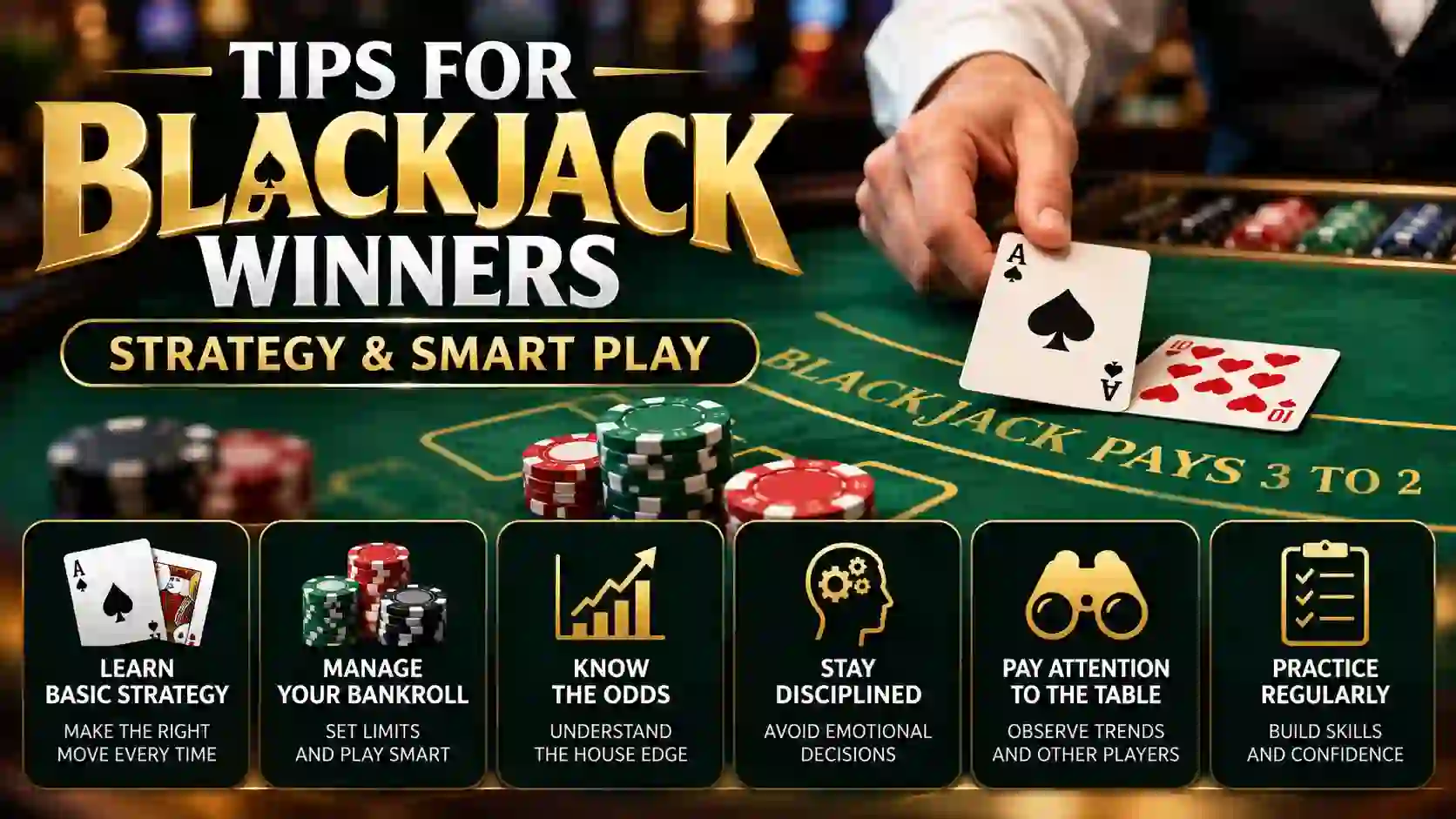
For anyone searching for practical tips for blackjack winners, the goal should therefore be disciplined play rather than trying to predict the next card.
Learn Blackjack Basic Strategy First
The foundation of intelligent blackjack play is basic strategy.
Basic strategy tells you the mathematically preferred action for a hand based on two pieces of information:
- Your cards
- The dealer’s exposed card
Depending on the situation, the recommended move may be to:
- Hit
- Stand
- Double down
- Split
- Surrender, when available
Basic strategy was developed through mathematical analysis of blackjack outcomes rather than intuition. Modern research continues to model blackjack decisions using probability, expected value, and dynamic programming.
Why is this important?
Imagine you hold a hard 16 while the dealer shows a 10. Emotion may tell you that taking another card feels dangerous because you could bust. Blackjack mathematics, however, evaluates not only the chance of busting but the expected result of every available decision.
That is the principle behind basic strategy: choose the action expected to lose the least or win the most over many repeated situations.
A casual player may rely on instinct. A disciplined blackjack player relies on probabilities.
Use the Correct Strategy for the Table
Not every blackjack game uses identical rules.
Basic strategy can change depending on factors such as:
- Number of decks
- Whether the dealer hits or stands on soft 17
- Whether doubling after splitting is permitted
- Whether surrender is available
- Whether players may resplit aces
Specialist blackjack calculations demonstrate that these rule variations affect expected player return.
For that reason, avoid memorizing a random blackjack chart without knowing which rules it assumes.
Choose 3:2 Blackjack Whenever Possible
One of the most valuable blackjack tips has nothing to do with playing your cards.
Look at the payout.
Traditional blackjack commonly pays 3:2 for a natural blackjack. Some tables instead offer 6:5.
That difference may appear small, but mathematically it is significant.
A £10 blackjack at 3:2 pays £15 in winnings.
The same £10 blackjack at 6:5 pays only £12.
Specialist blackjack calculations estimate that changing the blackjack payout from 3:2 to 6:5 can increase the house advantage by roughly 1.4 percentage points under otherwise comparable rules.
That is a substantial difference in a game where skilled players are often trying to reduce the house edge by fractions of a percentage point.
Smart rule:
When similar tables are available, favor 3:2 blackjack over 6:5 blackjack.
Checking the payout before sitting down can be more valuable than memorizing another advanced strategy variation.
Understand the Dealer’s Soft-17 Rule
Look for wording such as:
Dealer stands on all 17s
or
Dealer must hit soft 17
A soft 17 might consist of an Ace and a 6. Because the Ace can count as 1 or 11, the dealer can draw another card without immediately risking a bust in the same way as a hard 17.
From the player’s perspective, a table where the dealer stands on soft 17 is generally preferable.
Blackjack rule analysis estimates that requiring a dealer to hit soft 17 worsens expected player return by approximately 0.2 percentage points compared with standing on soft 17, although the precise effect depends on the complete ruleset.
Small rule differences accumulate.
A strong blackjack player therefore evaluates the game before evaluating the first hand.
Never Assume Insurance Is Protection
When the dealer shows an Ace, players may be offered insurance.
The name makes the bet sound defensive, but insurance is actually a separate wager on whether the dealer’s hidden card has a value of 10.
If the dealer has blackjack, insurance typically pays 2:1.
For ordinary basic-strategy players who do not possess additional information about the remaining cards, insurance is generally considered an unfavorable wager. Specialist blackjack analysis advises basic-strategy players against routinely taking it.
The psychological trap is obvious: players may feel they are protecting a strong hand.
But blackjack decisions should be evaluated independently.
Ask:
Does this wager have positive expected value?
Not:
Will I feel worse if I don’t take it and the dealer has blackjack?
Removing emotion from that decision is part of smart blackjack play.
Understand When to Double Down
Doubling down can be one of the most powerful tools available to a blackjack player.
When you double:
- Your original wager is increased.
- You receive one additional card.
- Your hand normally ends after that card.
The advantage is that you are putting additional money into situations where your hand has favorable mathematical characteristics.
A classic example is a total of 11 against many dealer upcards.
However, doubling should not simply mean:
“I have a good hand, so I’ll bet more.”
Correct doubling decisions depend on both your total and the dealer’s card.
Basic strategy identifies exactly when the expected value of doubling is better than hitting normally.
Tables that permit double after split, often abbreviated DAS, can also be more favorable than those that prohibit it. Blackjack rule analysis estimates that removing the ability to double after splitting reduces player return.
Split Pairs According to Mathematics, Not Appearance
Splitting is another area where inexperienced players frequently make emotional decisions.
Some pairs look strong but should not necessarily be split. Others may look weak but are often profitable candidates for splitting.
Two famous basic-strategy principles are:
Usually split Aces.
Usually split 8s.
Why?
Two Aces begin as a 12, an awkward total. Splitting gives each Ace a chance to form a strong hand.
A pair of 8s produces 16, one of blackjack’s weakest totals. Splitting provides an opportunity to build two more playable hands.
Conversely:
Do not automatically split 10s.
A total of 20 is already one of the strongest non-blackjack hands possible.
The larger lesson is more important than any single pair: use a strategy chart appropriate to the rules rather than relying on how a hand “feels.”
Pay Attention to the Dealer’s Upcard
Strong blackjack strategy is not merely about the value of your own cards.
The dealer’s exposed card changes everything.
Dealer cards are often loosely divided into two groups:
Weaker dealer upcards
2 through 6
Stronger dealer upcards
7 through Ace
A dealer showing 4, 5, or 6 has a greater possibility of eventually busting than a dealer beginning with a strong upcard such as 9, 10, or Ace.
That explains why basic strategy sometimes recommends standing on relatively modest totals against weak dealer cards.
Your objective is not always to build the highest possible hand.
Sometimes the mathematically stronger strategy is simply to avoid busting and allow the dealer to complete their required draw sequence.
This is one of the most important mindset changes for new blackjack players.
Avoid Chasing Losses
Suppose you lose five hands in a row.
The next hand does not become more likely to win simply because you are “due.”
Cards do not owe you a recovery.
This is where betting systems such as aggressively increasing wagers after losses become dangerous. They may create the impression that one eventual win will repair previous losses, but losing streaks can continue far longer than a player’s bankroll can tolerate.
The UK Gambling Commission identifies chasing losses and escalating gambling behavior among indicators associated with increased gambling harm.
Professional-minded blackjack play therefore requires accepting one uncomfortable reality:
Some sessions will lose.
Trying to force a losing session back into profit can turn a manageable loss into a much larger one.
Use a Defined Blackjack Bankroll
Before playing, decide how much money is available specifically for entertainment.
That amount should be separate from money needed for:
- Rent or mortgage payments
- Utilities
- Food
- Debt repayments
- Savings commitments
- Family expenses
- Emergency funds
Once the blackjack bankroll is established, divide it into manageable betting units.
For example:
Bankroll: £500
Base betting unit: £5
Total units: 100
This does not eliminate risk. It simply prevents every hand from becoming financially significant.
A player using £50 wagers with a £500 bankroll has only ten base betting units. Normal blackjack variance can destroy such a bankroll quickly.
Smaller units allow more room for ordinary winning and losing streaks.
Set Loss and Session Limits Before You Play
Bankroll management becomes much harder when decisions are made emotionally during a losing session.
Set boundaries in advance.
For example:
- Maximum session bankroll: £100
- Maximum session time: 90 minutes
- No additional deposits
- End the session when the planned loss limit is reached
Online gambling regulations in Great Britain increasingly emphasize player-controlled financial limits. The Gambling Commission requires regulated online operators to provide accessible facilities that allow customers to establish financial limits, including deposit-limit functionality.
Whether gambling online or in a physical casino, the principle remains useful:
Make financial decisions before the emotions of the game begin.
Be Careful With Blackjack Side Bets
Modern blackjack tables frequently offer additional bets such as:
- Perfect Pairs
- 21+3
- Lucky Ladies
- Match the Dealer
- Various progressive jackpots
They can add entertainment, but they are separate wagers from the main blackjack hand and frequently carry different—and often significantly larger—house advantages.
A player who carefully chooses a favorable blackjack table but repeatedly places high-edge side bets may give away much of the mathematical benefit gained through basic strategy.
If your objective is disciplined blackjack play, understand the odds of every side wager before making it.
Never assume a bet is favorable simply because the potential payout looks large.
Don’t Change Strategy Because of Recent Results
Humans naturally look for patterns.
After seeing five small cards in succession, someone may believe a high card “must” arrive next.
After three dealer blackjacks, another player may assume a fourth is impossible.
Neither conclusion follows automatically.
Short sequences can look unusual while still being perfectly consistent with randomness.
Likewise, avoid changing a mathematically sound decision because the same decision failed previously.
Suppose you correctly doubled an 11 and received a 3.
That result does not mean doubling was wrong.
A blackjack decision should be judged according to the information available when the decision was made, not according to the card that happened to arrive afterward.
This is the difference between decision quality and outcome quality.
Good decisions sometimes lose.
Bad decisions sometimes win.
Over the long run, disciplined players focus on making better decisions.
Don’t Copy the Player Beside You
Casino tables are filled with advice.
Some of it is excellent.
Some of it is completely wrong.
A confident player may tell you:
- Never hit 16.
- Always split face cards.
- The dealer is due to bust.
- A new player ruined the shoe.
- Always increase your bet after losing.
Confidence does not make a strategy mathematically correct.
Use a legitimate basic-strategy chart rather than table folklore.
Another player’s decision may change the sequence of cards that appears, but that does not mean they “stole” your winning card or caused your loss in any meaningful predictive sense.
Focus on the decisions you control.
Understand Variance Before Increasing Your Bets
Blackjack has a comparatively low house edge under favorable rules and correct strategy, but that does not mean results are smooth.
You can:
- Make every correct decision and lose repeatedly.
- Make several poor decisions and temporarily win.
- Finish an evening far ahead.
- Experience an extended losing run.
That is variance.
Short-term outcomes do not reliably demonstrate skill.
This is especially important after a winning streak. Players sometimes increase stakes dramatically because they believe they are playing with “house money.”
But money already won is still your money.
A £100 profit can disappear just as quickly as the original £100 bankroll.
Maintain consistent risk limits regardless of whether you are currently winning or losing.
Play at a Pace That Allows Good Decisions
Speed increases the number of wagering decisions made during a session.
If a player has a mathematical disadvantage, more hands can mean more exposure to that disadvantage over time.
Do not let a fast dealer, other players, or an online interface pressure you into making decisions before thinking.
Take enough time to identify:
- Your hand type
- The dealer’s upcard
- The correct basic-strategy action
- Whether additional wagers are appropriate
- Whether you remain within your predetermined limits
Accuracy is more important than appearing experienced.
Know When to Leave the Table
Perhaps the most underrated blackjack skill is stopping.
There is no rule requiring you to continue because:
- You have just won several hands.
- You are almost back to even.
- You believe the shoe has become favorable.
- You want to recover one final loss.
- Other players are staying.
Create objective stopping conditions.
You might leave because:
- Your session timer expires.
- Your bankroll limit is reached.
- You are tired.
- You notice yourself making impulsive bets.
- Alcohol is affecting your judgment.
- You are no longer enjoying the game.
A disciplined exit is part of strategy.
Quick Blackjack Strategy Checklist
Before playing blackjack, ask yourself:
| Question | Smarter Approach |
| Does blackjack pay 3:2? | Prefer it to 6:5 when other conditions are similar. |
| Does the dealer stand on soft 17? | Generally more favorable to the player. |
| Do I know the correct basic strategy? | Use a chart designed for the specific rules. |
| Am I considering insurance? | Basic-strategy players generally avoid it. |
| Am I using side bets? | Check their house edge separately. |
| Do I have a defined bankroll? | Set it before beginning. |
| Have I established a loss limit? | Decide before the session. |
| Am I chasing previous losses? | Stop rather than escalating emotionally. |
| Am I changing strategy after losing? | Judge decisions by mathematics, not recent results. |
| Am I still focused and comfortable? | Leave when concentration or discipline declines. |
Common Blackjack Mistakes to Avoid
Even players who understand the rules can increase the casino’s advantage through avoidable mistakes.
Common errors include:
- Playing 6:5 tables without checking the payout
- Ignoring basic strategy
- Taking insurance automatically
- Refusing to hit because of fear of busting
- Splitting pairs based on intuition
- Playing excessive side bets
- Raising stakes aggressively after losses
- Betting money needed for essential expenses
- Assuming winning streaks will continue
- Blaming other players for card sequences
- Playing while tired or impaired
- Continuing after reaching a planned limit
Avoiding these mistakes does not guarantee a winning session.
It simply reduces unnecessary disadvantages.
FAQs
Can you consistently win at blackjack?
No strategy guarantees consistent short-term winnings. Blackjack involves randomness, and the casino normally retains a mathematical advantage under standard rules.
Basic strategy aims to make the most efficient decisions available and reduce avoidable losses rather than guarantee profit.
What is the best blackjack strategy for beginners?
Start with basic strategy. Learn when to hit, stand, double, and split based on your cards and the dealer’s upcard.
After that, focus on selecting favorable table rules and managing your bankroll.
Is blackjack mostly luck or skill?
It involves both.
You cannot choose which cards are dealt, so chance determines individual outcomes. However, unlike many casino games, blackjack gives players meaningful strategic decisions that influence expected returns.
Is 3:2 blackjack better than 6:5?
Yes, from a payout perspective. A 3:2 blackjack pays 1.5 times your original wager, while 6:5 pays only 1.2 times your wager. Mathematical blackjack analysis shows that the reduced payout can materially increase the house advantage.
Should you always stand on 17?
It depends on whether the hand is hard or soft and on the applicable blackjack rules. A soft 17 contains an Ace counted as 11 and can require a different decision from a hard 17.
Use the correct basic-strategy chart for your game.
Should blackjack players use betting systems?
Progressive staking systems do not change the underlying probability of the cards. Increasing wagers after losses can also expose a bankroll to severe risk during extended losing streaks.
Bankroll management is generally more useful than attempting to recover losses through increasingly large wagers.
Final Thoughts
The most useful tips for blackjack winners are not secret tricks.
They are habits.
Learn mathematically sound basic strategy. Check the table rules before playing. Prefer 3:2 blackjack where available. Understand doubling and splitting decisions. Treat insurance and side bets carefully. Protect your bankroll. Set limits before the session begins. And never allow recent wins or losses to dictate your next decision.
Most importantly, remember that blackjack remains gambling.
Even excellent strategy cannot eliminate randomness or guarantee a profit. The purpose of strategy is to make stronger decisions with the information available—not to create certainty where none exists.
Players who approach blackjack intelligently focus on what they can control:
the table they choose, the decisions they make, the amount they risk, and the moment they stop playing.
That is the foundation of smarter blackjack play.
ADVERTISEMENT

18+ | Affiliate link | Terms apply | Please gamble responsibly.


