

18+ | Affiliate link | Terms apply | Please gamble responsibly.
Last Updated on September 30, 2026 by Maurya
Blackjack is one of the most recognisable casino card games in the world. Its appeal comes from a combination of simple rules and meaningful player decisions: you do not need to memorise dozens of betting combinations to start, yet understanding when to hit, stand, split, or double can make a significant difference to how you play.
The central objective is straightforward: finish with a hand closer to 21 than the dealer without exceeding 21. You are competing against the dealer rather than the other players at the table. Standard cards from 2 to 10 count at face value, kings, queens, and jacks are worth 10, while an ace can normally count as either 1 or 11.
Online blackjack follows the same fundamental principle, although individual games can differ in areas such as blackjack payouts, the number of decks, dealer rules, splitting restrictions, doubling rules, and surrender.
What Is Blackjack?
Blackjack, also known as Twenty-One, is a comparing card game in which players attempt to beat the dealer.
You can win a normal blackjack hand in several ways:
- Your final total is higher than the dealer’s without exceeding 21.
- The dealer exceeds 21, known as going bust, while your hand remains at 21 or below.
- You receive a natural blackjack and the dealer does not.
A natural blackjack normally consists of an ace plus a card worth 10—either a 10, jack, queen, or king—as the first two cards.
That distinction matters. A hand such as 7-7-7 also totals 21, but it is usually treated as an ordinary 21 rather than a natural blackjack.
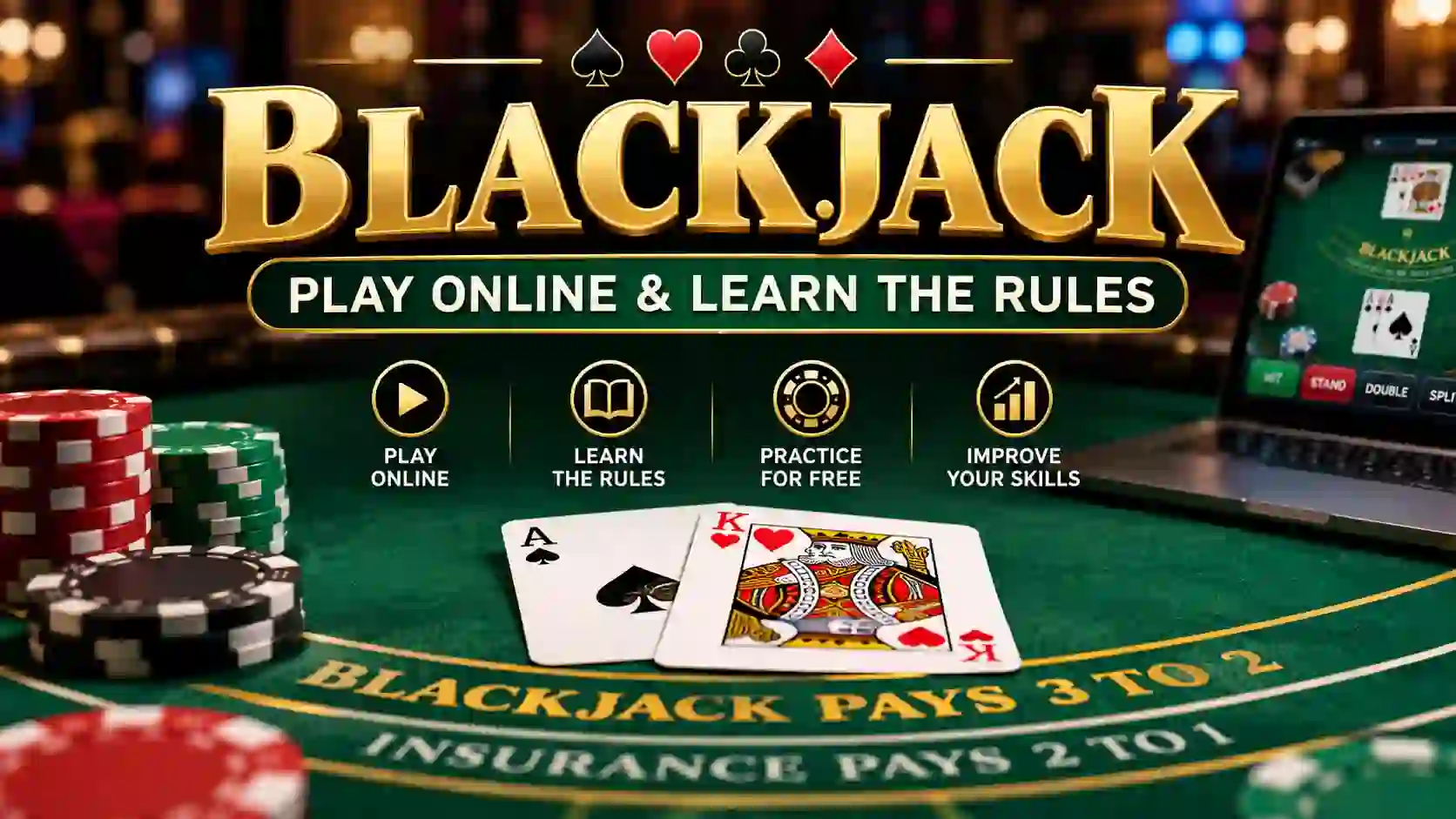
Traditional rules commonly pay a natural blackjack at 3:2, although some games use other payouts such as 6:5. Because payout rules influence the mathematical value of the game, checking the blackjack payout before playing is important.
How to Play Blackjack Online
A standard round of online blackjack generally follows five stages.
Before the cards are dealt, you select your stake within the table’s stated minimum and maximum limits.
Online games may also display additional side bets. These are separate wagers and should not be confused with the main blackjack bet.
- Receive the Initial Cards
The player usually receives two cards. Depending on the blackjack variant, the dealer may receive two cards immediately—with one visible and one hidden—or may initially receive only one exposed card.
The dealer’s visible card is called the upcard.
Your decisions are based on both your hand and that upcard.
- Choose Your Action
Depending on the rules and your cards, you may have several options:
Hit: Take another card.
Stand: Keep your current hand and take no more cards.
Double Down: Increase your original wager—commonly by an amount equal to the initial stake—receive one additional card, and then stand.
Split: If your first two cards form an eligible pair, divide them into two separate hands. A second wager equal to the original bet is normally required.
Surrender: Available only in certain blackjack variations. You give up the hand before completing it and typically lose part rather than all of your original wager.
Insurance: A separate wager that may be offered when the dealer shows an ace. Under conventional rules, insurance pays 2:1 when the dealer has blackjack.
Not every online blackjack game offers every action, so the rules screen should always be checked first.
- The Dealer Plays
Once the player’s decisions are complete, the dealer follows fixed rules rather than choosing strategically.
A common rule requires the dealer to draw cards while holding 16 or less and stand after reaching 17 or more. However, one important variation concerns soft 17.
A soft 17 could be an ace and a six, because the ace can count as 11 without causing the hand to bust. Some tables require the dealer to stand on soft 17 (S17), while others require the dealer to hit soft 17 (H17).
This is one reason players should never assume that every blackjack table has identical rules.
- Settle the Hand
After the dealer finishes drawing, the two hands are compared.
Under standard rules:
| Result | Typical Outcome |
| Player beats dealer | Main bet wins 1:1 |
| Dealer busts and player has not busted | Player wins |
| Player busts | Main bet loses |
| Dealer has higher valid total | Main bet loses |
| Equal totals | Push; main bet returned |
| Natural blackjack | Often pays 3:2, depending on table |
Always verify the individual game’s paytable because blackjack variants can use different settlement rules.
Blackjack Card Values Explained
Learning blackjack card values takes only a few minutes.
Cards 2–9: Worth their printed value.
10, Jack, Queen and King: Worth 10 points.
Ace: Worth 1 or 11, whichever is appropriate for the hand.
For example:
- 10 + 7 = 17
- King + 9 = 19
- Ace + King = blackjack
- Ace + 6 = soft 17
- Ace + 6 + 10 = 17, because the ace changes from 11 to 1
The flexible value of an ace creates the distinction between hard hands and soft hands.
Hard Hands vs Soft Hands
A hard hand either contains no ace or contains an ace that must count as 1 to prevent the total exceeding 21.
For example:
10 + 6 = hard 16
A soft hand contains an ace that can currently count as 11 without the hand exceeding 21.
For example:
Ace + 6 = soft 17
Soft hands offer additional flexibility because taking another card cannot immediately bust the hand in many situations—the ace can switch from 11 to 1 if necessary.
Understanding the difference between hard and soft totals is essential when learning blackjack basic strategy.
What Does Bust Mean in Blackjack?
A player goes bust whenever the hand exceeds 21.
Suppose you have:
10 + 6 = 16.
You hit and receive a 7:
16 + 7 = 23.
Your hand is therefore bust, and the wager normally loses immediately.
This reveals one of blackjack’s structural advantages for the casino: the player generally acts before the dealer. If you bust, your wager is already lost even if the dealer subsequently busts as well.
What Is a Push?
A push occurs when the player and dealer finish with equivalent qualifying hands under the game’s rules.
For example:
Player: 10 + 8 = 18
Dealer: King + 8 = 18
The result is a push, so the original main wager is normally returned rather than being won or lost.
A player blackjack and dealer blackjack are also generally treated as a tie.
What Does Double Down Mean?
Doubling down allows you to increase your investment in a hand before receiving exactly one additional card.
Suppose your initial wager is £10. If the table permits a full double down, you add another £10, making £20 at risk on that hand. You then receive one final card.
Specific doubling rules vary significantly. Some games permit doubling on almost any initial two-card hand, while others restrict it to totals such as 9, 10, or 11.
Because doubling requires committing additional money, it should be treated as a strategic decision rather than simply an opportunity to increase the bet.
How Does Splitting Work?
If your initial cards form an eligible pair, the game may allow you to split them.
For example, you are dealt:
8 + 8
Instead of playing this as a hard 16, you may be able to separate the cards into two hands.
You must normally place another wager matching your original wager. Each eight then receives another card and is played independently.
Rules involving splits vary considerably. A table may limit:
- How many times a player can re-split
- Whether aces can be re-split
- Whether split aces receive more than one additional card
- Whether doubling after splitting is permitted
- Whether 21 after splitting aces counts as blackjack or ordinary 21
Under traditional rules, an ace plus a ten-value card created after splitting aces is generally not treated as a natural blackjack for the enhanced payout.
What Is Blackjack Insurance?
Insurance is an optional side bet commonly offered when the dealer’s exposed card is an ace.
The wager is based on whether the dealer’s hidden card will give the dealer a natural blackjack. Traditional insurance is limited to half the player’s main wager and pays 2:1 when successful.
Insurance may sound like protection, but mathematically it is a separate wager rather than conventional insurance on your original hand.
For ordinary players using standard basic strategy, mathematical blackjack analysis generally advises against taking insurance.
Blackjack Basic Strategy
Blackjack basic strategy is a mathematically derived framework for deciding how to play a hand based on your cards and the dealer’s exposed card.
It does not predict the next card and does not guarantee that a particular hand will win.
Instead, it seeks the mathematically preferable available decision over a large number of hands given a particular ruleset.
That last point is crucial: there is no single strategy chart that perfectly covers every blackjack variation.
Strategy can change depending on factors including:
- Number of decks
- Whether the dealer hits or stands on soft 17
- Whether doubling after splitting is allowed
- Surrender availability
- Dealer hole-card rules
- Restrictions on doubling
- Rules for splitting and re-splitting
Mathematical blackjack calculators demonstrate how changing these rules changes both optimal decisions and the theoretical house advantage.
Useful Beginner Principles
Although an exact basic-strategy chart should match the game you are playing, several broad principles help explain the logic.
A dealer showing 4, 5, or 6 is relatively vulnerable. Players often stand more conservatively because the dealer is required to continue drawing until reaching the required standing total.
Strong dealer cards require more aggressive improvement. When the dealer shows 7 through ace, weak player totals are less likely to succeed without drawing.
A pair is not automatically worth splitting. Some pairs become stronger as a single hand.
Soft hands are played differently from hard hands. The ace provides additional flexibility.
Most importantly, basic strategy is about probabilities, not certainty. Making the mathematically preferred decision can still result in losing that individual hand.
Blackjack House Edge: What Players Should Know
You may encounter websites claiming that blackjack has a single universal house-edge percentage. That oversimplifies the game.
The theoretical house edge depends on the exact rules and the player’s decisions.
Factors affecting it include:
- 3:2 versus 6:5 blackjack payouts
- Number of decks
- Dealer soft-17 rule
- Double-down restrictions
- Doubling after splits
- Surrender
- Re-splitting rules
- Dealer peek or no-hole-card rules
For example, mathematical analysis of one specific European six-deck ruleset with the dealer standing on soft 17 produces a theoretical house edge of approximately 0.62% when the appropriate basic strategy is followed. That figure should not be applied automatically to another blackjack game with different rules.
This is why reading the rules page can matter as much as learning how to hit and stand.
3:2 Blackjack vs 6:5 Blackjack
One of the easiest rules to check before playing is the payout for a natural blackjack.
With a 3:2 payout, a £10 qualifying blackjack would pay £15 in winnings.
With a 6:5 payout, the same £10 qualifying blackjack would pay £12.
The difference may look small on an individual hand, but blackjack occurs repeatedly over extended play, so the payout structure affects the game’s mathematics.
Blackjack rule calculators specifically include the blackjack payout among the variables used to determine theoretical house advantage.
For that reason, never assume that the word “blackjack” means every table offers identical economics.
RNG Blackjack vs Live Dealer Blackjack
Online blackjack generally appears in two broad formats.
RNG Blackjack
RNG blackjack is software-based. Cards are generated by the game’s randomisation system, and gameplay can move quickly because there is no physical dealer waiting for decisions.
Possible advantages include:
- Faster rounds
- Wide range of stake levels
- Availability on desktop and mobile devices
- Multiple game variations
- Straightforward interface for practising the rules
Live Dealer Blackjack
Live blackjack streams a real dealer and physical or studio-based table to the player’s screen.
Players make decisions electronically while the dealer handles the cards.
Live blackjack is designed to reproduce more of the atmosphere and pacing of a land-based casino, although minimum stakes, available seats, rule variations, and side bets may differ between tables.
Neither “live” nor “RNG” automatically tells you whether a game offers favourable blackjack rules. The paytable and rules remain the important factors.
American Blackjack vs European Blackjack
Two common labels you may encounter online are American Blackjack and European Blackjack.
The distinction can involve when the dealer receives or checks the second card.
In many American-style games, the dealer receives a hole card and may check for blackjack when showing an ace or ten-value card.
European-style games can use a no-hole-card arrangement in which the dealer does not initially take the second card. Depending on the exact rules, this can affect what happens to additional wagers from doubles and splits when the dealer later completes a blackjack.
The title of the game alone is therefore insufficient. Read the actual rules, particularly the section explaining dealer blackjack.
Other Popular Online Blackjack Variations
Online casinos may offer several blackjack variations, including:
Classic Blackjack: Usually designed around familiar traditional rules.
Multi-Hand Blackjack: Allows several blackjack hands to be played simultaneously.
Single-Deck Blackjack: Uses one deck, although other rules and payouts must still be checked before assuming the game is more advantageous.
European Blackjack: Commonly incorporates European dealing conventions.
Live Blackjack: Played through a streamed dealer.
Blackjack Switch and other modified variants: Introduce additional mechanics and may change standard payouts or dealer rules.
A familiar name should never substitute for checking the game information screen.
How to Choose an Online Blackjack Game
Before playing blackjack for real money, examine the game rather than simply selecting the first available table.
Check:
Blackjack Payout
Look for the payout awarded for a natural blackjack.
Dealer Soft-17 Rule
Determine whether the dealer stands or hits on soft 17.
Number of Decks
Strategy can vary between single-deck and multi-deck games.
Doubling Rules
Check which hands are eligible for doubling and whether doubling after a split is permitted.
Splitting Rules
Look for restrictions concerning aces, re-splitting, and additional cards.
Surrender
Some tables allow late surrender; many do not.
Dealer Blackjack Procedure
Check whether the dealer takes a hole card, checks for blackjack, or uses European no-hole-card rules.
Minimum and Maximum Stake
Choose stakes that fit a predetermined gambling budget rather than increasing stakes to chase earlier losses.
Regulation
Use gambling services that are legally permitted and appropriately licensed for your location.
For example, businesses providing remote gambling to consumers in Great Britain require the appropriate Gambling Commission licensing, and the regulator advises consumers to verify a gambling business’s licence before gambling.
Can You Guarantee a Win at Blackjack?
No.
Blackjack involves random card outcomes, and neither basic strategy nor a betting system can guarantee a winning session.
Basic strategy is valuable because it addresses how to make mathematically informed decisions under specified rules. It cannot determine which card will be dealt next.
Likewise, staking systems do not alter the probability structure of the underlying cards. Increasing a wager after a loss can simply increase the amount of money at risk.
Any claim that an online blackjack method guarantees profit should therefore be treated with caution.
Playing Blackjack Online Responsibly
Learning the rules is only part of informed blackjack play. Bankroll and time management matter because gambling always carries the possibility of losing money.
Useful safeguards include:
- Decide what you can afford to lose before beginning.
- Set a financial limit before gambling rather than during a losing session.
- Set a time limit.
- Do not treat gambling as a source of guaranteed income.
- Never chase losses by increasing stakes beyond your planned budget.
- Avoid gambling when impaired by alcohol or other substances.
- Use time-outs or self-exclusion when appropriate.
- Keep gambling separate from money required for bills, rent, debt repayments, savings, or everyday living expenses.
In Great Britain, online operators are required to provide accessible financial-limit facilities. New requirements effective 30 September 2026 require gross deposit limits to be offered, with systems preventing further deposits after that limit is reached until the defined period restarts or the permitted process for changing the limit is completed.
Age restrictions also depend on jurisdiction. In Great Britain, for example, online gambling is restricted to people aged 18 or over, and regulated online operators must verify age and identity before a customer gambles.
Always follow the laws and minimum-age requirements where you live.
FAQs
What is the main goal of blackjack?
The goal is to beat the dealer by finishing with a valid hand closer to 21 than the dealer’s, or by remaining at 21 or below when the dealer goes bust.
Is 21 always a blackjack?
No. A natural blackjack normally consists specifically of an ace plus a ten-value card as your first two cards. A three-card 21 is ordinarily simply a total of 21.
What happens if I go over 21?
You bust and normally lose the wager immediately.
What is the best possible starting hand?
A natural blackjack—an ace with a 10, jack, queen, or king—is the strongest standard starting hand.
Does the dealer make choices in blackjack?
Normally no. Dealer actions are controlled by fixed table rules. For example, a dealer may be required to draw through 16 and stand at 17, with the exact treatment of soft 17 determined by the game rules.
What is a soft 17?
A soft 17 is a hand worth 17 that contains an ace currently counted as 11, such as ace-six.
Should I always stand on 17?
Not necessarily. A hard 17 and soft 17 are different hands, and the mathematically appropriate decision can depend on the game rules and dealer upcard.
Can I play more than one hand?
Some online blackjack tables offer multi-hand play, allowing several hands to be wagered on simultaneously. Each additional hand increases the total amount of money placed at risk.
Does blackjack require skill?
Blackjack outcomes contain substantial randomness, but players also make decisions that affect the mathematical expectation of a hand. Basic strategy is designed to identify the preferable decision for defined card combinations and table rules.
Is card counting useful in online blackjack?
Traditional card counting depends on tracking cards that have been removed from a finite shoe. Many digital blackjack games shuffle or effectively reset frequently, making techniques designed for a persistent physical shoe inappropriate. Live games also differ in penetration and shuffling procedures. Players should never assume that methods developed for a particular physical casino format transfer directly to an online game.
Is online blackjack legal?
That depends on your country, state, province, or other jurisdiction. Gambling regulation varies significantly around the world. Check your local law and use only operators legally authorised to offer gambling where you are located.
Final Thoughts
Blackjack is easy to understand at a basic level but contains considerably more detail once you examine how individual tables work.
The essential rule is simple: get closer to 21 than the dealer without going over 21.
From there, informed play means understanding card values, natural blackjack, hard and soft hands, hitting, standing, doubling, splitting, insurance, dealer procedures, and payouts.
For online blackjack players, one additional principle is especially important: read the rules of the specific game before playing. A change from 3:2 to 6:5 blackjack, a different dealer soft-17 rule, restrictions on doubling, or a different dealer hole-card procedure can affect both strategy and the mathematical characteristics of the game.
Basic strategy can help you make decisions based on probability, but blackjack remains gambling. No chart, betting progression, or online system eliminates the possibility of losing.
Approach the game as paid entertainment rather than a way to make money, establish limits before you begin, and play only where online gambling is legal and appropriately regulated in your jurisdiction.
ADVERTISEMENT

18+ | Affiliate link | Terms apply | Please gamble responsibly.


