

18+ | Affiliate link | Terms apply | Please gamble responsibly.
Last Updated on September 7, 2026 by Maurya
The ICC Cricket World Cup 2027 is already shaping up to be one of the most fascinating editions in the history of the 50-over game. International cricket’s premier ODI tournament will return to Africa for the first time in 24 years, with South Africa, Zimbabwe and Namibia sharing hosting duties.
Scheduled for October and November 2027, the 14th edition of the Men’s Cricket World Cup will bring together 14 nations and, following a major format change announced by the International Cricket Council in July 2026, will feature 57 matches rather than the previously planned 54.
The expanded tournament is significant for several reasons. It brings more nations into the World Cup, introduces an entirely new multi-stage competition structure and returns some of cricket’s biggest matches to famous African grounds such as Newlands, the Wanderers and Centurion.
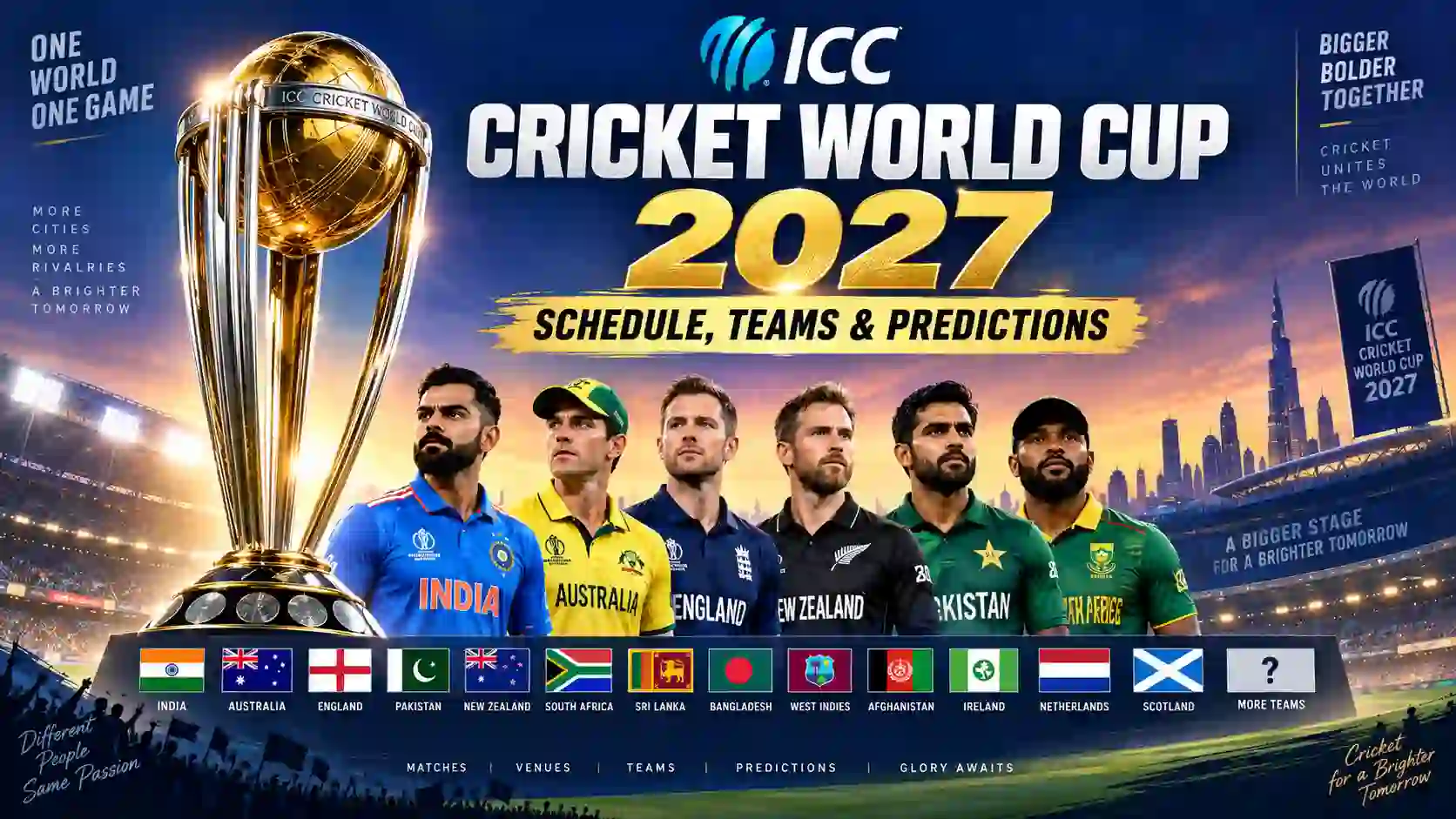
For supporters trying to understand what has actually been confirmed—and what remains a prediction—here is a comprehensive look at the ICC Cricket World Cup 2027 schedule, teams, venues, qualification system and early tournament favourites.
ICC Cricket World Cup 2027
| Detail | ICC Cricket World Cup 2027 |
| Tournament | ICC Men’s Cricket World Cup 2027 |
| Edition | 14th |
| Format | One Day International (50 overs) |
| Hosts | South Africa, Zimbabwe and Namibia |
| Dates | October-November 2027 |
| Teams | 14 |
| Matches | 57 |
| Venues | 12 |
| Defending ODI World Cup champions | Australia |
| Previous World Cup | India 2023 |
| Next World Cup | India and Bangladesh 2031 |
The tournament represents the Men’s Cricket World Cup’s first return to Africa since 2003, when South Africa, Zimbabwe and Kenya staged the competition. South Africa and Zimbabwe will therefore be hosting the men’s ODI World Cup for a second time, while Namibia will stage senior Men’s World Cup matches for the first time.
ICC Cricket World Cup 2027 Schedule
The most important point for fans looking for the Cricket World Cup 2027 schedule is that the ICC has confirmed the tournament will take place during October and November 2027, but, as of 7 September 2026, the complete match-by-match fixture list has not yet been officially released.
That means dates for individual games, the opening fixture, semi-finals and final should not yet be treated as confirmed unless subsequently announced by the ICC.
What has been confirmed is the competition’s structure.
Super Series
The World Cup will begin with a new Super Series involving the three lowest-ranked teams among the 14 qualifiers.
They will play one another in a round-robin competition, with only the first-placed side moving into the next phase.
This creates immediate jeopardy at the bottom of the tournament: two qualified nations could effectively see their main World Cup campaign end after only the opening stage.
Group Stage
Once the Super Series has been completed, 12 teams will enter the principal group phase.
They will be divided into:
- Group A: six teams
- Group B: six teams
Each team plays the other five teams in its group, creating 30 matches.
The top three teams in each group will qualify automatically for the Super 7. One additional place goes to the next best-performing team across the two groups.
Seven nations therefore progress.
Super 7
The Super 7 is effectively the tournament’s championship league.
All seven remaining teams play one another, producing 21 matches. Because every contender has to face the other leading sides at this stage, consistency will become especially important.
The top four in the Super 7 standings advance to the semi-finals.
Semi-Finals and Final
The semi-final pairings will be:
1st in Super 7 vs 4th in Super 7
2nd in Super 7 vs 3rd in Super 7
The winners meet in the ICC Cricket World Cup 2027 Final.
Together, the Super Series, 30-match group round, 21-match Super 7, two semi-finals and final produce a total of 57 matches.
This format replaces the older structure originally planned for 2027. Consequently, websites still describing the World Cup as a 54-match tournament involving two groups of seven followed by a Super Six are working from outdated information.
ICC Cricket World Cup 2027 Venues
The ICC confirmed 12 World Cup venues in July 2026: eight in South Africa, three in Zimbabwe and one in Namibia.
South Africa
South Africa will provide the majority of venues:
Wanderers Stadium – Johannesburg
One of Africa’s most famous cricket grounds. Johannesburg’s altitude and typically quick outfield have helped produce memorable high-scoring limited-overs matches.
Centurion – Tshwane
Another ground where pace, bounce and boundary-hitting can play major roles. Teams with strong fast-bowling attacks could be particularly dangerous here.
Newlands Cricket Ground – Cape Town
Few World Cup grounds will offer a more spectacular setting. Newlands can provide a different challenge from the high-altitude venues farther north.
Kingsmead Cricket Ground – Durban
Conditions at Kingsmead can introduce different tactical questions, making adaptability an important part of any successful campaign.
St George’s Park – Gqeberha
One of South Africa’s historic international venues.
Mangaung Oval – Bloemfontein
Another established South African international ground that will feature during the tournament.
Boland Park – Paarl
Paarl provides yet another geographic and tactical variation for teams travelling around South Africa.
Buffalo Park – KuGompo City
The venue in the city formerly known as East London completes South Africa’s eight-ground World Cup allocation.
Zimbabwe
Zimbabwe will stage games at three venues:
- Harare Sports Club – Harare
- Queens Sports Club – Bulawayo
- Mosi-oa-Tunya International Cricket Stadium – Victoria Falls
The inclusion of the new Mosi-oa-Tunya International Cricket Stadium at Victoria Falls should give the tournament one of its most distinctive destinations.
Namibia
Namibia’s matches will be staged at:
Namibia Cricket Ground – Windhoek
Namibia will be hosting matches at the senior Men’s Cricket World Cup for the first time. The Windhoek venue has already played an important role in Namibia’s growing international cricket programme.
Which Teams Have Qualified for the ICC Cricket World Cup 2027?
This is another area where it is important to distinguish confirmed teams from projected teams.
At present, the entire 14-team field has not been determined.
Confirmed Automatic Qualifiers
Two teams are guaranteed places because they are Full Member hosts:
- South Africa
- Zimbabwe
Despite being a co-host, Namibia does not receive automatic qualification and must earn a World Cup place through the qualifying pathway.
Eight Teams Through ODI Rankings
Another eight countries will earn direct World Cup qualification through the ICC Men’s ODI Team Rankings.
As an indication of the current picture, the ICC’s 2026 annual rankings update had India first, followed by New Zealand and Australia, while South Africa, Pakistan, Sri Lanka, Afghanistan and England occupied the remainder of the top eight positions. Bangladesh were ninth and West Indies tenth.
Because South Africa already qualify as a host, the rankings race lower down the table is particularly important.
If a similar order were maintained when qualification is determined, the likely direct qualifiers alongside South Africa and Zimbabwe would include:
- India
- New Zealand
- Australia
- Pakistan
- Sri Lanka
- Afghanistan
- England
- Bangladesh
This is a projection rather than a confirmed list. ODI results before the qualification cut-off can still change the rankings.
West Indies in particular remain an obvious threat to break into the direct-qualification positions.
How Will the Remaining Four Teams Qualify?
Four World Cup places will be awarded through the ICC Men’s Cricket World Cup Qualifier.
The qualification ecosystem also includes ICC Cricket World Cup League 2.
League 2 consists of:
- Canada
- Namibia
- Nepal
- Netherlands
- Oman
- Scotland
- United Arab Emirates
- United States
The top four League 2 teams progress directly to the World Cup Qualifier, while teams farther down the standings have another route involving the Qualifier Play-Off pathway. The eventual World Cup Qualifier will determine the remaining four participants in the 14-team finals.
That system creates one of the most intriguing stories ahead of 2027: will Namibia manage to qualify for its own home World Cup?
The ICC has explicitly noted that Namibia is not automatically guaranteed a place despite being one of the hosts. Their League 2 campaign therefore carries enormous significance.
Predicted ICC Cricket World Cup 2027 Teams
Predicting the exact 14-team field more than a year before the tournament naturally involves uncertainty, but the current rankings and qualification routes provide a reasonable basis for an early forecast.
Predicted Direct Qualifiers
My projected 10 direct qualifiers are:
- South Africa
- Zimbabwe
- India
- New Zealand
- Australia
- Pakistan
- Sri Lanka
- Afghanistan
- England
- Bangladesh
Predicted Qualifier Teams
My early four selections to emerge from the qualifier are:
- West Indies
- Ireland
- Scotland
- Netherlands
Namibia would be one of the most interesting challengers to that prediction, particularly given the motivation associated with playing a World Cup on home soil.
The qualifier has a history of producing surprises. West Indies famously failed to reach the 2023 World Cup, illustrating how dangerous it is to regard traditional Full Members as automatic winners of qualification tournaments.
ICC Cricket World Cup 2027 Predictions
Predicting a World Cup this far in advance requires more than simply looking at reputations.
Several factors matter:
ODI form: The 50-over game demands a different rhythm from T20 cricket.
Squad depth: A 57-match competition structure could make this a physically demanding tournament for teams that progress deep.
Fast bowling: South African conditions in particular can reward quality pace.
Batting against pace and bounce: Teams accustomed to slower surfaces may need to adapt quickly.
Venue diversity: Conditions across South Africa, Zimbabwe and Namibia will not necessarily be identical.
Tournament experience: Knockout cricket creates pressure that rankings alone cannot measure.
Based on those factors, several nations stand above the rest.
India – Early Tournament Favourite
India have perhaps the strongest overall case to be regarded as one of the favourites.
They remained No.1 in the ICC Men’s ODI Team Rankings following the May 2026 annual update, demonstrating sustained strength in the format.
India’s biggest advantage is depth. Few countries can produce the same volume of international-standard batters, fast bowlers, spinners and all-round options.
Conditions in South Africa could test India’s batting against high-quality pace, but modern Indian sides are considerably better equipped for fast and bouncing surfaces than several previous generations.
Prediction: Semi-finalist with a strong chance of reaching the final.
South Africa – Home Advantage Could Be Crucial
South Africa may have the most compelling combination of conditions and talent.
Playing the majority of the tournament in familiar surroundings should reduce the adaptation period required of the Proteas. Their traditional strength in pace bowling is another obvious advantage at venues capable of providing bounce and carry.
The psychological question is harder to measure. South Africa’s World Cup history contains numerous painful knockout exits, but history does not determine future results.
A home World Cup presents both additional pressure and a major opportunity.
Prediction: Finalist and genuine title contender.
Australia – Never Underestimate the Champions
Writing Australia out of a Men’s ODI World Cup is almost always a mistake.
Australia won the 2023 World Cup in India, defeating the hosts in the final, and their history in the competition gives them something few rivals possess: repeated evidence that Australian sides can handle World Cup pressure.
Fast-bowling-friendly conditions could also suit the Australian style.
Personnel will inevitably evolve between 2026 and the start of the tournament, but Australia’s cricketing system tends to regenerate effectively.
Prediction: Super 7 comfortably; serious semi-final threat.
New Zealand – The Consistent Contenders
New Zealand have spent much of the modern era outperforming expectations at ICC events.
They combine disciplined bowling, adaptable batting and strong tactical organisation. New Zealand were second in the ODI rankings after the ICC’s May 2026 annual update, reinforcing their status among the elite 50-over teams.
Conditions in Southern Africa should not intimidate them either.
New Zealand may attract less attention than India, Australia or South Africa, but they remain one of the safest early selections to reach the later stages.
Prediction: Super 7 with a good chance of making the semi-finals.
Pakistan – The Unpredictable Challenger
Pakistan’s ceiling remains extremely high.
When their fast bowlers find rhythm and their leading batters produce consistent runs, Pakistan are capable of defeating any side in international cricket.
The challenge is maintaining that performance across a long tournament.
The new Super 7 structure is particularly demanding because a team cannot rely on one or two spectacular performances. Repeated victories against strong opposition will be necessary.
Prediction: Super 7; potential semi-finalist.
Afghanistan – The Dark Horse
Afghanistan should no longer be considered merely an emerging cricket nation.
Their performance at the 2023 World Cup demonstrated how dangerous they can be in 50-over cricket, and their subsequent position among the higher-ranked ODI teams supports the idea that their progress is sustainable.
The major question is how effectively their attack operates across the range of African surfaces.
If Afghanistan’s batting continues developing alongside their established bowling quality, they could cause several major upsets.
Prediction: Dark horse for the Super 7 and possibly the semi-finals.
Could England Challenge for the Trophy?
England will inevitably attract considerable attention.
Their 2019 World Cup triumph changed the country’s approach to ODI cricket, but the disastrous defence of their title in 2023 demonstrated how quickly the international hierarchy can shift.
By 2027, England are likely to have undergone another significant transition.
Their chances may depend heavily on finding the right combination of attacking batting and bowlers capable of exploiting Southern African conditions.
Prediction: Dangerous contender, although not currently among my top three favourites.
Players to Watch at the 2027 World Cup
Predicting exact World Cup squads more than a year in advance would be premature. Injuries, retirements, selection changes and form can all dramatically alter international line-ups.
However, several emerging and established players across international cricket will shape the road to 2027.
Rather than focusing exclusively on existing superstars, watch for the younger generation currently becoming established in ODI cricket. By October 2027, players who were emerging prospects during the 2023-26 cycle could be entering their peak years.
South Africa’s preparation is already exposing younger players to international cricket. Their August-September 2026 Namibia tour, for example, featured names including Dewald Brevis, Kwena Maphaka and Lhuan-dré Pretorius in a younger Proteas squad.
Squad evolution over the next 12 months could therefore be one of the defining themes of the World Cup.
Why the New 2027 World Cup Format Matters
The change to 14 teams is positive for international cricket because a World Cup should represent more than a narrow group of established nations.
However, the most interesting development is not simply expansion—it is the structure.
The Super Series means the lowest-ranked qualifiers immediately face high-pressure matches.
The six-team group stage then creates meaningful competition for seven Super 7 places.
Finally, the Super 7 means potential champions must repeatedly compete against elite opponents before reaching the knockout phase.
That should reduce the likelihood of a team reaching a semi-final primarily because of a favourable initial group.
It also rewards depth.
A side hoping to become world champion may need high-level contributions from 15 players rather than depending on the same small group throughout the event.
Who Will Win the ICC Cricket World Cup 2027?
More than a year before the opening match, my early contenders can be divided into three tiers.
Leading Favourites
India – Outstanding depth and current ODI strength.
South Africa – Home conditions plus an excellent fast-bowling tradition.
Australia – Proven World Cup mentality and a style suited to Southern African conditions.
Strong Challengers
New Zealand – Consistent, tactically strong and comfortable in varied conditions.
Pakistan – Match-winning quality but greater consistency required.
Dark Horse
Afghanistan – Increasingly capable of defeating the traditional powers in ODI cricket.
If forced to make an early prediction, India and South Africa would be my two finalists, with the home advantage making South Africa an especially dangerous opponent.
My current narrow pick for the trophy is India, although there is little separating the leading three teams at this stage.
Those predictions should naturally be reassessed once the final qualifying field, World Cup groups, squads and full fixture schedule are known.
FAQs
When is the ICC Cricket World Cup 2027?
The ICC has confirmed that the tournament will be staged during October and November 2027. Exact match dates are still to be confirmed.
Where will the 2027 Cricket World Cup be held?
The tournament will be jointly hosted by South Africa, Zimbabwe and Namibia.
How many teams will play in the 2027 World Cup?
A total of 14 teams will participate.
How many matches will be played?
The revised tournament format contains 57 matches.
Has the full Cricket World Cup 2027 schedule been announced?
No. As of 7 September 2026, the ICC has confirmed the October-November tournament window, format and venues, but the complete match-by-match fixture schedule has not yet been published.
Does Namibia automatically qualify because it is a host?
No. Namibia is a co-host but must qualify through the normal qualification pathway. South Africa and Zimbabwe receive automatic places as Full Member hosts.
Which teams are favourites for the 2027 Cricket World Cup?
India, South Africa and Australia currently form the strongest early group of favourites, with New Zealand and Pakistan among the leading challengers.
Who are the defending Cricket World Cup champions?
Australia are the defending champions after winning the 2023 Men’s Cricket World Cup in India.
Final Thoughts
The ICC Cricket World Cup 2027 promises to be considerably different from the tournament witnessed in India in 2023.
Fourteen countries will compete across 57 matches and 12 venues in South Africa, Zimbabwe and Namibia, while the new Super Series, six-team group phase and Super 7 structure will make consistency essential from beginning to end.
For South Africa, the event represents an opportunity to chase a first Men’s ODI World Cup on home soil. For Zimbabwe, it provides another chance to showcase international cricket to passionate local supporters. For Namibia, simply qualifying would create one of the tournament’s most compelling stories.
India and Australia will arrive carrying enormous expectations, while New Zealand, Pakistan, Afghanistan, England and other contenders will ensure there is unlikely to be an easy path through the competition.
Much can still change before October 2027. The final qualifying teams must be determined, squads selected and the complete schedule announced.
But one thing is already clear: after 24 years away, the Men’s Cricket World Cup is returning to Africa with a bigger field, a dramatically redesigned format and the ingredients for one of ODI cricket’s most intriguing global tournaments.
ADVERTISEMENT

18+ | Affiliate link | Terms apply | Please gamble responsibly.


