

18+ | Affiliate link | Terms apply | Please gamble responsibly.
Last Updated on October 13, 2026 by Maurya
Few sports leagues have changed as dramatically as the National Basketball Association. What began as a modest professional competition struggling for attention in the 1940s has developed into a worldwide sporting institution built around extraordinary athletes, famous franchises, memorable rivalries and constant innovation.
The story of NBA basketball history is much bigger than a collection of championship results. It is the story of how professional basketball evolved. Rule changes transformed the speed of the game. Pioneering players broke racial barriers. Rivalries brought television audiences to the league. Superstars became international celebrities, while the three-point shot eventually changed how basketball itself was played.
Today, the NBA consists of 30 teams, but its roots go back to an 11-team league formed in New York in 1946. Understanding how it reached its modern position requires going even further back—to the invention of basketball itself.
Before the NBA: The Invention of Basketball
The history of basketball begins more than half a century before the NBA existed.
In 1891, physical education instructor James Naismith developed a new indoor game in Springfield, Massachusetts. He wanted an activity that could keep students active during winter without the physical punishment associated with sports such as football.
Naismith created 13 original rules for what was initially written as “basket ball.” The first game was played on December 21, 1891, with nine players on each side and finished with a 1-0 score.
The game spread rapidly through YMCA networks, schools and colleges. Basketball later became an Olympic sport at the 1936 Berlin Games, which Naismith attended. By then, the sport he had created for an indoor gym class was already becoming an international game.
Professional basketball, however, still lacked a stable national league capable of attracting the same attention as baseball, boxing or college sports.
That began to change after World War II.
The Birth of the NBA: 1946
The league that eventually became the NBA was established on June 6, 1946, at the Commodore Hotel in New York City.
It was originally known as the Basketball Association of America (BAA). Maurice Podoloff served as its first president. Eleven franchises competed during the inaugural 1946-47 season.
The BAA’s strategy was important. Instead of operating mainly in smaller gymnasiums, the league sought to stage professional basketball in major arenas located in large cities.
The original teams included the Boston Celtics, New York Knicks, Philadelphia Warriors, Toronto Huskies, Washington Capitols, Providence Steamrollers, Chicago Stags, St. Louis Bombers, Cleveland Rebels, Detroit Falcons and Pittsburgh Ironmen.
Not all survived, but several became foundations of NBA history.
The Boston Celtics and New York Knicks remain in their original markets. The Philadelphia Warriors eventually relocated west and became today’s Golden State Warriors.
The First Game in NBA History
The first game recognized as part of NBA history took place on November 1, 1946, at Maple Leaf Gardens in Toronto.
The New York Knicks defeated the Toronto Huskies 68-66 in front of 7,090 spectators. Ossie Schectman of New York is credited with scoring the first basket in league history.
Basketball at the time looked noticeably different from today’s game.
There was no three-point line. There was no shot clock. Scoring was considerably lower, and statistical tracking was basic compared with the advanced analytics and player-tracking information available today.
Yet the foundation of modern professional basketball had been established.
The Philadelphia Warriors Win the First Championship
The first BAA championship was won by the Philadelphia Warriors in 1947.
Led by scoring star Joe Fulks, Philadelphia defeated the Chicago Stags 4-1 in the championship series. Fulks averaged 23.2 points during the regular season—an exceptional scoring rate at a time when entire teams commonly scored far fewer points than modern NBA clubs.
The championship created the first entry in what would eventually become the long history of the NBA Finals.
However, professional basketball was still fragmented between rival leagues.
How the BAA Became the NBA
The biggest competitor to the BAA was the National Basketball League, or NBL.
After the 1948-49 season, the BAA and much of the NBL came together. In 1949, the reorganized competition adopted the name National Basketball Association.
The new NBA began the 1949-50 campaign with 17 teams.
This distinction sometimes causes confusion when discussing when the NBA was founded.
The league officially traces its history to 1946 because the BAA is regarded as its direct predecessor. However, the name “National Basketball Association” dates to the 1949 consolidation.
George Mikan and the NBA’s First Superstar Era
During the league’s early years, one of basketball’s dominant figures was George Mikan.
Playing center for the Minneapolis Lakers, Mikan helped establish the importance of dominant interior play. His combination of size, scoring and rebounding made him one of professional basketball’s first genuine superstars.
The Minneapolis Lakers became an early dynasty and helped give a young league recognisable championship credibility.
Yet the NBA still faced significant challenges. Teams folded, attendance could be inconsistent and the style of basketball sometimes encouraged teams to protect leads by holding the ball for long periods.
Another problem was more fundamental: professional basketball was still segregated.
Breaking the NBA’s Racial Barrier
The 1950-51 season became one of the most socially significant chapters in NBA basketball history.
Three players—Chuck Cooper, Nat “Sweetwater” Clifton and Earl Lloyd—played different pioneering roles in integrating the league.
Cooper became the first Black player drafted by an NBA team when the Boston Celtics selected him in 1950. Clifton became the first Black player to sign an NBA contract, joining the New York Knicks. Because of the schedule, Lloyd became the first Black player to appear in an NBA regular-season game when he played for the Washington Capitols on October 31, 1950.
Their significance goes far beyond statistics.
They entered professional basketball during an era of legal segregation and widespread discrimination in the United States. Their participation helped open opportunities for generations of players who would subsequently transform basketball.
The NBA that developed in later decades would be impossible to understand without acknowledging these pioneers.
The 24-Second Shot Clock Changes Basketball
Perhaps no rule change was more important to the development of professional basketball than the introduction of the 24-second shot clock.
Before the shot clock, a team with the lead could keep possession for long periods, deliberately slowing games. The tactic could produce dull basketball and extremely low-scoring contests.
Syracuse Nationals owner Danny Biasone, working with general manager Leo Ferris, developed the 24-second concept as a solution.
The NBA introduced the shot clock for the 1954-55 season.
The effect was transformative.
Teams had to attempt a shot within 24 seconds, preventing endless stalling. Possessions increased, scoring rose and basketball became quicker and more attractive to spectators.
Much of the basic rhythm recognizable in today’s NBA can be traced to that innovation.
Bill Russell and the Boston Celtics Dynasty
If one team defined the next major chapter of NBA history, it was the Boston Celtics.
The arrival of Bill Russell gave coach Red Auerbach the defensive and rebounding force needed to complement Boston’s talented offensive players.
The Celtics won their first championship with Russell during the 1956-57 season, beginning one of the greatest dynasties in professional sports.
Russell ultimately helped Boston win 11 NBA championships in 13 seasons, including eight consecutive titles from 1959 through 1966. He became known not simply for scoring but for defense, shot-blocking, rebounding, leadership and an unusual ability to influence games without dominating the ball.
The Celtics’ dominance established several themes that would become central to NBA history: legendary franchises, championship rivalries and debates over what qualities make a player truly great.
Russell’s battles with Wilt Chamberlain provided one of basketball’s earliest superstar rivalries.
Wilt Chamberlain and the 100-Point Game
Where Russell represented championship-oriented defense and team play, Wilt Chamberlain became basketball’s ultimate statistical phenomenon.
His numbers remain extraordinary even by modern standards.
During the 1961-62 season, Chamberlain averaged 50.4 points per game. On March 2, 1962, he delivered the most famous scoring performance in NBA history.
Playing for the Philadelphia Warriors against the New York Knicks in Hershey, Pennsylvania, Chamberlain scored 100 points in a 169-147 victory.
He made 36 field goals and 28 free throws while also collecting 25 rebounds.
More than six decades later, 100 points remains the NBA’s single-game individual scoring record.
The Russell-Chamberlain era demonstrated that basketball could create personalities and records compelling enough to transcend individual games.
The NBA Expands During the 1960s and 1970s
As professional basketball became more established, the league expanded geographically.
The period produced stars such as Oscar Robertson, Jerry West, Elgin Baylor, Willis Reed, Walt Frazier and Kareem Abdul-Jabbar.
It also brought another challenge: the American Basketball Association (ABA).
Founded in 1967, the ABA competed directly with the NBA for fans and players. The younger league developed its own distinctive personality, including a more colourful style and greater emphasis on the three-point shot.
Players such as Julius Erving became symbols of the ABA’s creative, above-the-rim basketball.
Rather than remaining permanent competitors, the two leagues eventually came together.
The 1976 ABA-NBA Merger
The ABA ceased operations in 1976, and four of its franchises entered the NBA for the 1976-77 season:
the Denver Nuggets, Indiana Pacers, New York Nets and San Antonio Spurs.
Their arrival increased the NBA to 22 teams and brought an influx of ABA talent into the established league.
The merger had a lasting impact.
ABA players added athleticism, entertainment value and new ideas to professional basketball. Some concepts associated strongly with the ABA would later become essential parts of the NBA.
None became more influential than the three-point field goal.
The NBA Introduces the Three-Point Line
The NBA adopted the three-point line for the 1979-80 season, initially on a trial basis.
Boston Celtics guard Chris Ford made the first three-point field goal in NBA history on October 12, 1979.
At first, many coaches and players regarded the shot as little more than a novelty.
NBA teams averaged only 2.8 three-point attempts per game during its first season.
Few could have predicted how thoroughly it would eventually transform basketball.
Interestingly, the debut of the three-point line coincided with another event that changed the league: the arrival of Larry Bird and Magic Johnson.
Magic Johnson vs. Larry Bird: The Rivalry That Transformed the 1980s
The NBA entered the 1980s with two extraordinary stars positioned on opposite coasts.
Larry Bird joined the Boston Celtics, while Magic Johnson joined the Los Angeles Lakers.
Their rivalry had begun in college when Johnson’s Michigan State team defeated Bird’s Indiana State team in the 1979 NCAA championship game.
Once both entered the NBA, their personal competition became intertwined with the historic Celtics-Lakers rivalry.
The two franchises met in the NBA Finals in 1984, 1985 and 1987. Boston won in 1984, while Los Angeles captured the next two matchups. One team or the other appeared as NBA champion in eight of the nine seasons from 1980 through 1988.
Their contrasting styles made the rivalry particularly appealing.
Bird represented precision, shooting, anticipation and relentless competitiveness. Magic played with speed, imagination and extraordinary passing ability, becoming the face of the Lakers’ “Showtime” basketball.
Together, they helped turn NBA games into must-watch television events and laid the foundation for the league’s next explosion in popularity.
That explosion came with Michael Jordan.
Michael Jordan and the NBA’s 1990s Boom
Michael Jordan entered the NBA with the Chicago Bulls in 1984, but the 1990s became his defining decade.
Jordan combined elite scoring, defense, athleticism, competitiveness and extraordinary marketability. With Scottie Pippen, coach Phil Jackson and a carefully constructed supporting cast, the Bulls became basketball’s dominant team.
Chicago won six NBA championships between 1991 and 1998, completing two separate three-peats.
The final championship came during the 1997-98 season, giving the Bulls six titles in eight years. Jordan also earned his fifth regular-season MVP award that season.
Jordan’s influence extended far beyond the court.
His shoes, advertising campaigns and worldwide fame helped redefine what a professional athlete could represent commercially. NBA stars increasingly became figures in fashion, advertising, music and global popular culture.
Meanwhile, another event accelerated basketball’s international development.
The 1992 Dream Team and the Global Growth of Basketball
At the 1992 Barcelona Olympics, NBA professionals represented the United States at the Olympics for the first time.
The celebrated “Dream Team” featured many of the era’s biggest stars, including Michael Jordan, Magic Johnson and Larry Bird.
The team dominated its Olympic competition, winning its eight games by an average of 44 points on the way to the gold medal. More importantly for basketball history, it displayed elite NBA talent before an enormous worldwide audience.
The Dream Team became one of the symbolic turning points in basketball’s globalisation.
Young players outside the United States increasingly grew up watching NBA stars and imagining themselves competing in the same league.
The NBA itself was also expanding beyond the United States.
In 1995, the Toronto Raptors and Vancouver Grizzlies began play, increasing the league from 27 to 29 teams.
Vancouver later relocated to Memphis, while Toronto eventually became one of the league’s established international franchises.
The 2000s: Shaq, Kobe, Duncan and LeBron
The end of the Bulls dynasty did not leave the league short of star power.
The early 2000s were dominated in part by Shaquille O’Neal and Kobe Bryant, whose Los Angeles Lakers won three consecutive championships from 2000 through 2002.
At the same time, Tim Duncan and the San Antonio Spurs created a remarkably durable championship culture built around teamwork, defense and consistency.
Then came the celebrated 2003 NBA Draft.
LeBron James was selected first overall by the Cleveland Cavaliers, while the same draft class also produced Carmelo Anthony, Chris Bosh and Dwyane Wade.
James would become one of the central figures in the next two decades of NBA history.
This period also demonstrated that there was no single formula for NBA success. Some champions were built around dominant interior players, others around defensive systems, superstar partnerships or versatile perimeter creators.
The next major tactical revolution would change those formulas again.
Stephen Curry, Golden State and the Three-Point Revolution
The three-pointer had existed since 1979, but its strategic importance increased enormously during the 2010s.
At the centre of that transformation was Stephen Curry.
Alongside Klay Thompson, Draymond Green and the rest of the Golden State Warriors, Curry demonstrated how devastating high-volume, high-efficiency three-point shooting could become when combined with ball movement, spacing and versatile defense.
Golden State’s 2015 championship is often associated with accelerating the NBA’s modern three-point revolution.
The statistical change was dramatic.
Long-distance shooting evolved from a specialised weapon into one of the foundations of modern offense. Guards began pulling up from distances that earlier generations would have considered reckless. Centers increasingly developed perimeter skills. Coaches redesigned offensive systems around spacing and shot efficiency.
Curry’s rise illustrated how NBA history repeatedly works: a rule or tactical idea can exist for decades before the right players and coaches discover its full potential.
The NBA Becomes a Truly International League
Perhaps the biggest long-term change in NBA basketball history is the geographic diversity of its talent.
The modern league is no longer simply an American competition watched overseas. International players frequently rank among its most accomplished stars.
The scale of that transformation can be measured directly.
The NBA announced that 135 international players from 43 countries across six continents were on opening-night rosters for the 2025-26 season—a league record for international players. Every NBA team had at least one international player.
Players from Europe, Africa, Canada, Australia and elsewhere are now central to the league rather than exceptions within it.
That development represents a remarkable circle in basketball history. A game invented by a Canadian educator in a Massachusetts gym in 1891 has developed into a worldwide sport whose most prominent professional league draws elite talent from around the globe.
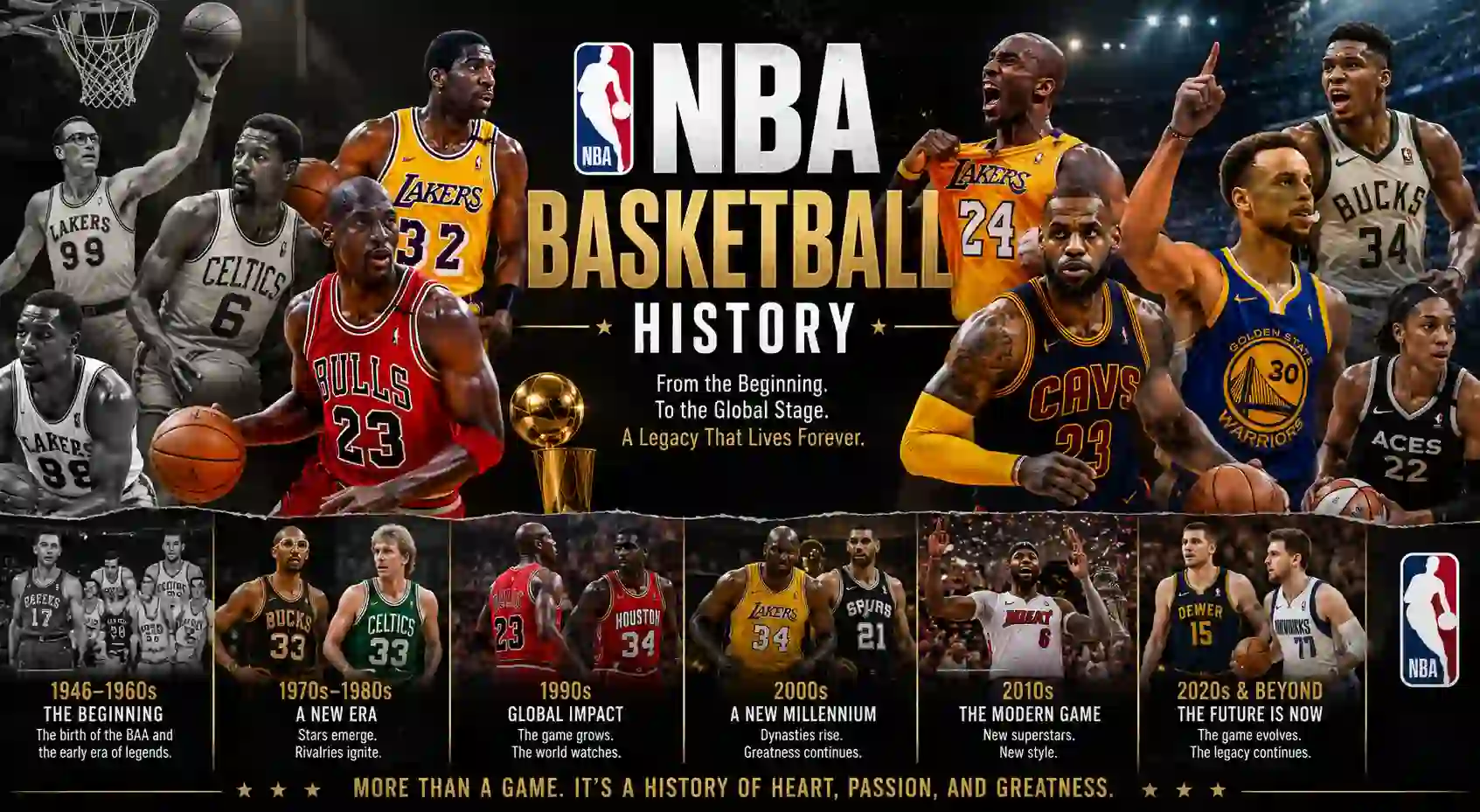
NBA Basketball History Timeline
A simplified NBA history timeline shows how rapidly professional basketball evolved.
| Year | Historic NBA Milestone |
| 1891 | James Naismith invents basketball in Springfield, Massachusetts |
| 1946 | Basketball Association of America is founded |
| 1946 | Knicks defeat the Toronto Huskies in the first BAA/NBA game |
| 1947 | Philadelphia Warriors win the first championship |
| 1949 | BAA and NBL consolidation creates the modern NBA |
| 1950 | Earl Lloyd, Chuck Cooper and Nat Clifton become integration pioneers |
| 1954 | NBA adopts the 24-second shot clock |
| 1957 | Bill Russell’s Celtics win the first title of their dynasty |
| 1962 | Wilt Chamberlain scores 100 points |
| 1976 | Four ABA franchises join the NBA |
| 1979 | NBA introduces the three-point line |
| 1979 | Magic Johnson and Larry Bird make their NBA debuts |
| 1990s | Michael Jordan’s Bulls win six championships |
| 1992 | NBA stars compete on the Olympic Dream Team |
| 1995 | Toronto Raptors and Vancouver Grizzlies join the NBA |
| 2003 | LeBron James enters the league in a historic draft class |
| 2010s | Golden State helps accelerate the three-point revolution |
| 2020s | International stars and positionless basketball define the modern era |
How NBA Basketball Has Changed Over Time
Comparing today’s league with basketball in 1946 reveals just how much has changed.
The earliest professional games had no shot clock or three-point line. Rosters were not racially integrated. Most teams were concentrated in the United States, franchises regularly folded and television had not yet turned professional athletes into worldwide celebrities.
Modern NBA basketball emphasises spacing, speed, three-point shooting, analytics and versatile players capable of performing several traditional positional roles.
Yet certain elements have remained surprisingly consistent.
Great teams still depend on communication and decision-making. Defense remains essential in championship basketball. Individual rivalries still attract audiences. And despite enormous advances in training and strategy, the fundamental challenge remains the one Naismith established more than a century ago: put the ball through the basket more effectively than your opponent.
Why NBA History Matters
Studying NBA basketball history helps explain why the modern game looks the way it does.
The 24-second clock explains basketball’s pace. The ABA helps explain the eventual acceptance of the three-pointer and an increasingly entertainment-driven presentation of the game. Bill Russell’s Celtics demonstrate the value of defense and team structure. Magic Johnson and Larry Bird show the commercial power of rivalry. Michael Jordan illustrates how an athlete can become a global cultural figure. Stephen Curry’s career demonstrates how skill and strategy can redefine what coaches consider a good shot.
History also puts modern statistical debates into perspective.
Comparing players across eras requires more than looking at points, rebounds or championships. Rules changed. Seasons changed. Training changed. Travel improved. Defensive restrictions evolved. The three-point line altered scoring economics, while analytics changed shot selection.
That context is essential when discussing the greatest NBA players or teams of all time.
FAQs
When was the NBA founded?
The NBA traces its founding to June 6, 1946, when the Basketball Association of America was established in New York City. The competition adopted the National Basketball Association name after its 1949 consolidation with teams from the National Basketball League.
What was the first NBA game?
The New York Knicks defeated the Toronto Huskies 68-66 on November 1, 1946, at Maple Leaf Gardens in Toronto. The game was technically played under the BAA name but is recognised as the first game in NBA league history.
Who won the first NBA championship?
The Philadelphia Warriors won the inaugural BAA championship in 1947, defeating the Chicago Stags in five games. The NBA includes the BAA seasons within its historical record.
When was the NBA shot clock introduced?
The 24-second shot clock was introduced for the 1954-55 NBA season. Danny Biasone and Leo Ferris of the Syracuse Nationals were responsible for developing the concept.
When did the NBA introduce the three-point line?
The NBA introduced the three-point field goal during the 1979-80 season. Boston’s Chris Ford made the first three-pointer in NBA history on October 12, 1979.
Who scored the most points in a single NBA game?
Wilt Chamberlain holds the NBA record with 100 points, scored for the Philadelphia Warriors against the New York Knicks on March 2, 1962.
Which player has won the most NBA championships?
Bill Russell won 11 championships during his 13-season career with the Boston Celtics, the most championships won by an NBA player.
Conclusion
The history of the NBA is ultimately a story of reinvention.
The league survived unstable franchises and limited early audiences. It integrated its rosters, introduced rules that saved the sport from slow and unattractive basketball, absorbed talent from a rival league and embraced technologies and strategies that repeatedly altered how the game was played.
Every era contributed something different.
George Mikan helped establish the professional big man. Bill Russell made defense and winning inseparable parts of his legacy. Wilt Chamberlain pushed statistics toward seemingly impossible territory. Julius Erving brought spectacular athleticism to a wider audience. Magic Johnson and Larry Bird made rivalry central to the NBA’s television appeal. Michael Jordan transformed the meaning of global sports superstardom. Kobe Bryant, Tim Duncan, Shaquille O’Neal and LeBron James carried the league into a new century. Stephen Curry helped reshape offensive basketball around the three-point line.
Meanwhile, the increasing influence of international players has turned the NBA into a genuinely global competition. With a record 135 international players on 2025-26 opening-night rosters and talent coming from six continents, the league’s evolution continues.
From a small indoor game invented in 1891 to a 30-team professional league followed around the world, NBA basketball history shows that basketball has never stopped evolving.
And that may be the most important lesson in the NBA’s story: its greatest traditions were often created by people willing to change the game.
Would you like the next version WordPress-ready HTML, SEO with FAQ schema, or expanded to 2,500+ words?
ADVERTISEMENT

18+ | Affiliate link | Terms apply | Please gamble responsibly.


