

18+ | Affiliate link | Terms apply | Please gamble responsibly.
Last Updated on October 15, 2026 by Maurya
Wimbledon has always been a tournament where history and unpredictability meet. From Roger Federer’s record-breaking dominance to Goran Ivanisevic’s remarkable 2001 victory as a wildcard, the grass courts of the All England Club have produced some of tennis’s most memorable moments. They have also delivered extraordinary results for the betting markets.
For decades, bookmakers have attempted to price the chances of Wimbledon champions before the first ball is struck. Sometimes, the favourites justify their short odds. On other occasions, relatively overlooked players emerge from the draw and leave the betting markets stunned.
The contrast has become particularly noticeable in recent years. Novak Djokovic, Carlos Alcaraz and Jannik Sinner have enjoyed sustained success in the men’s competition, while the women’s singles tournament has produced a remarkable sequence of different champions.
Understanding Wimbledon betting history means looking beyond the names engraved on the trophies. Historical betting odds, previous champions, playing conditions and tournament trends all help explain how expectations have changed.
A Brief History of Wimbledon and Tennis Betting
The first Wimbledon Championships took place in 1877, making the tournament the oldest Grand Slam event in tennis. The inaugural competition featured men’s singles, while women’s singles joined the programme in 1884.
Over time, Wimbledon developed into one of the most prestigious sporting events in the world.
Its history includes legendary champions such as Björn Borg, Martina Navratilova, Pete Sampras, Steffi Graf, Serena Williams and Roger Federer. Each generation has brought different playing styles, competitive rivalries and expectations.
Betting markets have evolved alongside the sport.
Historical betting information from Wimbledon’s earliest decades is limited, and directly comparable pre-tournament prices are not available for every champion. Modern betting coverage, however, provides detailed information about outright winners, individual matches and changing tournament expectations.
Today’s markets typically include outright championship winners, individual match results, correct scores, set betting, total games and player-specific statistics.
Although these options differ, the central question remains unchanged: Which player is most likely to win Wimbledon?
The history of the Championships shows why that question is not always easy to answer.
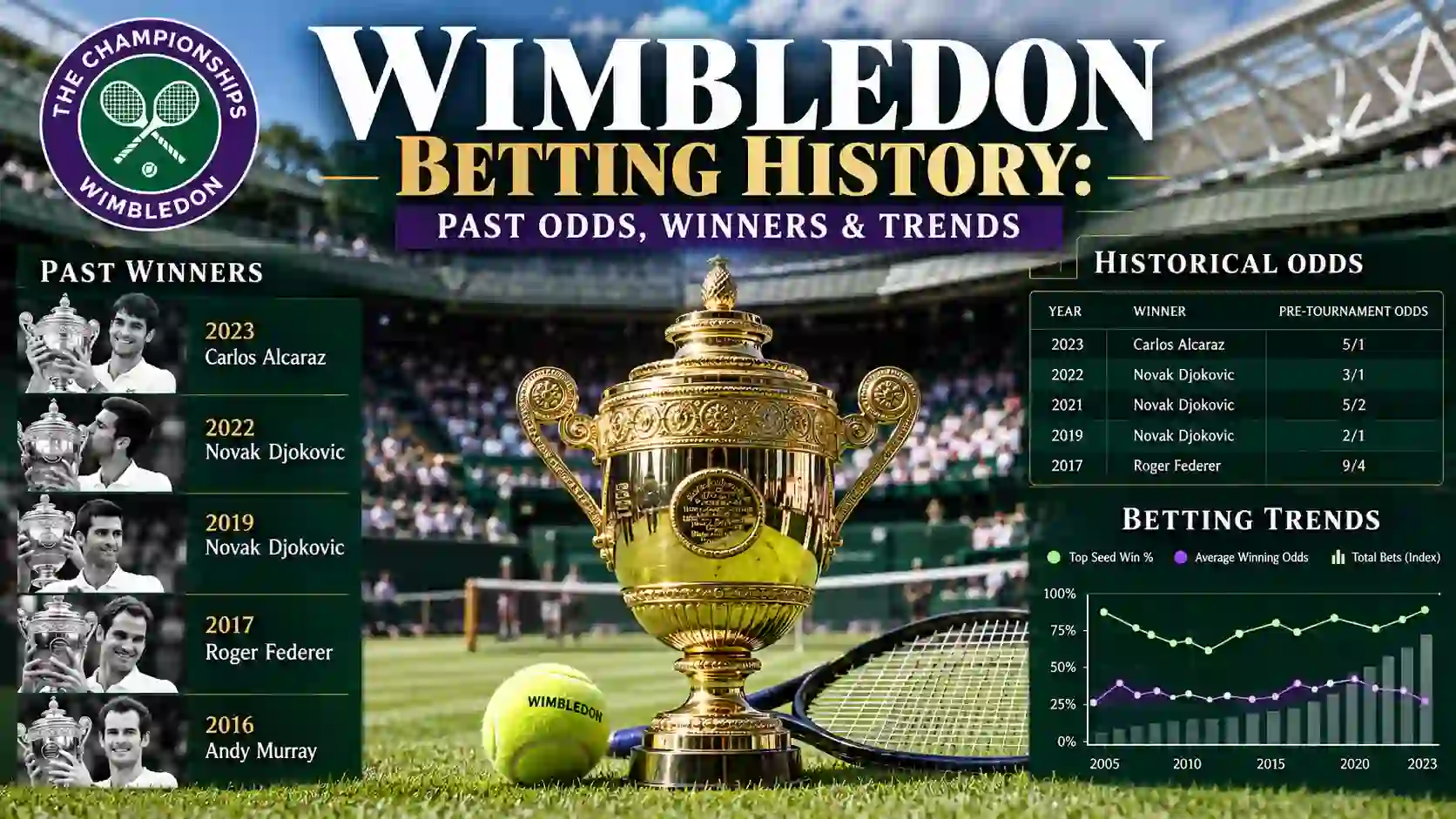
Wimbledon Past Winners: Men’s and Women’s Champions (2016–2026)
A useful starting point for analysing historical Wimbledon betting trends is examining recent champions.
The following table covers the last ten editions of Wimbledon, including the 2026 tournament.
| Year | Men’s Singles Winner | Women’s Singles Winner |
| 2026 | Jannik Sinner | Linda Noskova |
| 2025 | Jannik Sinner | Iga Swiatek |
| 2024 | Carlos Alcaraz | Barbora Krejcikova |
| 2023 | Carlos Alcaraz | Marketa Vondrousova |
| 2022 | Novak Djokovic | Elena Rybakina |
| 2021 | Novak Djokovic | Ashleigh Barty |
| 2020 | Tournament cancelled | Tournament cancelled |
| 2019 | Novak Djokovic | Simona Halep |
| 2018 | Novak Djokovic | Angelique Kerber |
| 2017 | Roger Federer | Garbine Muguruza |
| 2016 | Andy Murray | Serena Williams |
The difference between the men’s and women’s competitions is striking.
From 2016 through 2026, the men’s singles titles were shared among just five players: Murray, Federer, Djokovic, Alcaraz and Sinner.
Over the same ten completed editions, ten different women won the singles championship.
This distinction is significant when interpreting historical outright markets.
The men’s tournament has featured extended periods of dominance by established champions. The women’s tournament, meanwhile, has demonstrated greater winner diversity over the same period.
That does not automatically make one competition easier to predict than the other. However, it does suggest that applying identical assumptions to both draws can be misleading.
Historical Wimbledon Betting Odds: Famous Winners and Their Prices
Historical betting odds reveal how bookmakers evaluated Wimbledon contenders before the tournament began.
A short-priced favourite represents a player expected to have a comparatively strong chance of winning. Longer odds indicate that bookmakers consider the outcome less likely.
Several Wimbledon champions have won despite entering the competition at substantial prices.
Notable Wimbledon Champions and Historical Odds
| Year | Champion | Published Odds | Odds Context |
| 2001 | Goran Ivanisevic | 150/1 | Pre-tournament outsider |
| 2013 | Andy Murray | 7/2 | Pre-tournament contender |
| 2013 | Marion Bartoli | 150/1 | Pre-tournament outsider |
| 2022 | Elena Rybakina | 100/1 | Published day-one price |
| 2023 | Marketa Vondrousova | 150/1 | Published opening price |
| 2024 | Barbora Krejcikova | 100/1 | ESPN BET pre-tournament price |
| 2025 | Jannik Sinner | +200 (2/1) | DraftKings pre-tournament price |
| 2025 | Iga Swiatek | +900 (9/1) | DraftKings pre-tournament price |
| 2026 | Jannik Sinner | 8/15 | Published pre-tournament favourite |
Historical sources include Sports Betting Dime’s 2013 odds archive, ESPN’s 2024 Krejcikova report, Sports Illustrated’s 2025 men’s and women’s previews, and Racing Post’s 2026 tournament preview. Historical reports from The Times and Ones to Watch document additional outsider prices.
The table demonstrates that Wimbledon champions have emerged from vastly different positions in the betting market.
Some winners were among the leading contenders before the competition. Others started at triple-digit odds, meaning relatively few bettors would have expected them to lift the trophy.
Those examples are fascinating, but they also require perspective. A handful of successful outsiders does not establish that regularly backing long shots is profitable.
The Biggest Wimbledon Betting Upsets in History
Wimbledon’s reputation for producing remarkable stories extends beyond close matches and dramatic finals.
Several champions have challenged the expectations of the entire tennis world.
Goran Ivanisevic, 2001: The Wildcard Who Won Wimbledon
Few victories capture the unpredictability of Wimbledon better than Goran Ivanisevic’s triumph in 2001.
The Croatian entered the tournament as a wildcard after injuries and declining results had pushed him outside the leading positions in the world rankings.
Despite reaching three previous Wimbledon finals, Ivanisevic was no longer regarded as a leading championship contender.
A retrospective published by The Times in June 2026 describes him as a 150/1 pre-tournament outsider.
What followed became one of tennis’s most celebrated underdog stories.
Ivanisevic advanced through the draw, overcame Tim Henman in a rain-interrupted semi-final and defeated Patrick Rafter in a dramatic five-set championship match.
He remains the only men’s singles wildcard to win Wimbledon.
His achievement provides an important historical lesson: a player’s current ranking does not always fully represent their potential on a particular surface.
Ivanisevic’s powerful serve and extensive Wimbledon experience were relevant strengths, even though his overall form had deteriorated.
Marion Bartoli, 2013: A 150/1 Champion
Marion Bartoli produced another extraordinary result in the women’s competition.
Before Wimbledon 2013, Sports Betting Dime published odds of 150/1 for the French player.
Those prices placed her well behind major contenders, including Serena Williams, Victoria Azarenka and Maria Sharapova.
Yet Bartoli completed a remarkable championship run without losing a set.
She defeated Sabine Lisicki 6-1, 6-4 in the final to claim her first Grand Slam singles title.
Her victory illustrated how quickly a tournament can move away from the original betting forecasts.
Early favourites can disappear from the draw, while players with favourable matchups and consistent performances gain momentum.
Bartoli’s success was unexpected according to her published pre-tournament price, but her performance throughout the fortnight showed that she fully deserved the championship.
Elena Rybakina, 2022: A Breakthrough on Grass
Elena Rybakina entered Wimbledon 2022 without a Grand Slam singles title.
A contemporary Ones to Watch betting report recorded her day-one outright odds at 100/1.
The Kazakhstan representative possessed qualities particularly suited to grass courts, including a powerful serve and aggressive baseline game.
She progressed through the competition before meeting Ons Jabeur in the final.
After losing the opening set, Rybakina recovered to win 3-6, 6-2, 6-2.
Her victory reinforced the importance of evaluating surface-specific strengths rather than relying exclusively on rankings and recent results at other tournaments.
Marketa Vondrousova, 2023: An Unseeded Champion
Marketa Vondrousova’s 2023 Wimbledon victory remains one of the most remarkable modern examples of a successful outsider.
A contemporary Ones to Watch report recorded her opening price at 150/1, although other historical accounts cite 100/1 depending on the bookmaker.
Before the tournament, Vondrousova had limited success on grass and was ranked outside the world’s top 40.
She had also endured serious injury setbacks.
Nevertheless, she defeated several higher-ranked opponents and reached the final against Ons Jabeur.
Vondrousova won 6-4, 6-4, becoming the first unseeded women’s singles champion at Wimbledon in the Open Era.
The result demonstrated why recent form, surface experience and historical expectations should not be treated as guarantees.
Barbora Krejcikova, 2024: Another Outsider Triumph
The following year brought another unexpected women’s champion.
Barbora Krejcikova entered Wimbledon 2024 after struggling with injuries, illness and inconsistent results.
ESPN reported that she had been priced at 100/1 by ESPN BET before the tournament. Other bookmakers offered different prices, including a reported 125/1 at BetMGM.
Krejcikova gradually rediscovered her best tennis, defeating strong opponents on the way to the final.
She ultimately overcame Jasmine Paolini 6-2, 2-6, 6-4 to claim her second Grand Slam singles title.
Her victory offered another example of how a player’s previous championship pedigree can remain relevant even after a difficult period.
It also marked the second consecutive year that a Czech player had won the women’s singles title.
Wimbledon Betting Trends: What History Reveals
Historical odds are most useful when examined alongside broader patterns.
Although no trend guarantees future results, Wimbledon records highlight several characteristics worth understanding.
- Men’s Singles Has Experienced Extended Periods of Dominance
The men’s competition has frequently been controlled by a small group of elite players.
Pete Sampras won seven Wimbledon singles titles, while Roger Federer established the men’s record with eight.
Novak Djokovic also accumulated seven Wimbledon championships.
More recently, Carlos Alcaraz claimed consecutive titles in 2023 and 2024, followed by Jannik Sinner in 2025 and 2026.
These repeated victories help explain why established champions frequently attract strong support in Wimbledon outright betting markets.
Winning seven matches across two weeks requires consistency, physical resilience and the ability to handle different opponents.
Players who have already demonstrated those qualities at Wimbledon may receive shorter odds than equally talented competitors without comparable grass-court records.
However, an established champion can still be overpriced if market expectations exceed their realistic chance of winning.
- Women’s Singles Has Produced More Recent Variety
The women’s tournament presents a different historical picture.
Between 2016 and 2026, no woman successfully defended the Wimbledon singles championship.
Instead, ten consecutive completed editions produced ten different winners.
That sequence includes established Grand Slam champions such as Serena Williams and Iga Swiatek, alongside breakthrough winners including Marketa Vondrousova and Linda Noskova.
The record does not prove that future women’s champions will always be new winners.
It does, however, show that recent Wimbledon history has been less concentrated around repeat champions than the men’s competition.
For anyone studying historical betting trends, distinguishing between the two draws is essential.
- Grass-Court Ability Can Matter More Than Overall Reputation
Grass creates a distinctive set of tactical demands.
A strong first serve, quick reactions, effective returning and confident movement can all be particularly valuable.
The surface also rewards players who can shorten points or manage low and changing bounces.
Yet there is more to grass-court tennis than simply hitting powerful serves.
Players must adjust to the court conditions, control their footwork and make tactical decisions quickly.
Wimbledon has used 100% perennial ryegrass since 2001. According to the All England Club’s official grass-court guidance, the change was intended primarily to improve durability, and factors such as weather and soil condition also influence how courts play.
This helps explain why simplistic assumptions about grass speed can be misleading.
A player’s effectiveness on grass should be assessed through a combination of serving, returning, movement, tactical flexibility and previous performances.
- Previous Wimbledon Success Is Valuable, but Not Decisive
Past Wimbledon champions frequently receive attention in subsequent betting markets.
Their previous victories provide evidence that they can handle the surface, surroundings and pressure associated with Centre Court.
That experience matters.
However, the defending champion does not automatically possess the same physical condition, confidence or competitive advantage from one year to the next.
The contrast between recent men’s and women’s results illustrates this perfectly.
Djokovic, Alcaraz and Sinner have produced consecutive championship wins, while the women’s event has repeatedly crowned a different winner.
Past performance is therefore a useful starting point for analysis, not a substitute for evaluating current circumstances.
- The Draw Can Change Championship Expectations
One of the most overlooked aspects of Wimbledon betting history is the importance of the tournament draw.
Two equally talented players can face very different routes to the final.
One may have to overcome several dangerous grass-court opponents, while another encounters more favourable stylistic matchups.
Unexpected early defeats can also alter the entire championship picture.
A leading contender’s elimination creates an opening for players elsewhere in the draw.
This is why outright betting odds change significantly during Wimbledon.
A player initially considered a long shot may become a serious contender after surviving difficult matches and seeing major rivals eliminated.
Still, shorter odds later in the event are not automatically better value. They reflect a changed probability and reduced number of remaining matches.
Wimbledon 2025 and 2026: What the Latest Results Tell Us
The two most recent Championships provide a useful comparison between established favourites and emerging contenders.
Wimbledon 2025: Sinner and Swiatek Win Their First Titles
The men’s 2025 tournament began with Carlos Alcaraz favoured to complete a Wimbledon hat-trick.
Sports Illustrated reported pre-tournament DraftKings odds of +120 for Alcaraz and +200 for Jannik Sinner.
Sinner ultimately defeated Alcaraz 4-6, 6-4, 6-4, 6-4 to win his first Wimbledon title.
Although Sinner was not the leading favourite in that published market, he was firmly among the main contenders.
In the women’s competition, Iga Swiatek entered at +900 according to Sports Illustrated’s DraftKings odds snapshot.
She went on to defeat Amanda Anisimova 6-0, 6-0 in the final.
The result was historically significant: Swiatek became the first woman in the Open Era to win the Wimbledon singles final without conceding a game.
Both victories show how a player can justify strong pre-tournament expectations without necessarily starting as the outright favourite.
Wimbledon 2026: Sinner Defends His Crown, Noskova Breaks Through
The 2026 Championships continued the contrasting narratives.
Jannik Sinner entered the men’s competition as a strong favourite, with Racing Post reporting odds of 8/15 before the tournament.
He successfully defended his title by defeating Alexander Zverev 6-7(7), 7-6(2), 6-3, 6-4.
Meanwhile, Linda Noskova claimed her first Grand Slam singles championship by beating fellow Czech Karolina Muchova 6-2, 5-7, 6-3.
Noskova’s victory was not comparable to the triple-digit outsider triumphs of earlier years. She was seeded ninth and had won a grass-court tournament in Berlin before arriving at Wimbledon.
Nevertheless, she entered the final as an underdog in some markets. Ladbrokes quoted Muchova at 8/13 and Noskova at 6/5 to win the championship.
Noskova’s success made her the third Czech woman in four years to lift the women’s singles trophy.
Together, the 2025 and 2026 results underline a recurring theme: historical patterns can help explain the market, but every Wimbledon campaign develops its own story.
How to Understand Historical Wimbledon Betting Odds
Comparing Wimbledon odds from different years requires understanding how betting prices work.
Fractional odds, decimal odds and American odds express the same underlying idea in different formats.
For example, a player priced at 10/1 has decimal odds of 11.00 and American odds of +1000.
A £10 winning bet at 10/1 would generate £100 in profit, plus the return of the original £10 stake.
Historical odds can also be converted into implied probabilities.
At 10/1, the basic implied probability is approximately 9.09%.
At 100/1, it is approximately 0.99%.
At 150/1, it is approximately 0.66%.
These calculations help illustrate why long-priced Wimbledon champions attract so much historical attention.
However, implied probability is not the same as the true probability of an outcome.
Bookmaker markets normally include a margin, and individual prices can reflect liabilities, customer demand and trading decisions.
Consequently, historical betting odds should be understood as evidence of past market expectations, not objective measurements of what was certain to happen.
How Wimbledon Betting Markets Have Changed
Wimbledon betting is no longer limited to predicting the eventual champion.
Modern sportsbooks offer multiple markets that respond to events throughout the tournament.
Outright Winner Betting
An outright bet concerns the player who will win the entire championship.
It is the most useful market for comparing historical Wimbledon champions with pre-tournament expectations.
However, outright bets require a player to survive seven matches, so injuries, draw difficulty and sustained performance all matter.
Match Winner Markets
Match winner odds focus on a single contest rather than the tournament.
They can provide insight into how strongly one player is favoured against a particular opponent.
These markets may also help explain the relationship between current expectations and past head-to-head results.
Set and Total Games Markets
Other markets concern the number of sets, total games or specific match scores.
These require different analysis from outright betting.
Serving strength, returning ability, match format and opponent styles can influence the likelihood of a long or short contest.
Wimbledon rules have also changed over time.
Since 2022, matches reaching 6-6 in the deciding set have used a first-to-ten-point tie-break, with a two-point winning margin required.
This replaced the previous Wimbledon rule introduced in 2019, which used a tie-break at 12-12 in the final set.
Such changes are important when comparing historical match-duration and total-games statistics with modern contests.
Live Betting
Live betting markets adjust while matches are being played.
Momentum, serving performance and injuries can cause prices to move rapidly.
However, a dramatic change in odds does not necessarily indicate an opportunity. It may simply reflect new information being incorporated into the market.
Historical examples of comebacks demonstrate how quickly tennis matches can change, but they should not be interpreted as proof that live betting consistently offers an advantage.
What Wimbledon Betting History Can Teach Us
The most useful historical lessons are not about blindly following favourites or searching for the biggest possible outsiders.
They concern the factors that shape realistic expectations.
Surface performance matters. A player’s results on clay or hard courts may not accurately represent their grass-court potential.
Recent form needs context. A disappointing season does not necessarily eliminate a player’s chances, particularly if injuries have affected previous results.
Experience can be valuable. Former Wimbledon champions and finalists may be more comfortable with the tournament’s particular demands.
The draw influences probability. Potential opponents and early-round matchups can dramatically change a player’s path to the title.
Odds are constantly changing. Comparing prices from different stages of the tournament without identifying their timing can produce misleading conclusions.
Most importantly, unusual past outcomes should not be mistaken for repeatable betting strategies.
The success of 100/1 or 150/1 outsiders is memorable precisely because those victories are uncommon.
FAQs
Who has won the most Wimbledon men’s singles titles?
Roger Federer holds the men’s singles record with eight Wimbledon championships. Novak Djokovic and Pete Sampras have each won seven.
Who has won the most Wimbledon women’s singles titles?
Martina Navratilova holds the women’s singles record with nine Wimbledon titles, including six consecutive championships from 1982 through 1987.
What are the biggest upsets in Wimbledon betting history?
Notable examples include Goran Ivanisevic in 2001, Marion Bartoli in 2013, Marketa Vondrousova in 2023 and Barbora Krejcikova in 2024.
Published historical prices for these champions vary, with some reports recording odds of 100/1, 125/1 or 150/1. A definitive all-time ranking would require a consistent historical odds database across bookmakers.
Do Wimbledon favourites always win?
No. Although favourites have regularly succeeded, Wimbledon history includes numerous champions who entered the tournament outside the leading betting contenders.
A bookmaker’s favourite has a higher estimated chance than other individual players, but that does not guarantee victory.
Why are Wimbledon betting odds different between bookmakers?
Different bookmakers can use different trading models, margins and approaches to balancing customer betting activity.
Odds also change as information becomes available, including withdrawals, injuries, completed matches and changes to the tournament draw.
Who won Wimbledon in 2026?
Jannik Sinner won the 2026 men’s singles championship by defeating Alexander Zverev. Linda Noskova won the women’s singles championship by defeating Karolina Muchova.
Can historical Wimbledon betting trends predict future champions?
Historical data can help identify relevant patterns, including surface suitability, previous tournament performance and periods of player dominance.
However, these patterns cannot reliably guarantee the outcome of a future Wimbledon championship.
Final Thoughts
Wimbledon betting history tells two stories simultaneously.
The first concerns dominance. Champions such as Roger Federer, Novak Djokovic and Serena Williams established extraordinary records that influenced expectations over multiple seasons.
The second concerns unpredictability. Goran Ivanisevic, Marion Bartoli, Marketa Vondrousova and Barbora Krejcikova demonstrated that even experienced bookmakers cannot anticipate every championship outcome.
The 2026 Championships added another chapter, with Jannik Sinner defending his men’s title while Linda Noskova continued the women’s tournament’s recent tradition of producing a new champion.
For tennis followers, historical odds offer a fascinating perspective on how champions were viewed before their defining victories.
For those examining betting markets, the central lesson is equally clear: Wimbledon history provides valuable context, but no historical trend removes the uncertainty of future results.
The strongest analysis combines reliable records, surface-specific statistics, player form and an understanding of how betting probabilities work.
That approach makes Wimbledon betting history more than a collection of famous winners and surprising prices. It becomes a revealing account of how tennis expectations have evolved on the sport’s most celebrated grass courts.
ADVERTISEMENT

18+ | Affiliate link | Terms apply | Please gamble responsibly.


