Last Updated on September 2, 2026 by Maurya
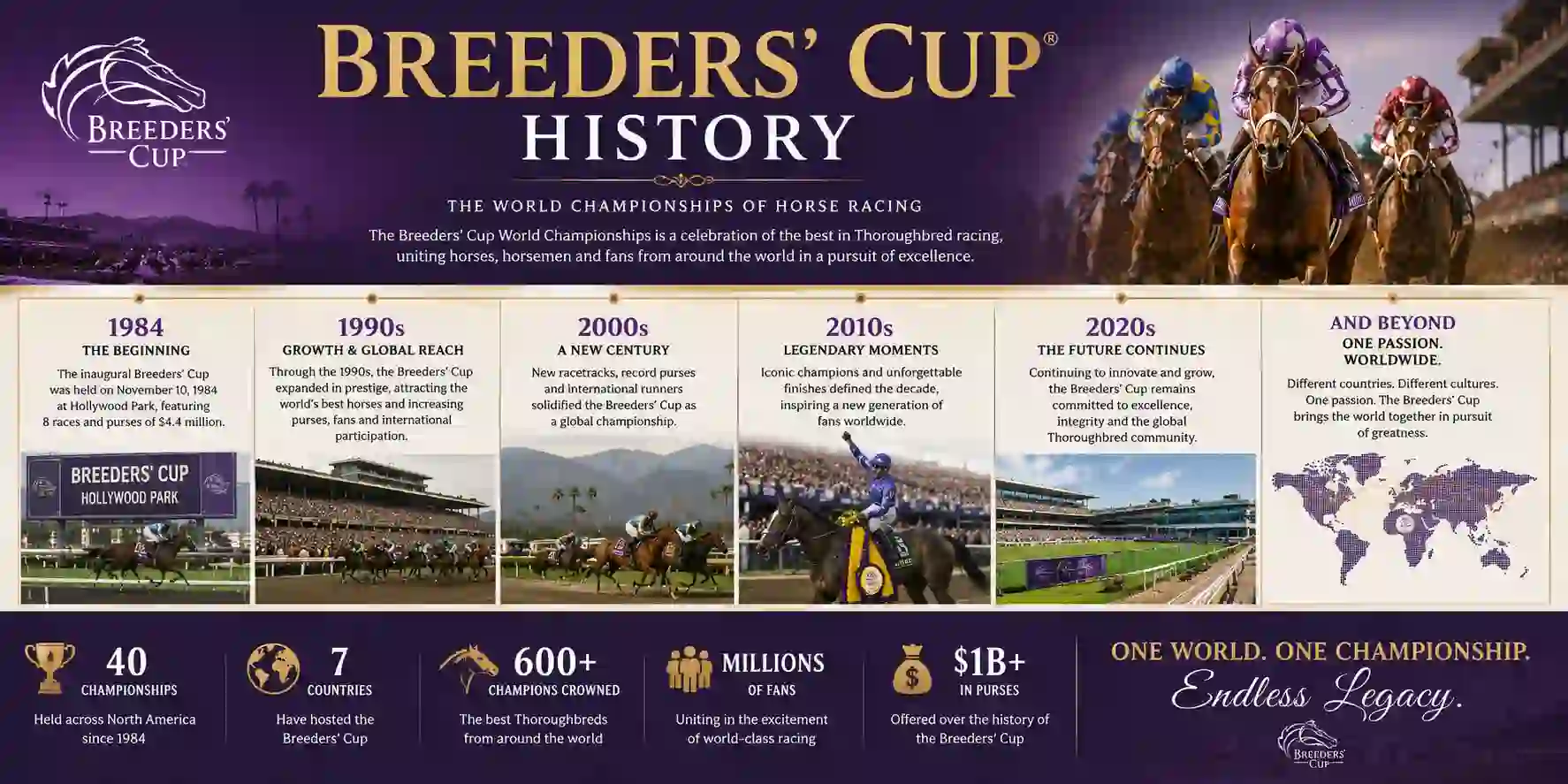
Few events in Thoroughbred racing have developed as quickly or achieved as much international prestige as the Breeders’ Cup World Championships. Although races such as the Kentucky Derby, Epsom Derby, Prix de l’Arc de Triomphe and Melbourne Cup have histories stretching back generations, the Breeders’ Cup is comparatively young. Its first championship meeting took place only in 1984.
Yet in just over four decades, the Breeders’ Cup has become one of the defining events on the global racing calendar.
The story of Breeders’ Cup history begins with an ambitious idea: bring the best horses from different divisions, regions and racing traditions together at the end of the season and create a championship event capable of deciding titles on the racetrack.
That vision developed into a multimillion-dollar racing festival featuring dirt and turf contests, juveniles and older horses, sprinters and stayers, American stars and international challengers.
Today, the Breeders’ Cup consists of 14 championship divisions. For 2026, the organization lists $34 million in purses and awards across the World Championships, with the $7 million Breeders’ Cup Classic serving as the richest race on the program.
Understanding how the event reached that point requires going back to the early 1980s and one of the most influential figures in modern American racing.
The Origins of the Breeders’ Cup
The central figure behind the creation of the Breeders’ Cup was John R. Gaines, a prominent Kentucky breeder and the founder of Gainesway Farm.
Gaines believed Thoroughbred racing needed a major championship event capable of bringing together leading horses from across the sport. Rather than allowing divisional championships to be decided largely through separate regional campaigns, his concept offered the possibility of settling many of those debates during one high-profile meeting.
The National Museum of Racing describes Gaines’ vision as creating something comparable to a “Super Bowl” for horse racing—an event attractive both to dedicated racing followers and a broader sporting audience. Its innovative funding model relied heavily on contributions connected to stallion and foal nominations, linking the breeding industry directly to the championship concept.
The idea became public on April 23, 1982, when Gaines announced plans for a multimillion-dollar, multi-race Breeders’ Cup series during the Kentucky Derby Festival’s “They’re Off” awards luncheon in Louisville.
Breeders’ Cup Limited was organized shortly afterward. By July 1982, plans called for a one-day championship featuring seven races. Southern California was selected for the inaugural meeting, and Hollywood Park was formally announced in February 1983 as the host of the first championships.
It was an unusually rapid journey from concept to reality.
The First Breeders’ Cup in 1984
The inaugural Breeders’ Cup took place at Hollywood Park in Inglewood, California, on November 10, 1984.
A crowd of 64,254 attended the historic meeting. Seven championship races were staged with total purses and nominator awards valued at approximately $10 million—an enormous figure for racing at the time. All seven championship races had also received Grade 1 status before the inaugural meeting.
The original seven races were the Juvenile, Juvenile Fillies, Sprint, Mile, Distaff, Turf and Classic.
Chief’s Crown has the distinction of winning the first Breeders’ Cup race ever staged, capturing the Juvenile. Outstandingly was awarded the Juvenile Fillies after the disqualification of Fran’s Valentine, while Eillo took the Sprint, Royal Heroine won the Mile, Princess Rooney dominated the Distaff and European challenger Lashkari captured the Turf.
Then came the race that would become the centerpiece of the championships: the Breeders’ Cup Classic.
Wild Again Wins the First Breeders’ Cup Classic
The inaugural Classic immediately produced the type of drama the new championship concept had promised.
Wild Again entered as a major outsider and was a supplemental entry to the race. With Pat Day riding for trainer Vincent Timphony, he battled Slew o’ Gold and Gate Dancer through an unforgettable stretch run.
Wild Again prevailed, while a stewards’ inquiry subsequently resulted in Gate Dancer being placed third and Slew o’ Gold second. The official Breeders’ Cup records show Wild Again at odds of $31.30 to $1.
A championship created partly to generate memorable sporting moments had achieved exactly that on its first afternoon.
The Breeders’ Cup Quickly Becomes a Major Racing Event
The success of 1984 showed that the concept could work beyond theory.
Unlike the Triple Crown, which is permanently associated with Churchill Downs, Pimlico and Belmont’s traditional New York circuit, the Breeders’ Cup was designed to move among major racetracks. That rotating model became an important part of its identity.
Aqueduct hosted the second edition in 1985. Santa Anita followed in 1986, while Hollywood Park welcomed the championships back in 1987 and Churchill Downs hosted for the first time in 1988.
The numbers demonstrated the event’s growing importance. In 1985, total on-track and simulcast wagering exceeded $28 million, establishing a North American single-day record at the time. The following year, 69,155 spectators attended the championships at Santa Anita, another early milestone in Breeders’ Cup history.
But attendance and wagering were only part of the story. Great horses were beginning to make the championships an essential part of racing history.
Personal Ensign Creates an Unforgettable 1988 Moment
One of the defining races of the Breeders’ Cup’s first decade came in the 1988 Distaff at Churchill Downs.
Personal Ensign entered undefeated but faced an enormous challenge against Kentucky Derby winner Winning Colors on a muddy track.
Winning Colors appeared to have done enough as the finish approached, but Personal Ensign produced a remarkable late rally to get up at the wire, maintaining her unbeaten career record.
She retired undefeated following the race. The Breeders’ Cup has subsequently ranked her victory among its most memorable championship moments.
Later that afternoon, Alysheba won the Classic. He had already captured the Kentucky Derby and Preakness Stakes as a three-year-old in 1987 and was named 1988 Horse of the Year after his outstanding older-horse campaign.
By the end of the 1980s, winning at the Breeders’ Cup had become closely connected with championship honors.
International Horses Become Central to Breeders’ Cup History
International participation was part of the Breeders’ Cup from the beginning.
Lashkari, representing the Aga Khan and trained in France, won the inaugural Turf. Royal Heroine, Irish-bred and trained by John Gosden, captured the first Mile.
European horses increasingly targeted the turf championships, and stars such as Miesque strengthened the event’s international reputation. Miesque won consecutive editions of the Breeders’ Cup Mile in 1987 and 1988.
International involvement produced one of the most astonishing results in Breeders’ Cup history in 1993.
Arcangues Produces a 133-1 Classic Upset
French-trained Arcangues arrived at Santa Anita for the 1993 Breeders’ Cup Classic as a massive outsider.
Few American bettors considered him a serious candidate.
Arcangues won anyway.
The official Breeders’ Cup timeline records his starting price at 133-1, making his Classic victory one of the great upsets in the history of the championships.
The result was significant beyond the betting shock. It demonstrated that the Breeders’ Cup’s international influence was no longer restricted primarily to turf racing.
More than three decades later, Arcangues remains an essential name in any discussion of Breeders’ Cup Classic history.
Woodbine Takes the Breeders’ Cup Outside the United States
Another major milestone arrived in 1996.
For the first time, the championships were staged outside the United States when Woodbine Racetrack in Toronto, Canada, hosted the event on October 26.
Breeders’ Cup records state that 42,380 attended, then a Canadian attendance record. Alphabet Soup won the Classic over Louis Quatorze, with defending champion Cigar finishing third.
Woodbine’s place in Breeders’ Cup history reinforced the organization’s international ambitions even though American racetracks remained the primary hosts in subsequent decades.
The Championship Program Begins to Expand
For many years, the original seven-race structure remained at the heart of the Breeders’ Cup.
That eventually changed.
The Filly & Mare Turf was added in 1999, with Soaring Softly winning its inaugural running at Gulfstream Park.
The biggest expansion, however, came during the 2000s.
In 2007, the championship format moved to two days at Monmouth Park. Three new Breeders’ Cup races were introduced: the Filly & Mare Sprint, Juvenile Turf and Dirt Mile.
The first two-day championships generated total wagering of more than $147 million. Curlin closed the meeting by winning the Classic by 4½ lengths on a sloppy track.
Three additional races were announced for 2008: the Turf Sprint, Juvenile Fillies Turf and Marathon. The expansion created a 14-race Breeders’ Cup with announced purses of $25.5 million.
The precise composition of the championship schedule has changed since then, but the transformation of 2007-08 established the modern two-day festival.
Tiznow Makes Breeders’ Cup Classic History
Few horses are more closely associated with the Classic than Tiznow.
He won the race in 2000 and returned to win again in 2001.
More than two decades later, Tiznow remains the only horse to win the Breeders’ Cup Classic twice. Official Breeders’ Cup records list both victories under trainer Jay Robbins.
His second victory also carried enormous emotional weight. The 2001 Breeders’ Cup was staged at Belmont Park only weeks after the September 11 terrorist attacks in New York and Washington.
On sporting merit alone, winning consecutive Classics is extraordinary. Historically, the context made Tiznow’s achievement even more memorable.
The “Win and You’re In” Era
The Breeders’ Cup’s development was not limited to adding races.
Qualification also became increasingly international.
The Breeders’ Cup Challenge Series, commonly promoted as “Win and You’re In,” linked major races around the world directly to the championships. Winners of designated qualifying events could earn automatic positions in the corresponding Breeders’ Cup division, subject to program rules.
The concept was underway by 2007 and expanded substantially in 2008, including qualifying races in Europe.
By 2026, the system had become truly global, with Breeders’ Cup Challenge events scheduled across numerous racing jurisdictions. Nominated winners receive an automatic starting position, paid pre-entry and entry fees, and other benefits under the program.
This qualification structure has helped transform the Breeders’ Cup from a predominantly North American championship into a genuine end-of-season target for international trainers and owners.
Zenyatta’s Historic 2009 Classic
If one performance captures the spectacle of the modern Breeders’ Cup, it may be Zenyatta’s victory in the 2009 Classic at Santa Anita.
Zenyatta had already won the Breeders’ Cup Distaff—then known as the Ladies’ Classic—in 2008.
A year later, her connections took the much more difficult option of challenging males in the Classic.
Known for racing well off the early pace before producing a devastating late run, Zenyatta once again dropped behind her rivals before charging through the field in the stretch.
She won, becoming the first female horse to capture the Breeders’ Cup Classic.
Her achievement remains ranked among the Breeders’ Cup’s signature moments, alongside Personal Ensign, American Pharoah and Flightline.
Goldikova Sets a Record in the Breeders’ Cup Mile
While Zenyatta dominated headlines in 2009, another extraordinary mare was writing her own chapter of Breeders’ Cup history.
French-trained Goldikova won the Mile in 2008, returned to defend the title in 2009 and completed a historic three-peat in 2010.
Official Breeders’ Cup trainer records credit Freddy Head with all three Goldikova victories.
Her three consecutive wins highlighted the international character of the Mile and established a standard of repeat success that remains exceptional even in an event filled with championship horses.
American Pharoah Completes Racing’s “Grand Slam”
The 2015 Breeders’ Cup at Keeneland produced another landmark.
American Pharoah had already become the first horse since Affirmed in 1978 to sweep the Kentucky Derby, Preakness Stakes and Belmont Stakes.
He ended his racing career in the Breeders’ Cup Classic.
American Pharoah won decisively, completing what was widely described as horse racing’s Grand Slam: the Triple Crown plus the Breeders’ Cup Classic.
Breeders’ Cup itself ranks the performance among the greatest moments in the event’s history.
For an event created only three decades earlier, that was a remarkable measure of its status. The Classic had become important enough that adding it to a Triple Crown season created an entirely new historical achievement.
Future Stars Friday Changes the Two-Day Format
Another structural change arrived in 2018.
Breeders’ Cup reorganized Friday around its five races for two-year-olds and introduced the branding “Future Stars Friday.”
The first edition took place at Churchill Downs. It also featured the inaugural Breeders’ Cup Juvenile Turf Sprint, won by Bulletin.
The format gave the two-day championships clearer identities: Friday showcases potential stars of the following season, while Saturday concentrates heavily on the established older-horse divisions and ends with the Classic.
The system remains in use for the 2026 championships.
Enable Makes European Racing History in 2018
The 2018 meeting also produced an achievement long considered extremely difficult.
The brilliant mare Enable arrived at Churchill Downs after winning the Prix de l’Arc de Triomphe in France.
She then defeated Magical in the Breeders’ Cup Turf, becoming the first horse to win the Arc and Breeders’ Cup Turf in the same year.
The victory demonstrated why the Breeders’ Cup Turf had become one of the world’s most important international grass races.
European champions no longer treated the Breeders’ Cup as an occasional postseason adventure. For many connections, it had become a major objective in its own right.
Flightline Delivers a Modern Classic Masterpiece
The 2022 Breeders’ Cup at Keeneland produced one of the most dominant Classic performances.
Flightline, unbeaten entering the race, defeated his rivals to complete a six-race career without a loss.
Breeders’ Cup statistics show that he earned $3.12 million for winning the 2022 Classic and finished his career with six victories from six starts. He was subsequently named the 2022 U.S. Horse of the Year.
His victory quickly entered discussions of the greatest performances in Breeders’ Cup history, particularly because of the extraordinary level he had displayed throughout his short career.
Forever Young Adds a New International Chapter in 2025
The Breeders’ Cup continued to reinforce its international identity in 2025.
At Del Mar, Japanese star Forever Young stayed close to the pace in the $7 million Classic before taking command approaching the final quarter-mile and defeating defending champion Sierra Leone.
According to the official Breeders’ Cup timeline, Forever Young became the first overseas runner since Arcangues in 1993 to win the Classic.
The result was a fitting illustration of how far John Gaines’ original championship concept had developed. A race conceived in Kentucky, launched in California and traditionally dominated by North American dirt horses had become a realistic target for elite runners based thousands of miles away.
Breeders’ Cup Records and Legendary Figures
The history of the meeting is not defined solely by horses.
Jockey Mike Smith holds one of its most impressive records. Official statistics credit him with 27 Breeders’ Cup victories, including wins aboard Zenyatta, Arrogate, Skip Away, Royal Delta, Songbird and other champions.
Among trainers, the numbers remain exceptionally competitive. Updated Breeders’ Cup statistics following the 2025 championships list Bob Baffert and Aidan O’Brien with 21 victories each. D. Wayne Lukas is close behind with 20.
Their records also illustrate the event’s international balance. Baffert’s successes have been built primarily around American dirt stars, while Ireland-based O’Brien has enjoyed extraordinary results in turf and juvenile divisions.
Individual horses have left equally distinctive marks. Tiznow remains the only two-time Classic winner. Goldikova won three consecutive Miles. Miesque, Lure, Bayakoa, Midnight Lute, Conduit, Groupie Doll, Wise Dan, Cody’s Wish and Elite Power are among the notable horses to have successfully defended a Breeders’ Cup title.
Where Has the Breeders’ Cup Been Held?
The rotating-host model has allowed different American racing regions to become part of Breeders’ Cup history.
Hollywood Park hosted the inaugural meeting, while Aqueduct, Santa Anita, Churchill Downs, Gulfstream Park, Belmont Park, Woodbine, Arlington Park, Lone Star Park, Monmouth Park, Keeneland and Del Mar have all staged editions of the championships.
Over time, several venues—particularly Santa Anita, Churchill Downs, Keeneland and Del Mar—have become frequent modern hosts.
The rotation is more than a change of scenery. Different track configurations, dirt surfaces, turf layouts, climates and home-track advantages can shape individual championships.
That variability is one reason comparing Breeders’ Cup winners from different eras requires more than simply comparing finishing times.
The Breeders’ Cup in 2026
The scale of the modern championships demonstrates how dramatically the event has grown since 1984.
The 2026 Breeders’ Cup World Championships are scheduled for October 30 and October 31 at Keeneland in Lexington, Kentucky. The program features 14 championship divisions and $34 million in purses and awards.
The Breeders’ Cup Classic carries a $7 million purse and is contested over 1¼ miles on dirt. The Breeders’ Cup Turf is worth $5 million over 1½ miles, while major divisions including the Distaff, Mile, Sprint, Juvenile and Juvenile Fillies offer substantial seven-figure purses.
That is a dramatic evolution from the seven-race, one-day championship staged at Hollywood Park more than 40 years ago.
Yet the central idea has remained surprisingly consistent: identify the best horses in each major division by bringing elite competitors together on racing’s biggest year-end stage.
Breeders’ Cup History Timeline
| Year | Historic Moment |
| 1982 | John R. Gaines publicly announces plans for a multimillion-dollar championship series. |
| 1984 | First Breeders’ Cup held at Hollywood Park; Wild Again wins the inaugural Classic. |
| 1986 | Santa Anita attracts a then-record Breeders’ Cup crowd of 69,155. |
| 1988 | Personal Ensign wins a dramatic Distaff and retires undefeated. |
| 1993 | Arcangues shocks the Classic at 133-1. |
| 1996 | Woodbine becomes the first venue outside the United States to host the championships. |
| 1999 | Filly & Mare Turf joins the championship program. |
| 2000-01 | Tiznow becomes the first and still only two-time Breeders’ Cup Classic winner. |
| 2007 | Breeders’ Cup expands to a two-day championship. |
| 2008 | Championship program grows to 14 races. |
| 2009 | Zenyatta becomes the first female winner of the Classic. |
| 2010 | Goldikova completes her third consecutive Mile victory. |
| 2015 | American Pharoah adds the Classic to his Triple Crown season. |
| 2018 | Future Stars Friday debuts; Enable completes the Arc-Breeders’ Cup Turf double. |
| 2022 | Unbeaten Flightline closes his career with a dominant Classic victory. |
| 2025 | Forever Young becomes the first overseas-based Classic winner since Arcangues. |
| 2026 | Keeneland hosts the 43rd championships with 14 divisions and $34 million in purses and awards. |
Why the Breeders’ Cup Became So Important
The Breeders’ Cup succeeded because it filled a gap that had existed in Thoroughbred racing.
The sport has no single league. Horses compete at different tracks, on different surfaces and in different countries. A champion sprinter may never meet a champion middle-distance horse, and American dirt horses traditionally follow very different campaigns from Europe’s leading turf runners.
The Breeders’ Cup does not eliminate those differences. It celebrates them by offering separate championship divisions while placing them together within one major international festival.
It has also become an important bridge between generations.
Juvenile winners can emerge as major three-year-olds the following season. Older champions can defend their titles. European turf stars can face American specialists. Kentucky Derby winners can return months later to meet older horses in the Classic.
Those competitive intersections give the championships historical value beyond individual purse money.
FAQs
When was the first Breeders’ Cup?
The first Breeders’ Cup was held on November 10, 1984, at Hollywood Park in California. The one-day meeting featured seven championship races and attracted 64,254 spectators.
Who founded the Breeders’ Cup?
The Breeders’ Cup was created from the vision of John R. Gaines, the influential Kentucky breeder associated with Gainesway Farm. He publicly announced plans for the series in April 1982.
Who won the first Breeders’ Cup Classic?
Wild Again, ridden by Pat Day and trained by Vincent Timphony, won the inaugural Breeders’ Cup Classic in 1984.
Which horse has won the Breeders’ Cup Classic twice?
Tiznow won in both 2000 and 2001 and remains the only two-time winner of the Classic.
Who was the first female horse to win the Breeders’ Cup Classic?
Zenyatta became the first female winner of the Classic when she defeated male rivals at Santa Anita in 2009. She had won the Breeders’ Cup Distaff the previous year.
Is the Breeders’ Cup always held at the same racetrack?
No. The championships rotate among selected host tracks. Hollywood Park staged the first meeting, and venues including Santa Anita, Churchill Downs, Belmont Park, Keeneland and Del Mar have hosted multiple editions. Woodbine in Canada hosted in 1996.
How many Breeders’ Cup races are there today?
For 2026, there are 14 Breeders’ Cup championship divisions, covering dirt and turf racing, juveniles, fillies and mares, sprinters, milers and longer-distance horses.
Conclusion
The history of the Breeders’ Cup is unusual because so much has happened in a relatively short period.
John R. Gaines publicly presented his championship concept in 1982. Only two years later, more than 64,000 people were at Hollywood Park watching Wild Again capture the first Breeders’ Cup Classic.
From there came Personal Ensign’s undefeated farewell, Arcangues’ 133-1 upset, Woodbine’s international hosting milestone, Tiznow’s consecutive Classics, Goldikova’s Mile three-peat, Zenyatta’s historic victory over males, American Pharoah’s Grand Slam, Enable’s Arc-Turf double, Flightline’s unbeaten finale and Forever Young’s landmark 2025 Classic.
At the same time, a seven-race American championship evolved into a two-day international festival comprising 14 divisions and tens of millions of dollars in purses and awards.
That evolution explains why Breeders’ Cup history matters. The event did not simply become another prestigious race meeting. It changed the structure of the Thoroughbred racing season by giving champions from different regions and disciplines a common destination.
More than 40 years after the first horses entered the starting gate at Hollywood Park, the fundamental purpose remains the same: bring the world’s best Thoroughbreds together and let championship performances be decided on the racetrack.Bottom of Form