

18+ | Affiliate link | Terms apply | Please gamble responsibly.
Last Updated on October 14, 2026 by Maurya
Horse racing has a way of turning a few minutes of sporting action into a memorable experience. The anticipation before the gates open, the changing positions throughout the race, and the final sprint to the finish make it one of the most exciting spectator sports. For many racing fans, betting adds another layer of interest.
However, betting on horse racing involves much more than choosing a horse with an appealing name or following the favourite. Understanding horse racing odds, analysing previous performances, recognising different bet types, and managing your spending are all important parts of making informed decisions.
A horse with impressive recent results is not necessarily the strongest contender in every race. Changes in distance, ground conditions, competition, and the weight carried can significantly influence performance. Even when a horse appears well suited to the race, the available odds may not offer good value.
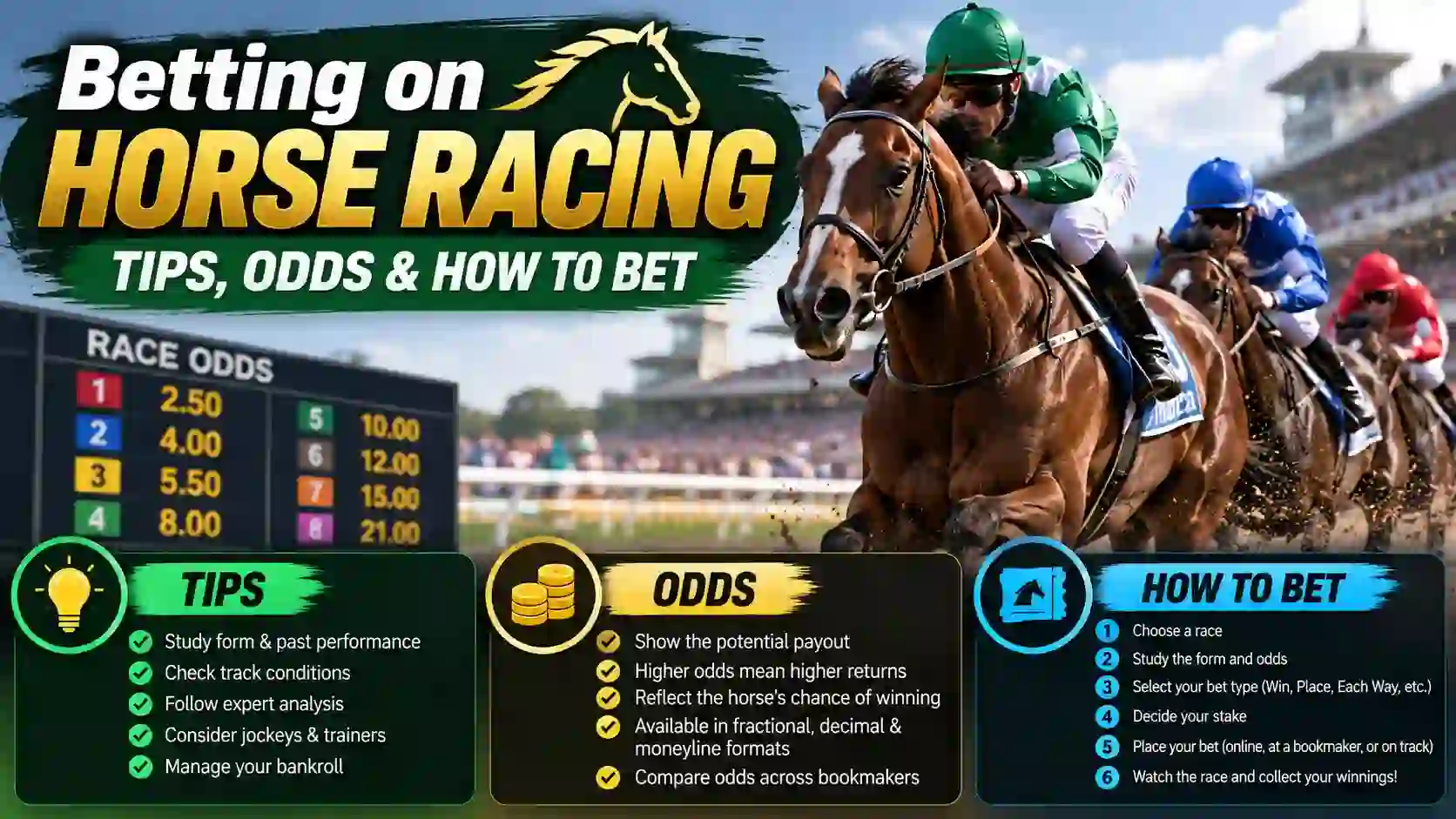
This guide explains how horse racing betting works, how to read odds, what the most common wagers mean, and which factors deserve attention before placing a bet. Whether you’re learning the basics or looking to improve your understanding of racing form, the aim is to help you approach the sport with greater knowledge and realistic expectations.
What Is Horse Racing Betting?
Horse racing betting involves predicting the outcome of a race and placing a wager on that prediction. The simplest bet is choosing which horse will win, but other markets allow you to back a horse to finish in a qualifying position or predict the exact finishing order of multiple runners.
Betting is available through licensed online operators, physical betting shops, and racecourse betting facilities, depending on local laws.
Two important elements determine the outcome of a wager: the selection you make and the price available when you place the bet.
For example, imagine two horses competing in the same race. One has won several recent starts and is heavily favoured by the market. Another has less impressive finishing positions but has previously performed well over the same distance and on similar ground.
The first horse may be more likely to win, but that does not automatically make it a better betting proposition. The second might offer a more attractive price relative to its estimated chance.
This distinction between finding a likely winner and finding a worthwhile price is fundamental to understanding horse racing betting.
Understanding Horse Racing Odds
Horse racing odds indicate the potential return on a successful wager. They also express an implied probability, although that probability may include a bookmaker’s margin or, in pool betting, deductions from the betting pool.
Odds are commonly displayed in three formats: fractional, decimal, and American.
Fractional Odds
Fractional odds are particularly common in British and Irish horse racing.
Suppose a horse is available at 5/1 (five to one).
For every £1 staked, a successful win bet produces £5 in profit, plus the original £1 stake.
With a £10 bet at 5/1:
- Stake: £10
- Potential profit: £50
- Total return: £60
A shorter price, such as 2/1, offers a smaller potential profit for the same stake. Longer odds, such as 20/1, offer a larger potential payout but generally reflect a lower market-estimated chance of success.
Decimal Odds
Decimal odds express the total return, including the original stake.
The calculation is straightforward:
Total Return = Stake × Decimal Odds
For example, a £10 winning bet at decimal odds of 6.00 returns £60, including £50 profit.
Decimal odds are particularly useful for comparing potential payouts without converting fractions.
American Odds
American odds use positive and negative numbers.
Positive odds show the profit available on a $100 winning bet. For example, +500 means a $100 stake would return $500 profit.
Negative odds show how much must be staked to make $100 profit. At -200, a successful $200 stake produces $100 profit.
Horse Racing Odds Comparison
| Fractional Odds | Decimal Odds | American Odds | Implied Probability |
| 1/2 | 1.50 | -200 | 66.67% |
| 2/1 | 3.00 | +200 | 33.33% |
| 4/1 | 5.00 | +400 | 20.00% |
| 8/1 | 9.00 | +800 | 11.11% |
These percentages represent the mathematical break-even probabilities before considering any additional costs or deductions.
To calculate implied probability using decimal odds:
Implied Probability = (1 ÷ Decimal Odds) × 100
For instance, decimal odds of 5.00 imply a 20% probability.
However, the odds are not an objective measurement of a horse’s true winning chance. Bookmaker prices include commercial considerations, and markets can overestimate or underestimate individual runners.
Types of Horse Racing Bets Explained
Before placing a wager, it is important to understand exactly what needs to happen for the bet to win.
Different markets have different settlement rules, and terminology varies between countries.
Win Bet
A win bet is the simplest form of horse racing wagering.
You select one horse, and it must finish first for your bet to succeed.
If you place £10 on a horse at 4/1 and it wins, your total return is £50, including your original stake.
If the horse finishes second or lower, the bet loses, subject to any applicable dead-heat or other settlement rules.
Each-Way Bet
Each-way betting is popular in the UK and Ireland.
An each-way bet consists of two separate wagers: one backing the horse to win and another backing it to finish within the qualifying places.
For example, a £5 each-way bet costs £10 in total.
The win portion is settled at the selected win odds. The place portion is settled at a specified fraction of those odds, often one-fifth or one-quarter, depending on the race and bookmaker’s terms.
The number of qualifying places also varies.
A horse that wins can collect on both portions. A horse that only finishes in a qualifying place collects on the place portion, while the win portion loses.
Each-way betting can provide a return without the horse winning, but it does not guarantee an overall profit.
Place and Show Bets
In traditional US horse racing wagering, a place bet wins if the selected horse finishes first or second.
A show bet generally wins when the horse finishes first, second, or third.
These differ from a bookmaker’s British each-way bet, which combines separate win and place wagers.
Always check the applicable racecourse or operator rules, especially when betting internationally.
Exacta Bet
An exacta requires you to predict the first two finishers in the correct order.
For example, if Horse A finishes first and Horse B finishes second, an exacta selecting A-B wins.
If those horses finish in reverse order, a straight exacta loses.
An exacta box covers multiple finishing orders, but the additional combinations increase the total cost.
Trifecta Bet
A trifecta requires the correct first three finishers in the exact order.
Predicting three positions is more difficult than selecting one winner, which is why successful trifecta wagers can produce substantial returns.
However, the larger potential payout comes with a lower probability of success.
Accumulator or Multi-Race Bet
An accumulator combines several selections into one wager, with each selection required to win under the applicable rules.
In US racing, comparable multi-race wagers include Pick 3, Pick 4, and Pick 5 bets, where bettors identify the winners of consecutive races.
These wagers can appear attractive because potential returns increase as more selections are added.
The drawback is that one losing selection can eliminate the entire bet.
For newcomers, understanding straightforward win bets before considering complex combinations makes it easier to recognise the relationship between risk and payout.
How to Bet on Horse Racing: Step-by-Step Guide
Once you understand the basic markets and odds, placing a horse racing bet is relatively simple.
The following process applies broadly to online betting, although specific steps vary by jurisdiction and operator.
- Choose a licensed betting operator. Select a provider legally authorised to offer horse racing betting in your location. Check its regulatory status, payment policies, withdrawal terms, and safer gambling features.
- Set your budget. Decide how much money you can afford to lose before opening a betting market. Treat this amount as entertainment spending rather than money intended to generate income.
- Find an upcoming race. Browse the day’s racing schedule and select a race you want to examine. Check the venue, distance, surface, number of runners, and expected conditions.
- Study the racecard. Review each horse’s previous performances, trainer, jockey, handicap rating, and relevant course or distance results.
- Compare the available odds. Look at different prices where comparison is legally available. Consider whether the potential payout reasonably reflects your assessment of the horse’s chance.
- Select your bet type and stake. Choose a win, each-way, or another permitted wager. Review the stake, potential return, place terms, and any applicable restrictions.
- Review the betting slip before confirming. Ensure that the horse, race, wager type, stake, and price are correct. Once a bet is accepted, cancellation may not be possible.
After the race, settlement generally occurs once the official result has been declared.
Online accounts typically credit successful wagers automatically, while physical betting tickets may need to be presented for payment.
How to Read a Horse Racing Racecard
One of the most useful skills for anyone interested in betting on horse racing is understanding a racecard.
A racecard contains the key information about the horses participating in a particular event.
According to the British Horseracing Authority, race records and handicap data provide information about previous finishing positions, race distances, going, weights, ratings, and performance figures.
Learning to interpret these details can help you move beyond simply following popular selections.
Recent Form
Form figures summarise a horse’s recent finishing positions.
For example, a sequence such as 5213 indicates previous finishes of fifth, second, first, and third, with the most recent result typically shown on the right in British racecards.
Letters can indicate incidents or incomplete races. An F commonly means the horse fell, while P can indicate that it was pulled up.
However, finishing positions do not tell the complete story.
A third-place finish against strong opposition may be more impressive than a victory in a weaker race.
That is why form should always be considered alongside race class and conditions.
Official Ratings
Handicap ratings are assessments used to help determine the weights horses carry in handicap races.
A horse with a higher rating is generally considered more capable by the handicapper, but it may also have to carry more weight.
Ratings are valuable reference points, not predictions of guaranteed performance.
Course and Distance Records
Some horses consistently perform better at particular tracks or over certain distances.
A runner with strong results over six furlongs may not reproduce those performances over a mile.
Similarly, a horse accustomed to a flat, galloping course may face a different challenge on a tighter track.
Course and distance records can help identify relevant experience, although they should never be treated as decisive evidence by themselves.
Horse Racing Betting Tips: Factors Worth Analysing
There is no reliable formula that guarantees winning horse racing bets.
Nevertheless, analysing relevant information can improve the quality of your decisions and help you avoid wagers based entirely on guesswork.
- Examine Recent Form in Context
A horse that has won its previous two races will naturally attract attention.
The important question is how those victories were achieved.
Were they against strong rivals? Did the horse benefit from an uncontested lead? Was the winning margin convincing, or did the result depend on a favourable trip?
Look beyond the finishing position and examine the quality of opposition, race pace, and circumstances.
Past performances provide evidence, but they cannot remove uncertainty about future results.
- Consider Ground and Track Conditions
The racing surface can play an important role in determining performance.
In British turf racing, going descriptions commonly range from firm through good to soft and heavy.
Some horses appear more comfortable on faster surfaces, while others perform more effectively when the ground has more moisture.
In American racing, dirt and turf present different demands, and the condition of the surface can also influence running styles.
Before analysing a race, check whether a horse has previously demonstrated ability under conditions similar to those expected.
Be cautious when drawing conclusions from very small samples.
- Evaluate Distance Suitability
Distance can influence stamina, pace, and a horse’s ability to finish strongly.
A sprinter may possess excellent early speed but struggle when competing over a longer trip.
A stamina-oriented horse, meanwhile, may find a short race unfolds too quickly to demonstrate its strongest qualities.
Consider previous performances at comparable distances, rather than assuming that a horse’s general ability will translate to every race.
- Study the Expected Pace
How a race is likely to unfold can matter almost as much as which horses are involved.
Some runners prefer to lead from the start, while others settle behind the leaders and make their challenge later.
A race containing several front-running horses may produce a different pace from one with a single obvious leader.
Strong early competition can sometimes benefit horses that finish late, while a slower pace may favour runners positioned near the front.
These are possibilities rather than fixed rules, and unexpected race tactics can quickly change the outcome.
- Assess the Draw
The draw determines a horse’s starting stall in many flat races.
Its importance varies according to the racecourse, distance, field size, and track conditions.
At certain courses, particular starting positions may have historically performed better.
However, draw statistics should be interpreted carefully. They can be affected by pace, field composition, and changing racing conditions.
A favourable stall does not guarantee a favourable race.
- Review Jockey and Trainer Records
Jockeys and trainers can influence how well a horse performs.
Useful information includes a trainer’s recent results, the jockey’s experience, and their records under comparable racing conditions.
Strong statistics can provide additional context, but they should not replace an assessment of the horse itself.
A high-profile jockey riding a poorly suited horse is not automatically a stronger betting proposition than a lesser-known rider aboard a well-matched runner.
- Monitor Odds Without Following Every Market Move
Horse racing odds often change as new bets enter the market.
A shortening price may reflect increased interest in a runner, while drifting odds can indicate weaker market support.
However, market movement is not proof that a horse will win or lose.
Prices can change because of public betting activity, liquidity, new information, or changes to the field.
Instead of chasing a rapidly shortening price, consider whether the available odds still represent a reasonable proposition.
What Is Value Betting in Horse Racing?
Value betting is the practice of comparing the odds on offer with your own estimate of an outcome’s probability.
It is different from simply choosing the horse most likely to win.
Suppose a horse is available at 4/1.
Those odds imply a break-even probability of 20%.
If your assessment suggests the horse has a 25% chance of winning, the quoted price would appear attractive on your estimate.
At 4/1, a £10 successful bet produces £40 profit. If the true winning probability were genuinely 25%, the theoretical expected profit would be £2.50 per £10 wager.
But there is an important catch.
Your probability estimate may be wrong.
Estimating a horse’s true winning chance is difficult, and even extensive research cannot ensure accuracy. Bookmaker margins, pool deductions, and changing race conditions further complicate the calculation.
Value betting is therefore best understood as an analytical framework, not a proven route to regular profits.
The underlying principle is useful: a bet should be judged by both the probability of success and the price, rather than by either factor alone.
Fixed Odds vs Pari-Mutuel Betting
Another important aspect of horse racing betting is understanding how prices are determined.
Fixed-Odds Betting
In fixed-odds betting, a bookmaker offers a particular price for a selection.
When the wager is accepted, that price is generally agreed for the bet.
For example, if you back a horse at 6/1 and it subsequently shortens to 3/1, your original accepted price generally remains 6/1.
However, settlement rules can affect returns, including deductions for non-runners and other market adjustments.
Always read the operator’s rules.
Pari-Mutuel Betting
Pari-mutuel betting, often called pool betting or tote betting, operates differently.
Bettors contribute money to a common pool. After the operator’s deductions, the remaining amount is distributed among successful wagers according to the applicable rules.
Unlike a conventional fixed-odds bet, the final payout depends on the pool when betting closes.
The New York Racing Association explains that pari-mutuel odds fluctuate as wagers are added and that payouts are determined using the final odds, not necessarily the price displayed when the bet was placed.
This distinction matters when calculating potential returns.
A displayed tote price should generally be viewed as provisional until the pool has closed.
Each-Way Horse Racing Betting: A Practical Example
Each-way betting deserves particular attention because the total stake and potential returns are sometimes misunderstood.
Imagine a horse priced at 8/1, with each-way terms paying one-fifth of the win odds for the first three finishers.
You place a £5 each-way bet.
Your total stake is £10, divided into:
£5 win bet at 8/1
£5 place bet at 8/5
If the horse wins, the win portion returns £45 and the place portion returns £13.
Your combined return is £58, representing £48 profit after deducting the £10 total stake.
If the horse finishes second or third, only the place portion succeeds.
You receive £13 back, representing £3 overall profit.
If the horse finishes outside the qualifying places, both portions lose.
This is an illustration, not a universal settlement rule. Actual place fractions, numbers of places, eligibility conditions, and dead-heat rules vary between races and operators.
The Jockey Club’s official betting guide also confirms that an each-way selection is made up of two separate stakes.
Common Horse Racing Betting Mistakes to Avoid
Even experienced racing followers can make poor decisions when excitement replaces analysis.
One common mistake is backing favourites automatically.
Favourites generally attract support because they are considered strong contenders. However, a high chance of winning does not mean the available price is attractive.
Another mistake is relying entirely on outside selections.
Professional tipsters and racing analysts can provide useful perspectives, but predictions are still opinions. No selection is certain, regardless of how confidently it is presented.
Some bettors also underestimate the total cost of combination wagers.
A trifecta box containing several horses may cover numerous finishing orders, but every additional combination increases the amount staked.
Similarly, accumulators can create the impression of exceptional value because of their potential payout, even though selecting several winners consecutively is difficult.
Finally, avoid treating a previous result as evidence that the next wager is more likely to succeed.
A losing streak does not mean a win is due, and an earlier victory does not make the next selection more dependable.
Each race should be assessed independently.
Managing Your Horse Racing Betting Budget
Understanding odds and racing form is only part of informed betting. Controlling spending is equally important.
A betting bankroll is a predetermined amount allocated to wagering.
It should consist entirely of money you can afford to lose without affecting essential expenses, savings, or financial commitments.
Some people divide a discretionary betting budget into smaller amounts to avoid staking too much on one race.
For example, a person with a £100 entertainment budget might decide that no individual wager should exceed £2.
This does not make the bets profitable or eliminate the risk of losing the entire budget. It simply establishes a spending boundary.
The most important rule is to avoid increasing your stake in an attempt to recover previous losses.
The National Council on Problem Gambling recommends setting time and financial limits, avoiding loss chasing, and never gambling with money intended for necessities.
Keeping a record of your wagers can also help you understand your spending. Record the date, selection, odds, stake, and outcome.
A betting record should be used to monitor behaviour and expenditure, not as an invitation to gamble more frequently.
If betting stops feeling recreational or begins causing financial or emotional strain, taking a break and seeking support is more important than finding another selection.
How to Choose a Safe Horse Racing Betting Platform
Safety should be a priority when selecting an online betting provider.
First, check that the operator is licensed in the jurisdiction where you live and legally permitted to offer the relevant betting services.
In Great Britain, the Gambling Commission’s public register allows consumers to check operating licences and related information.
Licensing requirements differ internationally, so use the appropriate regulator for your location.
A suitable platform should clearly explain its betting rules, deposits, withdrawals, customer support procedures, and applicable fees.
Pay particular attention to each-way terms, non-runner policies, bet settlement rules, and restrictions on promotional offers.
Account security and access to deposit, loss, or time limits are also worth checking.
An attractive welcome offer should never be the deciding factor in whether to use a gambling service. Read the conditions carefully, including any wagering requirements and withdrawal restrictions.
Most importantly, do not open a betting account unless you meet the legal minimum gambling age in your jurisdiction.
FAQs
Is horse racing betting suitable for beginners?
The basic mechanics of horse racing betting are relatively easy to understand, particularly simple win bets. However, predicting winners and assessing betting value are much more complicated.
Beginners can learn the fundamentals by studying racecards, watching races, and making hypothetical selections without risking money.
What is the easiest horse racing bet to understand?
A win bet is generally the simplest because it requires one horse to finish first.
The payout depends on the accepted odds and the amount staked. Although the rules are straightforward, choosing the winning horse remains uncertain.
What are good horse racing betting tips for beginners?
Useful starting points include reading recent form, understanding the race distance, checking track conditions, comparing odds, and learning the rules of the selected bet type.
Maintaining a strict spending limit is equally important.
No betting tip can guarantee a winning outcome.
Is it better to bet on favourites or outsiders?
Neither category is automatically better.
Favourites are generally considered more likely to win but offer shorter odds. Outsiders offer larger potential payouts but are generally less likely to succeed.
The relevant question is whether the available price fairly reflects the horse’s chance of winning.
What does 10/1 mean in horse racing?
Odds of 10/1 mean that a successful win bet produces £10 profit for every £1 staked.
A £5 winning bet at 10/1 would therefore return £55, including the original £5 stake.
The implied break-even probability is approximately 9.09%.
Can you make money consistently betting on horse racing?
Some bettors achieve profitable periods, but consistent long-term profits are difficult and cannot be guaranteed.
Bookmaker margins, pari-mutuel deductions, inaccurate probability estimates, and unpredictable racing outcomes all create challenges.
Horse racing betting should not be treated as a dependable source of income.
What happens if a horse does not run?
The outcome depends on the bet type and the operator’s rules.
A non-runner may result in a void bet and a returned stake, but deductions, substitutions, or different settlement arrangements can apply.
Always review the relevant rules before wagering.
Can horse racing odds change after placing a bet?
With conventional fixed-odds betting, the accepted price generally remains in place, subject to relevant settlement adjustments.
With pari-mutuel wagering, the final payout is calculated from the betting pool when wagering closes, so it may differ from the price displayed earlier.
Final Thoughts
Betting on horse racing becomes easier to understand when you focus on the information behind each race instead of looking only at the potential payout.
Learning how odds work, understanding different bet types, studying racing form, and recognising the importance of distance, ground conditions, pace, and competition can all help you evaluate a race more carefully.
The most valuable lesson, however, is that a well-researched selection can still lose.
Horse racing contains unavoidable uncertainty. No strategy, statistical model, or expert opinion can remove that risk.
For anyone who chooses to bet, the sensible approach is to understand the wager, consider the price, stay within a predetermined recreational budget, and remain comfortable with the possibility of losing the stake.
Racing is a sport that rewards curiosity and careful observation. You can enjoy learning about horses, trainers, jockeys, and race tactics without having to place a bet on every event—or any event at all.
Responsible gambling: Gambling involves financial risk and should only be undertaken by people who are legally eligible. Never bet money needed for essential expenses or attempt to recover losses by increasing stakes. In Great Britain, free confidential gambling support is available through GamCare, including its 24-hour National Gambling Helpline on 0808 8020 133.
ADVERTISEMENT

18+ | Affiliate link | Terms apply | Please gamble responsibly.


