

18+ | Affiliate link | Terms apply | Please gamble responsibly.
Last Updated on September 7, 2026 by Maurya
British horse racing has produced champions in almost every shape and form. Some were brilliant over a mile on the Flat. Others became household names by clearing fences through the depths of winter. A select few managed something even more difficult: they crossed the boundary between racing excellence and popular culture.
Choosing the three most iconic racehorses in UK racing history is therefore never going to be purely about ratings or prize money. Racing fans could make compelling cases for Arkle, Brigadier Gerard, Nijinsky, Dancing Brave, Sea The Stars, Kauto Star, Best Mate and several others.
Yet three horses have particularly powerful claims.
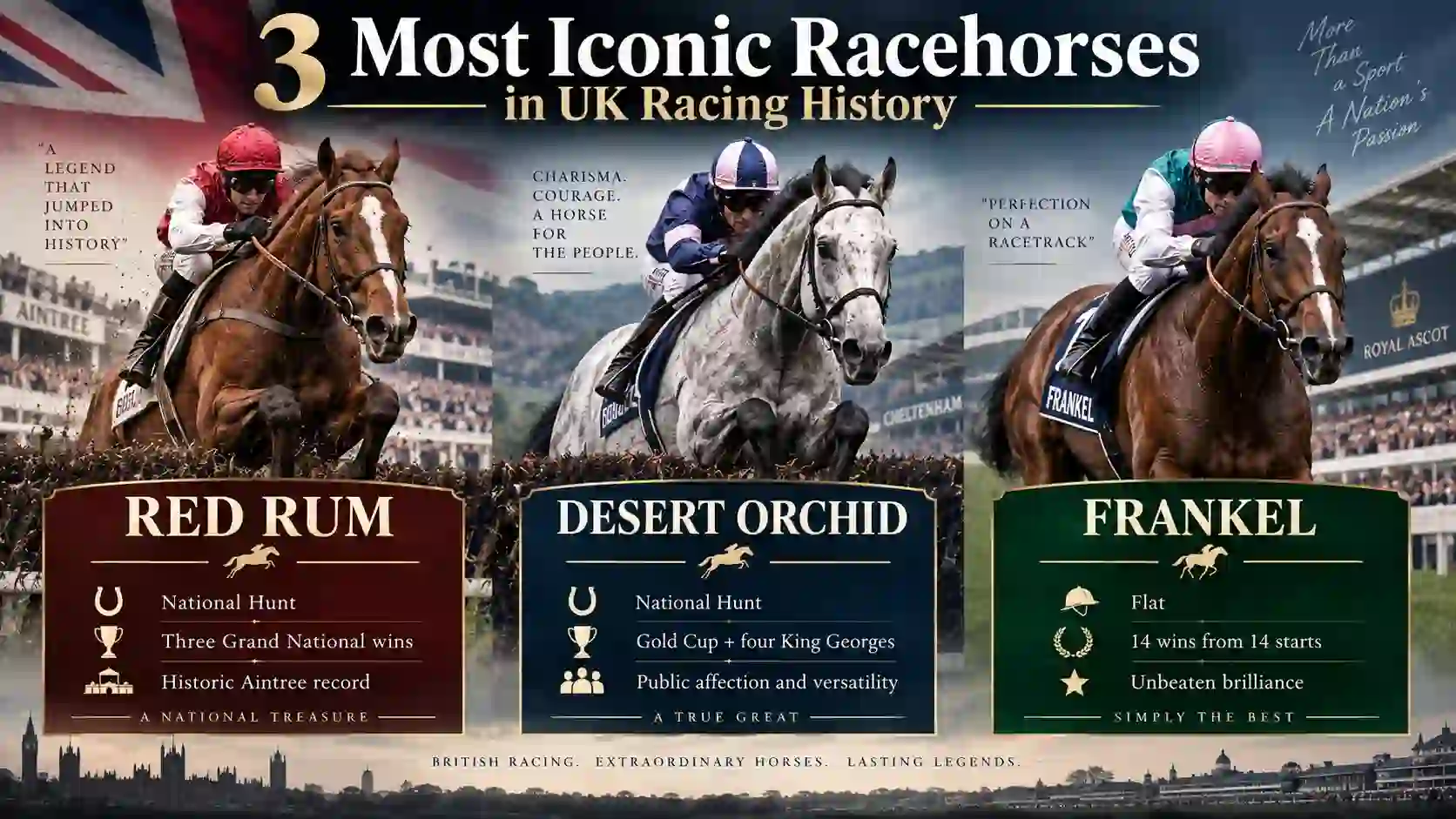
Red Rum became inseparable from the Grand National and remains the only horse to win the race three times. Desert Orchid, the unmistakable grey affectionately known as “Dessie”, became one of Britain’s great sporting celebrities during the 1980s and early 1990s. And Frankel produced a flawless 14-race career that established him as the highest-rated Flat horse in Timeform history.
These three legends competed in very different eras and disciplines, but they share the qualities that turn a champion racehorse into an icon: exceptional ability, unforgettable performances, public affection and a legacy that survives long after retirement.
How Were the Three Most Iconic British Racehorses Chosen?
There is no mathematical formula for deciding which horses are the most iconic. The fastest or highest-rated horse is not automatically the most culturally important.
For this list, four factors matter most: elite sporting achievement, historic significance, public popularity and lasting influence on British racing.
That approach also allows us to compare National Hunt horses with Flat champions. Red Rum’s greatness cannot sensibly be measured against Frankel simply by looking at speed figures, just as Desert Orchid’s extraordinary durability cannot be evaluated using the same standards as a Flat horse whose racing career lasted three seasons.
Instead, the question is simpler: which horses left British racing permanently different because they had existed?
On that basis, Red Rum, Desert Orchid and Frankel are difficult to overlook.
Red Rum — The Undisputed King of the Grand National
Few racehorses anywhere in the world have become as closely associated with one sporting event as Red Rum is with the Grand National.
Mention Aintree to an older generation of racing followers and it may be Red Rum rather than any jockey, trainer or modern winner who first comes to mind.
His record explains why.
Red Rum won the Grand National in 1973, 1974 and 1977, while finishing runner-up in both 1975 and 1976. More than half a century after his first victory, he remains the only horse to have won the Grand National three times.
That achievement becomes even more remarkable when considering how unusual his early career was.
From Five Furlongs to Aintree Immortality
Red Rum did not begin life looking like the ultimate long-distance steeplechaser.
The Jockey Club records that he began racing in five-furlong Flat races as a two-year-old and was even ridden by the legendary Lester Piggott. Eventually, however, Red Rum found the discipline in which his unusual blend of stamina, jumping ability and determination could make him immortal.
Under trainer Ginger McCain, he famously prepared on the sands at Southport.
Then came 1973.
The 1973 Grand National: Red Rum Versus Crisp
Red Rum’s first Grand National victory produced one of racing’s great sporting dramas.
Australian chaser Crisp, carrying top weight, established an enormous lead and at one stage appeared virtually uncatchable. Red Rum kept pursuing him.
The gap slowly disappeared.
Near the finish, Red Rum finally caught the exhausted leader and won by just three-quarters of a length. His winning time was a course record at the time.
The result was dramatic enough on its own, but history would transform it into the opening chapter of something much greater.
A year later, Red Rum returned to Aintree.
And won again.
The Remarkable 1974 Double
Defending the Grand National is difficult enough. Red Rum did it while carrying 12 stone, defeating L’Escargot by seven lengths.
Only three weeks later, he won the Scottish Grand National as well, completing a remarkable double. The Jockey Club notes that only a handful of horses in modern Grand National history have successfully carried 12 stone or more to victory at Aintree.
Red Rum appeared almost purpose-built for the unusual challenge of Aintree.
But his story was not finished.
He returned in 1975 and finished second to L’Escargot. In 1976, he was runner-up again, this time behind Rag Trade.
Five consecutive Grand Nationals would already have represented extraordinary longevity.
Then came 1977.
Red Rum’s Historic Third Grand National
Red Rum was 12 years old when he lined up for the 1977 Grand National carrying 11st 8lb, with Tommy Stack riding for Ginger McCain.
He won.
The victory created a record that has still never been equalled. The official Grand National roll of honour confirms his three victories in 1973, 1974 and 1977.
It was the perfect conclusion to one of British sport’s most compelling racing stories: champion, defending champion, twice runner-up and champion once again.
Why Red Rum Became More Than a Racehorse
Red Rum’s importance goes beyond statistics.
The Jockey Club itself describes him as “the horse that saved the Grand National”, reflecting the way his fame helped maintain public fascination with Aintree during a difficult period in the racecourse’s history.
His legacy remains physically embedded at Aintree. There is a Red Rum statue and Red Rum Garden at the racecourse, while his name remains inseparable from the world’s most famous steeplechase.
Other Grand National horses have achieved remarkable things. Tiger Roll came close to challenging Red Rum’s mythology by winning consecutive Nationals in 2018 and 2019.
But three victories?
That distinction still belongs to Red Rum.
Iconic achievement: Three Grand National victories
Grand National wins: 1973, 1974, 1977
Other National finishes: Second in 1975 and 1976
Why he is a legend: An unprecedented Aintree record and enormous cultural significance
Desert Orchid — The Grey Who Captured Britain’s Heart
If Red Rum became synonymous with Aintree, Desert Orchid became synonymous with racing itself for many British sports fans of the 1980s.
He was instantly recognisable.
Grey horses already stand out visually, but Desert Orchid also raced with a style that demanded attention. He was courageous, exuberant and frequently happiest attacking from the front.
Statistics show that he was much more than a popular personality.
Timeform records 70 career races and 34 victories, with major successes occurring at distances ranging from approximately two miles to beyond three and a half miles. His peak Timeform rating was 187.
That versatility was exceptional.
A Horse Who Could Win Almost Anywhere
Modern elite racehorses are often carefully targeted at particular distances and races.
Desert Orchid was different.
He contested top-class races at a variety of trips, sometimes carrying enormous weights in handicaps. He could operate as a fast two-mile chaser but could also stretch his stamina beyond three miles.
Among his most famous achievements were:
- Four victories in the King George VI Chase
- The 1989 Cheltenham Gold Cup
- The 1990 Irish Grand National
- Major handicap victories while conceding significant weight to his rivals
Timeform notes that Desert Orchid’s four King George wins were a record until Kauto Star eventually won the race five times.
But one afternoon defined his career above all others.
The 1989 Cheltenham Gold Cup
Desert Orchid’s relationship with Cheltenham had never been straightforward.
His best performances often came on right-handed racecourses such as Kempton, whereas Cheltenham is left-handed. The extremely testing ground for the 1989 Gold Cup seemed another serious disadvantage.
Snow and rain had produced heavy conditions.
Desert Orchid faced a gruelling test against horses expected to appreciate the ground more than he did.
Yet he kept fighting.
In the closing stages, Desert Orchid and Yahoo fought up the famous Cheltenham hill. The grey eventually prevailed by a length and a half, completing what became one of the defining victories of his career.
The Jockey Club calls Desert Orchid arguably the most popular Gold Cup winner, describing the extraordinary reaction when the nation’s favourite won in 1989.
There is another remarkable historical detail: Desert Orchid remains the only grey winner of the Cheltenham Gold Cup.
His Weight-Carrying Performances Added to the Legend
The Gold Cup may be Desert Orchid’s most emotional victory, but racing professionals often point to other performances when discussing just how talented he was.
In 1990, he carried 12st 3lb in the Racing Post Chase at Kempton while conceding two stone to runner-up Delius. He still won by eight lengths.
Timeform raised him to a rating of 187 following that performance.
That type of achievement explains why Desert Orchid’s reputation rests on more than nostalgia. His popularity was enormous, but underneath it was a genuinely elite racehorse.
Four King George Victories
Kempton became Desert Orchid’s stage.
He won his first King George VI Chase in 1986 by 15 lengths on his first attempt at three miles. Further victories followed, culminating in an unprecedented fourth success in 1990.
By then he was approaching 12 years old.
Crowds had followed him for years, and his Boxing Day appearances became part of British racing culture. Timeform recalls that Desert Orchid continued to appear at Kempton after retirement, parading before fans at King George meetings. His ashes were eventually scattered at the racecourse.
A statue at Kempton and the race now known as the Desert Orchid Chase further preserve his legacy.
Why Desert Orchid Remains an Icon
Desert Orchid gave racing something that cannot be manufactured: personality.
Fans knew what he looked like instantly. They understood his preferred style. They followed him across multiple seasons. And because he raced 70 times, the public had repeated opportunities to develop an attachment to him.
Frankel inspired awe.
Red Rum inspired fascination.
Desert Orchid inspired affection.
That distinction is important when discussing Britain’s most iconic racehorses.
Career starts: 70
Career wins: 34
King George VI Chase wins: Four
Cheltenham Gold Cup: 1989
Other major achievement: 1990 Irish Grand National
Why he is a legend: Durability, versatility, spectacular racing style and extraordinary public popularity
Frankel — The Unbeaten Flat Racing Phenomenon
Red Rum and Desert Orchid became icons partly because of their longevity.
Frankel achieved immortality in a completely different way.
He simply never lost.
Fourteen races.
Fourteen victories.
Ten Group 1 wins.
And at the end of it all, there was still no definitive evidence that racing fans had ever seen the limit of his ability.
Juddmonte confirms that Frankel retired unbeaten after 14 starts, including 10 Group 1 victories, having been trained throughout his career by Sir Henry Cecil.
Timeform rates him 147, the highest figure it has ever awarded to a Flat racehorse.
That combination gives Frankel one of the strongest claims to being the greatest Flat horse Britain has ever seen.
The 2011 2,000 Guineas Changed Everything
Frankel had already established himself as an exceptional juvenile, ending his two-year-old campaign by winning the Dewhurst Stakes.
His three-year-old season, however, elevated him into another category.
In the 2011 2,000 Guineas at Newmarket, Frankel attacked from the front at a pace that looked almost impossible to sustain.
Instead of weakening, he kept going.
He won the Classic by six lengths.
Juddmonte describes it as one of the outstanding displays ever produced on a British racecourse, while Timeform placed the performance among the elite Guineas efforts in its history.
Frankel went on to win the St James’s Palace Stakes, Sussex Stakes and Queen Elizabeth II Stakes during the same campaign.
But remarkably, the best was still to come.
Frankel’s 2012 Queen Anne Stakes Masterpiece
The performance most frequently used to demonstrate Frankel’s superiority came at Royal Ascot in June 2012.
Facing high-class opposition in the Queen Anne Stakes, Frankel accelerated away from his rivals and won by 11 lengths.
The performance earned a Timeform rating of 147, the highest Flat rating in the organisation’s history.
To understand the significance, consider the company below him.
Timeform’s historical list places Frankel’s 147 ahead of horses such as Sea-Bird on 145, Brigadier Gerard and Tudor Minstrel on 144, and Mill Reef on 141.
Ratings inevitably generate debate across generations, but Frankel’s position at the top of that particular system is unequivocal.
He Was More Than a Brilliant Miler
One question remained during the first part of Frankel’s career: could he reproduce his dominance over longer distances?
In August 2012, he answered it decisively in the Juddmonte International at York.
Stepping up to an extended mile and a quarter, Frankel defeated a Group 1-class field by seven lengths.
His presence itself became a sporting event. Juddmonte reports that 30,163 spectators attended the opening day of York’s Ebor Festival that year, 55% higher than the equivalent day in 2011.
That statistic tells us something ratings cannot.
Frankel had become box office.
People were travelling specifically to see him because every appearance might become part of racing history.
The Perfect Farewell at Ascot
Frankel’s final appearance came in the 2012 Champion Stakes at Ascot.
The ground was softer than ideal. He was stepping out at ten furlongs again. His opponents included high-class horses Cirrus Des Aigles and Nathaniel.
Frankel still won.
He retired with his perfect record intact: 14 races, 14 wins.
His full résumé included the 2,000 Guineas, two Sussex Stakes, Queen Anne Stakes, Queen Elizabeth II Stakes, Juddmonte International and Champion Stakes among his ten Group 1 victories.
He was also named Cartier Horse of the Year in both 2011 and 2012. In 2021, Frankel became the first horse inducted into the British Champions Series Hall of Fame.
Why Frankel Is a British Racing Icon
Frankel’s appeal was built on anticipation.
Every race raised the same question: surely somebody would eventually test him?
Instead, his winning margins and performances often became more impressive.
He gave British Flat racing a genuine sporting superstar at a time when television and digital media could carry performances around the world almost instantly.
And unlike many champions whose reputations depend on arguments about what might have happened under different circumstances, Frankel’s career contains one beautifully simple statistic:
He was never beaten.
Career record: 14 starts, 14 wins
Group 1 victories: 10
Peak Timeform rating: 147
Trainer: Sir Henry Cecil
Major victories: 2,000 Guineas, Queen Anne Stakes, two Sussex Stakes, Juddmonte International, Champion Stakes and more
Why he is a legend: Perfect record combined with historically exceptional ratings and dominant performances
Red Rum vs Desert Orchid vs Frankel: Who Was the Greatest?
Comparing the three directly is almost impossible because they represented different disciplines and eras.
| Racehorse | Discipline | Defining Achievement | Iconic Quality |
| Red Rum | National Hunt | Three Grand National wins | Historic Aintree record |
| Desert Orchid | National Hunt | Gold Cup + four King Georges | Public affection and versatility |
| Frankel | Flat | 14 wins from 14 starts | Unbeaten brilliance |
If the question is who achieved the most remarkable record at one famous race, Red Rum is the obvious answer.
If the question is which horse became one of Britain’s most beloved sporting personalities, Desert Orchid has an exceptional claim.
If the question is which produced the highest measurable level of Flat-racing performance, Frankel’s Timeform record puts him on top.
That is precisely why all three deserve inclusion.
Other Legendary British Racehorses Worth Remembering
Restricting a list to three inevitably means leaving out extraordinary champions.
Arkle dominated steeplechasing during the 1960s and won three consecutive Cheltenham Gold Cups. The Jockey Club describes him as, for many observers, the greatest Gold Cup horse of them all.
Brigadier Gerard remains one of Britain’s most celebrated Flat champions and sits among the highest-rated horses in Timeform history.
Nijinsky became the last horse to complete the traditional British Triple Crown of the 2,000 Guineas, Derby and St Leger.
Dancing Brave produced one of the great modern European campaigns.
Sea The Stars won six consecutive Group 1 races during an extraordinary 2009 season, including the 2,000 Guineas, Derby, Eclipse, Juddmonte International, Irish Champion Stakes and Prix de l’Arc de Triomphe.
And among National Hunt stars, Kauto Star deserves special recognition for eventually surpassing Desert Orchid’s King George record by winning the race five times.
The depth of those alternatives demonstrates just how rich British racing history is.
FAQs
What is the most famous racehorse in UK history?
Red Rum arguably has the strongest claim to being Britain’s most famous racehorse because of his unparalleled association with the Grand National. He won the race three times and finished second twice, a record that remains unique.
Which British racehorse was unbeaten?
Frankel completed his racing career unbeaten, winning all 14 of his starts, including ten Group 1 races.
What is Frankel’s Timeform rating?
Frankel received a Timeform rating of 147, the highest awarded to a Flat horse in Timeform’s history.
How many times did Red Rum win the Grand National?
Red Rum won the Grand National three times: 1973, 1974 and 1977. He was also second in 1975 and 1976.
How many King George VI Chases did Desert Orchid win?
Desert Orchid won the King George VI Chase four times. His record was subsequently surpassed by Kauto Star, who won five.
Did Desert Orchid win the Cheltenham Gold Cup?
Yes. Desert Orchid won the 1989 Cheltenham Gold Cup, defeating Yahoo in testing conditions. He remains the only grey horse to have won the Gold Cup.
Final Thoughts
The greatest racehorses do more than collect trophies. They give racing moments that survive for generations.
Red Rum gave Britain one of sport’s most extraordinary comeback stories and built a relationship with the Grand National that remains unmatched. Three victories and two second-place finishes across five consecutive Nationals turned him from a successful racehorse into part of Aintree’s identity.
Desert Orchid demonstrated that greatness could be combined with longevity and personality. His bold racing style, brilliant grey coat, four King George victories and unforgettable 1989 Cheltenham Gold Cup made him a favourite far beyond racing’s most committed followers.
Then came Frankel, whose story was based not on overcoming defeat but on avoiding it entirely. Across three seasons and 14 starts, no rival could beat him. His performances culminated in the highest Flat rating Timeform has ever awarded, making him the benchmark against which subsequent generations continue to be judged.
Arguments about the most iconic racehorses in UK racing history will never have a universally accepted answer—and that is part of their appeal. Arkle, Kauto Star, Sea The Stars, Brigadier Gerard and others all belong in the wider conversation.
But for record-breaking achievement, public impact and enduring fame, Red Rum, Desert Orchid and Frankel represent three distinct eras of British racing greatness.
ADVERTISEMENT

18+ | Affiliate link | Terms apply | Please gamble responsibly.


