

18+ | Affiliate link | Terms apply | Please gamble responsibly.
Last Updated on October 6, 2026 by Maurya
Gambling is built around a simple but powerful attraction: the possibility of turning a relatively small amount of money into something much larger.
People do win. Casino jackpots are real. Sports bettors occasionally produce impressive winning streaks. Lottery tickets sometimes transform lives overnight.
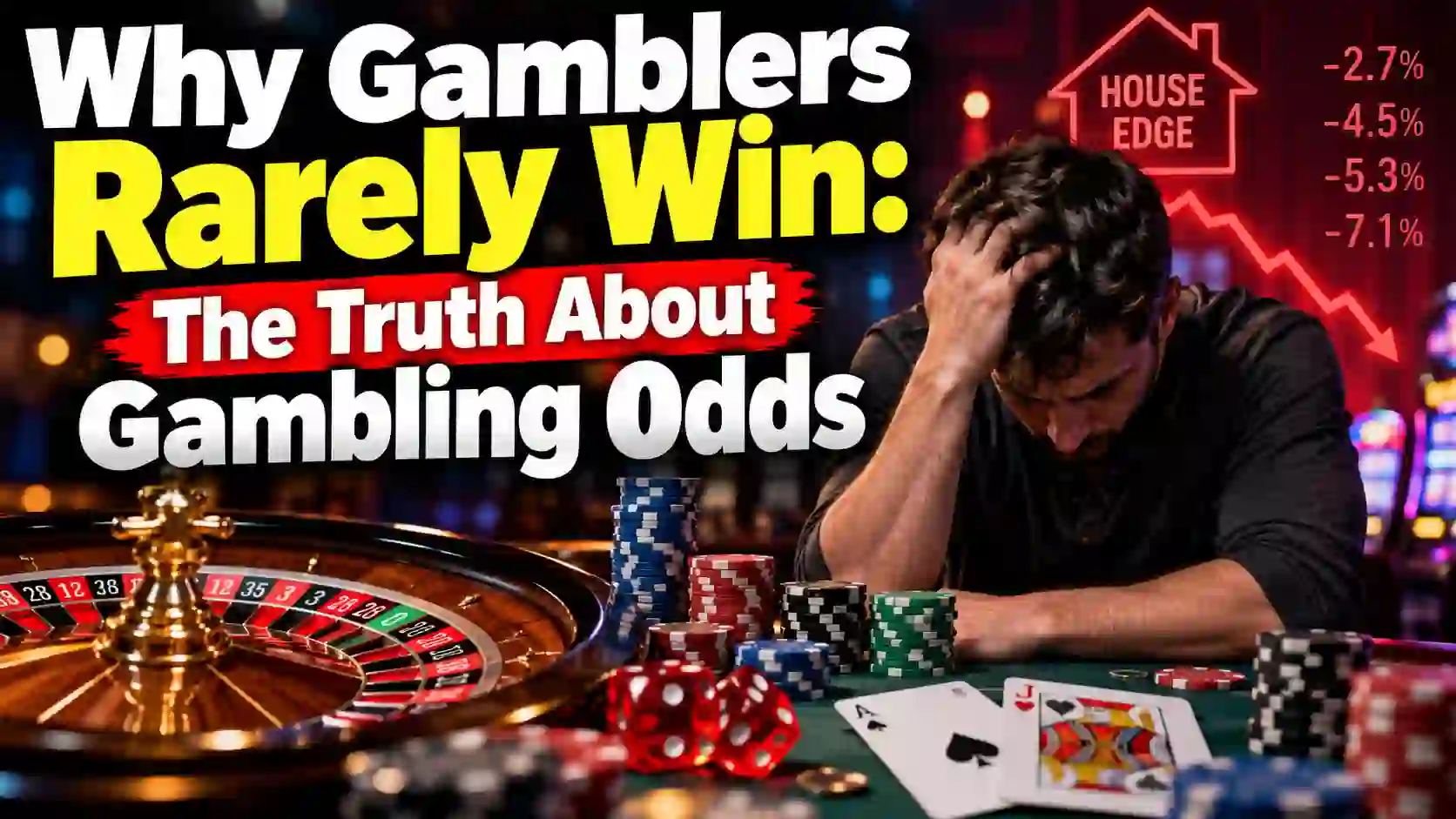
But those highly visible winners can hide an uncomfortable mathematical reality: most forms of commercial gambling are designed so that the average customer loses money over time.
This does not mean every gambler loses every session. Someone can enter a casino with $100 and leave with $1,000. A bettor can correctly predict five football matches in a row. A slot player can hit a jackpot within minutes.
The important distinction is between winning in the short term and having a positive mathematical expectation over the long term.
Casinos, bookmakers and lottery operators do not generally need to predict which individual will win tonight. Their advantage comes from something far more reliable: probability.
Once you understand house edge, expected value, return to player, variance and the psychology surrounding random outcomes, it becomes much easier to understand why gamblers rarely remain profitable over long periods.
The House Does Not Need to Win Every Bet
One of the most misunderstood sayings in gambling is:
“The house always wins.”
Taken literally, that is false.
Casinos pay winners every day. If nobody ever won, gambling would quickly become unattractive.
What the saying actually describes is a long-term mathematical advantage.
The UK Gambling Commission explains that casino games such as roulette and blackjack are games of unequal chance in which the rules create an advantage for the casino. This advantage is known as the house edge.
The casino therefore does not require every customer to lose.
It needs thousands or millions of wagers to be placed under rules that, collectively, favour the operator.
Imagine a game in which the casino has an average advantage of 5%. A player could still double their money during one lucky session. Another could win ten bets consecutively.
But as the number of wagers becomes very large, the mathematical advantage becomes increasingly important.
That is one reason casinos can operate enormous properties, employ thousands of people, offer promotions and still remain profitable businesses. They are not relying primarily on luck themselves. They are operating games with built-in mathematical margins.
What Do Gambling Odds Actually Mean?
Odds describe the relationship between the probability of an outcome and the potential reward offered for taking that risk.
But several related concepts are frequently confused.
| Concept | Meaning | Why It Matters |
| Probability | The likelihood that an event occurs | Determines the true chance of winning |
| Odds | A representation of that probability, often linked to a payout | Shows what a winning bet may return |
| House edge | The operator’s average mathematical advantage | Creates expected losses for players |
| RTP | The theoretical percentage returned to players over a very large number of plays | Does not guarantee what happens in one session |
| Variance | How widely short-term results can fluctuate | Explains large wins and losses despite long-term averages |
| Expected value | The average mathematical result of repeating a wager many times | Reveals whether a bet is favourable or unfavourable |
Expected value, often shortened to EV, is particularly important.
A negative expected value does not mean you must lose a particular wager.
It means that if the same type of wager could be repeated a sufficiently large number of times under identical conditions, the average financial result would be negative.
Most commercial casino games have negative expected value for the player.
The House Edge: The Mathematics Behind Casino Profits
Roulette provides a straightforward example of how a house edge is created.
Consider traditional American roulette.
The wheel contains 38 pockets: numbers 1 through 36, plus 0 and 00. Eighteen regular numbers are red and 18 are black, while 0 and 00 are green.
A bet on red generally pays 1:1.
At first glance, that may look like a 50-50 wager.
But it is not.
There are 18 winning red outcomes and 20 losing outcomes because both green pockets also cause the red bet to lose.
The probability of winning is therefore:
18 ÷ 38 = approximately 47.37%
The probability of losing is:
20 ÷ 38 = approximately 52.63%
Because the payout treats the bet as though the chance were 50%, the difference creates a house edge of approximately 5.26%.
The casino does not know where the ball will land on an individual spin. It does not have to.
The rules themselves provide the advantage.
European single-zero roulette illustrates the same principle. With 37 pockets instead of 38, a conventional even-money bet has a house edge of approximately 2.70%.
A player can still experience an extraordinary winning streak on either wheel. But repeating a negative-expectation wager exposes more money to the mathematical disadvantage.
RTP Does Not Mean You Get That Percentage Back
Slot machines and other electronic gambling products frequently display something called Return to Player, or RTP.
Suppose a game advertises an RTP of 96%.
A common misunderstanding is that betting $100 means the player should eventually receive $96 back.
That is not how RTP works.
The UK Gambling Commission states that RTP represents an average achieved over a significant number of game plays. It specifically warns that a player should not expect to receive the advertised RTP during an individual gambling session.
A theoretical 96% RTP corresponds to a theoretical 4% house advantage before considering other factors.
Over an enormous number of wagers, a game designed around those figures may move towards its theoretical return.
Your personal session can look completely different.
You might wager $100 and lose all of it.
You might wager $100 and finish with $300.
Neither result disproves the RTP.
This is where variance enters the picture.
Variance allows short-term outcomes to move dramatically above or below their mathematical average. It creates the possibility of jackpots and winning streaks while still allowing the operator to maintain an advantage across huge volumes of play.
Why More Gambling Usually Helps the House, Not the Player
Someone who has just lost several bets may think:
“I’ve been losing all night, so eventually I have to win.”
This sounds intuitive. In many independent games of chance, however, previous results do not improve the probability of the next result.
The UK Gambling Commission notes that on random gaming machines, the odds of winning the current game remain constant and are not affected by previous wins or losses.
Regulated random-number systems are also required to produce sufficiently random and unpredictable outcomes. UK technical standards, for example, require qualifying random-number generators to demonstrate randomness and unpredictability through accepted testing methods.
Consider a fair coin.
After five consecutive heads, many people instinctively feel tails is “due.”
Yet the probability of tails on the next independent flip remains 50%.
Five heads in the past do not create a memory inside the coin.
The same misunderstanding can affect gambling behaviour.
If a player continues wagering because they believe previous losses make an upcoming victory more likely, they may simply expose additional money to the same negative expected value.
The Gambler’s Fallacy: Why Randomness Feels Predictable
The belief that a random outcome becomes more likely because the opposite outcome has occurred repeatedly is known as the gambler’s fallacy.
Imagine a roulette wheel landing on black seven times consecutively.
Some players will conclude that red must now be unusually likely.
Others may reach the opposite conclusion and assume black is on an unstoppable “hot streak.”
Neither belief changes the structure of the next independent spin.
Humans naturally search for patterns. This ability is extremely useful in many areas of life—but random sequences can produce clusters, streaks and unusual-looking patterns entirely by chance.
That can make genuinely random behaviour feel non-random.
Research into gambling cognition has identified distorted beliefs including the gambler’s fallacy, superstitions, perceived predictive control and the illusion that players can exert greater influence over chance-based outcomes than they really can.
This psychological element is one reason understanding gambling odds involves more than learning percentages.
Players must also understand how their own minds interpret those percentages.
Why “Almost Winning” Is Still Losing
Another powerful psychological feature of gambling is the near miss.
Picture a slot machine displaying two jackpot symbols, with the third appearing just above the winning line.
Emotionally, that result can feel very different from a screen full of unrelated symbols.
Mathematically, however, both outcomes can have exactly the same financial result: a loss.
Research published in Neuron found that near-miss gambling outcomes could increase participants’ desire to continue playing and activate some brain circuitry also involved in monetary wins, despite providing no monetary reward.
The important lesson is that closeness does not necessarily have mathematical meaning in a game of chance.
A lottery ticket missing the jackpot by one number does not automatically make your next ticket more likely to win.
A roulette ball landing beside your chosen number does not mean your number is becoming “hot.”
A slot reel appearing to stop just short of a jackpot does not mean a jackpot is approaching.
A near miss may feel informative even when it tells you nothing useful about the next random outcome.
Sports Betting Has a House Edge Too
Casino games are not the only form of gambling structured around a margin.
Bookmakers can build their advantage directly into the odds they offer.
Consider a hypothetical sporting event in which two outcomes are genuinely equally likely.
True fair decimal odds for each side would be 2.00, representing an implied probability of 50%.
A bookmaker might instead offer:
Team A: 1.90
Team B: 1.90
An implied probability can be estimated using:
1 ÷ decimal odds
At odds of 1.90, each side represents approximately 52.63%.
Add them together:
52.63% + 52.63% = 105.26%
That amount above 100% represents the bookmaker’s built-in margin, often called the overround or vig.
Real betting markets are more complicated because actual probabilities are uncertain, odds move, and bookmakers manage different risks. Nevertheless, the fundamental idea remains: the price offered to a bettor can contain a margin benefiting the operator.
Simply being knowledgeable about a sport therefore does not automatically make someone profitable.
A successful bettor would have to make predictions accurately enough to overcome both uncertainty and the bookmaker’s pricing margin over a meaningful sample.
That is significantly harder than occasionally predicting the correct winner.
Lottery Jackpots Show the Difference Between “Possible” and “Probable”
Lotteries are perhaps the clearest demonstration of how humans can confuse enormous rewards with reasonable probabilities.
Winning a major jackpot is unquestionably possible.
But possible does not mean likely.
Powerball states that the odds of winning its jackpot are approximately 1 in 292.2 million, while the overall chance of winning any prize is much shorter at about 1 in 24.9.
Under the current Mega Millions structure, the official game reports jackpot odds of 1 in 290,472,336 and overall odds of any prize of approximately 1 in 23.
Those numbers illustrate why headlines can be deceptive.
Millions of people may buy tickets, which makes it unsurprising that somebody eventually wins. From the perspective of one individual ticket holder, however, the jackpot remains extraordinarily improbable.
The visibility of winners can also distort perception.
We see photographs of people holding giant cheques. We rarely see millions of photographs representing losing tickets purchased during the same period.
The winner is newsworthy precisely because the event is unusual.
Why Winning Streaks Can Be Misleading
One of gambling’s most persuasive experiences is winning early.
Suppose someone deposits $200 and quickly turns it into $800.
They may conclude that they are naturally talented, have discovered a reliable strategy or understand the game better than other players.
Perhaps skill really was involved.
But in a game dominated by chance, a small sample tells us very little.
Negative-expectation games must produce some winners in the short term. Without winning sessions, there would be far less incentive to participate.
Variance ensures that results do not arrive in a smooth line.
A game with a long-term mathematical disadvantage can still produce spectacular short-term profits.
The danger comes when a temporary winner interprets variance as evidence of a permanent edge and dramatically increases their wagering.
A useful question is not simply, “Did I win?”
It is:
“Would this decision be expected to make money if it were repeated thousands of times under the same conditions?”
That is a much harder test.
Can Professional Gamblers Actually Win?
Yes—but this does not contradict the mathematics described above.
Some gambling activities include substantial elements of skill. Professional poker players, for example, compete primarily against other players while a casino or platform takes a fee. A sufficiently skilled player may outperform weaker opponents.
Certain sports bettors also attempt to identify odds that underestimate the true probability of an outcome.
However, the existence of a small number of successful professionals does not make gambling generally profitable.
A professional seeking a genuine advantage needs to distinguish skill from luck, overcome transaction costs and operator margins, control risk, maintain discipline and demonstrate an edge over a large enough sample that random variance becomes less convincing as an explanation.
Casinos can also restrict certain forms of advantage play or change commercial conditions within applicable rules.
For the ordinary consumer, stories about professional gamblers should therefore not be interpreted as evidence that a conventional negative-expectation casino game can be transformed into a reliable income source simply through confidence, persistence or a betting system.
Why Betting Systems Cannot Eliminate a Mathematical Disadvantage
Systems such as doubling stakes after a loss can appear impressive on paper because they produce many small winning sequences.
But changing the size of a bet does not automatically change its underlying probability.
If a wager has negative expected value, increasing the amount risked after losing usually changes the distribution and size of potential losses—not the fundamental house advantage.
Betting systems also encounter practical constraints such as limited bankrolls and maximum betting limits.
A strategy that appears to produce frequent small gains while carrying a small probability of a devastating loss may still have negative expected value.
Money management can affect how quickly someone loses or how much volatility they experience.
It cannot, by itself, convert unfair odds into fair ones.
Chasing Losses Makes the Mathematics More Dangerous
After losing money, people may feel a powerful urge to recover it immediately.
This is known as chasing losses.
The problem is that the gambling game does not know how much you have already lost.
If the next wager still carries a house advantage, increasing the stake because of previous losses does not erase that disadvantage.
Instead, the player places more capital at risk while potentially making decisions under emotional pressure.
For people who feel unable to stop, chasing losses can become more than a mathematical issue. It can become a serious financial and health problem.
The World Health Organization notes that gambling-related harms can include financial distress, relationship breakdown and mental-health consequences, and estimates that approximately 1.2% of the world’s adult population experiences gambling disorder.
In the UK, GamCare advises people who have lost money, chased losses or feel out of control to step away from gambling and create distance from the urge to continue.
So Why Do People Keep Gambling If the Odds Are Against Them?
Because gambling is not experienced as a spreadsheet.
It combines uncertainty, excitement, entertainment, anticipation and the possibility—however small—of an unusually large reward.
People may also remember wins more vividly than routine losses. Near misses can feel significant. Winning streaks may create confidence. Losing streaks can generate a desire to recover money.
None of these reactions requires someone to be unintelligent.
Probability is often counterintuitive.
What matters is recognising the difference between the emotional experience of gambling and its mathematical structure.
A game can be exciting and still have negative expected value.
A player can be lucky today and still face unfavourable odds in the long run.
Both statements can be true simultaneously.
Gambling Is Entertainment, Not an Investment Strategy
The most useful way to understand conventional gambling is as paid entertainment with financial risk attached.
An investment is generally purchased because the owner expects an asset, business or income-producing activity to create economic value over time.
Most commercial gambling wagers work differently.
The player is accepting an uncertain outcome under conditions that commonly include a mathematical margin for the operator.
That distinction matters.
Someone who chooses to gamble should not assume that persistence guarantees recovery, that losing streaks make wins “due,” or that previous success proves future profitability.
No betting pattern can make a random independent outcome remember what happened before it.
And no exciting jackpot changes the underlying probability simply because the prize is large.
FAQs
Why do gamblers usually lose in the long run?
Most commercial gambling games contain a house edge or operator margin. Individual players can win over short periods, but repeated exposure to negative expected value generally favours the operator over a sufficiently large number of wagers.
Does the casino win every time?
No. Individual gamblers regularly win individual bets and entire sessions. “The house always wins” refers to the casino’s statistical advantage across large numbers of wagers rather than every customer losing every time.
Does a 96% RTP mean I will get £96 back from every £100?
No. RTP is a theoretical long-run average calculated over a very large number of plays. Your personal results during a single session can be dramatically higher or lower. The UK Gambling Commission specifically cautions against interpreting RTP as a guaranteed session return.
Are slot machines more likely to pay after a long losing streak?
On genuinely random games, previous outcomes do not make the next win “due.” UK Gambling Commission guidance explains that the chance of a win on a random gaming machine is not changed by earlier wins or losses.
Can a betting strategy beat the house edge?
Changing bet sizes can change volatility and the pattern of wins and losses, but it does not automatically change the expected value of the underlying wager. A negative-expectation bet remains mathematically unfavourable unless something changes the actual probabilities, payout or pricing.
Can skilled gamblers make money?
A minority may achieve positive results in activities where skill, opponent quality or inaccurate market pricing can create an advantage. That is fundamentally different from assuming that persistence can overcome a fixed house edge in a game of chance.
Why does a near miss feel like I was close to winning?
Near misses can create a strong psychological response even when they carry no useful information about the next random result. Laboratory research has found that near-miss outcomes can increase motivation to continue gambling despite being losses.
What are the odds of winning a major lottery jackpot?
They vary by game. As examples, Powerball reports jackpot odds of about 1 in 292.2 million, while the current Mega Millions game reports odds of 1 in 290,472,336.
Final Thoughts
The reason gamblers rarely remain winners over the long term is not that casinos possess supernatural luck or know the outcome of every game.
The explanation is mathematics.
Most commercial gambling products are structured so that the operator has an advantage. Randomness then creates enough short-term variation for some players to experience memorable wins—sometimes enormous ones—while the mathematical edge operates across the much larger volume of total wagers.
That distinction is the key to understanding gambling odds.
Winning is possible. Consistently overcoming negative expected value is something entirely different.
The house does not need every spin, hand, ticket or bet to lose.
It needs the underlying mathematics to remain in its favour while enough bets are placed.
Understanding that reality does not require believing that nobody ever wins. It simply requires separating possibility from probability, short-term luck from long-term expectation, and entertainment from a reliable way of making money.
For anyone who chooses to gamble, that may be the most important calculation of all.
Responsible Gambling : Gambling involves financial risk and should not be treated as a guaranteed method of earning money. If gambling is causing financial, emotional or personal harm, consider stopping and seeking confidential support from an appropriate gambling-support service in your country.
ADVERTISEMENT

18+ | Affiliate link | Terms apply | Please gamble responsibly.


