

18+ | Affiliate link | Terms apply | Please gamble responsibly.
Last Updated on October 19, 2026 by Maurya
Online poker sounds like the perfect solution for anyone who loves card games. You can join a Texas Hold’em table from your sofa, compete against players worldwide, and enjoy poker without visiting a physical casino. There is no need to travel, wait for a dealer, or follow a casino dress code.
So why do so many players complain about online poker?
The answer goes beyond losing money or getting unlucky cards.
Although online poker offers convenience, accessibility, and competitive gameplay, it also introduces frustrations that are less noticeable in traditional poker rooms. Bad beats, poker bots, aggressive opponents, high rake, technical problems, and concerns about game fairness can make the experience frustrating.
Some players believe online poker is rigged. Others dislike the lack of personal interaction or feel that modern games have become too competitive.
However, not every complaint indicates cheating or unfair software. Poker naturally involves uncertainty, and even experienced players can suffer extended losing streaks.
Understanding the difference between normal poker variance and genuine platform-related problems is essential.
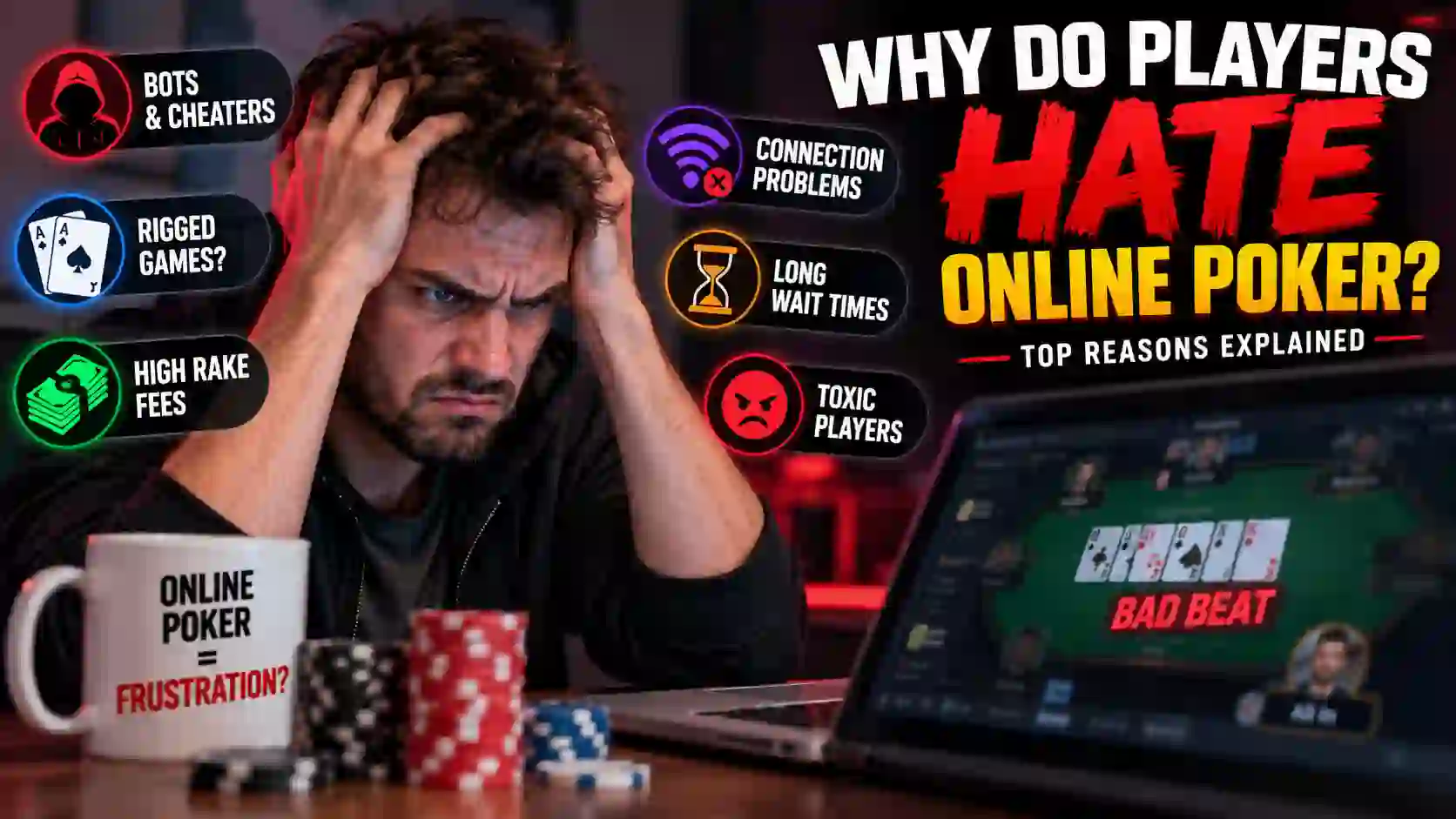
Why Do Players Hate Online Poker?
Players often dislike online poker because of frequent bad beats, unpredictable short-term results, difficult opponents, poker bots, collusion concerns, high rake fees, and limited face-to-face interaction.
Technical disconnections, withdrawal delays, and the emotional pressure of rapid gameplay can also contribute to negative experiences.
The biggest frustrations generally fall into three categories: gameplay difficulties, trust and security concerns, and problems with the overall player experience.
While reputable poker platforms use security systems and game-integrity controls, no online gambling environment is completely free from risks or potential disputes.
Let’s examine the most common reasons in detail.
- Bad Beats Make Online Poker Feel Unfair
One of the biggest reasons players hate online poker is the frequency of bad beats.
A bad beat happens when a player with a statistically strong hand loses to an opponent who draws a better hand against the odds.
Imagine holding pocket aces in Texas Hold’em. You raise before the flop, receive a call from an opponent with a weaker hand, and eventually lose when the opponent completes an unlikely straight or flush.
Losing such a hand can be frustrating, especially when a significant amount of money is involved.
The frustration becomes even stronger when similar situations happen repeatedly.
Why do bad beats seem more common online?
Online poker generally allows players to see more hands per hour than traditional live poker. Some platforms also support playing multiple tables simultaneously.
As a result, players experience more situations in which unlikely outcomes can occur.
Someone playing hundreds of hands online may encounter several memorable bad beats in a single session. A live poker player participating in far fewer hands may experience such situations less frequently during the same period.
The faster pace creates the impression that unusual outcomes happen constantly.
However, more bad beats do not automatically mean the cards are manipulated.
Poker is a game involving both skill and chance. Even a strong decision can produce an unfavorable result.
A peer-reviewed study published in PLOS ONE analyzed approximately 456 million player-hand observations. The research found evidence that skill influences long-term performance, while chance remains important over shorter periods.
The lesson is simple: making the correct decision does not guarantee winning an individual hand.
- Online Poker Has Become Extremely Competitive
Another common complaint is that online poker feels much harder than it once did.
Many recreational players join poker tables hoping to relax, test their skills, and enjoy some friendly competition.
Instead, they may face opponents who have spent years studying poker strategy.
Modern poker players can access educational material covering advanced concepts such as:
- Game Theory Optimal (GTO) strategy
- Pot odds and expected value
- Preflop ranges
- Position-based decision-making
- Bet sizing and bluff frequencies
- Opponent tendencies and hand analysis
Studying poker strategy is legitimate. However, the growing availability of advanced educational resources can make certain online games challenging for casual players.
Why is online poker harder than live poker?
Live poker often includes more conversation, slower gameplay, and a wider variety of recreational motivations.
Online players may focus more intensely on strategy, particularly at competitive stakes.
A player who occasionally enjoys a friendly home game might struggle against experienced online opponents who carefully analyze betting patterns.
This skill gap can create an unpleasant experience.
Instead of enjoying the game, beginners may feel that every decision requires complex mathematical calculations.
It is important to note that difficulty varies significantly depending on the platform, stakes, game format, and player pool.
Not every online table is filled with professionals. Nevertheless, facing opponents with stronger technical knowledge remains a major source of frustration.
- Poker Bots and AI Tools Create Trust Issues
Poker bots represent one of the most serious concerns surrounding online poker.
A poker bot is software designed to play poker automatically or assist a player in making decisions.
Some bots can evaluate available information, follow programmed strategies, and perform betting actions without normal human decision-making.
This creates understandable concerns about fairness.
Players expect to compete against other people, not automated systems operating without the same limitations.
How does AI affect online poker?
Artificial intelligence has introduced additional challenges for online poker platforms.
One particularly controversial category is Real-Time Assistance (RTA).
RTA involves software or services that provide strategic recommendations while a hand is being played.
For example, a player might receive advice about whether to call, raise, or fold based on the current situation.
This is different from studying poker strategy away from the table.
PokerStars explicitly prohibits automated bots and tools that provide prohibited real-time advice, as explained in its third-party software policy.
Its game-integrity team also describes methods used to investigate suspicious accounts and prohibited assistance.
Nevertheless, anti-cheating systems cannot justify assuming that every suspicious opponent is cheating—or that every possible violation is detected immediately.
The uncertainty itself can damage player confidence.
For many users, knowing that bots are a possible threat is enough to make online poker less enjoyable.
- Collusion and Multi-Accounting Raise Fairness Concerns
Poker is meant to be a competition in which players make independent decisions.
Collusion undermines that principle.
Online poker collusion occurs when two or more players secretly cooperate to gain an unfair advantage over others.
For example, players might share information about their cards, coordinate their betting decisions, or deliberately transfer chips between accounts.
Another concern is multi-accounting, where one person improperly operates multiple accounts or competes using more than one identity in circumstances prohibited by platform rules.
These activities can harm legitimate participants.
Why is collusion difficult for players to identify?
At a physical poker table, suspicious communication or unusual coordination may sometimes be visible.
Online, players cannot easily observe what their opponents are doing away from the game.
Two accounts might be controlled by people communicating privately through an external application.
This makes individual players more dependent on the platform’s ability to monitor suspicious behavior.
The UK Gambling Commission’s technical standard RTS 11 requires relevant operators to implement measures that deter, prevent, and detect cheating and collusion.
These requirements demonstrate that cheating prevention is a recognized regulatory concern.
They do not, however, establish how frequently collusion occurs on every poker platform.
Players should report suspicious patterns rather than assuming that unusual betting decisions are proof of cheating.
- High Rake Fees Reduce Players’ Returns
Even when the games are fair, online poker can become expensive because of rake.
Rake is the fee a poker operator charges for hosting a game.
In cash games, the operator commonly takes a percentage of eligible pots, subject to rules and maximum limits.
Tournament fees are typically included in the total amount paid to enter an event.
According to PokerStars’ rake explanation, cash-game fees vary based on factors such as stakes, game type, and the number of players.
Why do players complain about poker rake?
Rake reduces the money available for players to win collectively.
Consider a simplified example.
If a poker room charges 5% on an eligible $100 pot, the fee would be $5 before applying any relevant cap or special rule.
That may seem small for one hand.
However, fees can accumulate over many sessions.
A player who performs reasonably well against opponents might still lose money overall after accounting for rake.
This is especially frustrating for recreational players who already face strong competition.
High rake can also make marginally profitable strategies unprofitable.
For this reason, understanding the actual fee structure is essential before joining cash games or tournaments.
- Many Players Believe Online Poker Is Rigged
Few topics generate as much debate as whether online poker is rigged.
After repeated losses, some players begin questioning the software itself.
They may wonder whether poker websites deliberately generate dramatic hands, favor certain accounts, or manipulate outcomes to encourage additional play.
These concerns are often strengthened by memorable losing streaks.
However, suspicion alone is not evidence of manipulation.
Is online poker actually rigged?
There is no reliable basis for claiming that all online poker platforms are rigged.
Reputable operators use random number generators (RNGs) or equivalent shuffling technology to determine card order.
PokerStars states that its software uses a verified RNG, with a shuffle generated before each hand, and that its shuffle process has been independently certified by Gaming Laboratories International.
Its game fairness information also explains that player actions do not change the predetermined order of the shuffled deck.
This describes PokerStars’ published system, not a guarantee about every poker website.
Randomness can also produce surprising streaks.
A player might lose with pocket aces several times over a relatively short period. Although unpleasant, such results are mathematically possible.
Human psychology adds another complication.
People tend to remember painful losses more vividly than routine wins. This can create a distorted impression of how frequently bad outcomes occur.
That said, players should still investigate legitimate concerns, review hand histories where available, and use regulated platforms with transparent security procedures.
The correct approach is neither blind trust nor automatic suspicion.
- Fast Gameplay Creates Stress and Mental Fatigue
Online poker is designed around speed and convenience.
Players can join games quickly, make decisions within short time limits, and potentially participate in multiple tables.
While some enjoy this efficiency, others find the experience exhausting.
Traditional poker often provides natural pauses between hands. Players can observe the table, talk with others, or take a moment to think.
Online poker frequently feels more continuous.
Why does poker speed matter?
Every hand requires decisions involving incomplete information.
Players must assess their cards, possible opponent ranges, betting patterns, and the amount at risk.
Making these decisions repeatedly can become mentally demanding.
The pressure increases when several difficult hands happen close together.
Some players also struggle with decision timers. An important call or fold might require careful consideration, but the available time can be limited.
When poker stops feeling entertaining and starts feeling like repetitive work, frustration naturally increases.
Playing fewer tables and avoiding unnecessarily long sessions may reduce this pressure.
- Online Poker Lacks the Social Experience of Live Games
Poker has always been about more than cards.
For many people, the atmosphere is part of the appeal.
A live poker game includes conversations, jokes, physical expressions, and the excitement of sharing a table with other players.
Online poker cannot fully reproduce those experiences.
Players usually interact through avatars, usernames, and betting actions.
Even platforms offering chat features cannot perfectly recreate face-to-face conversation.
What makes live poker more enjoyable for some players?
At a physical table, players can observe posture, expressions, and other behavioral details.
These observations may offer clues about an opponent’s comfort or confidence, although physical tells are far from reliable.
Online poker removes most of this information.
Players must rely more heavily on betting patterns, timing, and previously observed behavior.
For strategy-focused users, this may be appealing.
For social players, however, it can make the game feel impersonal.
Someone who enjoys poker primarily as a social activity may find a live casino or friendly home game considerably more satisfying.
- Internet Disconnections Can Ruin Important Hands
Technical problems are another frustrating part of online poker.
Imagine reaching the final stages of a tournament after several hours of play.
You receive a strong hand, begin planning your next move, and suddenly lose your internet connection.
By the time the connection returns, you may have missed an important decision.
Situations like this can be particularly upsetting because they involve circumstances unrelated to poker skill.
What happens if the internet disconnects during poker?
The answer depends on the platform and game format.
Some poker sites provide additional reconnect time or limited disconnection protection.
Others may fold a player’s hand after the relevant timer expires.
PokerStars tournament rules explicitly address disconnections and explain the circumstances in which additional protection may apply.
Players should never assume that a poker website will compensate them for losses caused by their personal internet connection.
Software crashes, device problems, server interruptions, and unstable networks can all interfere with gameplay.
This dependence on technology remains an unavoidable disadvantage compared with physical poker tables.
- Withdrawal Delays and Account Verification Cause Frustration
Winning money is exciting, but difficulties accessing an account balance can quickly damage trust.
Some players complain about delayed withdrawals, unexpected verification requests, or confusing payment procedures.
A poker platform may ask customers to verify their identity, payment details, or source of funds.
Such checks can be legitimate and necessary for regulatory compliance.
However, problems arise when requirements are unclear or customers encounter avoidable delays.
Are withdrawal complaints a genuine issue?
Yes, although the scale and causes vary.
In July 2024, the UK Gambling Commission reported that it continued to receive approximately 2,000 complaints annually concerning withdrawal delays across the gambling industry.
The regulator described withdrawal delays as its leading category of consumer complaints at that time.
These figures cover gambling operators generally, not online poker alone.
The Commission has also emphasized that operators should not create unnecessary obstacles when customers request their money.
For players, the distinction between a legitimate compliance check and an unreasonable delay may not always be obvious.
Clear withdrawal policies, transparent identity-verification procedures, and responsive customer support are essential for maintaining trust.
- Bonuses and Promotions Can Be Confusing
Welcome bonuses, loyalty rewards, and special promotions can initially make online poker seem attractive.
However, promotional offers sometimes include conditions that players overlook.
A bonus may have eligibility rules, time limits, minimum activity requirements, or restrictions on how funds can be used.
For example, a promotion advertised as a deposit bonus may not always be equivalent to immediately withdrawable cash.
Why do poker bonuses disappoint players?
Problems frequently arise when expectations differ from the actual terms.
A player might believe that receiving bonus funds guarantees additional money, only to discover that conditions must first be satisfied.
Promotional rules also vary by market and operator.
In Great Britain, for example, Gambling Commission rules introduced in January 2026 restrict bonus wagering requirements and prohibit certain mixed-product promotions.
These changes aim to make gambling offers clearer and reduce potentially harmful incentives.
The safest approach is to evaluate promotions on their actual terms rather than their advertised headline value.
A bonus should never be a reason to gamble more than intended.
- Losing Streaks Can Lead to Tilt and Emotional Decisions
Poker is psychologically demanding.
Even when players understand the mathematics, losing money can affect their emotions.
One of the most common problems is tilt.
Tilt describes a state in which frustration, anger, or disappointment interferes with decision-making.
For instance, a player might lose a large pot after making a reasonable call.
Instead of accepting the result, they begin playing more aggressively, entering weak hands, or attempting to recover the loss immediately.
These reactions can make an already difficult session worse.
Why can tilt be especially problematic online?
Online poker makes it easy to continue playing without a natural stopping point.
A frustrated player can quickly enter another game or continue making decisions without giving themselves time to recover emotionally.
The temptation to chase losses can become dangerous.
The World Health Organization’s gambling fact sheet explains that gambling-related harm can include financial difficulties, mental-health problems, and damage to relationships.
Poker’s skill component does not eliminate these risks.
Players who feel compelled to recover losses, conceal their gambling, or continue despite negative consequences should consider stopping and seeking support.
Taking a break is not a failure of poker skill. Sometimes, it is the most sensible decision available.
- Lack of Transparency and Weak Customer Support Damage Confidence
Trust is essential in online poker.
Players must rely on the operator to manage their money, enforce the rules, distribute cards fairly, and investigate potential cheating.
If a platform provides vague explanations or slow customer support, confidence can deteriorate.
For example, a player may report suspected collusion but receive little information about the outcome.
Another player might experience an account restriction without immediately understanding the reason.
Some investigations legitimately require confidentiality, particularly when revealing detection methods could help cheaters.
Nevertheless, operators still need clear policies and fair complaint-handling procedures.
Players should be able to find information about prohibited software, account restrictions, payments, and dispute resolution without unnecessary difficulty.
The UK Gambling Commission’s rules for peer-to-peer gaming require applicable operators to provide information about cheating policies, recovered funds, and how customers can report suspected cheating.
These expectations reflect a fundamental principle: players are more likely to trust systems when the rules and complaint procedures are transparent.
When communication breaks down, even an otherwise legitimate platform can appear unreliable.
Is Online Poker Really Worse Than Live Poker?
Online poker is not necessarily worse than live poker. The two experiences simply offer different advantages and disadvantages.
Online poker provides convenience, flexible access, fast gameplay, and opportunities to study digital hand histories.
Live poker offers face-to-face interaction, a physical gaming environment, and a generally slower pace.
The better option depends on what someone expects from the game.
A player who values analytical competition may prefer online poker.
Someone who enjoys conversation and social interaction may prefer live poker.
However, neither format guarantees fair opponents, consistent winnings, or protection from financial loss.
Both require players to understand the rules, recognize gambling risks, and make informed decisions.
How Can Players Avoid Common Online Poker Problems?
Not every negative online poker experience can be prevented. Nevertheless, players can make more informed decisions about where, when, and whether they participate.
Choose a properly licensed poker platform
Licensing is one of the first things to investigate.
Players should confirm that an operator is authorized to provide online poker in their jurisdiction.
For example, consumers in Great Britain can check the UK Gambling Commission’s public register.
A valid licence does not guarantee that problems will never occur, but it provides an important regulatory framework.
Understand the rake structure
Before playing, review the cash-game rake, tournament fees, and any relevant caps.
A game with lower advertised stakes is not automatically inexpensive.
The actual cost depends on the fees charged and the format selected.
Review game-integrity policies
Look for clear policies covering poker bots, prohibited assistance tools, collusion, and multi-accounting.
Players should also understand how suspicious activity can be reported.
A platform’s security claims should be evaluated alongside its actual policies, licensing, and independent evidence.
Protect account and payment information
Use strong passwords, enable two-factor authentication where available, and avoid sharing account credentials.
Review withdrawal conditions and complete legitimate identity-verification requirements through official channels.
It is also worth checking how customer funds are protected if the operator becomes insolvent.
Set firm financial and time limits
Decide in advance how much money and time can be spent without affecting essential expenses or responsibilities.
Never use borrowed money or funds needed for bills to gamble.
Avoid increasing stakes to recover losses.
If gambling starts causing distress or financial pressure, stopping entirely may be safer than simply changing poker strategies.
Take complaints seriously
If a hand appears suspicious, preserve the relevant hand history or transaction information where available.
Use the operator’s official reporting process and follow the applicable complaint or dispute-resolution procedure.
A documented complaint is more useful than an unsupported accusation.
FAQs
Why do people hate online poker so much?
People dislike online poker for several reasons, including frequent bad beats, strong competition, concerns about bots, high rake fees, and the absence of face-to-face interaction. Some also experience technical problems, payment delays, or emotional stress caused by rapid gameplay. The reasons vary from player to player.
Is online poker rigged against players?
There is no credible evidence that all online poker platforms manipulate cards against players. Reputable operators use tested shuffling systems and security procedures. However, standards vary between platforms, and individual misconduct can occur. A losing streak alone does not prove that a game is rigged.
Why do I keep losing at online poker?
Repeated losses can result from unfavorable variance, stronger opponents, strategic mistakes, rake fees, or emotional decision-making. Even correct decisions can lose individual hands. Long-term results depend on many factors, and no strategy guarantees profitability.
Are online poker bots really a problem?
Yes. Bots and prohibited real-time assistance are recognized game-integrity threats. Major poker operators publish policies against their use and employ systems to investigate suspicious behavior. However, the presence or frequency of cheating cannot be determined from an unusual hand alone.
Why is online poker harder than live poker?
Online poker can feel harder because some online player pools contain highly experienced opponents who study mathematical strategy and betting patterns. Faster gameplay also increases the number of decisions made during a session. Nevertheless, difficulty depends on the specific players, stakes, and format.
Can players still make money playing online poker?
Some skilled players can achieve positive results over sufficiently large samples, but profitability is never guaranteed. Competition, variance, and fees all affect outcomes. Most importantly, online poker should not be treated as a dependable source of income or a solution to financial problems.
Is online poker safe for beginners?
The financial and practical risks depend on the operator, local regulation, and the player’s behavior. Beginners should understand the rules, check licensing, review fees, and learn about gambling-related harm before participating. Free-to-play options can provide a way to learn the basic mechanics without risking real money, provided they do not encourage later harmful gambling.
Should I stop playing online poker if I hate it?
If online poker consistently causes stress, anger, financial difficulties, or relationship problems, stopping may be the best decision. Nobody needs to continue gambling simply because they have already invested time or money. Self-exclusion tools and professional support are available for people who find stopping difficult.
Final Thoughts
So, why do players hate online poker?
For some, the answer is simple: they are tired of losing strong hands to unlikely outcomes.
For others, the frustration runs deeper. Poker bots, cheating concerns, high rake, difficult opponents, technical interruptions, and poor customer experiences can make online poker feel stressful rather than entertaining.
It is important, however, to separate legitimate concerns from common misunderstandings.
A bad beat is not automatically evidence of rigged software. Likewise, a licensed operator is not necessarily free from security incidents, technical issues, or customer complaints.
Online poker remains appealing to people who enjoy strategic competition and the convenience of playing digitally.
But it is not the right entertainment choice for everyone.
The most important question is not whether online poker is better than live poker. It is whether the experience remains enjoyable, affordable, and compatible with a player’s well-being.
When frustration consistently outweighs enjoyment, walking away can be the smartest move of all.
ADVERTISEMENT

18+ | Affiliate link | Terms apply | Please gamble responsibly.


