

18+ | Affiliate link | Terms apply | Please gamble responsibly.
Last Updated on November 8, 2026 by Maurya
Online casino laws in the United States can be confusing. A state may allow mobile sports betting but prohibit online slots. Another may permit online poker without authorizing roulette or blackjack. Some states have legal land-based casinos yet make no provision for real-money casino games played online.
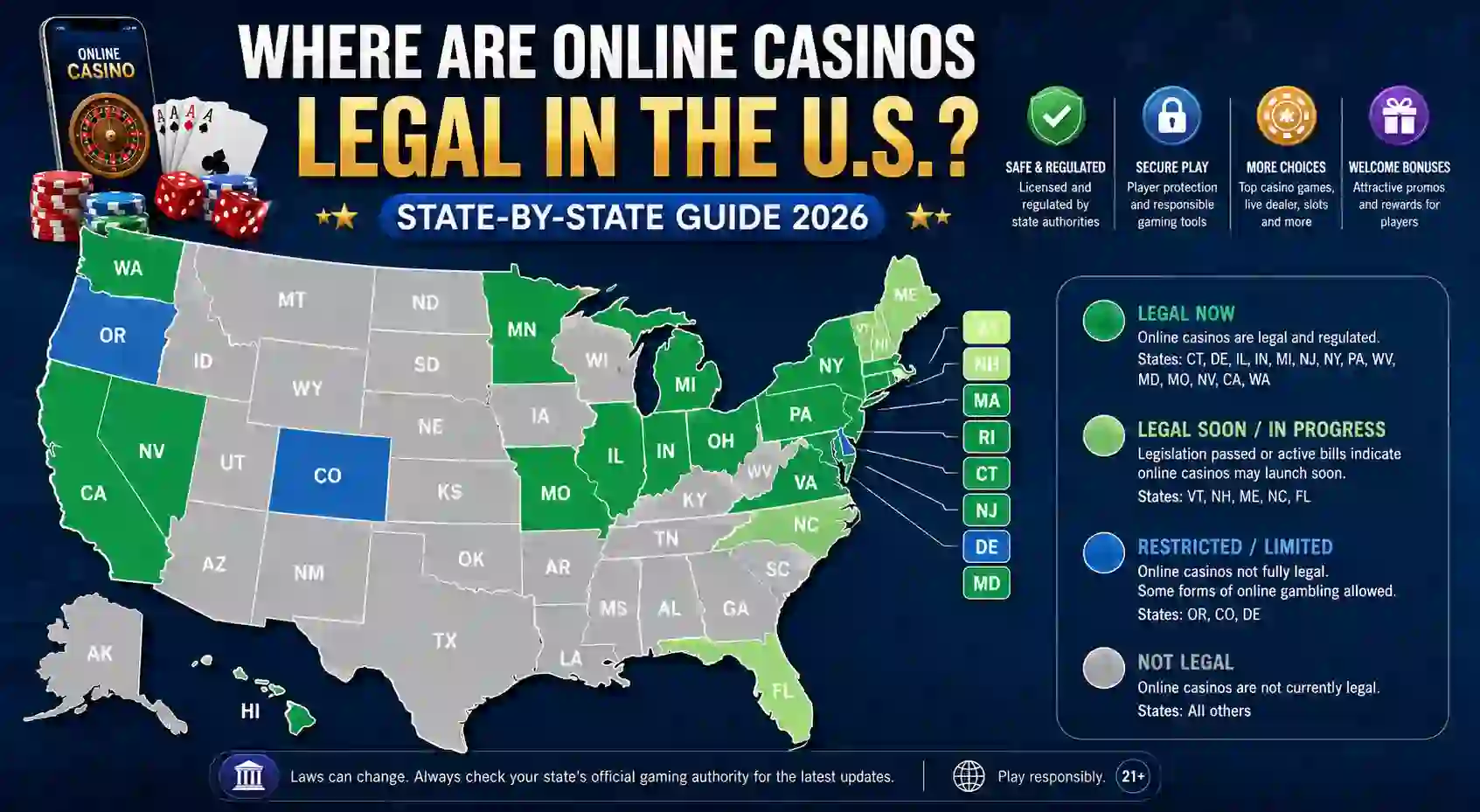
So, where are online casinos legal in the U.S. in 2026?
As of August 2026, eight states have authorized regulated real-money online casino gaming: Connecticut, Delaware, Maine, Michigan, New Jersey, Pennsylvania, Rhode Island, and West Virginia. However, there is an important qualification: Maine has legalized internet gaming but its regulated market has not yet fully launched. That means seven states currently have live regulated online casino markets.
Nevada deserves a separate mention. Despite being America’s best-known casino state, Nevada’s regulated interactive gaming market remains limited to online poker rather than full online casino games such as slots, blackjack and roulette. Nevada Gaming Control Board standards specifically limit interactive gaming to poker.
That distinction is essential when comparing U.S. online gambling laws.
Are Online Casinos Legal in the United States?
There is no single nationwide U.S. online casino license that allows an operator to accept real-money casino wagers everywhere in the country.
Instead, online gambling is governed through a combination of federal law, state law and, where applicable, tribal gaming arrangements.
Federal law also recognizes the importance of state authorization. Under the federal definition of unlawful internet gambling, qualifying intrastate wagering may fall outside that definition when the wagering is expressly authorized under state law and the system includes appropriate age and location verification requirements.
The Unlawful Internet Gambling Enforcement Act, commonly known as UIGEA, also regulates the acceptance of payments connected with unlawful internet gambling. It does not create one nationwide list of legal casino websites. Whether a particular online casino wager is lawful therefore depends heavily on the law of the jurisdiction involved.
For players, the practical rule is much simpler: a real-money casino site should be specifically licensed or authorized by the gaming regulator in the state where the wager is being placed.
U.S. Online Casino Legal States
| State | Real-Money Online Casino Status in 2026 | Main Regulator |
| Alabama | Not legal | — |
| Alaska | Not legal | — |
| Arizona | Not legal | — |
| Arkansas | Not legal | — |
| California | Not legal | — |
| Colorado | Not legal | — |
| Connecticut | Legal and live | CT Department of Consumer Protection |
| Delaware | Legal and live | Delaware Lottery |
| Florida | Not legal | — |
| Georgia | Not legal | — |
| Hawaii | Not legal | — |
| Idaho | Not legal | — |
| Illinois | Not legal | — |
| Indiana | Not legal | — |
| Iowa | Not legal | — |
| Kansas | Not legal | — |
| Kentucky | Not legal | — |
| Louisiana | Not legal | — |
| Maine | Legalized; launch pending | Maine Gambling Control Unit |
| Maryland | Not legal | — |
| Massachusetts | Not legal | — |
| Michigan | Legal and live | Michigan Gaming Control Board |
| Minnesota | Not legal | — |
| Mississippi | Not legal | — |
| Missouri | Not legal | — |
| Montana | Not legal | — |
| Nebraska | Not legal | — |
| Nevada | Online poker only; full iCasino not legal | Nevada Gaming Control Board |
| New Hampshire | Not legal | — |
| New Jersey | Legal and live | NJ Division of Gaming Enforcement |
| New Mexico | Not legal | — |
| New York | Not legal | — |
| North Carolina | Not legal | — |
| North Dakota | Not legal | — |
| Ohio | Not legal | — |
| Oklahoma | Not legal | — |
| Oregon | Not legal | — |
| Pennsylvania | Legal and live | Pennsylvania Gaming Control Board |
| Rhode Island | Legal and live | Rhode Island Lottery / Department of Revenue |
| South Carolina | Not legal | — |
| South Dakota | Not legal | — |
| Tennessee | Not legal | — |
| Texas | Not legal | — |
| Utah | Not legal | — |
| Vermont | Not legal | — |
| Virginia | Not legal | — |
| Washington | Not legal | — |
| West Virginia | Legal and live | West Virginia Lottery Commission |
| Wisconsin | Not legal | — |
| Wyoming | Not legal | — |
| District of Columbia | Full online casino gaming not legal | — |
Recent August 2026 state-by-state reporting similarly identifies Connecticut, Delaware, Michigan, New Jersey, Pennsylvania, Rhode Island and West Virginia as operating regulated markets, with Maine authorized but awaiting launch and Nevada limited to poker.
New Jersey
New Jersey is one of the most important states in the history of regulated U.S. online casino gambling.
The state authorized internet casino gaming in 2013, and regulated sites began accepting wagers later that year. New Jersey’s regulatory structure subsequently became an influential model for other states considering iGaming legislation.
Online casino gaming is overseen primarily by the New Jersey Division of Gaming Enforcement, while the Casino Control Commission handles casino licensing responsibilities. New Jersey law specifically includes provisions covering internet gaming, and the state maintains information allowing consumers to identify authorized internet gaming sites.
Players physically located within New Jersey can access approved real-money casino games including online slots, blackjack, roulette, baccarat, video poker and various live-dealer products, depending on the licensed platform.
New Jersey also demonstrates an important principle of the U.S. market: a familiar national casino brand is not automatically legal everywhere. The operator must have the appropriate authorization for the state in which the player is wagering.
Delaware
Delaware was among the earliest U.S. states to authorize regulated internet casino gaming.
The market operates through the Delaware Lottery and the state’s casino properties. Current Delaware Lottery information directs players to online slots, table games and related offerings powered through BetRivers at Delaware Park, Bally’s Dover and Harrington Raceway & Casino.
Delaware also makes the geographic requirement particularly clear. Its Lottery states that players must be at least 21 and physically within Delaware to play its regulated online games.
This illustrates why simply possessing an account is not enough. Legal U.S. casino platforms use location verification before allowing real-money wagers.
Pennsylvania
Pennsylvania has developed into one of America’s largest regulated iGaming markets.
The Pennsylvania Gaming Control Board, or PGCB, regulates casino gambling as well as internet-based gaming. The regulator maintains a dedicated list of licensed interactive gaming operators so consumers can check whether a website or app is authorized.
Pennsylvania’s legal online casino market includes digital slot machines, table games and other approved interactive products. Online poker is also regulated separately within the state’s broader online gaming structure.
The importance of iGaming to Pennsylvania has increased substantially. The American Gaming Association reported that Pennsylvania’s annual iGaming revenue reached approximately $3.46 billion in 2025, making it the largest state internet gaming market for that year.
That scale helps explain why lawmakers in other states continue to evaluate online casino legalization as a potential source of tax revenue.
West Virginia
West Virginia legalized interactive wagering through the West Virginia Lottery Interactive Wagering Act.
State law defines interactive gaming broadly enough to include computerized or virtual casino games, including slot simulations and table games approved by the commission.
The West Virginia Lottery states that iGaming was enacted during fiscal year 2020, allowing qualifying existing casino properties to provide approved interactive wagering platforms.
West Virginia law also explicitly permits licensed operators to accept interactive wagers from an individual physically located within the state using an approved mobile or digital platform. Players must be at least 21.
For consumers, that statutory language provides a particularly useful example of how regulated U.S. iGaming works: licensing, approved platforms, age controls and geolocation all form part of the legal framework.
Michigan
Michigan has grown into another major U.S. online casino market.
The state’s legal framework comes from the Lawful Internet Gaming Act, enacted in 2019. The Michigan Gaming Control Board regulates internet casino operators and monitors their platforms for compliance and gaming integrity.
The regulated market launched in 2021 and now includes a combination of commercial casino and tribal gaming operators.
By the end of 2025, the Michigan Gaming Control Board reported that 15 operators were authorized for internet gaming and/or internet sports betting. A March 2026 regulatory report stated that 15 operators were offering internet gaming and that March internet gaming gross receipts reached approximately $322.1 million.
Michigan is therefore one of the clearest examples of a mature U.S. iCasino market, with state-approved online slots, table games and other casino products available through regulated platforms.
Connecticut
Connecticut legalized online casino gaming in 2021 following agreements involving the state’s tribal gaming operators.
The Connecticut Department of Consumer Protection Gaming Division regulates the market. Current state regulations specifically cover online casino gaming alongside online sports wagering and other forms of authorized gaming.
Connecticut’s iCasino market is more limited in operator numbers than Pennsylvania, Michigan or New Jersey. The Department of Consumer Protection states that DraftKings through Foxwoods and FanDuel through Mohegan Sun are authorized to offer online casino gaming.
That restricted structure makes checking the regulator especially important. Connecticut has taken enforcement action against companies offering unlicensed gambling products and has repeatedly warned consumers that an attractive website or app should not be assumed to be lawful.
Rhode Island
Rhode Island became the seventh state with a live regulated online casino market in 2024.
The Rhode Island General Assembly enacted legislation directing the state, through the Lottery Division of the Department of Revenue, to implement and control iGaming. The law took effect on March 1, 2024.
State financial reports confirm that Rhode Island iGaming operations commenced in March 2024, offering online slot and table-game wagering.
Unlike competitive markets such as New Jersey, Rhode Island uses a much more concentrated structure involving Bally’s and the Rhode Island Lottery.
Nevertheless, it counts as a full legal online casino jurisdiction because eligible players located within Rhode Island can wager on approved real-money online slots and table games under state regulation.
Maine
Maine is the major addition to the 2026 U.S. online casino map.
Governor Janet Mills announced in January 2026 that LD 1164, An Act to Create Economic Opportunity for the Wabanaki Nations, would become law. The legislation authorizes federally recognized Wabanaki Nations to conduct regulated internet gaming under the oversight of the Maine Gambling Control Unit.
Maine’s regulator defines internet gaming to include approved online versions of games such as blackjack, poker, dice games, craps, roulette and baccarat.
However, legalization does not mean operators can begin taking wagers immediately.
Throughout 2026, the Maine Gambling Control Unit has been developing the regulatory framework needed for licensing and operation. Its rulemaking page showed proposed internet gaming rules and public-comment proceedings during summer 2026.
Therefore, the most accurate description as of August 20, 2026 is:
Maine has legalized online casino gaming, but consumers should wait for officially licensed platforms to launch before attempting to play real-money iCasino games under Maine’s new system.
What About Nevada?
Nevada frequently causes confusion in articles about legal online casinos.
Las Vegas may be synonymous with casino gambling, but Nevada does not currently operate the same full-scale online casino market found in New Jersey, Pennsylvania or Michigan.
Nevada regulates interactive gaming, and the Gaming Commission lists licensed online gaming operators. However, Nevada’s interactive gaming rules limit this category to poker.
Therefore:
Online poker: legal and regulated in Nevada.
Real-money online slots, roulette, blackjack and other standard casino games: not authorized as statewide regulated iCasino products.
Nevada should consequently not be counted as one of the eight states that have authorized full online casino gaming.
Online Casino Laws vs. Online Sports Betting
One of the most common mistakes U.S. players make is assuming that legal sports betting means legal online casino gambling.
It does not.
Many states permit sportsbook apps while still prohibiting full online casino games. States such as Arizona, Colorado, Indiana, Iowa, Kansas, Kentucky, New York, Ohio, Tennessee and Virginia have allowed various forms of regulated sports wagering without creating comparable statewide real-money iCasino markets.
Sports betting and casino gaming require separate statutory authorization.
A sportsbook app available legally in your state may even have a “casino” section in another jurisdiction. That does not mean the casino section can legally accept wagers where you live.
Geolocation controls normally prevent users from accessing gambling products that are not authorized in their current jurisdiction.
Does Legal Online Casino Gambling Require State Residency?
Usually, physical location when wagering matters more than permanent residency.
For example, West Virginia law permits an approved operator to accept wagers through a mobile platform from an individual physically located within the state. Delaware similarly tells online players that they must be within Delaware to play.
A visitor who otherwise satisfies the operator’s eligibility requirements may therefore be able to play while physically present in a legal jurisdiction, whereas a resident who crosses into a state where online casinos are prohibited will generally be blocked from wagering.
Regulated casino apps use geolocation technology to determine whether the device is within the permitted boundaries.
How to Tell Whether an Online Casino Is Legal
The safest approach is to start with the state regulator rather than with an advertisement or search-engine result.
A legal U.S. online casino should be authorized by the relevant state gaming authority, use age and identity verification, confirm the player’s physical location before wagering, provide clearly stated responsible-gambling controls, use approved games and payment systems, and offer a formal method for consumer complaints.
Pennsylvania, for example, publishes a list of regulated interactive gaming operators and specifically encourages users to verify a site before wagering.
Connecticut has similarly warned that illegal offshore gambling sites can look highly professional while operating without the consumer protections imposed on state-regulated platforms.
The American Gaming Association also notes that illegal gambling operations function outside normal state oversight and consumer-protection systems.
Are Offshore Online Casinos Legal in the U.S.?
An offshore website accepting American customers should not automatically be described as a legal U.S. casino simply because the website is accessible from the United States.
A state-regulated casino has been authorized by the gaming authority responsible for the jurisdiction. An offshore operator may instead be licensed in another country—or may operate without the state authorization required to legally serve players in a particular U.S. jurisdiction.
That difference matters if there is a dispute over withdrawals, account closure, game integrity or personal data.
Players looking for regulated gambling should therefore check the official state regulator’s operator list rather than relying on claims such as “U.S. accepted,” “American-friendly” or “internationally licensed.”
Are Sweepstakes Casinos the Same as Legal Online Casinos?
No.
Sweepstakes casinos generally use a promotional or sweepstakes-based model rather than the traditional state-regulated real-money iCasino structure used in New Jersey, Pennsylvania or Michigan.
The user experience can sometimes resemble a conventional online casino, but the underlying legal model is different.
The legal treatment of sweepstakes gaming has also been changing rapidly, with multiple states taking regulatory or legislative action against certain products. The American Gaming Association maintains information on state enforcement activity involving illegal and sweepstakes gambling sites.
For that reason, a sweepstakes casino should not be counted as proof that conventional real-money online casino gambling is legal in a state.
Which States Could Legalize Online Casinos Next?
Expansion remains possible, but predicting the next legal state requires caution.
Illinois introduced Internet Gaming Act legislation during its 2026 legislative session. House Bill 4797 proposed an internet gaming licensing framework, age and location verification, responsible gaming requirements and a 25% privilege tax, but it was re-referred to the Rules Committee in March 2026 rather than becoming law.
Maryland also considered several internet gaming proposals during 2026. One referendum proposal, SB 761, was withdrawn by its sponsor in March, while another measure concerning internet gaming and online bingo received legislative consideration without creating a live regulated iCasino market.
These examples highlight a pattern seen repeatedly across the country: filing an iGaming bill does not mean online casinos are legal. A proposal normally must pass the legislature, receive any required voter or gubernatorial approval, become law, move through regulatory rulemaking and licensing, and finally reach an authorized launch date.
Maine’s experience in 2026 demonstrates that the period between legalization and actual launch can itself take months.
Why Are Online Casinos Legal in So Few States?
The contrast between sports betting and iGaming is striking.
According to the American Gaming Association, seven states generated regulated online casino revenue during 2025. Those markets produced approximately $10.73 billion in iGaming revenue, representing growth of 27.6% from the previous year. Pennsylvania, Michigan and New Jersey accounted for the overwhelming majority of that total.
Despite that revenue potential, online casino legislation can face resistance involving problem-gambling concerns, disagreement over tax rates, tribal gaming rights, relationships with existing casinos, fears of cannibalizing physical casino revenue and debates over how many operators should receive licenses.
Maine’s tribal-focused model, Connecticut’s limited tribal partnerships, Rhode Island’s concentrated system and New Jersey’s competitive casino-linked structure show that there is no single U.S. approach.
Each state creates its own regulatory solution.
FAQs
How many states have legalized online casinos in 2026?
Eight states have authorized full real-money online casino gaming as of August 2026: Connecticut, Delaware, Maine, Michigan, New Jersey, Pennsylvania, Rhode Island and West Virginia. Maine is the newest state but remains in the implementation and launch process. Seven of the eight currently have live regulated iCasino markets.
What states currently have live online casinos?
The seven states with operational regulated online casino markets are Connecticut, Delaware, Michigan, New Jersey, Pennsylvania, Rhode Island and West Virginia.
Is online casino gambling legal in New York?
No. New York permits regulated online sports betting, but full real-money online casino games such as slots, blackjack and roulette have not been legalized statewide as of August 2026.
Are online casinos legal in California?
No. California has not authorized a regulated statewide real-money online casino market.
Are online casinos legal in Florida?
No. Florida has regulated forms of gambling, including tribal casino gaming and mobile sports betting through the Seminole Tribe’s Hard Rock Bet arrangement, but full statewide real-money online casino gaming has not been authorized.
Are online casinos legal in Texas?
No. Texas has not legalized regulated real-money online casino gaming.
Are online casinos legal in Nevada?
Full online casinos are not. Nevada permits regulated online poker, but its current interactive gaming framework does not authorize the broad online slots and table-game market available in states such as New Jersey or Michigan.
Is online gambling legal if I use cryptocurrency?
Using Bitcoin, Ethereum, stablecoins or another cryptocurrency does not make an otherwise unauthorized casino legal. The determining issue is whether the operator and gambling activity are lawful in the relevant jurisdiction.
Can I play in another state’s legal online casino using a VPN?
Licensed platforms require location verification, and attempting to disguise your physical location can violate operator rules and potentially applicable gaming regulations. Players should only wager when the regulated platform confirms that they are physically within an authorized jurisdiction.
Final Verdict
The legal U.S. online casino market remains much smaller than the sports betting market.
As of August 20, 2026, full real-money online casino gaming has been authorized in Connecticut, Delaware, Maine, Michigan, New Jersey, Pennsylvania, Rhode Island and West Virginia.
Of those eight, seven currently have live regulated iCasino markets. Maine became the newest legal state in 2026 but remains in the regulatory implementation phase before full commercial launch. Nevada is a special case because it permits regulated online poker but does not currently offer a conventional statewide real-money online slots and table-games market.
For players, the most important lesson is simple: legal sports betting does not automatically mean legal online casino gaming, and an accessible gambling website is not necessarily a state-licensed casino.
Before depositing money, verify the operator directly with the relevant state gaming regulator and make sure you are physically located in a jurisdiction where that particular form of gambling is authorized.
Because U.S. gambling laws continue to change, this is also a topic where the date of the information matters. Maine’s legalization in 2026 has already changed the national map, and additional states may revisit iGaming legislation in future sessions.
ADVERTISEMENT

18+ | Affiliate link | Terms apply | Please gamble responsibly.


