Last Updated on September 5, 2026 by Maurya
Virtual reality has moved well beyond experimental technology. Modern headsets can track hands and controllers, reproduce three-dimensional environments, deliver spatial audio, and allow people in different countries to meet inside the same digital space. It was therefore only a matter of time before casino-style gaming became part of the VR ecosystem.
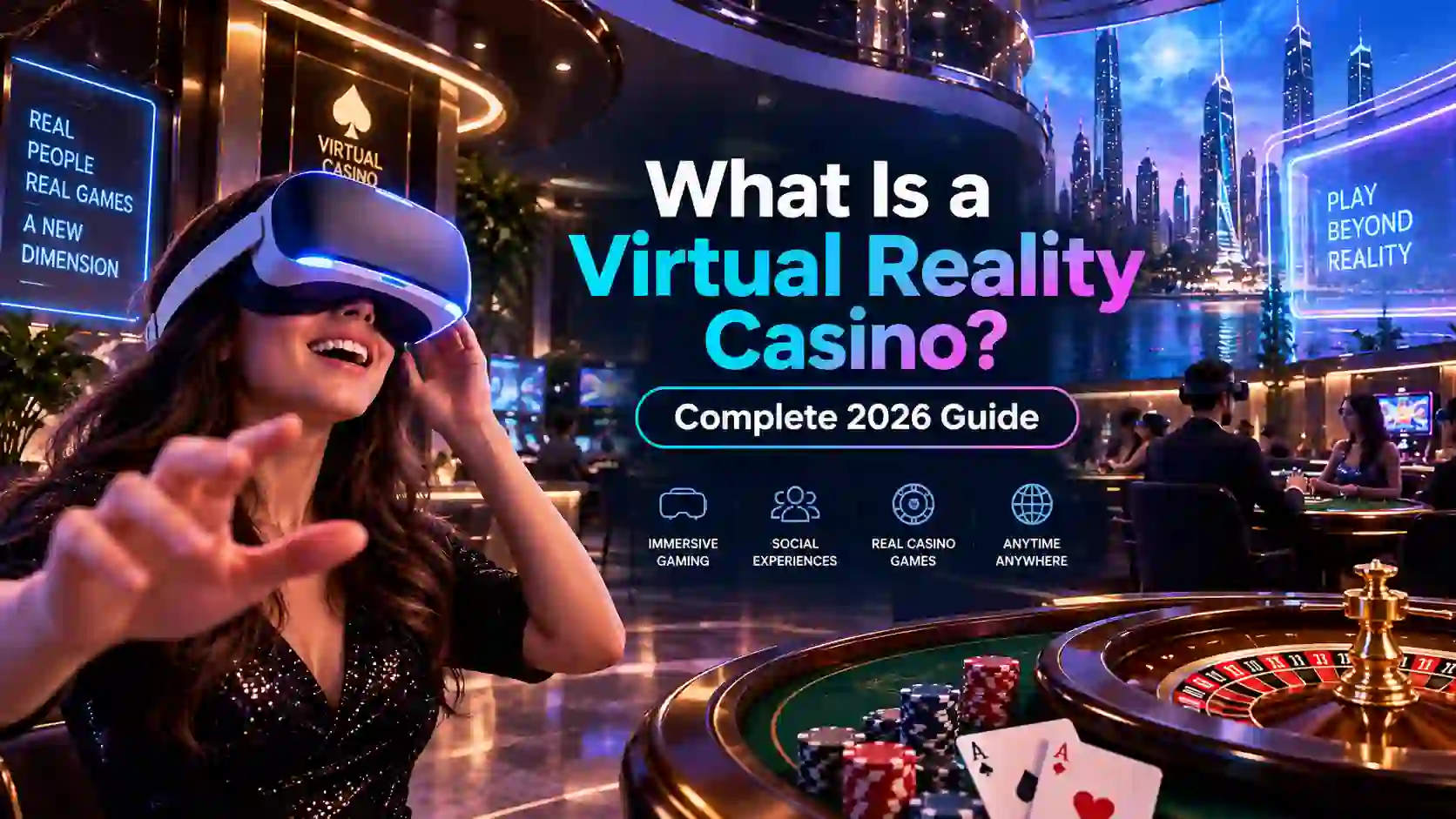
A virtual reality casino, or VR casino, is a three-dimensional digital casino environment that players can enter using a compatible headset. Rather than clicking a roulette icon or slot button on a conventional website, a player may find themselves standing on a simulated casino floor, sitting at a blackjack table, picking up virtual poker chips, looking around a room, and communicating with other players through avatars.
The concept sounds straightforward, but the VR casino market in 2026 requires some important distinctions. A realistic-looking VR casino is not automatically a real-money gambling site. Some of today’s most sophisticated virtual casinos use only virtual chips that cannot be withdrawn as cash.
What Is a Virtual Reality Casino?
A virtual reality casino is a casino-style digital environment designed to create the feeling of being physically present inside a casino.
Traditional online gambling takes place through a two-dimensional interface. You normally use a mouse, touchscreen, keyboard, or mobile device to select games and place bets.
VR changes that relationship.
After putting on a headset, the player’s field of vision is replaced—or, in mixed reality, supplemented—by a three-dimensional environment. Head and hand movements can be tracked so the player can look around, interact with objects, approach gaming tables, manipulate chips or cards, and communicate with other users.
Typical VR casino features can include:
- Fully rendered 3D casino environments
- Virtual poker, blackjack and roulette tables
- Interactive slot machines
- Motion-controller or hand-tracking support
- Player avatars
- Multiplayer tables
- Voice communication
- Spatial audio
- Virtual chips and casino objects
- Private rooms or social areas
- Customisable clothing and accessories
- Mixed-reality or passthrough features on supported hardware
This means a VR casino is better understood as an environment rather than simply another casino website design.
How Does a VR Casino Work?
Most virtual reality casino experiences combine several technologies.
- A VR Headset Creates the Environment
The headset provides separate images to the player’s eyes to create depth and three-dimensional perception.
Modern devices can also track the direction and movement of the user’s head. When you turn to the right, for example, the virtual casino moves naturally with your viewpoint rather than behaving like a fixed computer screen.
Hardware has become substantially more capable. Meta’s documentation lists a Quest 3 eye-buffer resolution of 2064 × 2208 pixels per eye with a field of view of approximately 110° × 96°.
High-end spatial-computing hardware has pushed the technology further. Apple’s current Vision Pro uses a micro-OLED 3D display system with 23 million pixels and supports hands, eyes and voice as input methods. The current M5 model supports refresh rates of up to 120Hz.
These specifications do not automatically make a headset a gambling platform, but they illustrate how sophisticated immersive interfaces have become.
- Tracking Systems Detect Your Movements
A VR casino can track controllers or hands and translate their position into the digital environment.
Instead of pressing a conventional “deal” button, a VR blackjack game might allow you to gesture for another card. At a poker table, you may physically move virtual chips forward.
The goal is to make interacting with the game feel more like interacting with objects than navigating a website.
- Casino Software Runs the Games
The visual casino environment is only one layer.
Behind the graphics is gaming software controlling cards, roulette outcomes, slot reels, player balances, multiplayer connections and other functions.
Where actual regulated gambling is involved, changing the visual interface to VR does not remove the normal technical and regulatory obligations of the casino.
For example, Great Britain’s Gambling Commission’s Remote Gambling and Software Technical Standards cover subjects including customer account information, result determination, random outcomes, interrupted games, financial limits, responsible product design and live dealer studios. The standards were most recently updated in March 2026.
- Multiplayer Systems Create the Social Experience
One of VR’s biggest differences from ordinary casino websites is its social layer.
Players can potentially:
- Sit beside other users
- Talk through voice chat
- Watch another player act
- Use gestures
- Play private tables with friends
- Move between different casino areas
- Attend multiplayer events
This attempts to restore an element traditional online casinos often lack: the feeling that other people occupy the same space.
Are VR Casinos Real-Money Casinos?
Not necessarily.
This is one of the most important facts for anyone researching VR gambling in 2026.
There are effectively two categories.
Social or Simulated VR Casinos
These reproduce casino games without allowing players to win withdrawable real money.
Vegas Infinite is currently one of the clearest examples.
The platform offers poker, blackjack, roulette, craps and slots and incorporates multiplayer environments, private tables, avatars and social interaction. It is available across VR and other platforms.
However, Vegas Infinite explicitly states that its games are intended for amusement, do not offer real-money gambling, and do not provide an opportunity to win real money. Its virtual items have no monetary value.
Players can purchase virtual chips, but those chips cannot be redeemed for real-world value.
That makes Vegas Infinite an immersive simulated casino experience, rather than a conventional online casino.
Real-Money VR Gambling
A true real-money VR casino would combine an immersive headset-based casino environment with actual deposits, wagering and cash withdrawals.
Experiments with this model are not new. SlotsMillion attracted attention around a decade ago for demonstrating a real-money multiplayer VR casino. However, its current website is being repositioned as a casino and sportsbook comparison service rather than providing evidence that the historical VR product remains a current mainstream VR gambling platform.
That history illustrates an important point: real-money VR gambling has developed more slowly than VR casino simulation.
In 2026, players should be particularly sceptical of websites claiming to be “VR casinos” when the product is simply a normal casino website displaying 3D graphics or 360-degree video.
VR Casino vs Online Casino vs Live Casino
The terms are sometimes confused, but the experiences are different.
| Feature | VR Casino | Traditional Online Casino | Live Dealer Casino |
| Headset normally required | Yes for full VR | No | No |
| 3D environment | Usually | Rarely | No or limited |
| Physical-style interaction | High | Low | Low |
| Avatar interaction | Common | Rare | Rare |
| Real human dealer | Possible, but not essential | Usually no | Yes |
| Social presence | Potentially high | Low | Moderate |
| Real-money play | Depends on product | Common where legal | Common where legal |
| Hardware requirement | Higher | Low | Low |
| Mobile convenience | Lower | Very high | High |
A live casino should therefore not automatically be described as virtual reality.
Live blackjack or roulette generally streams a real dealer from a studio onto a phone or computer display. VR instead attempts to place the player inside a three-dimensional digital environment.
What Games Can You Play in a Virtual Reality Casino?
Casino games are well suited to VR because many are based on recognisable physical objects.
VR Poker
Poker is arguably one of VR’s most natural casino formats.
A player can sit around a virtual table, look toward opponents, handle chips and cards, talk to other users and use gestures.
Vegas Infinite demonstrates this model particularly well, combining multiplayer poker with avatars and social environments.
VR Blackjack
Instead of tapping buttons marked Hit, Stand or Double, blackjack interfaces can translate movements or controller actions into game decisions.
Cards can appear physically on the virtual table, making the experience closer to casino-floor blackjack than a conventional browser game.
VR Roulette
Roulette benefits from depth and scale because the wheel can occupy an actual-looking space in front of the player.
Users may be able to examine the table, place virtual chips on individual betting areas and watch the wheel operate from different viewing positions.
VR Slots
Slot machines are another natural fit.
Rather than selecting a slot from a menu, the player can potentially walk through a virtual floor, approach a machine and interact with it as though standing in front of a physical cabinet.
Craps and Other Table Games
VR environments can also simulate dice games such as craps.
Vegas Infinite currently includes craps alongside poker, blackjack, roulette and slots, demonstrating how multiple game categories can exist inside a single virtual casino environment.
What Equipment Do You Need for VR Casino Gaming?
Requirements depend entirely on the software.
Common VR ecosystems in 2026 include:
- Meta Quest headsets
- PlayStation VR2
- PC-connected VR systems
- SteamVR-compatible headsets
- Spatial-computing devices
- Motion controllers
- Hand-tracking systems
Vegas Infinite, for example, is available on Meta Quest and PSVR2 as well as non-VR platforms. Its PlayStation listing supports seated, standing and room-scale styles of play.
A stable internet connection is especially important for multiplayer casino environments because player positions, voice communication and game states need to remain synchronised.
Fortunately, VR casino games usually involve less continuous physical movement than action titles. Poker or blackjack can often be played while seated, which may also make longer sessions more comfortable.
Are Virtual Reality Casinos Legal?
The legality of a VR casino depends primarily on what is happening inside the application and where the player is located, rather than whether a headset is being used.
A play-money VR casino and a real-money VR gambling platform are very different regulatory products.
In Great Britain, for example, the Gambling Commission defines remote gambling broadly enough to include gambling conducted through the internet and other forms of remote technology. Businesses providing remote gambling to consumers in Great Britain need the appropriate Commission licence, including operators located overseas.
The fact that wagering happens through a VR headset instead of a browser does not create an exemption.
British online gambling companies must also verify a customer’s age and identity before the customer is allowed to gamble.
Regulation differs between countries—and sometimes between states or provinces—so users should verify that a real-money operator is authorised specifically for their location.
How to Check Whether a Real-Money VR Casino Is Safe
Immersive graphics are not evidence that a casino is trustworthy.
Before depositing money with any platform marketed as a VR casino, check the same fundamentals you would investigate at a conventional online casino.
Verify the Gambling Licence
Look for:
- The regulator’s name
- Operating company
- Licence number
- Countries the licence covers
- A regulator database entry
Do not rely exclusively on a licence logo displayed in the casino footer.
Confirm Whether the Product Uses Real or Virtual Money
Terms such as “chips”, “cash games” and “casino balance” can create confusion in social casino apps.
Check whether winnings can actually be withdrawn.
Vegas Infinite provides a useful example of clear disclosure: its terms explicitly explain that virtual items have no monetary value and the platform does not offer real-money gambling.
Check Game Information
A regulated real-money casino should clearly explain:
- Game rules
- Betting limits
- How outcomes are determined
- RTP where applicable
- Bonus conditions
- Withdrawal restrictions
For British-regulated remote gambling, technical standards specifically address game rules, likelihood of winning, result determination and generation of random outcomes.
Review Financial Controls
Legitimate operators should provide meaningful tools for controlling gambling expenditure.
In Great Britain, remote operators must implement customer-interaction systems intended to identify and minimise gambling harm. Commission requirements include monitoring customer activity and responding when indicators of potential harm are detected.
Advantages of Virtual Reality Casinos
VR gambling technology offers several genuine advantages from an entertainment and user-experience perspective.
Greater Sense of Presence
A normal online casino presents information through a screen.
VR surrounds the user’s field of vision, creating a stronger sense of being somewhere rather than simply viewing something.
More Social Interaction
Multiplayer VR can make poker and table games considerably more social.
Being able to talk, gesture and move around a shared environment gives developers tools that ordinary casino interfaces cannot easily reproduce.
More Natural Controls
Manipulating chips, cards and casino objects through tracked hands or controllers can feel more intuitive than navigating menus.
Creative Environments
Virtual casinos are not restricted by physical architecture.
A poker table could be located in a conventional casino, futuristic city, penthouse, space station or fantasy environment.
Vegas Infinite already uses environments ranging from luxury casino floors and private suites to rooftop and space-inspired settings.
Disadvantages of VR Casinos
The technology also introduces meaningful drawbacks.
Additional Hardware
A phone or laptop is sufficient for conventional online gaming.
Full VR generally requires a headset, which introduces additional cost, charging requirements and setup.
Less Convenient for Short Sessions
Opening a casino app on a smartphone takes seconds.
Putting on a headset, adjusting it and entering a virtual environment creates more friction.
For casual play, conventional mobile interfaces remain difficult to beat.
Physical Comfort
Some users experience eyestrain, fatigue or motion sickness in VR.
Sony specifically warns that VR games can cause motion sickness for some players on its Vegas Infinite product listing.
Smaller Product Selection
There are vastly more conventional online casino games than genuine headset-native VR casino experiences.
That means the phrase “VR casino” is frequently used more broadly in marketing than the technology itself justifies.
Does VR Make Gambling More Risky?
This is an area where responsible discussion is particularly important.
The same feature that makes VR attractive—immersion—could also affect gambling behaviour.
Research comparing a gambling game played on a laptop with one played inside an immersive VR betting-shop simulation found that participants reported higher levels of immersion and arousal in the VR condition. The study included 48 participants and its authors called for further investigation of VR gambling experiences.
Other research has investigated near-miss effects and physiological responses inside VR casino environments. A study involving 60 adults used an immersive VR casino-bar and measured heart-rate responses during slot play.
A 2024 study using a simulated VR slot-machine environment also found relationships between problem-gambling measures and responses to near-misses in its sample.
Researchers continue to investigate the subject. A 2026 project called SAFESLOT uses an immersive VR slot-machine environment alongside eye tracking and physiological measurements to study factors including craving, flow and cognitive biases.
These studies should not be interpreted as proof that every VR gambling experience is inherently more harmful. Sample sizes are limited and VR gambling research remains relatively young.
They do, however, provide a strong reason for operators and players to treat immersion as more than a cosmetic feature.
Practical safeguards are therefore especially important:
- Set a spending limit before gambling
- Set a time limit for VR sessions
- Take the headset off for regular breaks
- Avoid chasing losses
- Do not gamble with borrowed money
- Keep notifications and reality checks enabled
- Use self-exclusion where necessary
- Treat gambling as entertainment, not income
The State of VR Casinos in 2026
The phrase virtual reality casino is arguably ahead of the real-money market.
The technology needed to create compelling virtual casino spaces unquestionably exists. Modern headsets provide high-resolution displays, positional tracking, hand interaction and increasingly sophisticated spatial computing.
Consumer VR casino software exists too.
What has not yet become mainstream is the combination of full immersive VR + regulated real-money gambling + large game libraries + widespread headset support.
The strongest current VR casino experiences therefore tend to demonstrate what the interface can become rather than signalling the immediate replacement of mobile gambling.
This distinction is likely to remain important during the next stage of development.
What Is the Future of Virtual Reality Casinos?
Several trends could influence VR casinos over the next few years.
Mixed Reality
Instead of completely replacing the player’s surroundings, mixed reality could place a roulette table, slot machine or poker table inside the user’s real room.
This approach may reduce some of the isolation associated with conventional VR.
Hand and Eye Tracking
Devices increasingly support natural inputs beyond controllers.
Apple’s Vision Pro, for example, supports hand, eye and voice input.
Future casino interfaces could therefore require less traditional menu navigation.
Cross-Platform Casinos
Vegas Infinite already provides an interesting example of a casino-style social ecosystem spanning VR, PC, mobile and console platforms.
Cross-platform design may ultimately be more practical than requiring every user to own a headset.
Stronger Responsible-Gambling Interfaces
VR also creates opportunities for more visible safeguards.
Reality checks, time displays, spending information and session reminders could be integrated directly into the three-dimensional environment rather than hidden inside account menus.
For regulated real-money VR products, this area could become as important as graphical realism.
FAQs
What is a VR casino?
A VR casino is a three-dimensional casino-style environment accessed through virtual reality technology. Players can look around the environment and may interact with tables, machines, cards, chips and other players through tracked controllers or hands.
Do VR casinos use real money?
Some historical and experimental products have combined VR with real-money gambling, but many modern consumer VR casino experiences use virtual currency instead. Always check whether chips can actually be redeemed before assuming a VR casino is a gambling product.
Is Vegas Infinite a real-money casino?
No. Vegas Infinite’s current terms state that its games are for amusement purposes and do not provide real-money gambling or an opportunity to win real money.
What games are available in VR casinos?
Common examples include poker, blackjack, roulette, craps and slots. Availability varies by platform.
Do I need a VR headset?
You need a compatible headset for the full immersive VR experience. Some modern platforms are cross-platform and can also be accessed using conventional screens.
Are VR casinos legal in the UK?
Casino-style VR games using only non-redeemable virtual currency are different from real-money gambling. Any business providing real-money remote gambling to consumers in Great Britain must have the appropriate Gambling Commission licence.
Is a live dealer casino the same as a VR casino?
No. A live casino usually streams a human dealer through a two-dimensional video interface. A genuine VR casino places the player inside a three-dimensional interactive environment.
Can you play VR casino games on Meta Quest?
Yes, casino-style VR software is available for Meta Quest. Vegas Infinite, for example, is listed among Meta Quest experiences and provides poker and other simulated casino games.
Can VR gambling cause motion sickness?
Some users can experience discomfort or motion sickness in virtual reality. Headset manufacturers and platform stores provide health and safety warnings, and taking regular breaks is sensible.
Final Verdict
Virtual reality casinos provide one of the clearest examples of how online casino interfaces could evolve beyond websites and mobile apps.
Instead of selecting games from thumbnails, users can enter a digital casino floor. Instead of clicking on poker chips, they can manipulate virtual objects. Instead of reading a chat window, they can sit beside avatars representing other players.
The technology is already convincing enough for products such as Vegas Infinite to demonstrate a genuinely social, immersive casino-style environment.
But 2026 is also a year when readers need to separate VR casino entertainment from real-money VR gambling.
A sophisticated headset experience does not automatically mean money can be won or withdrawn, and a website describing itself as a “VR casino” does not necessarily provide native virtual reality at all.
For real-money gambling, the fundamentals remain unchanged: licensing, fair game mechanics, transparent terms, identity verification, payment security and responsible-gambling protections matter far more than 3D graphics.
VR can dramatically change how a casino feels. It does not change the underlying mathematics of gambling, and it does not turn a game of chance into a reliable way to make money.
As headset technology, mixed reality, hand tracking and cross-platform gaming continue to develop, virtual reality casinos are likely to become more technically impressive. Whether fully immersive real-money VR gambling becomes mainstream will depend not only on hardware, but also on regulation, consumer adoption, development costs and how effectively operators address the additional responsibilities created by more immersive gambling environments.


