

18+ | Affiliate link | Terms apply | Please gamble responsibly.
Last Updated on October 22, 2026 by Maurya
Poker is a game of skill, strategy, patience, and calculated decisions. But before you can master bluffing, read opponents, or make confident bets, you need to understand one fundamental rule: which poker hands are the strongest?
Imagine sitting at a poker table with a flush while your opponent confidently reveals a full house. Both hands look impressive, but only one wins. Knowing the difference can save you from costly mistakes and help you recognize valuable opportunities.
Whether you’re a complete beginner learning Texas Hold’em or a casual player looking to improve your knowledge, understanding poker hand rankings is essential.
The good news? Poker hands follow a clear hierarchy that’s surprisingly easy to remember once you understand how the combinations work.
What Are the Best Hands in Poker?
The best hand in standard poker is a royal flush, consisting of an ace, king, queen, jack, and ten, all belonging to the same suit.
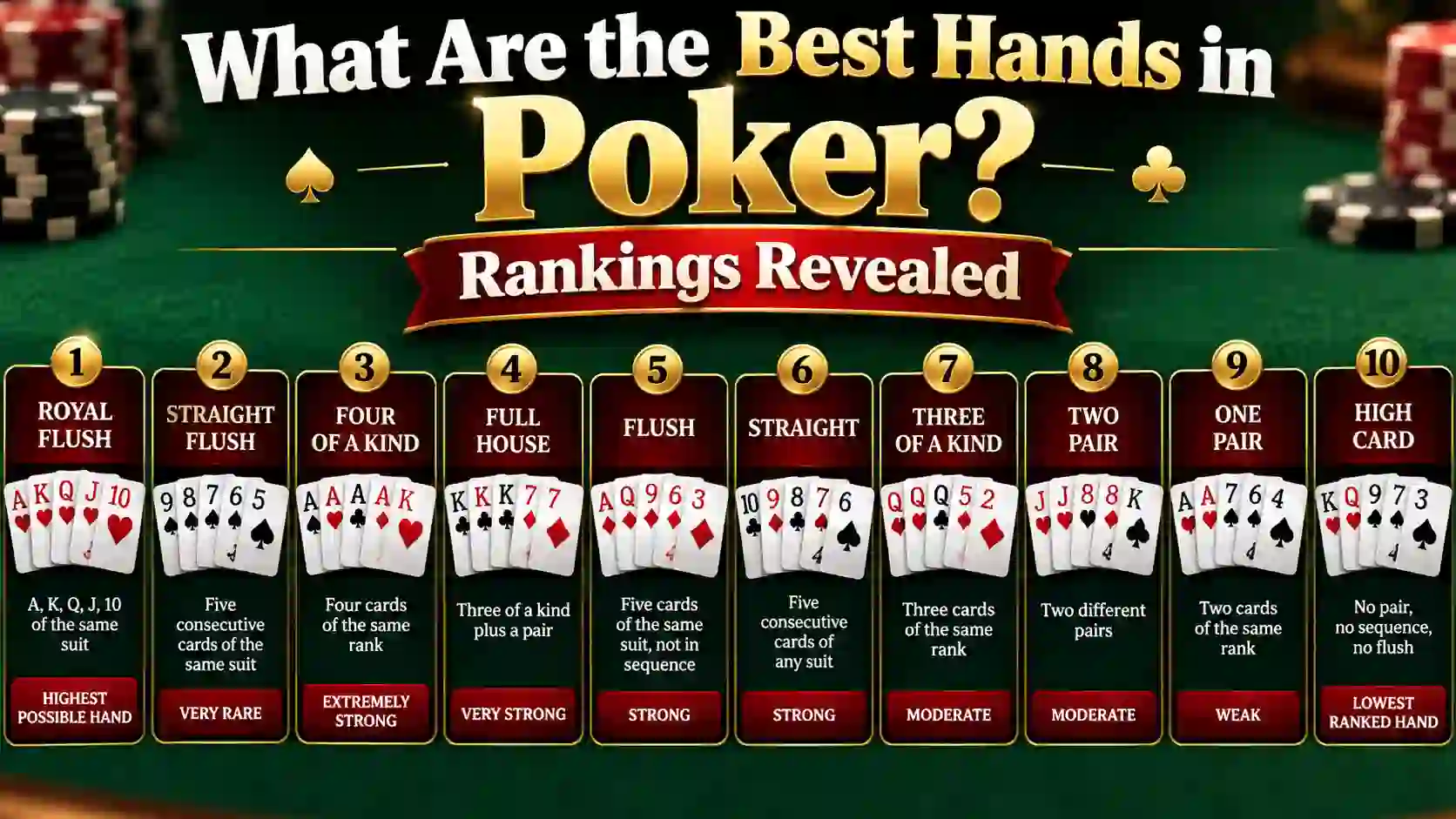
The ten poker hands, ranked from strongest to weakest, are royal flush, straight flush, four of a kind, full house, flush, straight, three of a kind, two pair, one pair, and high card.
These rankings determine the winner at showdown in popular games such as Texas Hold’em, Omaha, Seven-Card Stud, and Five-Card Draw.
A higher-ranked category always defeats a lower-ranked category, regardless of the individual card values.
Poker Hand Rankings Chart: Strongest to Weakest
Before exploring the details, here’s a complete poker hands ranking chart to help you understand what beats what.
| Rank | Poker Hand | Example | Strength |
| 1 | Royal Flush | A♠ K♠ Q♠ J♠ 10♠ | Highest |
| 2 | Straight Flush | 9♥ 8♥ 7♥ 6♥ 5♥ | Extremely strong |
| 3 | Four of a Kind | K♠ K♥ K♦ K♣ 3♠ | Very strong |
| 4 | Full House | Q♠ Q♥ Q♦ 8♣ 8♥ | Very strong |
| 5 | Flush | A♥ J♥ 8♥ 6♥ 3♥ | Strong |
| 6 | Straight | 9♣ 8♦ 7♥ 6♠ 5♣ | Strong |
| 7 | Three of a Kind | Q♠ Q♦ Q♣ A♥ 6♦ | Moderate |
| 8 | Two Pair | J♠ J♥ 7♦ 7♣ K♠ | Moderate |
| 9 | One Pair | 10♦ 10♣ A♠ 8♥ 3♣ | Common |
| 10 | High Card | A♣ Q♥ 9♠ 6♦ 2♣ | Lowest |
Important: This ranking applies to traditional high-hand poker played with a standard 52-card deck and no wild cards. Certain variants use different rules.
The 10 Best Poker Hands Explained in Detail
Understanding the names of poker combinations is useful, but recognizing how they work at the table is even more important.
Let’s examine each hand, starting with the strongest.
- Royal Flush — The Best Hand in Poker
Example: A♠ K♠ Q♠ J♠ 10♠
A royal flush is the ultimate poker hand. It consists of the five highest consecutive cards, all sharing the same suit.
There are only four possible royal flushes in a standard deck: one each in spades, hearts, diamonds, and clubs.
A royal flush cannot be beaten by any other hand under standard poker rankings. Even four aces or a king-high straight flush are weaker.
Its extraordinary rarity makes it one of poker’s most recognizable achievements.
In a random five-card deal, the probability of receiving a royal flush is approximately 1 in 649,740.
However, remember that a royal flush does not automatically guarantee sole ownership of the pot. In Texas Hold’em, if the community cards themselves form a royal flush, all players remaining at showdown share the same winning hand.
- Straight Flush — Five Consecutive Cards of the Same Suit
Example: 9♥ 8♥ 7♥ 6♥ 5♥
A straight flush contains five cards in numerical sequence, with every card belonging to the same suit.
It combines the characteristics of a straight and a flush, making it considerably stronger than either hand individually.
A straight flush beats four of a kind, a full house, and every lower-ranked combination.
When two straight flushes are compared, the one with the highest top card wins.
For example, a jack-high straight flush beats a nine-high straight flush.
Technically, a royal flush is the highest possible straight flush. However, poker ranking charts usually display it as a separate category for clarity.
The probability of receiving a non-royal straight flush in a random five-card deal is approximately 1 in 72,193.
- Four of a Kind — Four Matching Cards
Example: K♠ K♥ K♦ K♣ 3♠
Four of a kind, commonly called quads, consists of four cards sharing the same rank alongside one additional card.
Four kings, four queens, and four sevens are all examples.
The fifth card is called the kicker. It can determine the winner when two players share the same four-of-a-kind combination.
Four aces represent the highest possible four of a kind, while four twos are the lowest.
This hand defeats a full house, flush, straight, three of a kind, and every lower combination.
Only a straight flush or royal flush can beat it.
In a random five-card deal, the probability of making four of a kind is approximately 0.024%, or about 1 in 4,165 hands.
- Full House — Three of a Kind Plus a Pair
Example: Q♠ Q♥ Q♦ 8♣ 8♥
A full house contains three cards of one rank and two cards of another rank.
Poker players often call this combination a boat.
For example, Q-Q-Q-8-8 is described as “queens full of eights.”
A full house defeats a flush, straight, three of a kind, two pair, one pair, and high card.
When comparing two full houses, the rank of the three matching cards determines the winner first.
Consider these combinations:
Hand A: 8-8-8-2-2
Hand B: 7-7-7-A-A
Hand A wins because three eights outrank three sevens, even though Hand B contains a pair of aces.
This is an important distinction that beginners sometimes overlook.
A full house appears approximately once in every 694 random five-card deals.
- Flush — Five Cards of the Same Suit
Example: A♥ J♥ 8♥ 6♥ 3♥
A flush consists of five cards of the same suit that do not form a consecutive sequence.
For example, five hearts create a flush, regardless of whether the card values are connected.
An ace-high flush is stronger than a king-high flush.
If two players have flushes with the same highest card, their second-highest cards are compared. If those also match, the comparison continues down the five-card hand.
A common beginner question is whether a flush beats a straight.
Yes, a flush always beats a straight in standard poker.
However, a flush loses to a full house, four of a kind, straight flush, or royal flush.
Another important point: suits have equal value at showdown. A spade flush does not automatically beat a heart flush.
The probability of receiving an ordinary flush, excluding straight flushes, is approximately 1 in 509 five-card deals.
- Straight — Five Consecutive Cards
Example: 9♣ 8♦ 7♥ 6♠ 5♣
A straight contains five cards in sequential order. Unlike a straight flush, those cards do not all share the same suit.
Straights are particularly interesting because an ace can function as either the highest or lowest card.
The strongest possible straight is:
A-K-Q-J-10, also known as Broadway.
The weakest possible straight is:
5-4-3-2-A, commonly called the wheel.
The ace cannot connect the top and bottom of the sequence. For example, K-A-2-3-4 is not a valid straight.
When two players have straights, the one with the highest top card wins.
A straight beats three of a kind, two pair, one pair, and high card, but loses to a flush or anything stronger.
Its probability in a random five-card deal is approximately 0.3925%, or 1 in 255.
- Three of a Kind — Three Matching Cards
Example: Q♠ Q♦ Q♣ A♥ 6♦
Three of a kind contains three cards of identical rank and two additional unmatched cards.
For example, three queens form a stronger three of a kind than three jacks.
In Texas Hold’em, you’ll often hear players distinguish between a set and trips.
A set usually describes three of a kind made using a pocket pair and one matching community card.
Trips generally describes three of a kind made using one hole card and two matching community cards.
Both have exactly the same ranking strength. The terms simply explain how the hand was formed.
Three of a kind defeats two pair, one pair, and high card.
When two players have the same three matching cards, the remaining kickers help determine the winner.
This combination occurs in approximately 2.11% of random five-card hands.
- Two Pair — Two Separate Pairs
Example: J♠ J♥ 7♦ 7♣ K♠
Two pair contains two cards of one rank, two cards of another rank, and one additional card.
For example, two jacks and two sevens make two pair.
When comparing two-pair hands, the higher pair is considered first.
Suppose one player has aces and fives, while another has kings and queens.
The player holding aces and fives wins because the pair of aces outranks the pair of kings.
If the highest pairs match, the second pairs are compared. If both pairs match, the kicker determines the winner.
Two pair beats one pair and high card, but loses to three of a kind and every stronger hand.
Its probability in a random five-card deal is approximately 4.75%.
- One Pair — Two Matching Cards
Example: 10♦ 10♣ A♠ 8♥ 3♣
One pair consists of two cards with the same value alongside three cards of different ranks.
Although it appears near the bottom of the poker hand rankings, one pair is an important combination in everyday gameplay.
A pair of aces defeats a pair of kings, while a pair of kings defeats a pair of queens.
When two players have the same pair, their remaining cards determine the winner, starting with the highest kicker.
A pair of aces supported by a king kicker is stronger than a pair of aces supported by a queen kicker, assuming the remaining kickers do not change the result.
One pair defeats high card but loses to two pair or better.
It occurs in approximately 42.26% of random five-card deals, making it one of the most common poker combinations.
- High Card — The Lowest Poker Hand
Example: A♣ Q♥ 9♠ 6♦ 2♣
High card applies when a player cannot form a pair, straight, flush, or any stronger combination.
In this situation, the strongest individual card determines the hand’s initial value.
For example, an ace-high hand beats a king-high hand.
If two players share the same highest card, the remaining cards are compared in descending order until a winner is found.
High card is the weakest category in traditional poker, but that doesn’t mean it can never win.
An opponent might miss a draw, hold an even weaker high-card combination, or fold before showdown.
In fact, high card accounts for approximately 50.12% of all random five-card deals.
Poker Hand Odds: How Rare Are the Best Hands?
Poker hand rankings are closely connected to mathematical probability.
A standard 52-card deck contains exactly 2,598,960 possible five-card combinations when card order is ignored.
The following table shows how often each category occurs when five random cards are dealt.
| Poker Hand | Number of Combinations | Probability |
| Royal Flush | 4 | 0.000154% |
| Straight Flush (excluding royal) | 36 | 0.00139% |
| Four of a Kind | 624 | 0.0240% |
| Full House | 3,744 | 0.1441% |
| Flush | 5,108 | 0.1965% |
| Straight | 10,200 | 0.3925% |
| Three of a Kind | 54,912 | 2.1128% |
| Two Pair | 123,552 | 4.7539% |
| One Pair | 1,098,240 | 42.2569% |
| High Card | 1,302,540 | 50.1177% |
These numbers highlight an important lesson: spectacular hands are extraordinarily rare.
Royal flushes and straight flushes receive plenty of attention, but ordinary pairs and high-card situations account for a substantial proportion of five-card deals.
The probabilities are different in Texas Hold’em, where a player can select the best five-card hand from seven available cards after the river.
For example, a royal flush appears in approximately 1 out of every 30,940 possible seven-card combinations. That is much more frequent than in a five-card deal, although still exceptionally rare.
Knowing this distinction helps prevent confusion when comparing poker odds charts.
How Do You Determine the Winning Hand in Poker?
Knowing the ranking order is the first step. The next is learning how to compare hands correctly.
Step 1: Identify the Best Five-Card Combination
In Texas Hold’em, each player receives two private cards, known as hole cards.
Five community cards are eventually placed face-up on the table.
Players create their strongest possible five-card combination from these seven available cards.
You can use both hole cards, one hole card, or neither hole card.
Only your best five cards count toward your final hand.
Step 2: Compare the Hand Categories
Once the strongest five-card combinations are identified, compare their categories.
For example, a full house beats a flush, regardless of how high the cards in the flush are.
Similarly, a straight beats three of a kind, even if that three of a kind consists of aces.
A higher-ranked hand category always takes priority.
Step 3: Apply the Tie-Breaking Rules
When two players hold the same category of hand, card ranks determine the winner.
Consider this Texas Hold’em example.
Community cards: A♣ 9♦ 9♥ 5♠ 2♣
Player 1: A♦ K♠
Player 2: A♥ Q♠
Both players have two pair: aces and nines.
However, Player 1 has a king kicker, while Player 2 has a queen kicker.
Player 1 wins because the king is the stronger fifth card.
If both players have identical five-card combinations in rank, the pot is split.
What Are the Best Starting Hands in Texas Hold’em?
There’s an important difference between the best completed poker hands and the best starting hands.
A royal flush is the strongest completed hand, but you cannot receive a royal flush as your initial hand in Texas Hold’em because you’re only dealt two hole cards.
Instead, starting-hand strength depends on factors such as card rank, pairing potential, suitedness, and how the hand performs against possible opponent holdings.
Here are some of the strongest starting combinations.
Pocket Aces (AA)
Pocket aces are the strongest starting hand in Texas Hold’em.
They begin as the highest possible pair and are favored against every other individual starting-hand combination before the flop.
However, they are not unbeatable.
An opponent can still improve to a straight, flush, full house, or another stronger combination as community cards appear.
Pocket Kings (KK)
Pocket kings are another premium starting hand.
They perform well against most opposing hands, although the appearance of an ace on the board can create difficult decisions.
Pocket Queens (QQ)
Pocket queens are a strong starting pair with significant preflop value.
They remain vulnerable to aces, kings, and opponents who improve after the flop.
Pocket Jacks (JJ)
Pocket jacks are powerful but can be challenging to play when higher community cards appear.
Their value depends on the betting action, opponent tendencies, and board texture.
Ace-King Suited (AKs)
Ace-king suited combines two high-ranking cards with the potential to make strong pairs, straights, and flushes.
It is one of the strongest unpaired starting hands.
However, unlike pocket pairs, ace-king does not begin with a made pair.
Key takeaway: A premium starting hand improves your chances, but it never guarantees that you will win the pot.
Common Mistakes Beginners Make With Poker Hand Rankings
Even players who memorize the ranking chart can make mistakes when evaluating hands.
Confusing a Flush With a Straight
Some beginners believe a straight beats a flush because consecutive cards appear more difficult to collect.
In standard poker, the opposite is true.
A flush ranks above a straight.
Forgetting That Only Five Cards Count
Texas Hold’em provides seven available cards by the river, but only five make up your final hand.
A sixth or seventh card cannot break a tie when two players already have equally ranked five-card combinations.
Assuming Suits Have Different Values
Spades, hearts, diamonds, and clubs are equal when evaluating winning hands.
A flush made with spades does not beat an otherwise equally ranked flush made with hearts.
Overvaluing a Pair
A pair of aces might look excellent, but it can be defeated by any two pair, three of a kind, straight, flush, or higher combination.
The strength of your hand must always be considered relative to the community cards and your opponents’ possible holdings.
Chasing Rare Hands Too Often
Trying to complete a flush or straight without considering the odds can lead to poor decisions.
Good poker decisions depend on more than the potential strength of a completed hand. The price of calling, available outs, pot odds, and likely opponent hands all matter.
Do Poker Hand Rankings Change Between Different Variants?
For the most popular traditional high-hand games, the ranking order remains consistent.
Texas Hold’em, Omaha, Five-Card Draw, and Seven-Card Stud generally use the same five-card hand hierarchy.
However, the way players construct their hands can differ significantly.
In Texas Hold’em, players may use any five cards from their two hole cards and five community cards.
In Omaha, players must use exactly two of their four hole cards and exactly three community cards.
Certain variants also change the hand-ranking system itself.
For example, lowball poker games reward lower combinations rather than traditional high hands.
Some Short Deck poker rules rank a flush above a full house because the smaller deck changes the probabilities.
Always confirm the rules of the particular poker variation before playing.
How to Remember Poker Hand Rankings Easily
Memorizing ten combinations may seem challenging at first, but the process becomes easier with practice.
Start by dividing the hands into three broad groups.
The strongest combinations are royal flush, straight flush, four of a kind, and full house.
The middle group includes flush, straight, and three of a kind.
The remaining group consists of two pair, one pair, and high card.
Pay special attention to combinations that beginners commonly confuse.
Remember that a full house beats a flush, a flush beats a straight, and a straight beats three of a kind.
Practice identifying five-card combinations from randomly selected cards. Then compare two hands and decide which wins.
You can also use free-play or no-stakes poker exercises to improve recognition without risking money.
With repetition, identifying poker hands becomes much more natural.
FAQs
What is the number one best hand in poker?
The royal flush is the highest possible hand in standard poker. It consists of A-K-Q-J-10, all belonging to the same suit. No other hand can beat it under traditional high-hand rules.
What are the top five poker hands?
The five strongest poker hands are royal flush, straight flush, four of a kind, full house, and flush, ranked in that order.
Does a full house beat a flush?
Yes. A full house always beats a flush in traditional poker because it ranks higher in the standard hand hierarchy.
Does a straight beat three of a kind?
Yes. Any valid straight beats three of a kind, regardless of the ranks of the three matching cards.
Is a royal flush better than four aces?
Yes. A royal flush ranks above four of a kind, including four aces, which is the strongest possible four-of-a-kind combination.
What is the weakest poker hand?
High card is the lowest-ranked hand category. It occurs when a player has no pair or stronger combination. Among high-card hands, the ranks of all five cards determine which is better.
Can two players have the same winning hand?
Yes. When two players have equally ranked five-card combinations, neither wins outright, and the pot is split according to the game’s rules.
What is the best starting hand in Texas Hold’em?
Pocket aces (AA) are the strongest starting hand in Texas Hold’em. They begin as the highest possible pair, although community cards can still change which player has the best completed hand.
Does a flush beat four of a kind?
No. Four of a kind ranks above a flush. Only a straight flush or royal flush can defeat four of a kind under standard high-hand poker rules.
Can an ace be low in poker?
Yes. An ace can count as the lowest card when completing the straight A-2-3-4-5. It can also be the highest card in 10-J-Q-K-A. It cannot wrap around between king and two.
What happens if everyone has the same straight?
If the best five-card hand is the same for all remaining players, the pot is split. For example, a community board showing A-K-Q-J-10 in mixed suits can give every remaining Texas Hold’em player the same ace-high straight.
Are the highest poker hands always the best hands to play?
Not necessarily. Completed hand rankings determine the winner at showdown, but starting-hand selection and betting decisions depend on position, opponent ranges, pot odds, and other factors. A hand with strong potential may still be unprofitable to play in a particular situation.
Final Thoughts
Learning the best hands in poker is one of the simplest ways to build a stronger foundation in the game.
From the unbeatable royal flush to the common high-card hand, every combination has a specific place in the ranking system.
Understanding these rankings allows you to evaluate your cards accurately, identify stronger opposing hands, and avoid basic mistakes.
However, successful poker involves more than memorizing which combination wins. Position, mathematical probability, bet sizing, opponent behavior, and disciplined decision-making all influence long-term results.
The next time you sit at a poker table, remember the essential order: royal flush, straight flush, four of a kind, full house, flush, straight, three of a kind, two pair, one pair, and high card.
Learn the rankings first. Then focus on making better decisions with the cards you receive.
If you choose to play poker for money, follow local laws, set clear spending limits, and never risk more than you can comfortably afford to lose.
ADVERTISEMENT

18+ | Affiliate link | Terms apply | Please gamble responsibly.


