

18+ | Affiliate link | Terms apply | Please gamble responsibly.
Last Updated on October 30, 2026 by Maurya
Video poker looks simple: you receive five cards, choose which ones to keep, discard the rest, and hope the draw completes a winning poker hand. But underneath that straightforward gameplay is one of the most mathematically interesting games in a casino.
Unlike most slot-style games, your decisions in video poker directly affect the theoretical return. Holding the correct cards won’t guarantee a winning session, but consistently making mathematically sound decisions can significantly reduce the house advantage compared with playing by instinct.
That is what makes a good video poker strategy so important.
For example, full-pay 9/6 Jacks or Better has a theoretical return of approximately 99.54% when played with optimal strategy, leaving a house edge of roughly 0.46%. The “9/6” refers to a full house paying 9 credits for every credit wagered and a flush paying 6.
However, that return is theoretical. You only approach it over a very large number of hands while following the correct strategy for the exact paytable you are playing.
What Is Video Poker Strategy?
Video poker strategy is a mathematical system for deciding which cards to hold and which cards to discard after the initial five-card deal.
Every possible starting hand can be evaluated by looking at all possible replacement cards and calculating the expected value (EV) of each decision.
Imagine you are dealt:
5♠ 5♦ 8♣ 9♣ 10♣
You could keep the pair of fives, or perhaps keep cards that appear capable of developing into a straight.
A mathematically correct strategy doesn’t ask which option “feels lucky.” It calculates which decision produces the highest average return across every possible draw.
That distinction is fundamental.
Video poker is still gambling, and the next cards remain unpredictable. Strategy cannot tell you what card will appear. What it can do is determine which choice gives you the strongest mathematical expectation before the draw.
Why Video Poker Strategy Matters
A common misconception is that because cards are randomly generated, your decisions cannot affect your long-term results.
The initial deal and replacement cards are random, but your hold/discard decision determines which potential outcomes remain available.
That makes video poker different from a conventional slot where, after starting the spin, there is normally no meaningful strategic decision affecting the mathematical return.
The difference between competent and perfect video poker strategy can be relatively small, but repeated over thousands of hands it becomes important.
For full-pay 9/6 Jacks or Better, Wizard of Odds calculates approximately:
| Playing Method | Theoretical Return |
| Optimal strategy | 99.54% |
| Intermediate strategy | 99.52% |
| Simplified strategy | 99.46% |
The simplified strategy therefore sacrifices only around 0.08 percentage points compared with perfect play. According to the same analysis, that is equivalent to approximately one additional total wager lost for every 1,178 hands.
For most recreational players, learning a reliable simplified strategy first can therefore be more practical than trying to memorise hundreds of rare exceptions immediately.
Start With the Paytable Before You Play
One of the strongest video poker tips has nothing to do with individual card decisions:
Check the paytable before wagering.
Two machines may both say “Jacks or Better” while offering substantially different theoretical returns.
A traditional full-pay Jacks or Better game is commonly called 9/6 Jacks or Better because:
- A full house pays 9 for 1.
- A flush pays 6 for 1.
Under the standard full-pay structure, the main rewards per credit at the five-credit level are equivalent to:
| Hand | Typical 9/6 Jacks or Better Return |
| Royal Flush | 800 per credit at max bet |
| Straight Flush | 50 |
| Four of a Kind | 25 |
| Full House | 9 |
| Flush | 6 |
| Straight | 4 |
| Three of a Kind | 3 |
| Two Pair | 2 |
| Jacks or Better | 1 |
With optimal decisions, this structure returns approximately 99.5439% theoretically.
Change the full-house or flush payout and the maths changes.
For example, Wizard of Odds calculates an optimal return of approximately 98.45% for 9/5 Jacks or Better, compared with about 99.54% for the 9/6 version.
That difference may look insignificant on a single wager. Across thousands of hands, however, it can represent a meaningful increase in expected losses.
Choosing the right paytable can be just as important as choosing the right cards.
Basic 9/6 Jacks or Better Strategy
Jacks or Better is often the best starting point for learning video poker because the rules and paytable are relatively straightforward.
Strategy charts rank possible holds according to expected value. When several options exist, you normally choose the highest-ranking play that applies to your hand.
A practical simplified hierarchy for full-pay 9/6 Jacks or Better is:
- Keep a made straight flush, four of a kind or royal flush.
- Hold four cards to a royal flush.
- Keep a full house, flush, straight or three of a kind.
- Hold four cards to a straight flush.
- Keep two pair.
- Keep a pair of Jacks, Queens, Kings or Aces.
- Consider three cards to a royal flush.
- Hold four cards to a flush.
- Keep a low pair.
- Hold four cards to an open-ended straight.
- Prefer strong suited high-card combinations where appropriate.
- Consider three-card straight-flush draws.
- Keep useful unsuited high cards when no stronger draw exists.
- Keep one high card when necessary.
- If nothing has worthwhile value, discard all five cards.
This hierarchy is a simplified version of mathematically derived 9/6 Jacks or Better strategy. Exact optimal strategy contains additional exceptions involving suits, straight penalties and specific card combinations.
Let’s look at some of the most important principles in more detail.
- Never Break a Strong Made Hand Without a Mathematical Reason
New players are sometimes tempted to break an existing winner while chasing a bigger jackpot.
Usually, that is a mistake.
If you already have a straight, flush or full house, you generally keep it unless a particularly valuable draw—most notably four cards to a royal flush—has greater expected value.
For example:
10♠ J♠ Q♠ K♠ A♦
You already have a straight. But four cards—10♠ J♠ Q♠ K♠—form four to a royal flush.
In full-pay Jacks or Better, optimal strategy favours pursuing the royal in certain four-to-a-royal situations rather than automatically protecting the lower-value made hand.
This illustrates why intuition alone is unreliable.
The goal is not to maximise the probability of winning the next hand. The goal is to select the decision with the highest expected value.
Those are not always the same thing.
- Treat Four to a Royal Flush as an Exceptionally Strong Draw
A royal flush is rare, but its large payout makes a four-card royal draw unusually valuable.
Suppose you receive:
10♥ J♥ Q♥ K♥ 6♣
Hold:
10♥ J♥ Q♥ K♥
Discard the six.
Even though you currently have no winning hand, the possible royal, straight flush, flush, straight and high-pair outcomes make the draw valuable.
In a proper strategy chart, four cards to a royal ranks above many already completed paying hands.
- Know the Difference Between a High Pair and a Low Pair
In Jacks or Better, a pair of Jacks, Queens, Kings or Aces already qualifies for a payout.
A pair of tens or lower does not.
However, low pairs should not automatically be discarded.
For example:
7♠ 7♦ J♣ Q♥ 3♣
Keeping the pair of sevens is generally stronger than holding the unsuited Jack and Queen.
Why?
Because the pair can develop into three of a kind, two pair, a full house or four of a kind.
One of the biggest beginner errors is overvaluing isolated face cards simply because they appear powerful.
- Understand Inside vs. Open-Ended Straights
Not all four-card straight draws have the same value.
Consider:
5-6-7-8
A 4 or 9 completes the straight. This is an open-ended straight draw, giving you eight possible completing cards in a standard deck before accounting for cards already visible.
Compare that with:
5-6-8-9
Only a 7 completes the straight. This is an inside straight draw, offering fewer useful cards.
As a result, open-ended straight draws usually rank substantially higher in video poker strategy.
Players who simply think “four cards to a straight” without recognising the difference can make costly holding mistakes.
- Pay Attention to Suits
Suits frequently change the correct decision.
Consider two hands:
J♠ Q♠ 4♦ 7♣ 9♥
and
J♠ Q♥ 4♦ 7♣ 9♥
The ranks are almost identical, but the first hand contains two suited high cards.
That adds potential flush and straight-flush possibilities, improving the value of the combination.
This is why a genuine video poker strategy chart distinguishes between suited and unsuited high cards.
- Don’t Apply One Strategy to Every Video Poker Game
One of the most important advanced lessons is that there is no universal video poker strategy.
Jacks or Better, Bonus Poker, Double Bonus Poker, Double Double Bonus, Deuces Wild and Joker Poker can require different decisions.
The reason is simple: their paytables reward hands differently.
If four of a kind receives a particularly large bonus, for example, drawing opportunities involving pairs and three of a kind become more valuable.
The mathematical effect is measurable. Wizard of Odds calculated that using 9/6 Jacks or Better strategy while playing 9/6 Double Double Bonus would produce an expected return of about 98.61%, compared with approximately 98.98% when using optimal Double Double Bonus strategy.
In other words:
Learn the strategy for the exact game and paytable you intend to play.
- Understand the Maximum-Coin Royal Flush Rule
Traditional video poker machines often award a disproportionately larger royal-flush prize when the maximum number of credits is wagered.
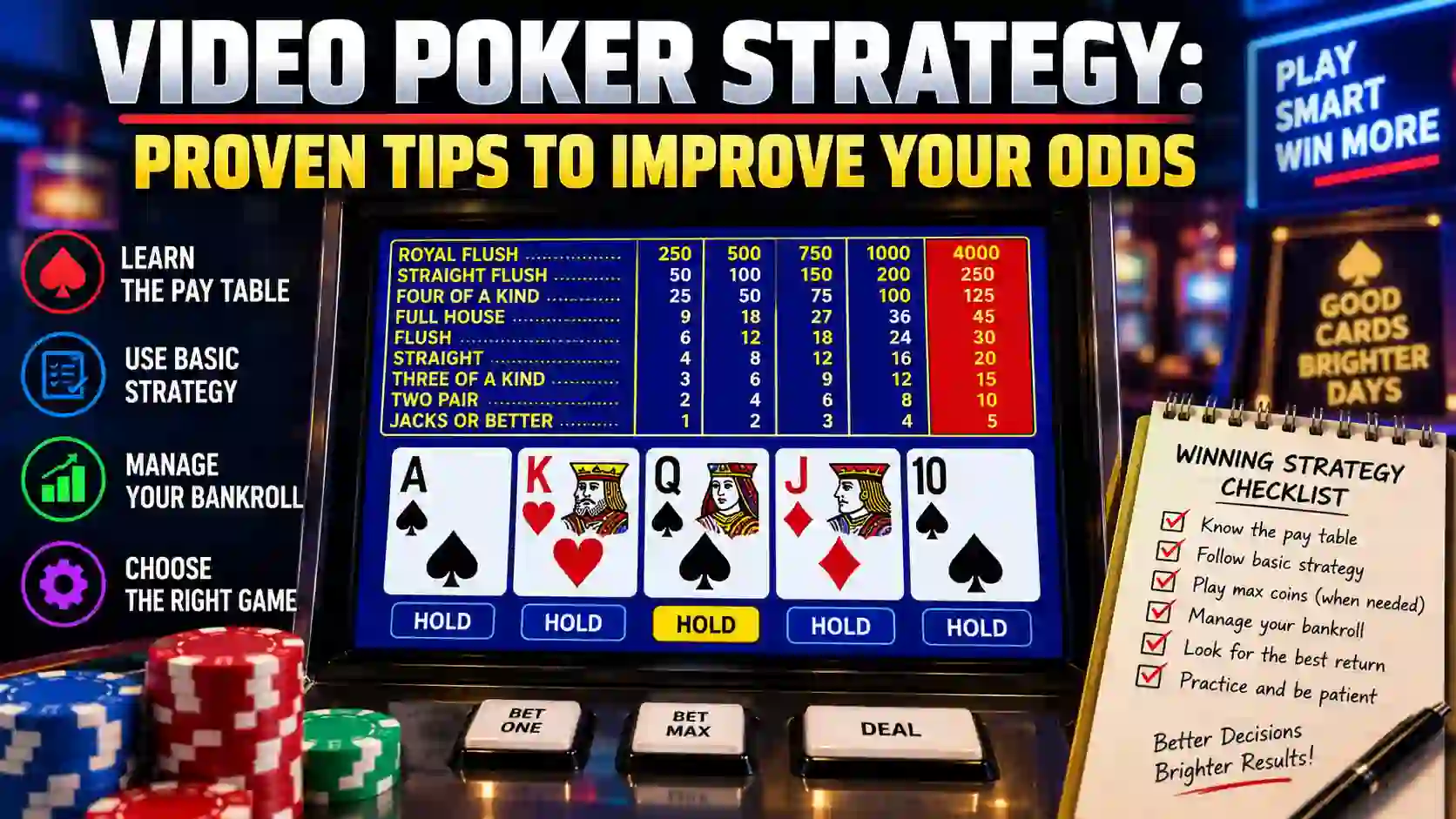
A common structure might award approximately 250 credits per credit wagered when fewer than five credits are played, but 4,000 credits for a five-credit royal, equivalent to 800 per credit.
Examples of video poker paytables documented by Wizard of Odds show precisely this type of jump at the five-credit level.
This can materially affect theoretical RTP.
However, this does not mean you should increase your stake beyond your budget merely to activate the larger royal payout.
A better approach is to choose a lower denomination where you can comfortably play the required credit level—or simply accept the different return.
Always examine the actual paytable first because modern video poker variants do not all follow identical payout structures.
- Don’t Chase Losses or Change Strategy Because You’re Losing
Imagine you have gone 30 hands without a meaningful win.
It can feel as though the game is “due.”
It isn’t.
Likewise, hitting several strong hands does not mean the machine has suddenly become “hot.”
For regulated online gambling in Great Britain, the UK Gambling Commission’s technical standards require random outcomes to be acceptably random and unpredictable. The standards also prohibit adaptive behaviour designed to change probabilities based on previous play.
That means previous results should not influence your next strategy decision.
If the mathematically correct play is to hold a low pair, it remains the correct decision whether your previous ten hands were winners or losers.
Good video poker strategy is deliberately boring in this respect:
Make the same mathematically correct decision every time the same situation occurs.
- Understand RTP Properly
A 99.54% theoretical RTP does not mean you will receive £99.54 back every time you wager £100.
RTP is a long-term statistical expectation based on an enormous number of plays.
For 9/6 Jacks or Better, a theoretical return of approximately 99.54% corresponds to a long-term house edge near 0.46% under optimal play.
The simple expected-loss calculation is:
Expected Loss = Total Amount Wagered × House Edge
If £1,000 were theoretically wagered through a game with a 0.46% house edge:
£1,000 × 0.0046 = approximately £4.60
That does not predict what will happen during an individual session.
You could finish significantly ahead or significantly behind because video poker has substantial variance, particularly because a meaningful portion of its theoretical return comes from rare premium hands.
The UK Gambling Commission requires licensed online operators to make information such as RTP, house edge or the probability of winning available where applicable so customers can make informed decisions.
- Expect Long Periods Without a Royal Flush
Royal flushes receive most of the attention in video poker, but they are extremely rare.
Under optimal 9/6 Jacks or Better strategy, Wizard of Odds calculates a royal-flush probability of roughly 0.0025% per completed hand, or approximately one royal in every 40,000 hands on average.
“On average” is the critical phrase.
You might hit two royals relatively close together. You might also play far more than 40,000 hands without seeing one.
Random events do not follow a timetable.
This is another reason bankroll decisions should never depend on believing that a jackpot is overdue.
- Use a Strategy Trainer Before Playing for Money
Reading a strategy chart is useful. Practising it is better.
A video poker strategy trainer presents hands and asks you to choose the cards you would hold. It can then compare your choice with the mathematically preferred decision.
This helps you identify recurring mistakes such as:
- Keeping too many high cards.
- Chasing weak inside straights.
- Breaking pairs unnecessarily.
- Ignoring suits.
- Misplaying three-card royal draws.
- Using the wrong strategy for the paytable.
Free-play modes can also be useful for understanding controls and pacing. In Great Britain, regulated operators offering equivalent free-play and real-money games must ensure the free version accurately represents the relevant game rules and likelihood of winning.
Practice doesn’t eliminate variance, but it can reduce avoidable decision errors.
- Slow Down
Video poker can be played quickly, particularly online.
Speed does not improve your mathematical advantage.
In fact, playing faster can increase the number of mistakes you make and the amount of money put into action per hour.
Suppose two players both wager £1 per hand on the same game.
One plays 300 hands per hour.
The other plays 600.
Even if they have the same theoretical house edge, the faster player is putting twice as much money into action.
When learning strategy, give yourself enough time to check:
Made hand → premium draw → pair → flush/straight opportunities → high cards → discard.
Accuracy is more valuable than speed.
Common Video Poker Strategy Mistakes
Even players who understand poker hand rankings can lose theoretical value through seemingly minor errors.
Among the most common mistakes are choosing a game based only on its name rather than checking the paytable, breaking strong hands to chase improbable jackpots, overvaluing Ace-high combinations, confusing inside and open-ended straight draws, ignoring suits, playing maximum credits without considering total stake size, and switching strategy after a sequence of wins or losses.
Another major error is assuming that memorising Jacks or Better strategy makes you an expert at every form of video poker.
It doesn’t.
Paytable changes alter expected values, and expected values determine strategy.
Does Perfect Video Poker Strategy Guarantee a Profit?
No.
This point deserves to be completely clear.
Optimal video poker strategy does not guarantee that you will win.
It means that, for a given hand and paytable, you are making the decision with the greatest mathematical expected value.
Even a game returning 99.54% theoretically still has a house advantage of roughly 0.46% before any unusual promotions or other external value is considered.
Short-term outcomes can also vary dramatically from the mathematical average.
Strategy improves decision quality. It does not control random cards.
FAQs
What is the best video poker strategy for beginners?
Learning full-pay Jacks or Better is a sensible starting point because the paytable is relatively simple and extensive mathematical strategy information is available. Start with a simplified strategy chart before learning rare exceptions.
What does 9/6 mean in video poker?
In Jacks or Better, “9/6” normally means a full house pays 9 credits per credit wagered and a flush pays 6.
What is the RTP of 9/6 Jacks or Better?
Under optimal strategy, full-pay 9/6 Jacks or Better has a theoretical return of approximately 99.54%.
Is video poker based on skill or luck?
Both factors matter.
Random cards determine the available outcomes, but the player’s hold/discard choices influence the expected value of each hand. That makes strategy relevant even though the cards themselves remain random.
Should I always hold an Ace?
No.
An Ace can be useful, but automatically keeping it can destroy stronger opportunities involving pairs, flushes, straights, straight flushes or royal flushes.
Always evaluate the complete hand.
Should I always bet five credits?
Not automatically.
Some traditional games offer a disproportionate royal-flush payout at the maximum-credit level, making the max-credit paytable mathematically stronger. However, never increase your stake beyond what you are comfortable losing simply to qualify for that reward. Check the specific machine’s paytable first.
Can a video poker machine become hot or cold?
Past outcomes don’t create a reliable prediction of the next randomly generated hand. On properly regulated games, outcomes must meet randomness and unpredictability requirements.
Can strategy overcome the house edge?
In most commonly available video poker games, optimal strategy reduces the house edge rather than eliminating it. Certain unusual paytables or promotions may theoretically exceed 100% return under specific conditions, but availability can be limited and the result remains a long-term statistical expectation rather than guaranteed profit.
Final Thoughts
The most effective video poker strategy is not built around lucky machines, betting systems or attempts to predict the next card.
It comes down to mathematics.
Start by finding the strongest available paytable. Learn a strategy chart designed specifically for that game. Understand the difference between premium draws and weak draws. Pay attention to suits, pairs and straight structures. Avoid changing decisions because of recent wins or losses.
For players learning Jacks or Better, full-pay 9/6 is an excellent example of why strategy matters. Optimal play produces a theoretical RTP of roughly 99.54%, while even a simplified strategy can come surprisingly close at approximately 99.46%.
The important word is theoretical.
No strategy guarantees a royal flush, a winning session or a profit. What strong strategy does is remove as many avoidable mathematical mistakes as possible.
Approach video poker as a game of calculated decisions rather than predictions. Check the paytable, use the correct strategy for the variant, practise before wagering real money and set firm limits on what you are prepared to spend.
That is the closest thing video poker has to a proven formula: you cannot control the cards, but you can control the quality of your decisions.
ADVERTISEMENT

18+ | Affiliate link | Terms apply | Please gamble responsibly.


