

18+ | Affiliate link | Terms apply | Please gamble responsibly.
Last Updated on October 13, 2026 by Maurya
The history of casinos in the United States is a fascinating story of risk, ambition, entertainment, and changing American attitudes toward gambling. Long before Las Vegas became famous for its dazzling lights and luxurious casino resorts, Americans were placing bets in colonial taverns, playing card games on Mississippi River steamboats, and trying their luck in Wild West saloons.
Over the centuries, gambling in America has experienced remarkable highs and lows. It has been celebrated as entertainment, condemned as a social problem, prohibited by law, and eventually transformed into a multibillion-dollar regulated industry.
Today, the American casino industry stretches far beyond Nevada. From Atlantic City’s famous Boardwalk to Native American casinos, regional gaming destinations, and regulated online gambling platforms, casinos have become an important part of the country’s tourism and entertainment economy.
But how did it all begin?
To understand US casino history, we need to travel back several centuries and explore the people, places, and landmark decisions that shaped gambling in America.
The Early History of Gambling in America (1600s–1700s)
Gambling existed in North America long before the first modern American casino opened its doors.
During the colonial period, European settlers introduced and popularized various forms of wagering, including card games, dice games, horse racing, and lotteries.
Gambling attitudes differed significantly between communities. Some religious groups strongly opposed betting, considering it morally unacceptable. Others viewed gambling as a normal recreational activity, provided it remained within reasonable limits.
Perhaps the most surprising part of early American gambling history is the importance of lotteries.
Unlike today’s casino games, colonial lotteries frequently served public purposes. Local governments and other organizations used them to raise money for infrastructure, educational institutions, and community projects.
According to the Smithsonian National Postal Museum, lotteries helped finance roads, bridges, schools, and other public works during America’s early development.
This created an interesting contradiction: gambling could be criticized as an individual vice while simultaneously being accepted as a practical way to raise public money.
By the late 1700s, wagering had become familiar in many parts of American society. However, there was still no nationwide casino industry resembling the one we know today.
That transformation would begin as the country expanded westward.
Gambling in the Wild West and on Mississippi Riverboats (1800s)
The 19th century marked an important turning point in the history of gambling in the USA.
As American settlements expanded westward, gambling traveled with merchants, miners, soldiers, and fortune seekers.
The Rise of Wild West Saloons
The American frontier was filled with opportunity, but daily life could also be unpredictable and dangerous.
For many settlers, saloons offered more than alcoholic drinks. They provided places to socialize, exchange information, and enjoy games of chance.
Poker became closely associated with frontier culture, alongside games such as faro and various dice games.
Faro, a card game in which players bet on cards drawn from a deck, was particularly popular in 19th-century gambling establishments. It later lost much of its appeal as other casino games became more prominent.
Unlike modern casinos, frontier gambling houses generally operated with limited oversight. Rules varied between establishments, and disputes over cheating or unpaid winnings could become serious.
These saloons helped establish an enduring American image: the professional gambler seated at a card table, surrounded by cowboys and travelers hoping to turn a few dollars into a fortune.
Although Hollywood romanticized this era, actual frontier gambling was often less glamorous and considerably less secure.
Gambling Along the Mississippi River
During the same period, the Mississippi River became another important setting for American gambling.
Steamboats transported passengers and goods between growing cities, creating opportunities for social activities during lengthy journeys.
Card games and wagering became associated with river travel, while professional gamblers sometimes targeted inexperienced passengers.
Riverboat gambling also reflected the wider culture of betting surrounding steamboat travel. As Smithsonian Magazine documents, spectators even wagered substantial amounts on steamboat races.
The connection between gambling and river travel eventually became part of American popular culture.
More than a century later, states would revive the riverboat casino concept as a regulated form of gaming.
The Anti-Gambling Movement and Prohibition Era (Late 1800s–Early 1900s)
Despite gambling’s popularity, the industry did not experience uninterrupted growth.
During the 19th century, religious reformers and political movements increasingly campaigned against lotteries and commercial betting.
Critics argued that gambling encouraged financial irresponsibility, corruption, fraud, and other social problems.
These concerns contributed to restrictive laws across much of the United States.
By the early 20th century, legal gambling opportunities had become much more limited.
The Smithsonian’s historical research shows that anti-lottery campaigns and government restrictions played a major role in reducing legalized gambling by 1910.
However, banning gambling did not eliminate public interest.
Underground card rooms, illegal betting operations, and other unauthorized activities continued in various parts of the country.
During the broader Prohibition era of the 1920s, some criminal organizations became involved in illegal gambling alongside their other activities.
This relationship between gambling and organized crime would later influence the development of casinos in Las Vegas, as well as the creation of stricter gaming regulations.
The next major change arrived in Nevada during the Great Depression.
Nevada Legalizes Casino Gambling in 1931: A Historic Turning Point
One of the most significant dates in US casino history is March 19, 1931.
On that day, Nevada Governor Fred Balzar signed legislation restoring broad commercial gambling rights in the state.
The decision came during the Great Depression, when Nevada was struggling economically and searching for new sources of business activity and government revenue.
Importantly, 1931 was not the first time Nevada had legalized gambling.
According to historian David G. Schwartz of the University of Nevada, Las Vegas (UNLV), Nevada had permitted commercial gambling in 1869 before introducing restrictions in 1909.
The 1931 legislation therefore marked the return of legal commercial casino-style gambling rather than its original introduction.
Why Nevada’s Decision Mattered
Nevada’s new gambling framework allowed licensed businesses to offer games such as blackjack, craps, and other house-banked games.
Small gambling halls began operating openly, creating the foundation for a legitimate industry.
One of the earliest licensed establishments was the Northern Club in downtown Las Vegas.
The City of Las Vegas historical timeline identifies Mayme Stocker and Joe Morgan as recipients of Clark County’s first gaming license in 1931.
At the same time, construction of nearby Hoover Dam brought thousands of workers to southern Nevada.
The combination of construction activity, population growth, and legalized gambling helped create favorable conditions for Las Vegas to expand.
Still, the city looked nothing like the enormous entertainment destination it would eventually become.
Early gambling establishments were relatively modest.
The luxury hotels, celebrity performances, and massive casino floors came later.
The Birth of Las Vegas Casinos (1940s–1950s)
The 1940s transformed Las Vegas from a small desert gambling destination into the beginnings of an internationally recognized resort city.
The most important development was the introduction of the integrated casino resort.
El Rancho Vegas: The First Resort on the Las Vegas Strip
On April 3, 1941, hotelier Thomas Hull opened El Rancho Vegas.
The property is widely recognized as the first self-contained casino resort on what would become the Las Vegas Strip.
According to UNLV Special Collections, El Rancho Vegas combined a casino with lodging, restaurants, entertainment, and other guest facilities.
Although it originally offered only 63 rooms, its business model was revolutionary.
Instead of visiting a gambling hall for a few hours, travelers could enjoy an entire vacation at one destination.
This idea became the foundation of the modern Las Vegas casino resort.
The Flamingo and the Influence of Organized Crime
Another major milestone occurred in December 1946, when the Flamingo opened.
The Flamingo became closely associated with Benjamin “Bugsy” Siegel, a notorious organized crime figure.
Siegel’s involvement helped create the enduring image of early Las Vegas as a glamorous city influenced by gangsters and wealthy investors.
However, popular stories sometimes exaggerate his role.
UNLV historian David G. Schwartz explains that the Flamingo was originally conceived by nightclub entrepreneur Billy Wilkerson and was not the first casino on the Strip.
The UNLV analysis of common gaming myths offers a useful correction to this frequently repeated misconception.
During the 1950s, new hotels and casino properties further developed the resort experience.
Lavish entertainment, celebrity performers, increasingly elaborate buildings, and distinctive neon signs helped make Las Vegas a popular tourist destination.
The city was developing an identity that combined gambling with nightlife, hospitality, and spectacle.
Yet this glamorous image had a darker side. Racial segregation excluded many Black visitors and performers from opportunities available to white patrons, even as Black entertainers contributed significantly to the city’s success. UNLV’s historical collections document these inequalities and the development of segregated neighborhoods.
The rise of Las Vegas was therefore both an entertainment success story and a reflection of the social divisions of its time.
Casino Regulation and the Corporate Transformation (1950s–1970s)
As Las Vegas casinos grew, concerns surrounding organized crime, financial transparency, and gaming integrity became increasingly important.
Nevada responded by strengthening its regulatory system.
In 1955, lawmakers established the Nevada Gaming Control Board to investigate casino operations and help enforce gaming laws.
The Nevada Gaming Commission followed in 1959, creating an additional layer of regulatory oversight.
These institutions helped establish licensing standards, investigate gaming businesses, and improve public confidence.
The Nevada Gaming Control Board continues to play a central role in regulating gaming activities.
Howard Hughes and Corporate Ownership
The late 1960s introduced another significant change.
Businessman Howard Hughes began acquiring major Las Vegas casino properties, becoming an influential figure in the industry’s transition toward corporate investment.
In 1969, Nevada enacted the Corporate Gaming Act.
The law helped make casino ownership more practical for publicly held companies by changing requirements related to shareholder investigations.
This encouraged a different type of investment.
Instead of relying primarily on individual owners and private financial networks, casino businesses could increasingly attract capital through larger corporate structures.
The consequences were substantial.
Major hospitality and entertainment companies gained opportunities to develop increasingly expensive properties.
Over time, the industry’s business model expanded from gambling-centered establishments toward large-scale leisure destinations.
Atlantic City Becomes America’s Second Major Casino Destination (1970s–1980s)
For decades, Nevada dominated legal commercial casino gambling in the United States.
That changed in the 1970s when New Jersey began exploring casino development as a possible economic solution for Atlantic City.
Once a thriving seaside vacation destination, Atlantic City had experienced significant economic decline.
Supporters believed legalized casino gambling could attract tourism, create employment, and encourage investment.
In 1976, New Jersey voters approved a constitutional amendment allowing casino gambling specifically in Atlantic City.
The measure received approximately 56% voter support, according to the New Jersey Casino Control Commission.
The state followed with casino legislation and regulatory institutions in 1977.
The First Atlantic City Casino Opens in 1978
On May 26, 1978, Resorts International opened as Atlantic City’s first legal casino.
The event represented a major breakthrough in American casino history.
For the first time in decades, a major commercial casino market was emerging outside Nevada.
Other casino hotels followed, establishing Atlantic City as an important East Coast gambling destination.
The city’s famous Boardwalk became closely associated with casino tourism, while new developments attracted visitors from surrounding metropolitan areas.
However, casino expansion was not a complete solution to Atlantic City’s economic difficulties.
Although gambling produced jobs, investment, and public revenue, questions remained about whether those benefits were reaching the wider community.
Atlantic City’s experience demonstrated that casino development could stimulate a regional economy without automatically resolving longstanding urban problems.
Native American Casinos and the Indian Gaming Regulatory Act of 1988
No account of US casino history is complete without examining Native American gaming.
The expansion of tribal casinos fundamentally changed the geographic and economic landscape of American gambling.
How Tribal Gaming Began Expanding
During the 1970s, several Native American tribes established bingo operations to generate income for tribal governments and community services.
Disagreements soon emerged between tribal governments and state authorities over the right to conduct and regulate gaming on tribal lands.
A landmark Supreme Court decision helped clarify the situation.
In 1987, the Court ruled in California v. Cabazon Band of Mission Indians that California could not apply certain gambling restrictions to tribal gaming operations under the circumstances considered.
Congress subsequently passed the Indian Gaming Regulatory Act (IGRA) in 1988.
According to the National Indian Gaming Commission (NIGC), the legislation established a federal framework for regulating tribal gaming and recognized important aspects of tribal governmental authority.
The law organized tribal gaming into three classes, each subject to different regulatory requirements.
Class III gaming, which includes traditional casino-style gambling such as slot machines and many table games, generally requires a tribal-state compact.
The Economic Impact of Tribal Casinos
Tribal gaming created new opportunities for many Native American nations.
Casino revenue can help tribal governments finance education, healthcare, housing, infrastructure, and other programs.
Some tribal casinos have also developed into major resorts featuring hotels, entertainment venues, restaurants, and conference facilities.
The industry’s scale demonstrates how significant this transformation has been.
In July 2026, the NIGC reported that tribal gaming generated $46.2 billion in gross gaming revenue during fiscal year 2025, based on audited reports from 545 gaming establishments operated by 246 tribes across 29 states.
Tribal casinos are not simply another category of commercial gambling business. They operate within a distinct legal and governmental framework closely connected to tribal sovereignty.
Their growth remains one of the most consequential developments in modern American gambling history.
The Return of Riverboat Casinos and Regional Gambling (1990s)
By the end of the 1980s, legalized casino gambling was expanding beyond its traditional centers.
States increasingly considered casinos as potential sources of tourism, employment, and tax revenue.
Iowa played a pioneering role.
In 1989, the Iowa Legislature authorized casino gambling aboard riverboats, helping establish a new model for regulated gaming.
Other states adopted various forms of riverboat, dockside, or land-based casino gambling during the 1990s.
These establishments often served regional customers who preferred gambling closer to home instead of traveling to Las Vegas or Atlantic City.
The development of regional casinos changed the industry in several important ways.
Casino gaming became accessible in more parts of the country, competition increased, and state governments developed their own regulatory frameworks.
The return of riverboat casinos also connected modern gambling tourism with an older chapter of American history.
However, these newer operations were regulated commercial casinos, not continuations of the informal gambling that took place on 19th-century steamboats.
The Rise of Modern Casino Mega-Resorts (1980s–2000s)
While casino gambling spread across the country, Las Vegas was preparing for another dramatic transformation.
In November 1989, developer Steve Wynn opened The Mirage.
The luxury resort introduced a new standard for large-scale casino development.
Its combination of upscale accommodations, elaborate attractions, dining, and entertainment helped inspire the next generation of Las Vegas properties.
UNLV historian David G. Schwartz identifies The Mirage’s opening as a pivotal moment in the development of the modern mega-resort era.
Throughout the 1990s and early 2000s, ambitious developments changed the appearance of the Las Vegas Strip.
Properties such as the Luxor, MGM Grand, Bellagio, and Venetian brought increasingly elaborate architectural concepts and entertainment experiences to the city.
Casino resorts were no longer competing solely through gambling options.
They increasingly attracted visitors through luxury shopping, restaurants, concerts, exhibitions, conventions, and immersive environments.
This diversification helped transform Las Vegas into a broad tourism and entertainment destination.
For visitors, the experience changed as well.
A person could spend several days at a major resort without necessarily making gambling the main purpose of the trip.
That remains a defining characteristic of modern casino resorts.
The Digital Revolution: Online Casinos in the United States
The development of the internet introduced one of the biggest changes in the history of gambling in America.
Traditional casinos required customers to visit physical locations.
Online gaming made it possible for eligible customers to access certain gambling products through computers, and later, smartphones.
However, the development of regulated online casinos in the United States was more complicated than simply moving casino games onto the internet.
Federal laws, state restrictions, licensing requirements, and the distinction between different types of online gambling created a complex legal environment.
Legal Online Gambling Expands in 2013
The year 2013 became an important milestone for regulated internet gaming.
Nevada introduced legal online poker, while Delaware and New Jersey established broader forms of regulated online gambling.
New Jersey’s online casino operations began in November 2013, allowing eligible adults physically located within the state to access approved gaming platforms.
The New Jersey Casino Control Commission documents this expansion as a significant development in the state’s casino industry.
Unlike unregulated gambling websites, licensed online casino operators must comply with applicable state requirements.
These can include identity verification, age restrictions, geolocation systems, gaming software standards, and player protection measures.
Mobile Gaming Changes Customer Expectations
Smartphones have made digital convenience a major factor in modern gambling.
In states where online casino gaming is legal, eligible players may be able to access games such as blackjack, roulette, poker, and digital slots without visiting a physical casino.
Some platforms also offer live-dealer games that stream real table-game sessions to players.
Still, an important distinction remains: online casino gambling is not legal in every US state, and the availability of online sports betting does not necessarily mean online casino games are permitted.
Customers must follow the laws applicable to their location.
Sports Betting Legalization in 2018: Another Major Milestone
Another turning point arrived on May 14, 2018.
In Murphy v. National Collegiate Athletic Association, the United States Supreme Court struck down the federal restrictions on state authorization of sports gambling contained in the Professional and Amateur Sports Protection Act (PASPA).
The decision allowed states to make their own choices about legalizing and regulating sports betting, subject to other applicable laws.
The ruling accelerated the expansion of regulated sports wagering across the country.
Many casino operators introduced sportsbooks, while mobile betting platforms became an increasingly visible part of the gambling market.
Sports wagering added another dimension to the modern casino business, connecting gambling with professional sports, entertainment, and digital technology.
It also renewed debates about advertising, gambling-related harm, consumer protection, and sports integrity.
US Casino Industry Today: Market Size and Economic Impact
The modern American casino industry is much larger and more diverse than its early pioneers could have imagined.
Commercial casino resorts, tribal gaming properties, regional casinos, sportsbooks, and licensed online platforms now form an extensive entertainment industry.
According to the American Gaming Association’s State of the States 2026 report, US commercial gaming generated $78.62 billion in revenue during 2025, an increase of 9.1% over the previous year.
The report also recorded $17.86 billion in direct gaming tax revenue from commercial gaming activities.
Regulated internet casino gaming contributed $10.73 billion in 2025 revenue across the seven states with lawful online casino markets during that year.
These figures are significant, but they require careful interpretation.
The American Gaming Association’s commercial gaming figures and the NIGC’s tribal gaming revenue figures represent different reporting categories. They should not be confused with one another or treated as identical measures.
Beyond the Gaming Floor
Today’s casino businesses often contribute to several parts of the economy, including hospitality, tourism, entertainment, food service, construction, and technology.
Large destinations can attract conferences, international visitors, and events that extend well beyond gambling.
At the same time, economic benefits differ by community.
The success of individual casinos does not guarantee that every nearby neighborhood will experience the same level of prosperity.
Employment conditions, competition, infrastructure demands, public spending, and gambling-related social costs all matter when evaluating the industry’s overall impact.
This broader perspective is essential for understanding the role of casinos in contemporary America.
Responsible Gambling and the Future of US Casinos
The next chapter of US casino history will likely be influenced by technology, customer preferences, and regulation.
Artificial intelligence, digital payment systems, mobile platforms, and increasingly sophisticated gaming technology may change how operators manage their businesses and serve customers.
Casino resorts are also likely to continue competing through experiences outside gambling, including major entertainment events, premium dining, and hospitality.
However, growth creates responsibilities.
Expanded access to gambling can increase risks for people who struggle to control their betting.
Responsible gaming measures, such as spending limits, voluntary self-exclusion, age verification, and access to support services, have become important parts of the regulatory discussion.
The National Council on Problem Gambling offers confidential support and referrals through the National Problem Gambling Helpline at 1-800-MY-RESET, available around the clock.
Future developments will depend not only on how casinos attract customers but also on how effectively regulators and operators protect them.
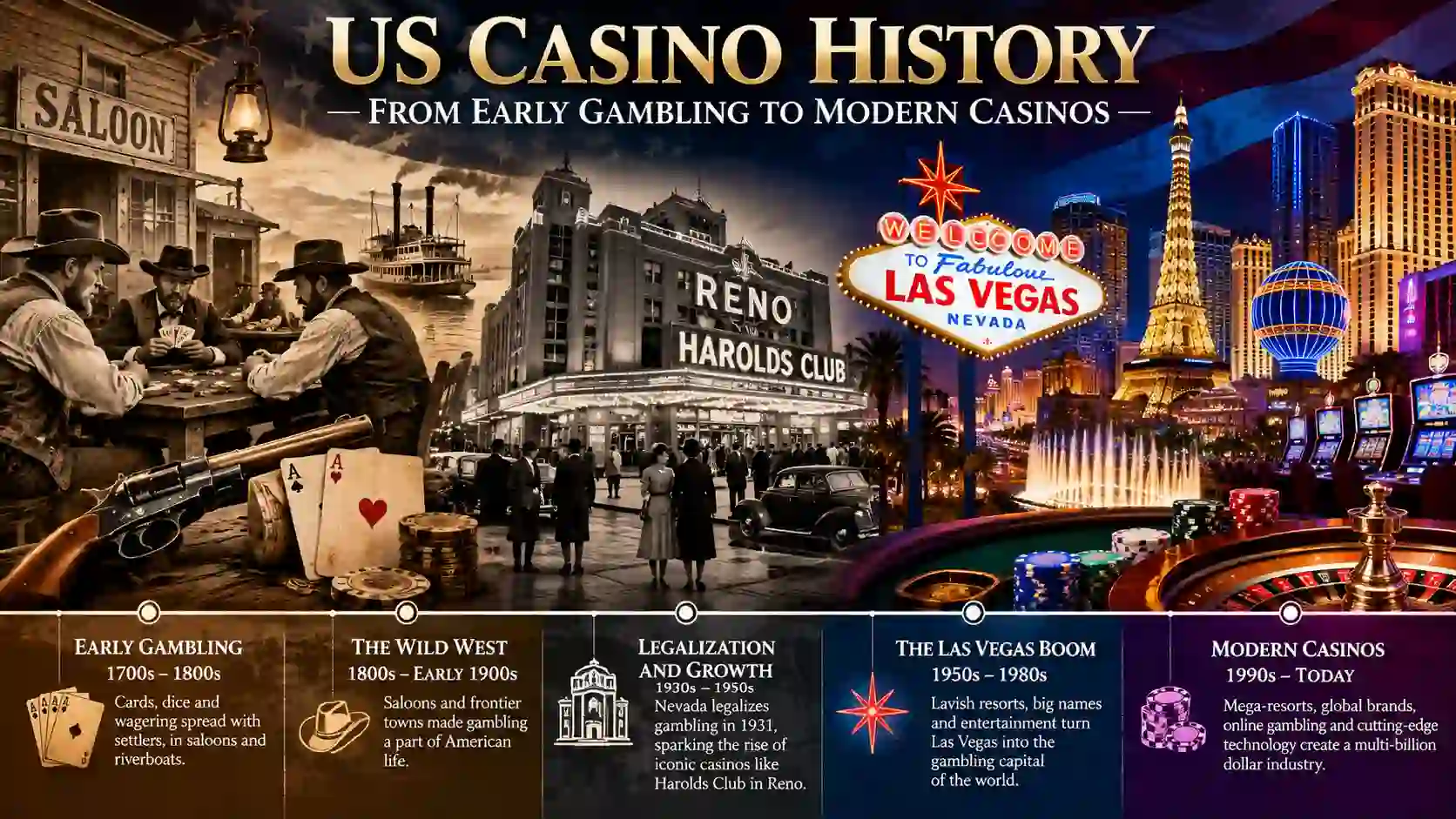
US Casino History Timeline: Key Dates and Events
The following timeline highlights some of the most important milestones in the evolution of American casinos:
- 1600s–1700s: Card games, wagering, and lotteries become established in colonial America.
- 1800s: Gambling grows in frontier saloons, river communities, and other expanding settlements.
- 1869: Nevada legalizes commercial gambling.
- 1909–1910: Nevada’s restrictions on commercial gambling take effect.
- 1931: Nevada restores wide-open commercial gambling on March 19.
- 1941: El Rancho Vegas opens as the first self-contained casino resort on the future Las Vegas Strip.
- 1946: The Flamingo opens in Las Vegas.
- 1955–1959: Nevada establishes major modern gaming regulatory institutions.
- 1969: Nevada’s Corporate Gaming Act helps facilitate corporate casino ownership.
- 1976: New Jersey voters approve casino gambling in Atlantic City.
- 1978: Resorts International opens as Atlantic City’s first casino.
- 1987: The Supreme Court issues its landmark Cabazon tribal gaming decision.
- 1988: Congress passes the Indian Gaming Regulatory Act.
- 1989: The Mirage opens in Las Vegas, and Iowa authorizes riverboat gambling.
- 1990s: Regional casinos and large-scale Las Vegas resorts expand rapidly.
- 2013: Regulated internet casino gaming expands in states including New Jersey and Delaware.
- 2018: The Supreme Court overturns PASPA’s restrictions on state-authorized sports betting.
- 2025: US commercial gaming revenue reaches $78.62 billion, according to figures published in 2026.
FAQs
When did casinos first appear in the United States?
Commercial gambling establishments existed in the United States long before modern casino resorts. Gambling houses and frontier saloons operated during the 19th century, while Nevada legalized commercial gambling in 1869. The modern Nevada casino industry developed after the state restored broad commercial gambling rights in 1931.
What was the first casino in America?
There is no universally accepted answer because the term “casino” has been used to describe different types of establishments throughout American history.
However, El Rancho Vegas, which opened on April 3, 1941, is recognized as the first self-contained casino resort on the Las Vegas Strip. It was not the first gambling establishment in America or Nevada.
Why did Las Vegas become famous for casinos?
Las Vegas benefited from Nevada’s 1931 gambling legislation, increased tourism, nearby Hoover Dam construction, and investment in casino resorts. Over time, entertainment, luxury accommodations, restaurants, and major attractions helped the city become a globally recognized destination.
When did Atlantic City legalize casino gambling?
New Jersey voters approved casino gambling in Atlantic City in November 1976. The state’s first legal casino, Resorts International, opened on May 26, 1978.
When did Native American casinos become legal?
Tribal gaming existed before 1988, but the Indian Gaming Regulatory Act established the principal federal framework for tribal gaming that year. The legislation followed the Supreme Court’s important 1987 Cabazon decision and recognized a system of tribal, federal, and state responsibilities.
When did online casinos become legal in the United States?
Regulated online gambling reached a major milestone in 2013, when Nevada, Delaware, and New Jersey implemented different forms of authorized internet gaming. Nevada’s initial market centered on online poker, while Delaware and New Jersey allowed broader online casino games. Online casino laws still vary by state.
How big is the US casino industry today?
The American Gaming Association reported $78.62 billion in US commercial gaming revenue for 2025, including traditional commercial casino gaming, regulated sports betting, and internet gaming. Tribal gaming is reported separately by the National Indian Gaming Commission, which recorded $46.2 billion for fiscal year 2025.
Conclusion
The history of casinos in the United States reflects more than the development of an entertainment business. It tells a broader story about American culture, economic opportunity, government regulation, and changing attitudes toward risk.
From colonial lotteries and Wild West saloons to Nevada’s gambling legalization in 1931, every era contributed something to the evolution of casino gaming.
Las Vegas introduced the destination resort model. Atlantic City demonstrated how casino gambling could reshape an established tourist city. Native American gaming created major opportunities for tribal economic development, while regional casinos brought gambling to new markets.
More recently, digital technology and the expansion of legal sports betting have introduced entirely new ways for eligible adults to participate.
US casino history is ultimately a story of constant reinvention. What began with relatively simple games of chance has developed into a complex industry that combines entertainment, hospitality, technology, and public policy.
And as new technologies and regulations emerge, the American casino industry will continue writing its next chapter.
ADVERTISEMENT

18+ | Affiliate link | Terms apply | Please gamble responsibly.


