

18+ | Affiliate link | Terms apply | Please gamble responsibly.
Last Updated on October 1, 2026 by Maurya
Knowing the types of poker hands and their rankings is one of the first skills every poker player needs to master. Whether you are learning Texas Hold’em, Omaha, Five-Card Draw, or another traditional high-hand poker game, understanding what beats what allows you to read the table quickly and determine the winning hand at showdown.
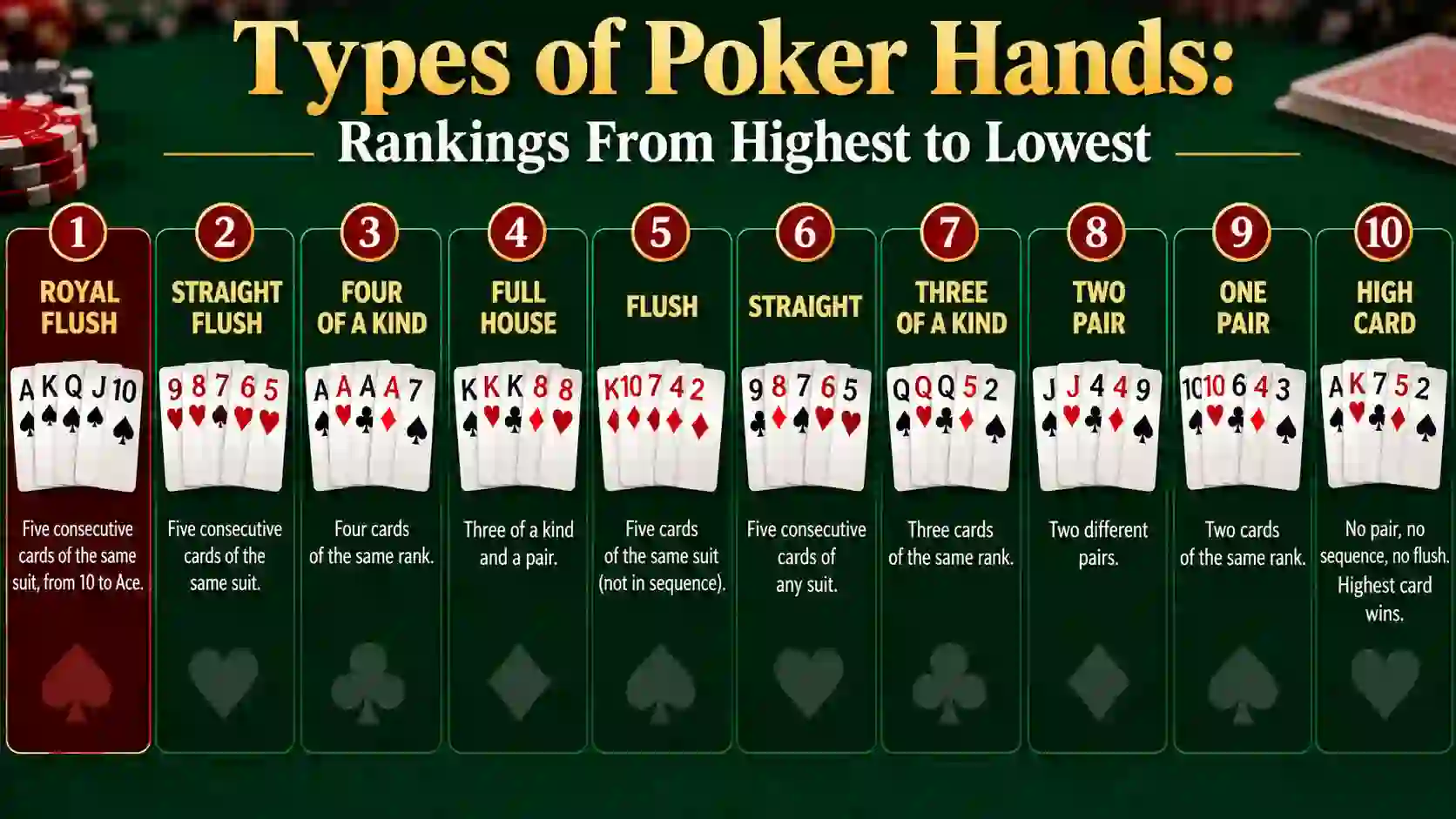
The standard poker hand rankings run from a Royal Flush—the strongest possible hand—to a High Card, which is the weakest category. Between those two are eight other combinations, including Straight Flushes, Four of a Kind, Full Houses, Flushes, Straights, Three of a Kind, Two Pair, and One Pair.
In Texas Hold’em, players have access to seven cards by the river: two private hole cards and five community cards. The objective at showdown is to make the strongest possible five-card poker hand from those available cards. You may use both hole cards, one hole card, or none of them if the community cards already create your best five-card combination.
Here is everything you need to know about the poker hands in order from highest to lowest, including examples, tie-break rules, probabilities, and common points of confusion.
Poker Hand Rankings Chart: Highest to Lowest
| Rank | Poker Hand | Example | Strength |
| 1 | Royal Flush | A♠ K♠ Q♠ J♠ 10♠ | Highest |
| 2 | Straight Flush | 9♥ 8♥ 7♥ 6♥ 5♥ | Extremely strong |
| 3 | Four of a Kind | Q♠ Q♥ Q♦ Q♣ 7♠ | Very strong |
| 4 | Full House | K♠ K♥ K♦ 8♣ 8♥ | Very strong |
| 5 | Flush | A♦ J♦ 8♦ 5♦ 2♦ | Strong |
| 6 | Straight | 10♠ 9♦ 8♣ 7♥ 6♠ | Strong |
| 7 | Three of a Kind | 7♠ 7♥ 7♦ K♣ 2♠ | Moderate |
| 8 | Two Pair | J♠ J♦ 5♣ 5♥ A♦ | Moderate |
| 9 | One Pair | A♠ A♥ 10♦ 6♣ 3♠ | Common |
| 10 | High Card | A♠ J♦ 9♣ 6♥ 3♦ | Lowest |
This is the standard traditional hierarchy used in games such as Texas Hold’em and other common high-hand poker formats. A higher category always defeats a lower category at showdown. For example, any Full House beats any Flush, while any Straight beats any Three of a Kind.
Royal Flush
A Royal Flush is the highest poker hand possible under standard high-hand rules.
It consists of:
Ace, King, Queen, Jack, and 10—all of the same suit.
Example:
A♥ K♥ Q♥ J♥ 10♥
A Royal Flush is technically the highest possible form of a Straight Flush, although poker ranking charts commonly give it its own category because of its unique status.
There are only four possible Royal Flush combinations in a standard 52-card deck: one each in spades, hearts, diamonds, and clubs.
Importantly, suits do not have different values in standard poker. A Royal Flush in clubs is worth exactly the same as one in spades.
In a random five-card deal from a conventional 52-card deck, there are only four Royal Flush combinations among 2,598,960 possible five-card hands, giving a probability of approximately 0.000154%, or roughly one in 649,740 five-card deals.
What does a Royal Flush beat? Everything.
Straight Flush
A Straight Flush contains five consecutive cards that all belong to the same suit.
Example:
9♣ 8♣ 7♣ 6♣ 5♣
Another example would be:
Q♦ J♦ 10♦ 9♦ 8♦
When two Straight Flushes are compared, the hand with the higher top card wins. Therefore, a Queen-high Straight Flush beats a Jack-high Straight Flush.
The highest possible Straight Flush is A-K-Q-J-10 of one suit, which is specifically known as a Royal Flush.
At the other end of the range, A-2-3-4-5 can form a five-high Straight Flush because an Ace may act as the low card in this sequence under standard rules. It cannot, however, wrap around—for example, Q-K-A-2-3 is not a Straight.
What does a Straight Flush beat? Four of a Kind, Full House, Flush, Straight, Three of a Kind, Two Pair, One Pair, and High Card.
Four of a Kind
Four of a Kind, often called quads, means holding four cards of exactly the same rank.
Example:
10♠ 10♥ 10♦ 10♣ A♠
Since a conventional deck contains four cards of each rank, all four suits of the same value are needed to make Four of a Kind.
If two players somehow have Four of a Kind in a game using shared cards, the higher set of four wins. Four Kings beat Four Queens, for example.
When both players use the same Four of a Kind from the community cards, the fifth card—the kicker—can decide the winner. If their complete best five-card hands are identical, the pot is split.
In a random five-card deal, Four of a Kind occurs in 624 of the 2,598,960 possible hands, or approximately 0.024% of the time.
What does Four of a Kind beat? Full House and every hand ranked below it.
Full House
A Full House combines Three of a Kind with a separate Pair.
Example:
K♠ K♥ K♦ 8♣ 8♦
This hand would normally be described as “Kings full of Eights.”
A Full House is stronger than a Flush but weaker than Four of a Kind.
When two Full Houses compete, you compare the three matching cards first—not the Pair.
For example:
Q-Q-Q-5-5 beats J-J-J-A-A because the three Queens outrank the three Jacks. The value of the Pair only becomes relevant when comparing hands whose three-of-a-kind component has the same rank.
There are 3,744 Full House combinations among all standard five-card hands, producing a probability of approximately 0.144% in a random five-card deal.
What does a Full House beat? Flush, Straight, Three of a Kind, Two Pair, One Pair, and High Card.
Flush
A Flush is made from five cards of the same suit that do not form a consecutive Straight Flush.
Example:
A♣ J♣ 8♣ 5♣ 2♣
The numerical values do not need to be consecutive. The only requirement is that all five cards share the same suit.
One of the most common beginner questions is: Does a Flush beat a Straight?
Yes. Under standard poker hand rankings, a Flush beats a Straight.
If two players have a Flush, the highest card in each five-card hand is compared first. If those cards tie, compare the second-highest cards, then the third-highest, and continue until a difference appears.
For example, an Ace-high Flush beats a King-high Flush.
Remember that the suit itself is not a tie-breaker. Spades do not outrank hearts, and diamonds do not outrank clubs under standard poker hand-ranking rules.
What does a Flush beat? Straight, Three of a Kind, Two Pair, One Pair, and High Card.
Straight
A Straight consists of five cards with consecutive ranks that are not all the same suit.
Example:
10♠ 9♦ 8♣ 7♥ 6♠
The highest card determines the strength of the Straight. An Ace-high Straight—A-K-Q-J-10—is the highest conventional Straight.
An Ace can also play low in:
A-2-3-4-5
This combination is normally called a five-high Straight or a “wheel.”
However, an Ace cannot connect the high and low ends of the deck simultaneously. Hands such as K-A-2-3-4 therefore do not qualify as Straights.
When comparing two Straights, only the highest card matters. A Jack-high Straight beats a 10-high Straight.
What does a Straight beat? Three of a Kind, Two Pair, One Pair, and High Card.
Three of a Kind
Three of a Kind consists of three cards with the same rank plus two unrelated cards.
Example:
8♠ 8♥ 8♦ K♣ 4♠
In Texas Hold’em, you may hear players use the terms “set” and “trips.” Both describe Three of a Kind, but they are formed differently.
A set is commonly made when you hold a pocket pair and a third matching card appears on the board. Trips generally describes holding one matching hole card when two cards of that rank appear among the community cards.
When two players hold Three of a Kind, the higher triplet wins. Three Queens beat Three Tens.
If the three matching cards are identical because they come from the board, the remaining kickers determine the winner.
What does Three of a Kind beat? Two Pair, One Pair, and High Card.
Two Pair
As the name suggests, Two Pair contains two separate pairs of cards plus one additional card.
Example:
K♠ K♦ 7♥ 7♣ A♠
This would be described as Kings and Sevens with an Ace kicker.
When comparing two Two-Pair hands, start with the highest Pair.
For example:
A-A-4-4-9 beats K-K-Q-Q-J
because the Pair of Aces is stronger than the Pair of Kings.
If both players have the same highest Pair, compare the second Pair. If both Pairs are equal, the fifth card—the kicker—breaks the tie.
What does Two Pair beat? One Pair and High Card.
One Pair
One Pair contains two cards of the same rank plus three other cards that do not create a stronger combination.
Example:
Q♠ Q♦ A♥ 8♣ 4♠
One Pair is one of the most frequently encountered made hands in poker. In a random five-card deal, approximately 42.26% of possible hands contain exactly One Pair.
When two players have a Pair, the higher Pair wins.
For example:
A-A-10-8-4 beats K-K-Q-J-9.
If the Pairs are identical, the kickers become important. Compare the highest remaining card first, followed by the next and then the final card if necessary.
What does One Pair beat? High Card.
High Card
High Card is the lowest category in standard poker hand rankings.
You have a High Card hand when your best five cards do not form a Pair, Two Pair, Three of a Kind, Straight, Flush, Full House, Four of a Kind, Straight Flush, or Royal Flush.
Example:
A♠ J♦ 9♣ 6♥ 3♦
This is called Ace-high because the Ace is the highest-ranking card.
If two players have High Card hands, compare their highest cards first. If those are equal, move to the second-highest card, then the third, fourth, and fifth until the tie is broken.
For example:
A-K-9-7-4 beats A-Q-J-10-8
because after the tied Aces are compared, the King outranks the Queen.
If all five cards are identical, the players tie and split the pot.
Poker Hand Probabilities
The following probabilities refer specifically to being dealt five random cards from a standard 52-card deck, not to the probability of finishing with each hand in Texas Hold’em after seeing seven available cards.
| Poker Hand | Five-Card Probability |
| Royal Flush | 0.000154% |
| Straight Flush, excluding Royal Flush | 0.00139% |
| Four of a Kind | 0.02401% |
| Full House | 0.1441% |
| Flush, excluding Straight Flush | 0.1965% |
| Straight, excluding Straight Flush | 0.3925% |
| Three of a Kind | 2.1128% |
| Two Pair | 4.7539% |
| One Pair | 42.2569% |
| High Card | 50.1177% |
There are 2,598,960 possible combinations when five cards are selected from a standard 52-card deck. The probabilities above illustrate an important principle behind conventional poker rankings: stronger hands generally correspond to combinations that are harder to make.
Do not confuse these numbers with Texas Hold’em river probabilities. In Hold’em, a player can select the best five-card combination from seven available cards, so the frequencies are different.
How Are Ties Decided in Poker?
Understanding the hierarchy is only half of learning what beats what in poker. Players also need to know what happens when two opponents hold the same category of hand.
Poker compares the best five-card hands.
Suppose two players both have One Pair. You first compare the value of the Pair. If the Pairs are the same, the highest kicker decides the winner. If that card also ties, move to the next kicker.
Flushes are compared from their highest card downward. Straights and Straight Flushes are determined by their highest card. Full Houses are compared by the Three-of-a-Kind component first. Two-Pair hands compare the higher Pair, then the lower Pair, followed by the kicker.
If every card in the two best five-card combinations is identical, neither player wins outright. The pot is divided between the tied players.
Do Suits Have a Ranking in Poker?
No. In standard poker hand comparisons, spades, hearts, diamonds, and clubs have equal value.
A King-high Flush in spades does not automatically beat a King-high Flush in hearts simply because of its suit. You compare the actual card ranks instead.
Suits are important for determining whether a player has made a Flush or Straight Flush, but they normally do not break ties between otherwise equal poker hands.
Do You Have to Use Both Hole Cards in Texas Hold’em?
No.
Texas Hold’em gives each player two private hole cards and eventually places five community cards on the table. At showdown, your hand is simply the best five-card combination available from those seven cards.
That means you can use both hole cards, only one hole card, or no hole cards at all.
For example, if the board itself reads:
A♥ K♥ Q♥ J♥ 10♥
every remaining player has the same Royal Flush regardless of their hole cards. The pot would therefore be split between the eligible players.
This is different from games such as Omaha, where rules governing how hole cards and community cards must be used are different.
Do Poker Hand Rankings Change Between Games?
The rankings covered in this guide apply to conventional high-hand poker and are commonly used in games such as Texas Hold’em and traditional high versions of Omaha and Stud.
However, not every poker variant follows exactly the same hierarchy.
For example, lowball games deliberately reward lower-value combinations rather than conventional high hands. Razz follows a low-hand system, while Deuce-to-Seven has its own lowball rules. Some Short Deck poker formats also alter the relative ranking of particular hands because removing lower cards changes the mathematical frequency of certain combinations. PokerStars, for example, notes that in its Short Deck ranking structure a Flush ranks above a Full House.
For that reason, always confirm the specific rules of the poker variant you are playing rather than assuming every game uses an identical ranking table.
Common Poker Hand Ranking Mistakes
Beginners often understand the individual hands but confuse the order in which they rank.
One of the most frequent mistakes is thinking a Straight beats a Flush. It does not: a Flush ranks above a Straight.
Another is assuming Three of a Kind beats a Straight because three matching cards seem more impressive. A Straight is actually the stronger hand.
Players can also overlook their best five-card combination in community-card games. Having two hole cards does not mean both must appear in your final Hold’em hand.
Finally, players sometimes try to use suit as a tie-breaker. In ordinary hand comparisons, the suit does not determine which otherwise equal hand wins.
Remembering these details is just as important as memorizing the ranking chart itself.
Easy Way to Remember Poker Hands in Order
The easiest approach is to learn poker hands in groups.
At the top are the rare premium combinations: Royal Flush, Straight Flush, Four of a Kind, and Full House.
Next come the two five-card pattern hands: Flush and Straight.
Then come the matching-rank combinations: Three of a Kind, Two Pair, and One Pair.
Finally, if you have none of those combinations, you are left with High Card.
With regular play, the order quickly becomes automatic.
FAQs
What are the poker hands in order from highest to lowest?
The standard order is Royal Flush, Straight Flush, Four of a Kind, Full House, Flush, Straight, Three of a Kind, Two Pair, One Pair, and High Card.
What is the highest hand in poker?
A Royal Flush is the highest standard poker hand. It consists of Ace, King, Queen, Jack, and 10, all from the same suit.
What is the lowest poker hand?
High Card is the lowest poker hand category. It applies when your best five cards do not create any stronger combination.
Does a Flush beat a Straight?
Yes. A Flush beats a Straight in standard poker hand rankings.
Does a Full House beat a Flush?
Yes. A Full House beats a Flush. It is the fourth-highest category in the conventional ranking order, sitting below Four of a Kind and above a Flush.
Does Three of a Kind beat Two Pair?
Yes. Three of a Kind beats Two Pair, regardless of the ranks involved. For example, three Twos still beat a Two-Pair hand containing Aces and Kings.
Can an Ace be low in a Straight?
Yes. An Ace can be used as the lowest card in A-2-3-4-5. It can also be high in 10-J-Q-K-A. It cannot wrap around between King and Two, so combinations such as Q-K-A-2-3 are not valid Straights.
What happens if two players have exactly the same poker hand?
If the players’ best five-card hands are identical, the hand is tied and the pot is normally split between them. Suits do not break the tie in standard hand rankings.
Is a Royal Flush different from a Straight Flush?
A Royal Flush is technically the highest possible Straight Flush—A-K-Q-J-10 of the same suit. However, it is traditionally displayed as a separate hand at the top of poker ranking charts.
Final Thoughts
Learning the types of poker hands from highest to lowest gives you the foundation needed to understand almost every decision made at a poker table.
The order begins with the unbeatable Royal Flush, followed by Straight Flush, Four of a Kind, Full House, Flush, Straight, Three of a Kind, Two Pair, One Pair, and finally High Card.
Knowing the names is only the beginning. You should also understand how equal categories are compared, when kickers matter, how Straights use an Ace, and why the best five-card combination—not simply the cards in your hand—determines the winner in games such as Texas Hold’em.
Once these poker hand rankings become second nature, reading showdowns becomes faster and far less confusing. Keep the ranking chart handy while learning, and before long you will know exactly what beats what in poker without having to think twice.
ADVERTISEMENT

18+ | Affiliate link | Terms apply | Please gamble responsibly.


