

18+ | Affiliate link | Terms apply | Please gamble responsibly.
Last Updated on October 29, 2026 by Maurya
The online gambling industry has become more regulated, more international and significantly more compliance-driven. For operators planning to launch an online casino, sportsbook, poker platform, lottery product or gambling software company, choosing the right jurisdiction in 2026 is no longer simply a question of finding the cheapest gaming licence.
Licensing reputation, market access, gambling tax, banking relationships, payment processing, technical requirements, anti-money-laundering controls, local substance requirements and the cost of ongoing compliance can all determine whether an iGaming business succeeds.
This is particularly important in 2026 because several established gambling jurisdictions have changed their regulatory or tax frameworks. Gibraltar introduced a new gambling regime, Curaçao is operating under its reformed National Ordinance on Games of Chance, Estonia changed gambling taxation, and the United Kingdom increased Remote Gaming Duty to 40%.
There is also no single licence that gives an operator unrestricted access to every major gambling market. The most effective structure may therefore involve a respected headquarters jurisdiction combined with separate local licences in important target markets.
Based on regulatory credibility, commercial practicality, taxation, licensing infrastructure and market opportunities, the following are among the top countries and jurisdictions for online gambling businesses in 2026.
Best Online Gambling Jurisdictions in 2026
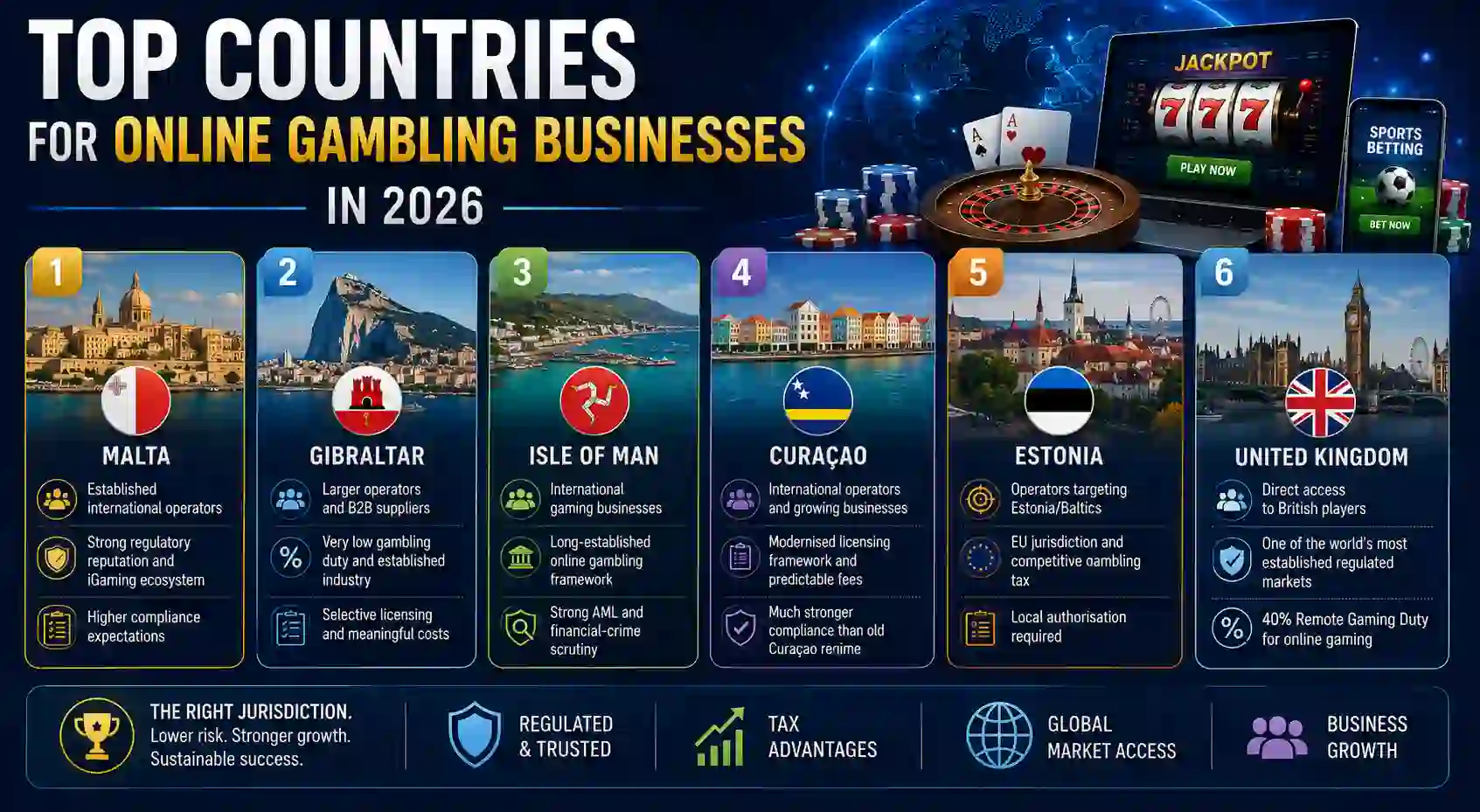
| Jurisdiction | Best For | Key Advantage | Main Consideration |
| Malta | Established international operators | Strong regulatory reputation and iGaming ecosystem | Higher compliance expectations |
| Gibraltar | Larger operators and B2B suppliers | Very low gambling duty and established industry | Selective licensing and meaningful costs |
| Isle of Man | International gaming businesses | Long-established online gambling framework | Strong AML and financial-crime scrutiny |
| Curaçao | International operators and growing businesses | Modernised licensing framework and predictable fees | Much stronger compliance than old Curaçao regime |
| Estonia | Operators targeting Estonia/Baltics | EU jurisdiction and competitive gambling tax | Local authorisation required |
| United Kingdom | Direct access to British players | One of the world’s most established regulated markets | 40% Remote Gaming Duty for online gaming |
Malta – Best Overall Base for Established iGaming Businesses
Malta remains one of the most important locations in international online gambling. The country has spent decades developing a specialist ecosystem encompassing operators, platform providers, game studios, payment businesses, compliance professionals, lawyers and technology companies.
The Malta Gaming Authority, or MGA, offers both B2C gaming service licences and B2B critical gaming supply licences, making Malta suitable for casino operators as well as software suppliers and gaming technology businesses.
For remote B2C gaming, the MGA currently lists a one-time application fee of €5,000 and a fixed annual licence fee of €25,000. Operators are also subject to applicable gaming tax and compliance contributions, with the latter varying according to the gaming activity and revenue generated.
Malta can be especially attractive for businesses that want more than a licence. Operators can build genuine corporate operations in an established European iGaming centre with access to experienced compliance officers, executives and suppliers.
Its B2B framework is another major advantage. MGA documentation shows that critical gaming supply licensing can cover game providers, platform technology and other essential gambling systems, with annual licensing costs varying according to revenue and the nature of the supply.
Why Malta is attractive in 2026
Malta’s biggest strength is credibility. An MGA licence is widely recognised within the industry, and the regulator’s extensive technical, financial and compliance requirements can make it easier for legitimate operators to demonstrate regulatory maturity to commercial partners.
However, businesses should not assume an MGA licence is an automatic passport into every European country. Gambling regulation is not fully harmonised across the European Economic Area. Individual countries can impose their own licensing requirements.
That makes Malta particularly useful as a corporate and international operating base, while operators may still require separate authorisation in regulated countries they actively target.
Best suited to: established casino operators, sportsbooks, B2B suppliers, platform providers and companies building a long-term European iGaming operation.
Gibraltar – A Premium Jurisdiction for Serious Gambling Operators
Gibraltar remains one of the industry’s most important gambling centres and entered a particularly significant regulatory period in 2026.
The jurisdiction’s Gambling Act 2025 came into operation in 2026, replacing the previous framework and broadening regulation across B2C operators, B2B businesses and certain gambling-related support services. The Gambling Division states that the new framework includes businesses managed or controlled in or from Gibraltar and a wider range of B2B activities.
Gibraltar is especially attractive because of its gambling duty. Under the 2026 regulations, General Gaming Duty and General Betting Duty are set at 0.15% of gross gaming or betting profit, with the first £100,000 exempt in the relevant categories.
The licence itself, however, is considerably more expensive than some offshore alternatives.
A new B2C gaming or betting operator application costs £30,000. Annual B2C licence fees start at £50,000 per vertical for operators with annual gross yield below £20 million, rising according to revenue. Gaming aggregators and platform suppliers can face annual B2B fees of £85,000 for a single vertical.
This illustrates an important distinction: Gibraltar is not competing primarily on cheap licence acquisition. It is designed for businesses capable of operating within a highly established professional gambling environment.
Gibraltar’s current register includes major international gambling and technology companies, further demonstrating its continuing role as an institutional iGaming centre.
Why Gibraltar stands out
The combination of an established regulator, specialist gambling workforce and low gambling duty can be compelling for sufficiently large businesses. It is particularly attractive when the operating scale makes the larger annual licence fee relatively small compared with revenue.
The jurisdiction also maintains extensive AML, customer due diligence and regulatory oversight requirements. Businesses choosing Gibraltar should therefore expect substance and compliance to matter just as much as tax efficiency.
Best suited to: well-funded B2C operators, established sportsbooks, casino companies, aggregators, platforms and other sophisticated B2B businesses.
Isle of Man – Strong for Internationally Focused Operators
The Isle of Man has been involved in regulating online gambling for more than two decades and remains a recognised international eGaming jurisdiction.
Its framework is based around the Online Gambling Regulation Act and supervision by the Gambling Supervision Commission. The legal framework requires online gambling licensees to be appropriately owned, financially capable and managed by suitable individuals.
The Isle of Man also operates a gambling-duty system based on gambling yield, with operators required to register, submit monthly returns and pay the relevant duty.
What has changed most noticeably is the intensity of financial-crime supervision.
In February 2026, the Isle of Man published a dedicated Gambling Sector Money Laundering Risk Assessment. It classified the gambling sector’s overall money-laundering risk as Medium High, highlighting the international nature of online gambling and increasingly sophisticated cross-border criminal risks.
This does not make the jurisdiction less attractive to legitimate businesses. Instead, it demonstrates why operators considering the Isle of Man should expect detailed scrutiny of ownership, source of funds, customers, jurisdictions served and business relationships.
The government has specifically said it is strengthening licensing, supervision and enforcement within the eGaming industry.
Why consider the Isle of Man?
Its long regulatory history and established corporate environment can make the Isle of Man valuable to operators seeking an internationally recognised structure outside the EU.
Its advantages are strongest for businesses prepared to establish genuine operations and invest properly in governance rather than companies simply searching for the quickest possible offshore licence.
Best suited to: international casino and betting operations, established gaming businesses and companies that prioritise reputation and regulatory continuity.
Curaçao – Best Improved International Licensing Option
Few gambling jurisdictions have changed as dramatically as Curaçao.
Historically, Curaçao became popular because of comparatively simple and inexpensive sublicensing arrangements. That model is no longer the correct way to understand the jurisdiction.
The National Ordinance on Games of Chance (LOK) came into force on 24 December 2024. Under the new regime, the Curaçao Gaming Authority directly regulates the online gaming industry and issues licences to operators and suppliers. Applications must be made through the CGA licensing portal.
By 2026, companies therefore need to evaluate Curaçao as a modern regulated jurisdiction rather than according to its historical master-licence model.
The current published CGA fee schedule lists a €4,592 one-time B2C application fee, plus applicable due-diligence charges. The standard B2C annual cost consists of a €24,490 licence fee and €22,960 supervisory fee, producing a total of €47,450 per year. B2B suppliers have a published annual supervisory fee of €24,490.
CGA requirements also include detailed corporate documentation and disclosures relating to ultimate beneficial owners, directors and key personnel.
What makes Curaçao attractive now?
Its strongest feature is the balance between international accessibility and a clearer regulatory structure.
For a growing business that cannot yet justify Gibraltar-level costs or a larger Malta operation, Curaçao may provide a viable alternative. Crypto-friendly or internationally oriented businesses may also investigate it, although payment methods and crypto activity remain subject to applicable CGA policies and AML controls.
The key difference in 2026 is that companies should not choose Curaçao because they expect minimal supervision. The reforms are explicitly designed to establish greater responsibility, transparency and regulatory control.
Best suited to: international casinos, sportsbooks, growing operators, B2B suppliers and businesses looking for a comparatively accessible regulated jurisdiction.
Estonia – An Interesting EU Option for Remote Gambling
Estonia deserves greater attention from gambling businesses evaluating regulated European markets.
The Estonian Tax and Customs Board requires gambling businesses to obtain an activity licence followed by the appropriate operating permit. Remote gambling requires its own authorisation, and permits are issued according to gambling type.
For games of chance, the activity-licence requirements include share capital of at least €1 million. The state fee for an operating-permit application for relevant gambling activities is currently €3,200.
Taxation became especially interesting in 2026.
Following legislation passed in February, Estonia clarified that remote games of chance and games of skill would be taxed uniformly at 5.5%, with the correction applying from 1 March 2026.
That is comparatively competitive for a regulated European gambling market.
However, operators must understand Estonia’s licensing limitation clearly. The Estonian Tax and Customs Board explicitly states that gambling rules are not harmonised across the EU and that a licence issued by another EEA country does not automatically give a company permission to offer gambling in Estonia.
This principle is important beyond Estonia: international gambling expansion increasingly requires a country-by-country market-access strategy.
Why Estonia makes the list
It offers an EU business environment, digitally mature administration and relatively competitive gambling taxation.
Nevertheless, the €1 million capital requirement for games of chance means Estonia should not be mistaken for an ultra-low-cost startup licence.
Best suited to: properly capitalised operators targeting Estonia and companies seeking exposure to regulated Baltic and European markets.
United Kingdom – Best for Access to the British Gambling Market
The UK occupies a different position from Malta, Gibraltar or Curaçao.
Companies generally do not choose the UK because it provides a cheap international gambling licence. They choose it because they want access to one of the world’s largest established regulated gambling markets.
The Gambling Commission makes the requirement explicit: regardless of where an operator is headquartered, it needs the appropriate British licence if it provides remote gambling facilities to consumers in Great Britain. A Malta-based or Gibraltar-based company therefore cannot simply rely on its home licence to target British consumers.
The major disadvantage in 2026 is taxation.
From 1 April 2026, UK Remote Gaming Duty increased from 21% to 40% of remote gaming profits from UK customers. The duty follows a place-of-consumption model, so locating the company outside Britain does not eliminate UK gambling duty when servicing UK customers.
Remote betting currently remains under the existing General Betting Duty framework, although the government has legislated for a 25% remote betting rate from April 2027, subject to specified exclusions such as UK horseracing.
Licence costs are also changing. The Gambling Commission has published revised fee bands taking effect on 1 October 2026, including new application and annual fee structures for remote casino and gambling software licences.
Is the UK still worth it?
For operators with the brand recognition, marketing budget and compliance systems required to compete effectively, absolutely.
But the UK should be viewed as a market-access licence, not necessarily as the cheapest place to establish the worldwide headquarters of an online casino.
Best suited to: operators specifically targeting British players and established companies capable of absorbing significant taxation and regulatory compliance costs.
How to Choose the Best Country for an Online Gambling Business
There is no universal winner.
A startup launching an international casino has completely different needs from a major sportsbook entering Britain or a game studio selling software to regulated operators.
Before selecting a jurisdiction, management should evaluate several interconnected factors:
- Target countries: determine where customers will actually be located.
- Licence recognition: investigate whether banks, PSPs, game suppliers and commercial partners accept the licence.
- Local market licences: establish whether additional licences are required in each target country.
- Gambling tax: compare tax on GGR or gambling profits rather than looking only at corporate income tax.
- Application and annual fees: budget for both initial licensing and ongoing supervision.
- Capital requirements: some jurisdictions require significant share capital or financial reserves.
- Company substance: determine whether local directors, offices or employees are necessary.
- AML/KYC: assess customer verification, source-of-funds, sanctions and transaction-monitoring obligations.
- Responsible gambling: operators increasingly need self-exclusion, player-protection and affordability/risk-control procedures.
- Technical compliance: game testing, platform certification, information-security controls and regulator integrations may be required.
- Banking and payments: a cheap gambling licence has limited commercial value if reputable financial institutions will not support the business.
The lowest headline tax rate should therefore rarely be the sole deciding factor.
Malta vs Curaçao vs Gibraltar: Which Is Best?
For an established international operator, Malta arguably provides the strongest overall combination of regulatory reputation, workforce and iGaming infrastructure.
For a large operator that values low gambling duty and premium regulatory positioning, Gibraltar can be exceptionally attractive, although the licence and operational commitment are greater.
For a growing international casino or sportsbook looking for more accessible entry costs, the reformed Curaçao regime has become increasingly interesting.
Estonia works differently: it is particularly relevant where the company intends to legally serve the Estonian market.
The Isle of Man remains valuable for companies that appreciate an established international framework and are comfortable with increasingly intensive compliance expectations.
The UK remains essential when the business objective is specifically to acquire British customers rather than simply establish an international corporate headquarters.
The Future of iGaming Licensing
The direction of travel in 2026 is clear: reputable gambling jurisdictions are moving toward greater transparency rather than lighter regulation.
Ultimate beneficial ownership, source-of-funds investigations, AML monitoring, responsible gambling, cybersecurity and operational substance are all becoming more important.
Curaçao’s restructuring is perhaps the clearest example. Gibraltar’s new 2026 regulatory environment and the Isle of Man’s enhanced focus on financial-crime risk point in the same direction. Meanwhile, high-value markets such as Britain continue to demand separate local compliance even when an operator already possesses an overseas licence.
Successful online gambling businesses should therefore treat licensing as part of their long-term commercial strategy—not simply as a document required to launch a website.
Conclusion
For most established international companies, Malta remains one of the strongest all-round iGaming jurisdictions in 2026, particularly for businesses seeking regulatory credibility, an experienced workforce and a mature B2B ecosystem.
Gibraltar is highly competitive for larger, sophisticated businesses, with remarkably low gambling duty but considerably greater entry costs and regulatory expectations.
Curaçao has evolved into a much more structured option under the LOK and may offer one of the better balances between accessibility and regulation for internationally focused operators.
The Isle of Man continues to appeal to legitimate global gambling businesses willing to satisfy strong governance and AML standards, while Estonia offers an interesting regulated EU opportunity with competitive 2026 gambling taxation.
Finally, the United Kingdom remains strategically important because of the commercial value of the British market—but its 40% Remote Gaming Duty makes it considerably less attractive from a pure tax-efficiency perspective.
Ultimately, the best online gambling jurisdiction in 2026 is the one that fits the operator’s target markets, product type, capital, banking requirements, compliance capacity and long-term growth strategy. A cheaper licence may reduce initial expenses, but a credible jurisdiction with reliable payment access, strong partners and sustainable market access can deliver significantly greater value over the life of the business.
Disclaimer: Gambling licensing, taxation and market-access rules vary by jurisdiction and can change. This article provides general business information rather than legal, tax or licensing advice.
ADVERTISEMENT

18+ | Affiliate link | Terms apply | Please gamble responsibly.


