

18+ | Affiliate link | Terms apply | Please gamble responsibly.
Last Updated on October 31, 2026 by Maurya
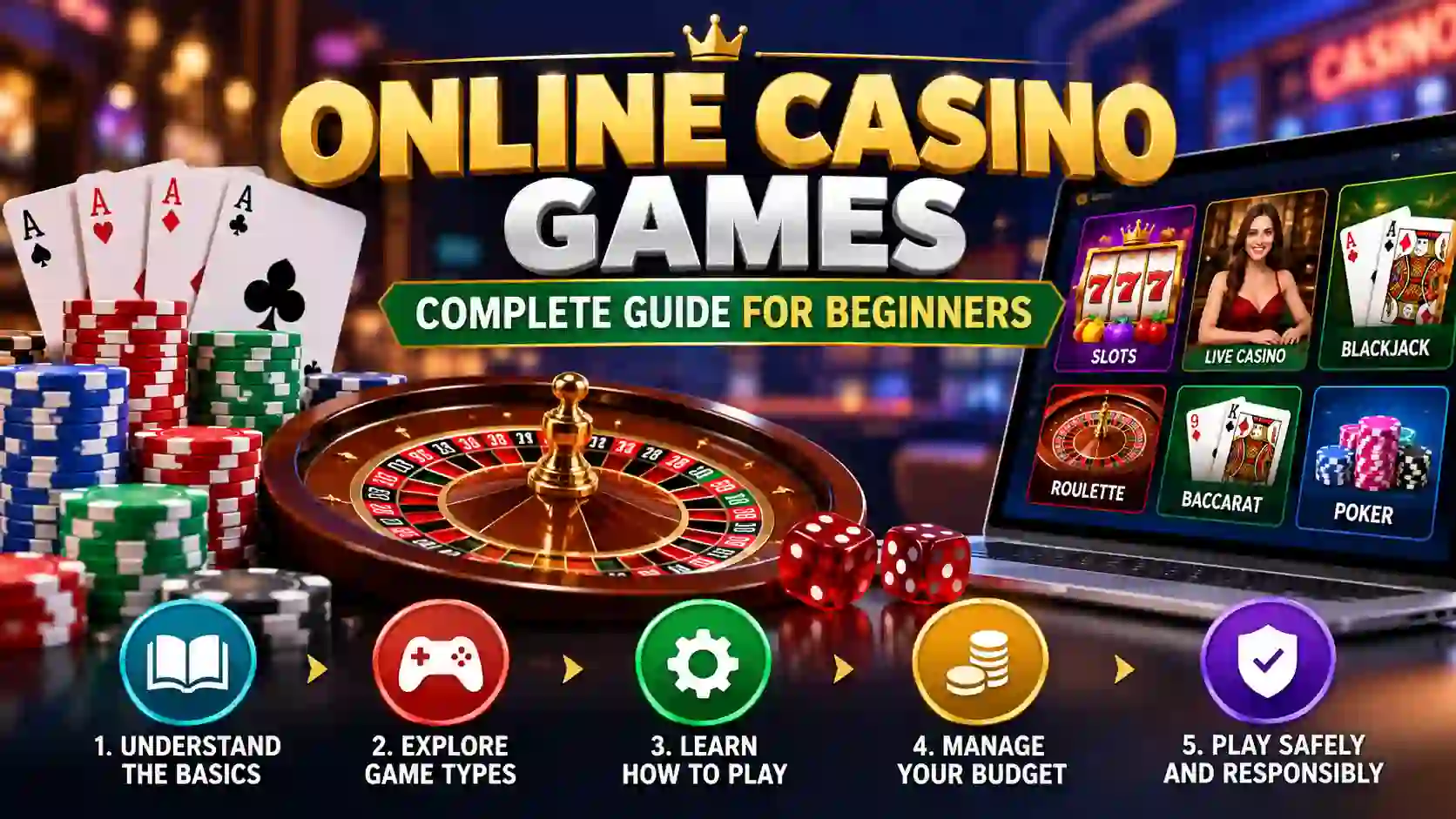
Online casino games have transformed the way people experience traditional casino entertainment. Instead of visiting a physical casino, adults can access digital versions of slots, blackjack, roulette, baccarat, poker and live dealer games through websites and mobile applications. However, understanding how these games work is essential before considering playing with real money.
For beginners, the variety of games, unfamiliar terminology and promotional offers can make online casinos seem complicated. What does return to player (RTP) mean? How are winning outcomes determined? Are online casino games fair? And how can you identify a properly licensed gambling website?
This complete guide to online casino games answers those questions, explains the main types of casino games, explores their mathematical foundations and covers important considerations such as game rules, bonuses, security, payments and responsible gambling.
The focus is on helping adults understand online casino gaming and make informed decisions rather than treating gambling as a reliable way to earn money.
What Are Online Casino Games?
Online casino games are digital versions of traditional gambling games that people can access through an internet-connected device. These games may use computer software to produce random outcomes or live video technology to connect players with human dealers.
Common examples include online slot machines, roulette, blackjack, baccarat, video poker and live casino games.
The main distinction between online casinos and traditional gambling venues is how players access the games. Physical casinos require visitors to attend a location, while online gambling platforms provide game interfaces through browsers or applications.
Many online casino games operate using a random number generator (RNG), which determines outcomes according to the game’s programmed rules and probabilities. Live dealer games typically use physical cards, wheels or other equipment, with the action streamed to a player’s screen.
It is important to remember that casino games usually include a mathematical advantage for the operator, known as the house edge. Although individual players may win during a particular session, the underlying mathematics generally favours the casino over extended play.
How Do Online Casino Games Work?
Online casino games combine software, game rules, mathematical probabilities and payment systems to deliver an interactive gambling experience.
In a typical digital casino game, the player selects a game, reviews its rules and chooses an available stake. The software then determines the result, calculates any applicable return and updates the account balance.
For example, an online slot game uses virtual reels and symbols. When a player initiates a spin, the software determines the outcome based on the game’s mathematical model. If a qualifying combination appears, a prize may be awarded according to the paytable.
Games such as roulette and blackjack work differently because they involve established table-game rules. Roulette outcomes depend on where the ball lands, while blackjack involves playing decisions that affect the statistical likelihood of different outcomes.
What Is a Random Number Generator?
An RNG is a system designed to produce outcomes that are unpredictable and consistent with a game’s specified probabilities.
In regulated online casino games, testing and monitoring are important safeguards. In Great Britain, the UK Gambling Commission requires relevant online gambling software to undergo testing by approved test houses before it is made available to players.
However, a properly functioning RNG does not mean every player receives an equal amount of winnings.
Individual results can vary substantially. Previous losses do not guarantee that a winning outcome is approaching, and a sequence of successful spins does not make future losses certain.
Each outcome must be understood within the rules and probability structure of the particular game.
Different Types of Online Casino Games
Not all online casino games offer the same experience. Some are based almost entirely on chance, while others involve decisions that influence the mathematical outcome.
Understanding these differences helps beginners recognise what each game involves before risking money.
- Online Slot Games
Online slots are digital slot-machine games featuring spinning reels, symbols, paylines and various bonus features.
They come in numerous formats, including classic three-reel slots, five-reel video slots, themed games and progressive jackpot titles.
A typical slot may feature wild symbols that substitute for other symbols, scatter symbols that activate special features, and free-spin rounds that follow specific game conditions.
Modern slots frequently include elaborate visual themes, animations and sound effects. These features contribute to the presentation but should not be confused with indicators of a game’s winning probability.
Important facts about online slots:
A slot’s return to player percentage describes its theoretical long-term payout. Volatility indicates how variable its results may be. A game’s maximum possible prize is not the same as the likelihood of achieving that prize.
Slots are games of chance. Changing the time of day, using a particular device or selecting a supposedly lucky spin pattern does not provide a proven advantage over a properly functioning random game.
Roulette is a traditional casino table game based on predicting where a ball will land on a numbered wheel.
Players can select individual numbers, groups of numbers, colours or other permitted betting positions.
Two well-known variations are European roulette and American roulette.
European roulette contains 37 pockets numbered from 0 to 36. American roulette generally contains 38 pockets, including both 0 and 00.
This difference matters because it changes the house edge.
With standard payouts, European roulette has a house edge of approximately 2.70%, while American double-zero roulette has a house edge of approximately 5.26%.
A lower house edge means a smaller theoretical average casino advantage, not a guarantee of better results in a short session.
Some French roulette variations have additional rules that may reduce the house edge on qualifying even-money bets.
Blackjack is a card game in which players try to finish with a hand value closer to 21 than the dealer without exceeding 21.
Number cards generally count at face value, picture cards count as ten, and an ace can usually count as one or eleven.
Players may be offered decisions such as hitting, standing, doubling down or splitting pairs.
Unlike slots, blackjack has a strategic component. The decisions a player makes can affect the expected result of a hand.
A mathematically informed basic strategy can reduce the casino’s advantage under particular game rules. Nevertheless, blackjack remains a gambling game with financial risk, and even correct decisions frequently result in losses.
Beginners should also recognise that not all blackjack tables use identical rules. The number of decks, dealer actions, payout for a natural blackjack and restrictions on doubling or splitting all influence the mathematical odds.
- Online Baccarat
Baccarat is a casino card game involving two hands known as the Player and the Banker.
The objective is to predict which hand finishes closest to a total value of nine, according to the game’s drawing rules.
Despite its reputation as a sophisticated casino game, the standard version has relatively straightforward betting choices.
Players typically select the Player hand, Banker hand or a Tie.
The Banker bet generally has a slightly lower house edge than the Player bet in standard commission baccarat, while the Tie wager carries a considerably larger house advantage.
However, baccarat variations may use different commission structures or rules, so the exact odds should always be checked.
- Online Poker and Video Poker
Poker-related games require an important distinction.
Traditional online poker commonly involves competing against other players. The operator typically earns revenue through a fee or rake rather than acting as the opponent in every hand.
Video poker, by contrast, is generally a casino game played against a fixed paytable.
In video poker, players receive cards, select which ones to hold and draw replacements. The final hand determines whether a prize is awarded.
The game’s expected return depends on its particular paytable and playing decisions.
Although poker involves skills such as probability assessment and decision-making, skill does not eliminate variance or guarantee profitable results.
- Live Dealer Casino Games
Live dealer games combine internet technology with real casino equipment and human dealers.
A live roulette table, for instance, may feature a dealer spinning a physical wheel while players view the action through a video stream.
Live blackjack and baccarat tables follow a similar format, allowing remote players to participate through digital betting interfaces.
These games often appeal to adults who prefer seeing the physical dealing process rather than interacting exclusively with animated software.
Nevertheless, a live dealer does not change the fundamental house advantage of the underlying game. The table limits, rules and potential delays or fees should still be considered carefully.
- Progressive Jackpot Games
Progressive jackpot games offer prizes that may increase as qualifying wagers are made across participating games or networks.
Rather than offering only a fixed top prize, a progressive system accumulates an advertised jackpot under defined conditions.
The main attraction is the possibility of a large award. However, jackpot-winning events can be extremely rare, and the advertised amount tells players little about their individual probability of winning.
Some jackpot games also have different RTP structures or eligibility requirements from ordinary slots.
A large headline prize should never be mistaken for a favourable expected return.
Understanding RTP, House Edge and Volatility
Three of the most important terms in online casino gaming are return to player, house edge and volatility.
They describe different aspects of how casino games behave over time.
| Term | Meaning | Why it matters |
| RTP | Theoretical percentage of total stakes returned as prizes over extensive play | Helps explain the game’s expected long-term return |
| House edge | The casino’s mathematical advantage | Indicates the theoretical expected loss as a proportion of total stakes |
| Volatility | How widely individual outcomes vary | Helps explain the frequency and size of different results |
| Paytable | Rules showing which outcomes receive prizes | Makes payout conditions transparent |
| Minimum stake | Smallest permitted wager | Determines the minimum amount placed at risk per round |
What Does 96% RTP Mean?
Imagine a slot game with a theoretical RTP of 96%.
For every £100 wagered across a sufficiently large volume of play, the model indicates an average return of £96 in prizes, leaving £4 as the theoretical house advantage.
This is not a prediction that someone who deposits £100 will finish with £96.
The figure refers to total amounts staked, including money that may be won and wagered again. An individual session might produce a larger win, a complete loss or any number of other outcomes.
The UK Gambling Commission explains that theoretical RTP and actual game performance need to be assessed across suitable volumes of play. Short sessions are not reliable indicators of whether a game is meeting its designed return.
What Is Casino Game Volatility?
Volatility describes how much results fluctuate.
A lower-volatility game generally produces a narrower distribution of outcomes, while higher-volatility games tend to involve greater variation and may award infrequent, larger prizes.
For example, one slot might offer relatively frequent small returns, while another produces long periods without significant prizes but occasionally awards a much larger payout.
Neither volatility level removes the house edge.
Higher volatility can produce substantial short-term financial swings, while lower volatility does not prevent a player’s balance from declining.
How to Choose a Safe Online Casino
Before considering any online casino, beginners should understand the difference between a licensed gambling business and an unregulated website.
A professional-looking homepage, large bonus advertisement or familiar payment logo does not independently establish that a website is authorised to provide gambling services.
In Great Britain, online casino operators serving consumers must hold the appropriate Gambling Commission licence.
The official register of gambling businesses allows users to search for businesses by company name, trading name or domain.
Essential Checks Before Using an Online Casino
- Verify licensing: Check the operator’s legal name and licence status through the relevant gambling regulator.
- Read the game rules: Confirm the house edge or RTP where available, along with minimum stakes and payout conditions.
- Examine withdrawal terms: Understand processing procedures, verification requirements and any applicable restrictions.
- Review bonus conditions: Check whether a promotion has wagering requirements, expiry dates or game exclusions.
- Assess security: Use official websites, secure connections and account protection such as strong passwords or multifactor authentication where available.
- Look for gambling controls: Ensure practical tools exist for setting financial limits, taking breaks and requesting self-exclusion.
These checks cannot remove the risks of gambling, but they can help people identify questionable operators and better understand the terms of a service.
How to Play Online Casino Games: A Beginner’s Overview
For adults who are legally eligible to gamble, the general process varies by platform but usually follows a similar pattern.
Step 1: Learn the Rules Before Playing
Start by understanding the particular game’s objectives, payout structure and betting options.
For instance, blackjack requires knowledge of card values and dealer rules, while slots require an understanding of the paytable and bonus features.
Never assume two games with similar names have exactly the same rules.
Step 2: Check Whether Demo Play Is Available
Some casino games have free demonstration versions that allow users to explore the interface without staking real money.
These versions can be useful for understanding controls and paytables, although some games or jurisdictions restrict access to demonstrations.
A demo game should not be viewed as evidence that real-money play will produce similar results over a short period.
Step 3: Complete Required Account Verification
Licensed operators in Great Britain must verify customers’ age and identity before allowing them to gamble.
This may involve matching personal details against verification databases or requesting appropriate documents.
Providing accurate information is important. Using another person’s identity or attempting to bypass account restrictions may create legal and security problems.
Step 4: Understand Payments and Financial Limits
If considering real-money gambling, review which payment methods are permitted and how deposits and withdrawals work.
Set a financial limit before any gambling begins. This should be an amount that can be lost without affecting essential expenses.
Being able to deposit money is not the same as being able to afford to lose it.
Step 5: Monitor Time and Spending
Casino games can involve repeated decisions and quick rounds.
A player may stake much more over an extended session than the amount initially deposited because previous winnings can be wagered again.
Monitor total stakes, net spending and time spent playing rather than focusing only on individual winning outcomes.
Online Casino Bonuses Explained
Casino bonuses are promotional incentives offered under specific terms.
Common formats include welcome offers, promotional free spins, bonus balances and loyalty rewards.
They can appear attractive because of their advertised value, but bonus funds are not necessarily the equivalent of withdrawable cash.
What Are Wagering Requirements?
A wagering requirement specifies how much qualifying gambling activity must occur before bonus-related funds or winnings can become withdrawable.
Consider a hypothetical £20 bonus with a ten-times wagering requirement.
The required qualifying wagering would be £200.
That does not mean the player needs to deposit another £200, nor does it mean the player will retain enough money to satisfy the requirement. Gambling losses can occur throughout the process.
In Great Britain, rules effective from 19 January 2026 prohibit licensed operators from applying bonus wagering requirements above ten times and from combining different gambling product categories within a single incentive.
Online Casino Payment Methods and Withdrawals
Online casino platforms may support payment methods such as debit cards, bank transfers and selected electronic wallets, depending on the operator and jurisdiction.
Payment availability, minimum deposits and withdrawal processing procedures differ between websites.
In Great Britain, licensed gambling businesses are prohibited from accepting credit card payments for gambling, including attempts to fund qualifying gambling transactions indirectly through electronic wallets.
This restriction is designed to reduce risks associated with gambling using borrowed money.
How Do Casino Withdrawals Work?
When an eligible account balance is withdrawn, the operator processes the request according to its procedures and applicable regulations.
The payment method, financial checks and provider processing arrangements may influence how long the transaction takes.
British operators cannot impose unreasonable withdrawal delays or restrictions. The Gambling Commission also states that identity checks should not be unnecessarily delayed until withdrawal when the information could reasonably have been requested earlier.
If a withdrawal problem occurs, contact the gambling business through its formal complaints process.
Unresolved eligible disputes can be referred to an independent Alternative Dispute Resolution (ADR) provider after the applicable complaints period, generally up to eight weeks, or sooner when a qualifying deadlock has been reached.
Can You Win Real Money Playing Online Casino Games?
Yes. Real-money casino games can award cash prizes when the required winning outcomes occur.
However, winning is possible without being probable or financially sustainable.
A casino’s house edge means that, in games with a built-in operator advantage, the expected financial result generally becomes less favourable to the player as the amount wagered increases.
Short-term luck can produce an exceptional win, but that outcome does not establish a method of generating regular income.
This is particularly important with progressive jackpots and games advertised around large prize amounts.
The existence of a multimillion-pound prize does not provide meaningful information about the likelihood that a particular player will receive it.
There is no reliable betting system capable of eliminating the mathematical advantage in ordinary house-banked casino games.
Common Online Casino Myths Beginners Should Avoid
Myth 1: A Slot Machine Must Pay After Several Losses
A losing streak does not mean the next spin is due to win.
For properly functioning independent random outcomes, previous spins do not force future results to compensate for earlier losses.
Myth 2: Betting More Guarantees Better Results
A larger stake may increase the potential monetary payout from a winning result, but it also increases the amount placed at risk.
It does not automatically improve the probability of winning a particular game round.
Myth 3: There Is a Perfect Time to Play Online Slots
Claims that slots pay more during particular hours are not supported by how properly functioning random games operate.
The time of day does not provide a legitimate way to predict an RNG-driven outcome.
Myth 4: Every High-RTP Game Is Safe for Beginners
A relatively high RTP does not mean a game cannot produce substantial losses.
Volatility, stake size, session length and total turnover remain relevant.
Myth 5: Casino Strategies Can Guarantee Profit
Decision-making can influence outcomes in some games, such as blackjack, but strategies cannot guarantee winnings.
Progressive betting systems, including doubling stakes after losses, cannot remove the underlying house edge and can produce severe financial losses.
Online Casino Games in the UK: Rules and Regulations in 2026
Online casino gambling is regulated in Great Britain under a framework overseen by the UK Gambling Commission.
The regulator sets requirements relating to licensing, gambling software, consumer protections, game design, age verification and operator conduct.
Several rules are particularly relevant to beginners.
Minimum Age Requirements
Online casino gambling is restricted to adults aged 18 and over in Great Britain.
Licensed operators must verify age and identity before allowing customers to gamble.
Online Slot Stake Limits
As of October 2026, the maximum permitted online slot stake per game cycle in Great Britain is:
- £2 for adults aged 18 to 24.
- £5 for adults aged 25 and over.
These limits were introduced during 2025 and apply specifically to online slots, not universally to other games such as roulette and blackjack.
Rules on Game Design
British rules also restrict features that can increase gambling intensity.
Autoplay is prohibited for online gaming, and controls restrict functionality designed to accelerate results or create misleading impressions about gameplay outcomes.
Relevant casino games must also provide information about gambling activity, helping players understand their net spending and time played.
Deposit Limit Protections
Since 30 June 2026, licensed online operators must give customers the opportunity to set clearly defined deposit limits based on the amount paid into their gambling account over a specified period.
Other types of financial limits may also be available.
Rules vary outside Great Britain, so readers in other countries should consult their own relevant gambling regulator before accessing any gambling service.
How to Reduce the Risks
The most important principle for beginners is understanding that gambling is a paid activity involving an inherent possibility of losing money.
Even legitimate, regulated games can cause financial and emotional harm.
Establish a Clear Financial Boundary
Money needed for rent, bills, groceries, savings commitments or debt repayments should never be used for gambling.
A spending limit should be based on disposable money that can genuinely be lost without creating difficulties.
Avoid Chasing Losses
Chasing losses means continuing to gamble or increasing stakes in an attempt to recover money already lost.
It often results in additional financial exposure rather than recovery.
A previous loss does not improve the mathematical prospects of the next wager.
Set Time Limits
Long gambling sessions can make it difficult to track spending and maintain perspective.
Using a time limit or taking a break can reduce exposure to rapid, repeated gambling decisions.
Recognise Warning Signs
Gambling may be becoming harmful when someone begins hiding their spending, borrowing money to continue, neglecting responsibilities, repeatedly trying to recover losses or feeling unable to stop.
These warning signs deserve attention rather than being dismissed as a normal part of gameplay.
Use Self-Exclusion When Needed
For UK residents, GAMSTOP Online is a free self-exclusion service covering online gambling operators licensed in Great Britain.
It offers minimum exclusion periods including six months, one year and five years, with an automatic-renewal option for the five-year period.
Anyone experiencing gambling-related harm can also seek confidential support.
In England and Scotland, the National Gambling Helpline is available free on 0808 8020 133, 24 hours a day. People in other parts of the UK can find appropriate support through the Gambling Commission or GambleAware.
Online Casino Games on Mobile Devices
Mobile casino gaming allows adults to access compatible casino games through smartphones and tablets.
Many operators offer websites optimised for smaller screens, while others provide dedicated applications.
Mobile interfaces may feature touch controls, responsive layouts and simplified navigation. The underlying game rules and mathematical probabilities should remain consistent with the specific game version being offered.
However, convenience creates additional considerations.
Easy access can increase the temptation to play repeatedly throughout the day, making spending and time limits particularly important.
Mobile users should also be cautious about fake applications, suspicious advertisements and websites requesting unnecessary permissions or personal information.
Only use authentic services from verified operators and keep devices protected with security updates.
Online Casino Games vs Land-Based Casino Games
Both online and physical casinos offer familiar games, but the experience differs in several ways.
| Feature | Online casino games | Land-based casino games |
| Access | Through eligible websites or apps | At a physical gambling venue |
| Game format | Digital, live streamed or both | Physical tables and gaming machines |
| Availability | Depends on the operator and local laws | Depends on venue opening hours |
| Social interaction | Varies by game and platform | Typically face-to-face |
| Payment process | Digital account transactions | Venue-specific payment arrangements |
| Gambling controls | Online limits, time-outs and self-exclusion | Venue controls and self-exclusion arrangements |
Neither format automatically provides better odds.
A game’s expected return depends on its mathematical structure and rules rather than whether it is accessed online or in a physical building.
FAQs
Are online casino games legal in the UK?
Yes, online casino games are legal for eligible adults in Great Britain when offered by appropriately licensed operators. The UK Gambling Commission regulates businesses serving British consumers. Rules in Northern Ireland and other jurisdictions should be checked separately where applicable.
What are the best online casino games for beginners?
That depends on what someone wants to learn. Slots generally involve simple controls but are chance-based. Roulette has straightforward betting categories, while blackjack introduces decisions and more complex rules. Beginners should understand each game’s odds, costs and risks before considering real-money play.
Are online casino games fair?
Games offered by appropriately licensed British operators are subject to testing and monitoring requirements. Nevertheless, fair operation does not mean equal chances of winning and losing or an absence of house advantage. A fair game can still be mathematically unfavourable to the player.
Can you play casino games online for free?
Some platforms provide demonstration versions of games that do not require real-money stakes. Availability depends on local regulations and the operator. Demo play can help explain rules but does not predict future real-money outcomes.
Which online casino game has the highest RTP?
There is no single answer across all game versions. Certain blackjack and video poker variants can offer relatively high theoretical returns under particular rules and decisions. Individual games should be compared using their actual published rules and paytables rather than broad category averages.
What is the safest online casino game?
No real-money casino game is free from financial risk. Risk depends on factors such as stake size, odds, volatility, time spent gambling and individual behaviour. Choosing a licensed operator improves regulatory protections but does not eliminate gambling losses.
Can online slots be predicted?
There is no reliable method for predicting outcomes from properly functioning RNG-based online slots. Claims about secret algorithms, guaranteed winning times or hidden spin patterns should be treated sceptically.
Do online casino bonuses guarantee free money?
No. Promotional offers often have eligibility conditions, time restrictions and wagering requirements. Bonus funds may not be immediately withdrawable, and attempting to fulfil bonus conditions can result in additional losses.
Can beginners consistently make money from online casinos?
Online casino games should not be treated as a dependable income source. House edges and unpredictable results make consistent profits unlikely for ordinary players. A short-term win is not evidence of a sustainable earning method.
How can I tell whether an online casino is trustworthy?
Check the relevant regulator’s licence register, verify the operator’s legal identity, read withdrawal and bonus policies, examine account security and confirm that meaningful safer-gambling tools are available. A licence is an important safeguard, but it is not a promise of financial gain.
Final Thoughts
Online casino games offer digital versions of familiar gambling activities, from slots and roulette to blackjack, baccarat and live dealer tables. Each category has different rules, probabilities and levels of complexity.
For beginners, the most useful knowledge is not a supposed winning trick. It is understanding how random outcomes work, what RTP and house edge really mean, how promotional conditions affect withdrawals and why licensing matters.
A properly regulated casino should provide clear game information, appropriate consumer protections and tools for managing gambling activity. Even with these safeguards, no gambling game guarantees a profit, and losses remain a normal mathematical possibility.
The key takeaway is simple: learn the rules, understand the risks, check the licence and never regard online casino games as a substitute for earning money.
ADVERTISEMENT

18+ | Affiliate link | Terms apply | Please gamble responsibly.


