

18+ | Affiliate link | Terms apply | Please gamble responsibly.
Last Updated on October 16, 2026 by Maurya
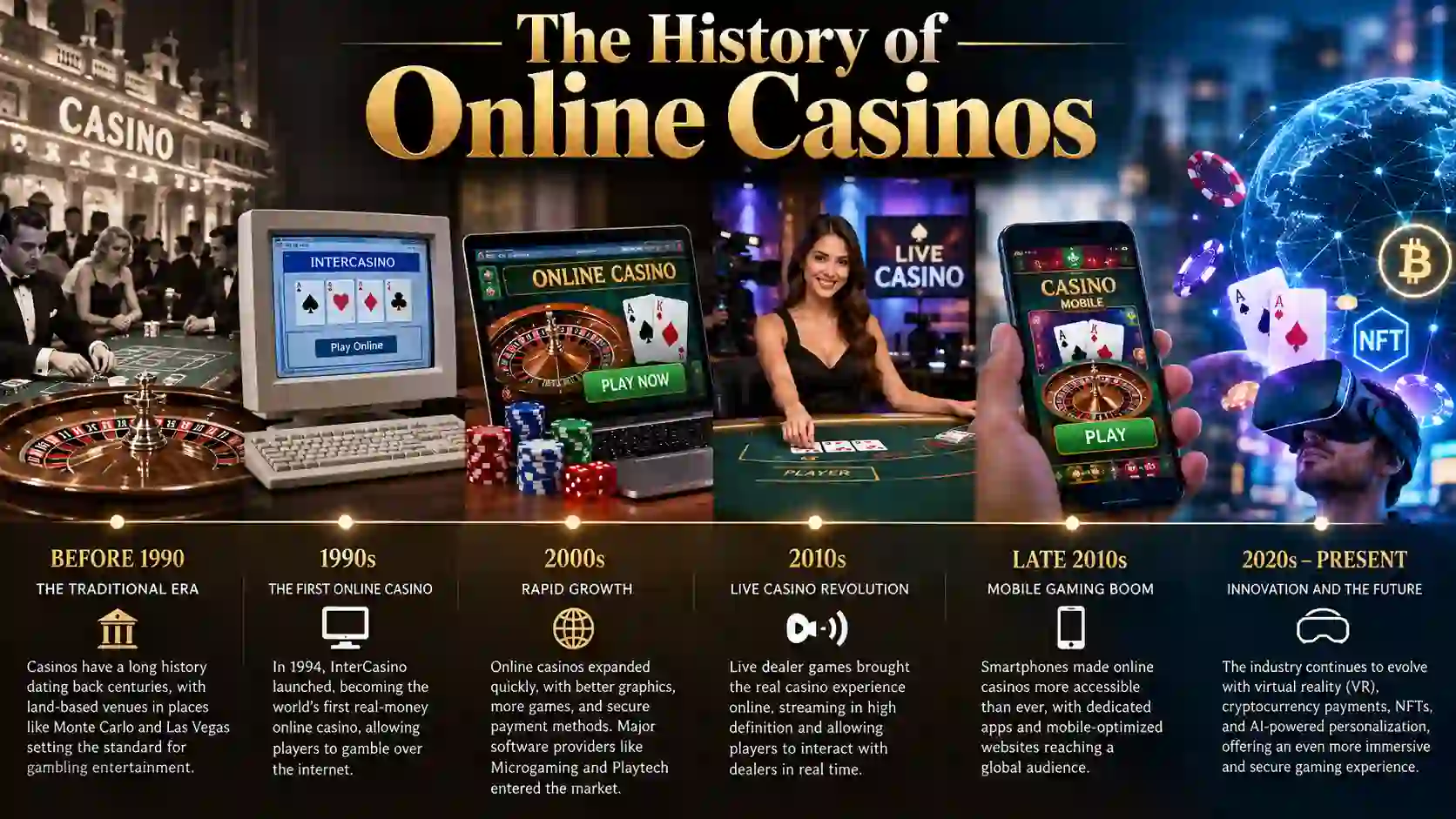
The history of online casinos is a remarkable chapter in the evolution of digital entertainment. What began as an experimental concept during the early days of the internet has developed into an international industry shaped by technological innovation, changing consumer behaviour, and increasingly sophisticated gambling regulations.
Today, online casino platforms can offer digital slot machines, roulette, blackjack, poker-related products, and live dealer games through smartphones, tablets, and desktop computers. However, the sophisticated gaming experiences available today are very different from the relatively basic casino websites that appeared during the 1990s.
Understanding how online casinos evolved requires looking beyond the games themselves. The industry’s development is closely connected to advances in internet infrastructure, electronic payments, software engineering, cybersecurity, and government regulation.
When Did Online Casinos First Appear?
Online casinos emerged during the mid-1990s, with 1994 widely recognised as a foundational year for the industry. That year, Antigua and Barbuda introduced legislation associated with the licensing of internet gambling businesses, while pioneering software developers began creating casino games for online use.
The earliest operational casino websites appeared around 1995, and InterCasino is widely credited with accepting one of the first real-money online casino wagers in 1996.
There is some disagreement about which website deserves the title of the world’s first online casino. Historical accounts distinguish between the earliest casino software, the first operational website, and the first platform to accept real-money wagers.
Nevertheless, the period between 1994 and 1996 established the technological and commercial foundations of modern internet casino gaming.
Online Casino History: Key Milestones
| Year | Historical development |
| 1994 | Antigua and Barbuda introduces an early legal framework associated with internet gambling. Microgaming emerges as a pioneering casino software developer. |
| 1995–1996 | Early casino websites begin operating, and real-money online gaming becomes commercially viable. |
| 1998 | Planet Poker introduces real-money online poker, expanding internet-based gambling beyond traditional casino games. |
| 2003 | Chris Moneymaker’s World Series of Poker victory accelerates public interest in online poker. eCOGRA is established. |
| 2005–2007 | Britain’s Gambling Act 2005 establishes a modern regulatory framework, coming fully into force in 2007. |
| 2006 | The United States introduces the Unlawful Internet Gambling Enforcement Act. Evolution is founded and develops live casino technology. |
| 2010s | Smartphones, HTML5 gaming, and dedicated mobile applications transform online casino accessibility. |
| 2013 | Delaware and New Jersey launch regulated internet casino gaming markets. |
| 2014 | Great Britain adopts a point-of-consumption licensing approach for online gambling. |
| 2020 | COVID-19 restrictions disrupt traditional casino operations and alter online gambling behaviour. |
| 2022 | Ontario launches a regulated market for private online gambling operators. |
| 2025–2026 | Industry growth continues alongside stronger player-protection requirements and interest in emerging technologies. |
Before Online Casinos: The Transition From Physical to Digital Gambling
Long before online casinos existed, gambling was associated with physical venues such as gaming houses, racetracks, and casinos.
Traditional casino gaming required players to visit a location where gaming tables, slot machines, and other gambling facilities were available. For much of the twentieth century, destinations such as Las Vegas and Monte Carlo became internationally associated with casino entertainment.
The rise of personal computers created an opportunity to rethink that model.
During the 1980s and early 1990s, computer games became increasingly sophisticated. Developers experimented with digital versions of card games, roulette, and other familiar casino activities.
However, these early computer games were generally standalone entertainment products. They were not necessarily connected to real-money gambling systems.
The arrival of the commercial internet changed what was technically possible.
For the first time, software developers could connect players to remote gaming platforms. Instead of requiring a physical gaming table or slot machine, a casino experience could be represented through a computer interface.
Three developments were particularly important: more accessible internet connections, software capable of calculating game outcomes, and electronic systems for processing financial transactions.
Together, these innovations made the concept of an online casino commercially realistic.
1994: The Birth of the Online Casino Industry
The year 1994 occupies an important place in online gambling history.
Antigua and Barbuda’s Early Regulatory Role
In 1994, Antigua and Barbuda passed the Free Trade and Processing legislation, commonly discussed as one of the first legal foundations for the emerging internet gambling industry.
The Caribbean nation’s approach helped attract businesses interested in offering gambling services to customers outside traditional casino environments.
At the time, internet gambling was still experimental. Most countries did not have legislation specifically designed to address digital casino platforms.
This created uncertainty about licensing, taxation, consumer rights, and the legal status of gambling transactions conducted across international borders.
Antigua’s early involvement demonstrated how internet-based gambling businesses could operate internationally while maintaining a registered business presence in a particular jurisdiction.
The country’s position also became important in later international trade disputes.
A historical analysis published through the United States International Trade Commission examines Antigua’s role and its subsequent disputes with the United States over cross-border online gambling services.
Microgaming and Early Casino Software
Another important development occurred with the emergence of Microgaming in 1994.
Microgaming became one of the pioneering companies associated with software designed for internet casino gaming.
Early casino software was considerably simpler than modern gaming platforms. Visual effects were limited, internet connections were slow, and game libraries were small.
Nevertheless, developers began building the technology required to reproduce casino games electronically.
Random number generation became particularly important because online games needed systems capable of producing outcomes without physical cards, dice, or roulette wheels.
The progress achieved during this period helped establish software development as one of the central pillars of the online casino industry.
1995–1996: The First Online Casinos and Real-Money Gambling
By the middle of the 1990s, the concept of internet casino gaming was becoming a functioning business model.
Which Was the World’s First Online Casino?
The answer depends on how the term first online casino is defined.
An early historical account by trade analyst Isaac Wohl identifies The Gaming Club as the first internet casino and dates the earliest casino launch to 1995.
Other industry histories identify InterCasino, associated with CryptoLogic technology, as a pioneer in accepting real-money online casino wagers in 1996.
These accounts are not necessarily contradictory. A platform could exist before it was technically or commercially prepared to process real-money payments.
This distinction is important because online casino history is sometimes simplified into the claim that one company invented the entire industry.
In reality, the first generation of online gambling developed through the combined efforts of software companies, internet entrepreneurs, payment technology providers, and early licensing jurisdictions.
The Importance of Secure Online Payments
The ability to place a real-money wager was a significant technical challenge.
An online casino needed more than a functioning game. It also required a way to receive deposits, maintain account balances, record transactions, and process withdrawals.
Companies such as CryptoLogic became associated with developing technology that supported secure electronic transactions and early online gaming operations.
These systems helped create a bridge between traditional financial services and internet-based entertainment.
However, early payment methods were far less convenient than modern digital banking. Transactions could involve processing delays, limited payment options, and unfamiliar security procedures.
The development of more reliable electronic payments was therefore essential to the industry’s expansion.
The Late 1990s: Online Casinos Begin to Expand
As internet access became more widespread, online casinos gradually developed from small experimental websites into more established commercial services.
During the late 1990s, gambling websites began offering broader collections of digital games.
Online slots, blackjack, roulette, and video poker became increasingly familiar features.
Compared with traditional casinos, internet platforms introduced a different type of accessibility. Games could be accessed remotely without travelling to a physical gambling destination, subject to the technology and laws applicable at the time.
Yet the early experience had significant limitations.
Slow dial-up connections could interrupt gaming sessions. Software often had to be downloaded and installed, while graphics and animations were basic.
Some users also questioned whether online games could be trusted to produce fair results or whether deposited funds would remain secure.
These concerns encouraged the industry to improve software quality, transaction systems, and standards of accountability.
Online Poker Arrives in 1998
One of the most notable developments occurred on January 1, 1998, when Planet Poker introduced real-money online poker.
This milestone helped establish poker as a viable form of internet gambling.
Unlike a conventional casino game played against the house, poker commonly involves players competing against one another.
Consequently, online poker platforms required technology capable of connecting multiple participants, managing shared game sessions, and maintaining accurate records of bets and outcomes.
Planet Poker helped demonstrate that multiplayer gambling could function on the internet.
Other poker operators subsequently entered the market, contributing to an increasingly competitive digital gaming environment.
The Early 2000s: Online Gambling Becomes Mainstream
The early 2000s represented a major period of expansion for internet gambling.
Broadband connections became more common, allowing faster communication between users and gaming servers.
Casino software also improved.
Developers introduced better graphics, smoother animations, larger game collections, and more sophisticated account management systems.
The online casino experience gradually moved beyond simple digital reproductions of traditional games.
New slot themes, progressive jackpot systems, and improved gaming interfaces helped platforms offer experiences designed specifically for online audiences.
The 2003 Online Poker Boom
A defining moment arrived in 2003 when Chris Moneymaker, an amateur player who qualified through an online poker tournament, won the World Series of Poker Main Event.
His victory attracted international attention and encouraged public interest in online poker.
According to BBC Sport’s retrospective on the poker boom, the World Series of Poker Main Event grew from 839 entrants in 2003 to 8,773 in 2006.
Although online poker is not identical to online casino gaming, its popularity contributed to the broader visibility of internet gambling.
The event illustrated how internet platforms could connect everyday users with established gambling events and institutions.
The Development of Live Dealer Casinos
One of the biggest technological changes in online casino history was the introduction and subsequent growth of live dealer gaming.
Traditional online table games generally relied on computer-generated graphics and software-based outcomes.
Live dealer casinos introduced a different approach.
Instead of displaying only a simulated casino table, these platforms used cameras to broadcast games operated by human dealers in professional studios.
Players could view the action remotely and interact through digital interfaces.
Evolution and the Growth of Live Casino Technology
Evolution, founded in 2006, became one of the influential companies in the development of live casino technology.
The company began with a studio in Latvia and expanded its live dealer services internationally.
Its 20th-anniversary company history documents how live casino technology developed into a major category of online gaming.
Live dealer roulette, blackjack, and baccarat helped combine elements of traditional casino presentation with the convenience of internet access.
As broadband speeds, streaming technology, and camera equipment improved, live casino broadcasts became smoother and more sophisticated.
The development also demonstrated an important change in consumer expectations: online casinos were no longer limited to replicating casino games through software alone.
They could also transmit real-time events from physical gaming studios.
The Mobile Casino Revolution: 2010–2020
Although the internet made remote gambling possible, smartphones fundamentally changed when and where online casino services could be accessed.
Before widespread smartphone adoption, many players relied on desktop computers or laptops.
Early mobile devices had small screens, limited processing power, and slow internet connections.
The arrival of modern touchscreen smartphones, followed by advances in mobile broadband, created opportunities for more accessible mobile gaming.
How HTML5 Changed Online Casino Games
One of the most important developments was the growing adoption of HTML5 technology.
Earlier online casino games frequently depended on browser plugins or downloadable software.
HTML5 enabled developers to create games that could operate through compatible web browsers across different devices.
This reduced dependence on particular operating systems and made cross-platform development more practical.
Developers also began designing interfaces specifically for smaller screens.
Buttons became easier to use on touchscreens, menus were simplified, and games were adapted to different display sizes.
The result was a broader transition towards mobile-friendly gambling platforms.
Mobile Applications and Digital Convenience
During the 2010s, online casino operators increasingly developed dedicated mobile applications and responsive websites.
These platforms integrated account management, payment systems, game libraries, and customer support into interfaces designed for handheld devices.
Mobile technology also introduced new regulatory challenges.
With gambling services potentially accessible at any time, concerns increased about impulsive spending, prolonged gaming sessions, and the reduced separation between gambling and daily activities.
The UK Gambling Commission’s analysis of mobile gambling discusses how constant accessibility can increase the risk of harmful gambling patterns.
The mobile revolution therefore transformed both the convenience of online casinos and the responsibilities of the companies operating them.
How Online Casino Laws and Regulations Evolved
Regulation has played a central role in shaping the history of online casinos.
During the industry’s early years, companies frequently operated across national borders while laws remained focused on traditional gambling premises.
Governments eventually recognised that internet gambling required specific approaches to licensing, financial security, taxation, advertising, and consumer protection.
United Kingdom: The Gambling Act 2005
The United Kingdom introduced an important regulatory framework through the Gambling Act 2005, which came fully into force in September 2007.
The legislation established the Gambling Commission as the regulator of commercial gambling in Great Britain.
It created a framework for overseeing gambling businesses, including remote gambling operations.
Another major development followed with the Gambling (Licensing and Advertising) Act 2014.
Under the amended system, operators providing remote gambling services to consumers in Great Britain generally needed an appropriate Gambling Commission licence, regardless of where their businesses were based.
This established a point-of-consumption approach to online gambling regulation.
The UK government’s announcement of the 2014 legislation explains the purpose of extending regulatory oversight to overseas-based operators serving British consumers.
United States: UIGEA and State-Level Regulation
The United States followed a different regulatory path.
In 2006, Congress enacted the Unlawful Internet Gambling Enforcement Act, commonly known as UIGEA.
The law restricted gambling businesses from knowingly accepting certain payments connected with unlawful internet gambling.
Importantly, UIGEA did not establish a universal prohibition on every form of online gambling. Instead, it addressed financial transactions associated with gambling that was unlawful under applicable federal or state law.
The Federal Reserve’s explanation of UIGEA provides further detail about these restrictions.
In 2011, federal action against major online poker companies, an event widely known as Black Friday in poker history, further demonstrated the legal uncertainty surrounding internet gambling in the United States.
However, state-level regulation subsequently created new opportunities for licensed online casino businesses.
In November 2013, Delaware launched a state-authorised online casino gaming system, followed later that month by regulated internet gaming operations in New Jersey.
These developments helped establish the foundations of the modern regulated American iGaming market.
Regulation Beyond the United States and Britain
Other countries and regions developed their own approaches.
Some jurisdictions introduced licensing systems that permitted private operators to provide online casino services under defined conditions.
Others maintained stricter limitations or prohibited particular forms of internet gambling.
Ontario, Canada, introduced its regulated market for private online gambling operators on April 4, 2022.
According to iGaming Ontario, registered operators entering the market were required to meet standards covering matters such as gaming integrity, fairness, and player protection.
These differences highlight a fundamental aspect of online gambling history: online casino legality depends on the jurisdiction, not simply on whether a website can be accessed.
Online Casino Security and Fair Gaming Standards
As online casinos expanded, security and game fairness became increasingly important.
Early platforms faced questions about whether software could be manipulated, how player information was stored, and whether financial transactions were adequately protected.
Over time, licensed gambling markets developed more detailed technical standards.
Random Number Generators
A random number generator, or RNG, is a system used to produce outcomes in many digital casino games.
For example, software-based slot machines and roulette games depend on mechanisms that generate results according to their programmed probabilities.
Independent technical assessment helps determine whether an RNG operates according to applicable regulatory requirements.
The UK Gambling Commission’s technical standards require relevant random outcomes to meet defined fairness and unpredictability criteria.
Importantly, a properly functioning RNG does not eliminate the mathematical house advantage built into a casino game.
Fairness means that the game operates according to its stated design and applicable standards, not that a player is guaranteed to win.
Independent Testing Organisations
Independent testing companies also became significant participants in the industry.
One example is eCOGRA, established in 2003.
The organisation developed from an early focus on self-regulation into an internationally active testing and certification body.
Its work includes assessing gambling software and gaming systems against technical and regulatory requirements.
The emergence of such organisations reflected the industry’s gradual movement towards more formal accountability and compliance.
Responsible Gambling Measures
The development of online casinos also increased awareness of gambling-related harm.
Regulators began placing greater emphasis on age verification, safer gambling information, financial controls, and systems intended to identify concerning behaviour.
Modern consumer-protection measures may include deposit limits, account activity information, self-exclusion arrangements, and access to support services.
In Great Britain, the GAMSTOP online self-exclusion scheme became available in 2018.
Regulatory requirements have continued to develop. For example, the Gambling Commission introduced changes in 2025 and 2026 aimed at improving how online gambling customers set and understand financial limits.
These developments demonstrate how the industry’s history involves not only better technology but also continuing attempts to address the risks associated with convenient, high-frequency gambling.
The Impact of COVID-19 on Online Casinos
The COVID-19 pandemic created another significant period in the evolution of online gambling.
Beginning in 2020, lockdowns and public health restrictions disrupted the operations of many physical casinos and other gambling venues.
Online gambling businesses were generally able to continue operating remotely, although patterns of consumer activity changed.
Some online gambling categories experienced increased activity, while others were affected by the cancellation or suspension of sporting events.
The pandemic’s effects were not uniform.
Research published by the UK Gambling Commission found changes in online gaming activity, including greater engagement with some products. However, its findings did not establish a sustained increase in gambling participation across the entire population.
The Commission also identified concerns about individuals whose financial or mental wellbeing had been adversely affected during the pandemic.
Its 2020 research into gambling behaviour provides a more detailed explanation.
For the online casino industry, this period reinforced the importance of digital infrastructure, remote customer services, and safeguards for potentially vulnerable consumers.
Online Casinos in the 2020s: A More Mature Digital Industry
By the 2020s, online casinos had become established components of the wider digital gambling market.
The industry increasingly relied on sophisticated software platforms capable of combining multiple gaming products, payment providers, identity verification systems, and compliance functions.
Casino websites also became more focused on mobile performance and personalised digital interfaces.
Operators invested in areas such as customer account security, transaction monitoring, accessibility, and game presentation.
How Large Has the Industry Become?
Regulated online casino activity has grown substantially in several established markets.
The American Gaming Association’s State of the States 2026 report recorded approximately $10.73 billion in internet gaming revenue across seven US states with lawful online casino markets during 2025.
This represented growth of 27.6% compared with the previous year.
These figures refer specifically to regulated US internet gaming revenue, not the entire global online gambling market.
They illustrate how online casinos have moved from experimental businesses in the 1990s into a significant commercial segment within regulated gambling jurisdictions.
The figures are available in the American Gaming Association’s 2026 report.
What Technologies Could Shape the Future of Online Casinos?
The next stage of online casino development will likely depend on a combination of technological progress and regulatory decisions.
Several emerging technologies are attracting attention, although their long-term effects remain uncertain.
Artificial Intelligence and Data Analytics
Artificial intelligence could influence customer service, fraud detection, software testing, and responsible gambling monitoring.
For example, automated systems may assist operators in identifying unusual account activity or patterns associated with potential financial harm.
However, AI applications also raise questions about personal data, transparency, and the ethical use of customer information.
The use of personalised technology to encourage gambling activity presents particularly important consumer-protection concerns.
Virtual Reality and Immersive Gaming
Virtual reality could enable more immersive digital casino environments.
In theory, players wearing compatible headsets could navigate simulated gaming spaces rather than interacting with conventional two-dimensional websites.
Yet mainstream adoption remains uncertain.
Hardware costs, user preferences, accessibility, and regulatory requirements may influence whether virtual reality becomes a major part of the online casino market.
Blockchain and Cryptocurrency
Blockchain technology and cryptocurrencies have also attracted attention within online gambling.
Potential applications include transaction processing and systems designed to make certain game calculations independently verifiable.
However, cryptocurrency gambling raises issues involving price volatility, fraud, anti-money-laundering controls, and legal compliance.
A cryptocurrency payment option does not automatically make a gambling platform legal, secure, or trustworthy.
Stronger Consumer Protection
Perhaps the most consequential future development will involve balancing technological convenience with consumer protection.
Regulators are increasingly concerned with how fast-paced digital games, constant accessibility, and personalised interfaces can affect consumer behaviour.
Consequently, future online casino systems may be shaped as much by restrictions, transparency requirements, and financial safeguards as by new entertainment features.
FAQs
When was the first online casino created?
The earliest online casino businesses appeared during the mid-1990s. The industry traces important developments to 1994, while historical research identifies operational casino platforms around 1995 and real-money online casino activity in 1996.
What was the first online casino in the world?
There is no universally accepted answer. The Gaming Club is identified as the first internet casino in one historical trade analysis, while InterCasino is widely credited with pioneering real-money online casino wagering in 1996. The distinction depends on whether the question concerns software, an operational casino website, or real-money betting.
Who invented online casinos?
No single individual can conclusively be credited with inventing online casinos. Their emergence involved several software developers, entrepreneurs, payment technology companies, and early licensing authorities. Microgaming and CryptoLogic were among the influential companies associated with the industry’s beginnings.
How did online casinos become popular?
Online casinos expanded as internet access improved, electronic payments became more practical, and gambling software developed. Broadband connections, larger game libraries, mobile applications, and live dealer technology subsequently helped broaden the market.
When did online casinos become legal?
There is no single worldwide legalisation date. Antigua and Barbuda established an early framework in the 1990s, while other jurisdictions developed their own licensing rules at different times. Great Britain’s modern framework emerged from the Gambling Act 2005, while Delaware and New Jersey launched regulated online casino markets in 2013.
How have online casinos changed since the 1990s?
Early online casinos generally offered basic desktop games, limited graphics, and relatively simple account systems. Modern regulated platforms can feature mobile-optimised games, live video streaming, electronic payments, independent software testing, and additional consumer-protection measures.
Are modern online casinos safer than early casino websites?
Licensed online casinos in well-regulated jurisdictions generally operate under more developed technical, financial, and consumer-protection requirements than existed during the industry’s early years.
However, gambling still involves financial risk, and licensing does not guarantee that every possible harm or security problem will be prevented. Consumer protections also vary between jurisdictions and operators.
What is the future of online casinos?
The future may involve improved mobile technology, more sophisticated live casino experiences, AI-assisted security systems, and potentially immersive digital environments. Regulatory developments and measures addressing gambling-related harm will also play an important role.
Conclusion
The history of online casinos illustrates how technological innovation can transform an established form of entertainment.
From the pioneering software and gambling legislation of 1994 to the first operational casino websites of the mid-1990s, the industry developed through a series of important breakthroughs.
Secure electronic payments made real-money internet gambling possible. Improved internet connections enabled more advanced games, while mobile technology removed many of the practical limitations associated with desktop-only gaming.
Live dealer studios subsequently brought real-time human interaction into the digital casino environment.
At the same time, governments and regulatory authorities faced difficult questions about licensing, consumer rights, financial transparency, and the risks of gambling-related harm.
Today, online casinos operate within a complex international industry where technological capabilities and regulatory requirements continue to evolve.
The industry’s next chapter will not be determined by innovation alone. It will also depend on how effectively operators, developers, and regulators address the challenges associated with digital gambling.
Ultimately, the evolution of online casinos is a story about the internet’s ability to reshape traditional industries—and the ongoing responsibility to manage the consequences of that transformation.
ADVERTISEMENT

18+ | Affiliate link | Terms apply | Please gamble responsibly.


