

18+ | Affiliate link | Terms apply | Please gamble responsibly.
Last Updated on October 4, 2026 by Maurya
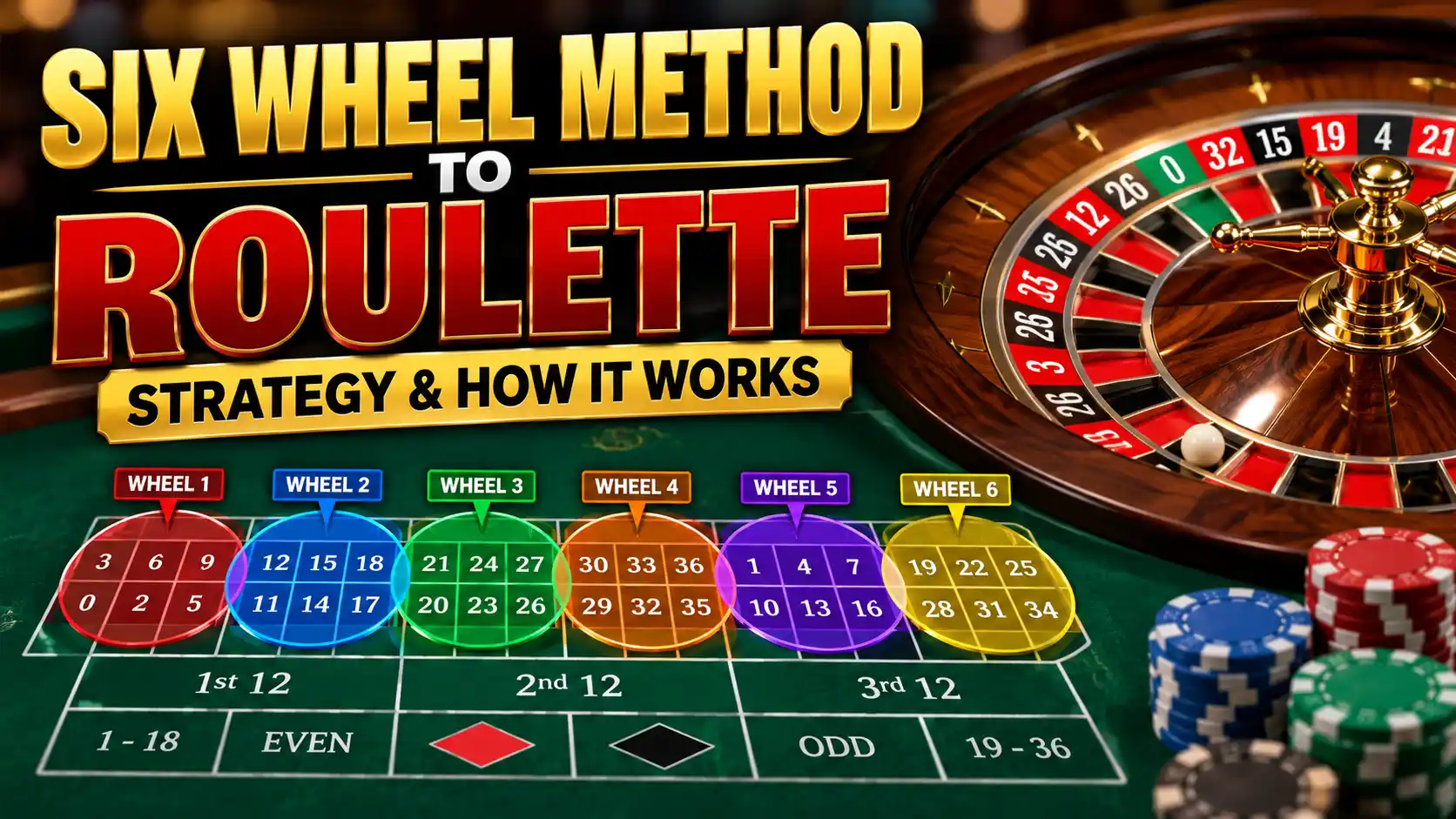
Roulette strategies usually focus on how much to bet, where to place chips, or how to adjust wagers after a win or loss. The Six Wheel Method to roulette is different. Rather than relying on a betting progression, its historical basis is the idea of studying multiple physical roulette wheels, collecting results, and looking for a mechanical bias that could make certain numbers appear more frequently than probability suggests.
The concept is closely associated with Joseph Jagger, a nineteenth-century Englishman who became famous for identifying an apparently biased roulette wheel at Monte Carlo. Historical accounts say observers recorded results from multiple roulette wheels and Jagger eventually identified one wheel that appeared to favour a group of numbers. Contemporary accounts disagree about some details—including the exact year—but the central idea remains consistent: Jagger was attempting to exploit a physical defect rather than predict a genuinely random sequence.
That distinction is crucial.
The Six Wheel Method does not prove that roulette can normally be beaten, and it does not eliminate the house edge on a correctly functioning wheel. It is better understood as an early example of roulette advantage play based on wheel bias.
What Is the Six Wheel Method in Roulette?
The term Six Wheel Method is not a universally standardized name in modern roulette literature. Instead, it is commonly associated with the historical technique of observing several roulette wheels independently and searching for abnormal number frequencies.
The best-known example comes from Joseph Jagger.
Accounts of Jagger’s exploits describe observers monitoring multiple roulette wheels at Monte Carlo and recording their results. One particular wheel eventually appeared to favour a group of numbers more often than expected. Jagger then concentrated his bets on the numbers associated with that wheel.
In other words, the method was approximately:
- Monitor several physical roulette wheels.
- Record the result of each spin separately for each wheel.
- Build a large sample of outcomes.
- Look for numbers or wheel sectors appearing significantly more often than expected.
- Determine whether the apparent pattern persists.
- Bet only if there is credible evidence of a genuine mechanical bias.
The word “six” is therefore historically significant because Jagger’s story involves several roulette wheels—often described in historical accounts as six—not because players must make six bets or follow a six-stage betting progression.
It should also not be confused with the Big Six Wheel, a separate casino game involving a large vertical money wheel rather than a conventional roulette wheel.
Where Did the Six Wheel Roulette Strategy Come From?
Joseph Jagger worked in England’s textile industry, where experience with rotating machinery reportedly gave him an appreciation for mechanical imperfections. His insight was simple: nineteenth-century roulette wheels were physical machines, and physical machines were not necessarily manufactured or maintained with absolute precision.
If one roulette wheel were fractionally tilted, worn or imperfect, perhaps some pockets could receive the ball slightly more often than others.
Jagger therefore sought data rather than relying on intuition.
An early published account describes Jagger employing a group of clerks to record roulette results while he analyzed the numbers from different tables. Another historical account states that the casino later moved wheels between tables, after which identifying the particular wheel became important.
The precise chronology is less certain than many gambling articles imply. Popular versions often date the incident to 1873, while more recent biographical research has placed Jagger’s Monte Carlo activity closer to 1880–1881. That disagreement is worth acknowledging because responsible gambling history should distinguish established facts from repeated legend.
What matters for understanding the strategy is the underlying principle: Jagger was looking for a defective wheel, not a pattern in independent random spins.
How Does the Six Wheel Method Work?
To understand the method, imagine a casino containing six traditional roulette tables.
Instead of sitting at one table and watching for red or black streaks, an observer records hundreds or thousands of outcomes from each physical wheel separately.
The results might eventually look something like this:
- Wheel 1: results broadly consistent with random variation
- Wheel 2: results broadly consistent with random variation
- Wheel 3: results broadly consistent with random variation
- Wheel 4: results broadly consistent with random variation
- Wheel 5: results broadly consistent with random variation
- Wheel 6: a particular group of pockets appears unusually frequently
The important word is “appears.”
Random sequences naturally produce clusters, streaks and unusual-looking results. Twenty appearances of one number do not automatically indicate a defective wheel. A serious wheel-bias analysis therefore needs far more data than a player watching the previous 20 or 50 spins displayed on an electronic scoreboard.
The historical Six Wheel Method can be divided into several practical concepts.
- Each Roulette Wheel Must Be Treated Separately
A mechanical bias belongs to the physical wheel that produces it.
Combining results from multiple wheels would therefore destroy much of the useful information. If Wheel A favours one sector while the other five are perfectly balanced, pooling all six datasets could hide Wheel A’s abnormal behaviour.
This is one reason Jagger’s historical approach was more sophisticated than simply writing down casino results.
- A Large Sample Is Required
Short-term roulette results are noisy.
On a European wheel, any specific number has a theoretical probability of 1/37, or approximately 2.70%, per spin. It would be completely normal for individual numbers to appear above or below that percentage over relatively short sessions.
Demonstrating that an apparent bias is something more than ordinary variance therefore requires substantial data. Modern discussions of wheel-bias analysis generally refer to thousands of observations when trying to distinguish a small physical advantage from statistical noise.
- The Player Looks for Persistent Bias, Not Streaks
This is where the Six Wheel Method differs fundamentally from the gambler’s fallacy.
Suppose black has landed eight times consecutively.
That does not mean red is now more likely on a fair roulette wheel. Previous independent outcomes do not create a debt that the wheel must repay.
A physical bias is different. If a mechanical defect genuinely changes how the ball and rotor interact, then the underlying probability distribution itself may be different from what it should be.
The method therefore asks:
“Is this particular physical wheel producing systematically abnormal results?”
It does not ask:
“Which number is due next?”
The Mathematics Behind the Six Wheel Method
The mathematics explains why an actual wheel bias could matter—and why ordinary roulette systems do not achieve the same thing.
A standard European roulette wheel has 37 pockets: numbers 1–36 plus a single zero. A straight-up bet on one number normally pays 35:1.
Because a winning bet returns 35 units of profit plus the original unit staked, its total return is 36 units.
But the chance of hitting the selected number on a fair European wheel is only 1/37.
That discrepancy creates the familiar European roulette house edge:
House edge ≈ 2.70%.
American roulette adds a 00 pocket for 38 total outcomes while retaining conventional payouts, increasing the standard house edge to approximately 5.26%.
A Nine-Number Example
Suppose a player stakes one unit on each of nine different numbers.
Total stake:
9 units
If one selected number wins, a one-unit straight-up wager produces a total return of:
36 units
For this nine-number portfolio to break even mathematically, the selected group therefore needs to win more often than:
9 ÷ 36 = 25%
On an unbiased European roulette wheel, nine specific numbers collectively have a probability of:
9 ÷ 37 ≈ 24.32%
That difference may look tiny, but it is the entire principle behind genuine wheel-bias advantage play.
If a physical defect pushed those nine numbers collectively above the 25% break-even threshold—and the difference were persistent rather than random noise—the expected value could theoretically become positive.
A staking system cannot do this.
Martingale, Fibonacci and similar systems change the amount of money wagered. A physical wheel bias, if genuinely present, changes the probability of the underlying event.
That is why the two concepts should not be confused.
Why Could the Six Wheel Method Work Historically?
Nineteenth-century roulette equipment was very different from modern regulated casino equipment.
Roulette wheels were mechanical devices exposed to manufacturing tolerances, wear, adjustment and continued physical use. A slightly uneven component, pocket geometry or wheel balance could theoretically influence where the ball finished.
Historical accounts indicate that Jagger’s observations identified one wheel behaving differently from the others. When the casino began moving or altering equipment, the advantage reportedly became harder or impossible to maintain.
The method therefore relied on three circumstances being true simultaneously:
First, a real mechanical defect had to exist.
Without an actual physical bias, abnormal-looking frequencies eventually tend to disappear into ordinary statistical variance.
Second, the defect had to be strong enough to overcome the house edge.
A tiny imperfection is meaningless if it does not change probabilities sufficiently to compensate for roulette’s payout disadvantage.
Third, the defect had to remain stable.
If a casino repairs, replaces, adjusts or moves the relevant components, historical data may no longer describe the current wheel.
Those requirements explain why Jagger’s approach should be viewed as a form of equipment-based advantage play rather than a general roulette betting strategy.
Does the Six Wheel Method Still Work Today?
For most modern roulette players, the historical Six Wheel Method is not a realistic way to obtain an advantage.
There are several reasons.
Modern Physical Wheels Are More Closely Controlled
Roulette equipment has improved enormously since the nineteenth century, and regulated casinos have strong incentives to detect defects.
In Great Britain, for example, Gambling Commission technical requirements state that random game outcomes must be “acceptably random.” Mechanically based random games are also subject to requirements relating to the physical components used to produce outcomes.
A sufficiently strong and persistent physical defect is therefore much less likely to remain unnoticed for the long periods required to collect useful data.
RNG Roulette Has No Physical Wheel Bias to Exploit
Many online roulette games use a random number generator rather than a physical ball and rotor.
In that environment, a strategy based on worn bearings, uneven pockets or physical wheel balance simply does not apply.
For UK-regulated remote gambling, RNG results are required to be uniformly distributed and unpredictable, and licensed operators must submit game and RNG test results as part of compliance requirements.
This does not mean that every gambling website on the internet is trustworthy. It means that the historical mechanical premise behind the Six Wheel Method is fundamentally different from how regulated RNG roulette operates.
Live Dealer Roulette Is Still Physical—but That Does Not Make Bias Easy to Find
Live dealer roulette uses actual equipment, so physical effects exist in principle.
However, “physical” does not automatically mean “predictably biased.”
A player would need evidence that one identifiable wheel consistently deviates from its theoretical distribution, enough observations to distinguish that difference from random variation, and confidence that the wheel has not subsequently been adjusted or replaced.
By the time those requirements are satisfied, the opportunity may no longer exist.
Six Wheel Method vs. Martingale and Other Roulette Systems
The Six Wheel Method belongs to an entirely different category from most roulette strategies.
| Strategy | Main Idea | Changes Outcome Probability? | Removes House Edge on a Fair Wheel? |
| Six Wheel / wheel-bias method | Identify a genuinely biased physical wheel | Potentially, if a real defect exists | Only if a verified bias is strong enough |
| Martingale | Double after losses | No | No |
| Fibonacci | Adjust stakes according to a number sequence | No | No |
| D’Alembert | Increase/decrease stakes gradually | No | No |
| Flat betting | Keep wagers the same size | No | No |
| Red/black pattern betting | Bet based on previous colours | No | No |
This distinction is probably the most important lesson in the entire strategy.
Progression systems rearrange variance and bankroll exposure. They cannot change a fair wheel’s probabilities.
Wheel-bias analysis attempts to establish that the wheel itself is not fair in the statistical sense.
If that premise is wrong, the supposed advantage disappears.
Advantages of the Six Wheel Method
From a theoretical perspective, the method has several strengths.
It Is Based on Evidence Rather Than “Hot Numbers”
The historical approach requires collecting data before betting. That is more rational than assuming a number is lucky because it has appeared several times recently.
It Recognizes the Difference Between Randomness and Mechanical Bias
Roulette mathematics assumes that each wheel pocket has its intended probability. If a physical defect materially violates that assumption, the expected-value calculation changes.
It Does Not Depend on Chasing Losses
Unlike Martingale-style progressions, the Six Wheel concept does not require increasingly large bets after consecutive losses.
That eliminates the exponential stake escalation associated with many negative-progression systems.
Disadvantages and Limitations
The limitations are much more substantial for modern players.
Genuine Bias Is Rare
A method designed to exploit defective equipment is useless when the equipment is functioning properly.
Huge Amounts of Data May Be Needed
Short samples produce false signals. A player may mistake perfectly ordinary randomness for a meaningful statistical deviation.
Historical Results Can Become Obsolete
Even if a wheel once displayed unusual results, adjustment, maintenance or component replacement can change its behaviour.
Selection Bias Can Produce False Confidence
If someone analyzes enough numbers, sectors and time windows, something will eventually look unusual by chance alone.
This is a classic statistical problem: finding an apparent pattern after searching a large dataset is not the same as predicting that pattern before seeing new data.
It Cannot Overcome the Mathematics of a Fair Game
If every pocket has the correct probability, no amount of charting changes the expected value.
The player still faces the underlying house edge.
How to Evaluate Claims About “Winning” Six Wheel Systems
Articles and videos about roulette strategies frequently confuse three very different ideas:
- A historical biased-wheel exploit
- A betting progression
- A pattern-prediction system
They should not be treated as interchangeable.
When evaluating a claim about the Six Wheel Method, ask:
- Does the strategy explain why the underlying probability should change?
- Is it analyzing one identifiable physical wheel or mixing data from multiple games?
- Is the sample large enough to distinguish chance variation from a genuine anomaly?
- Was the alleged bias confirmed on new data rather than discovered retrospectively?
- Does the claim promise guaranteed wins?
- Does it ignore roulette’s house edge?
A claim such as “number 17 appeared four times today, so keep betting it” is not wheel-bias analysis.
Neither is “red lost five times, so double your bet.”
Those ideas are simply pattern chasing or stake management.
Can Previous Roulette Spins Predict the Next Result?
On a properly functioning roulette game, previous results should not determine the next result.
That means a sequence such as:
Red – Red – Red – Red – Red
does not make black “due.”
Likewise, a number that has not appeared for 100 spins is not automatically more likely to appear on spin 101.
For regulated online gambling in Great Britain, technical standards specifically require RNG outputs to be unpredictable and distributed according to expected probabilities.
Historical wheel-bias strategies are only conceptually different because they investigate whether the assumption of equal probabilities has been physically violated.
Without credible evidence of such a violation, each spin should be treated according to the normal roulette odds.
Is European Roulette Better for This Strategy?
European roulette is generally preferable to American roulette from a purely mathematical cost perspective, regardless of the Six Wheel Method.
Standard European roulette carries a house edge of approximately 2.70%, while double-zero American roulette carries an edge of approximately 5.26% on most conventional bets.
That does not make European roulette profitable.
It simply means the structural disadvantage is smaller.
Some French roulette games can reduce the effective edge on qualifying even-money bets further when rules such as La Partage apply, although those rules do not transform ordinary random roulette into a positive-expectation game.
Is the Six Wheel Method the Same as the Big Six Wheel?
No.
The names sound similar, but they describe different subjects.
The Big Six Wheel, sometimes called the Money Wheel or Big Wheel, is a separate casino game featuring a large vertical wheel divided into prize or denomination segments. Players wager on the segment where the wheel will stop.
The Six Wheel Method to roulette, as discussed here, refers to monitoring multiple conventional roulette wheels in search of a statistically detectable mechanical bias.
Confusing the two leads to completely different rules, odds and strategies.
Does the Six Wheel Method Guarantee Roulette Profits?
No.
There is no guaranteed-win version of the Six Wheel Method.
Historically, the method depended on detecting an unusual piece of defective or biased equipment. If there is no defect, there is no mathematical advantage to exploit.
Even an apparent bias can disappear when more observations are collected. Statistical noise can look persuasive over short periods, particularly when someone searches many numbers until an interesting pattern appears.
Modern roulette players should therefore treat the Six Wheel Method primarily as an interesting example from the history of advantage gambling—not as a dependable way to make money from casino roulette.
FAQs
What is the Six Wheel Method in roulette?
The Six Wheel Method is best understood as a roulette wheel-bias strategy associated with the historical practice of monitoring several physical wheels and comparing their results. The objective is to identify one wheel that consistently favours particular pockets or sectors because of a mechanical imperfection.
Who invented the Six Wheel Method?
The concept is most closely associated with Joseph Jagger, the English textile worker and businessman famous for exploiting an apparently biased roulette wheel at Monte Carlo in the nineteenth century. Accounts differ over some dates and details, so describing him as the inspiration for the method is more accurate than claiming a formally patented or universally named “Six Wheel Method.”
Is the Six Wheel Method a betting progression?
No. Unlike Martingale or Fibonacci, it does not primarily tell a player how to adjust bet size. Its underlying premise is identifying abnormal probabilities caused by physical equipment.
Can the Six Wheel Method beat roulette?
Only if a real, persistent bias changes the probabilities enough to overcome the house edge. On a properly functioning fair wheel, the method provides no mathematical advantage.
Does it work with online roulette?
A physical wheel-bias strategy does not apply to RNG-based roulette because there is no physical rotor or pocket defect to analyze. Live dealer roulette uses physical equipment, but modern monitoring, manufacturing and maintenance make exploitable persistent bias substantially harder to establish.
How many spins are needed to identify a biased roulette wheel?
There is no universal number. The required sample depends on the strength and nature of the suspected bias and the statistical confidence required. Small deviations can require thousands of observations, and apparent patterns found in short samples may simply reflect normal variance.
Are hot and cold roulette numbers evidence of wheel bias?
Not by themselves. Random games naturally produce numbers that appear unusually often or rarely over short periods. A genuine bias would need to persist beyond what ordinary statistical fluctuation reasonably explains.
Does Martingale work better with the Six Wheel Method?
Martingale does not improve the underlying probability of any roulette outcome. Combining a betting progression with an unverified bias can instead increase bankroll risk because stakes escalate during losing sequences.
Final Verdict
The Six Wheel Method to roulette is fascinating because it illustrates an important distinction between gambling systems and genuine advantage play.
Most roulette systems attempt to manipulate bets.
The Six Wheel Method historically attempted to identify a defect that manipulated the probabilities themselves.
That is why Joseph Jagger’s story has survived for generations. Rather than believing that a winning number was “due,” he reportedly studied multiple physical wheels and looked for evidence that one behaved differently from the others.
But the same logic explains why players should not treat the strategy as a modern roulette shortcut.
On a properly functioning European roulette wheel, the house maintains an expected advantage of about 2.70%. American roulette increases that figure to about 5.26% on standard bets. Changing stake patterns does not erase those mathematical facts.
Modern regulated games are also subject to technical controls intended to ensure random and unpredictable results. In Great Britain, for example, Gambling Commission standards require qualifying random games to meet randomness requirements and licensed remote operators to submit game and RNG testing information.
So, does the Six Wheel Method work?
As a historical wheel-bias concept, the mathematics is legitimate: a sufficiently strong physical bias can change expected value. As a general strategy for beating today’s roulette games, however, it offers no reliable advantage unless an actual, persistent bias can first be demonstrated.
That makes the Six Wheel Method more valuable as a lesson in probability, statistics and casino history than as a promise of roulette profits.
Roulette should always be treated as paid entertainment rather than a source of guaranteed income. Set spending and time limits before playing, never chase losses, and only gamble with money you can afford to lose.
ADVERTISEMENT

18+ | Affiliate link | Terms apply | Please gamble responsibly.


