

18+ | Affiliate link | Terms apply | Please gamble responsibly.
Last Updated on October 31, 2026 by Maurya
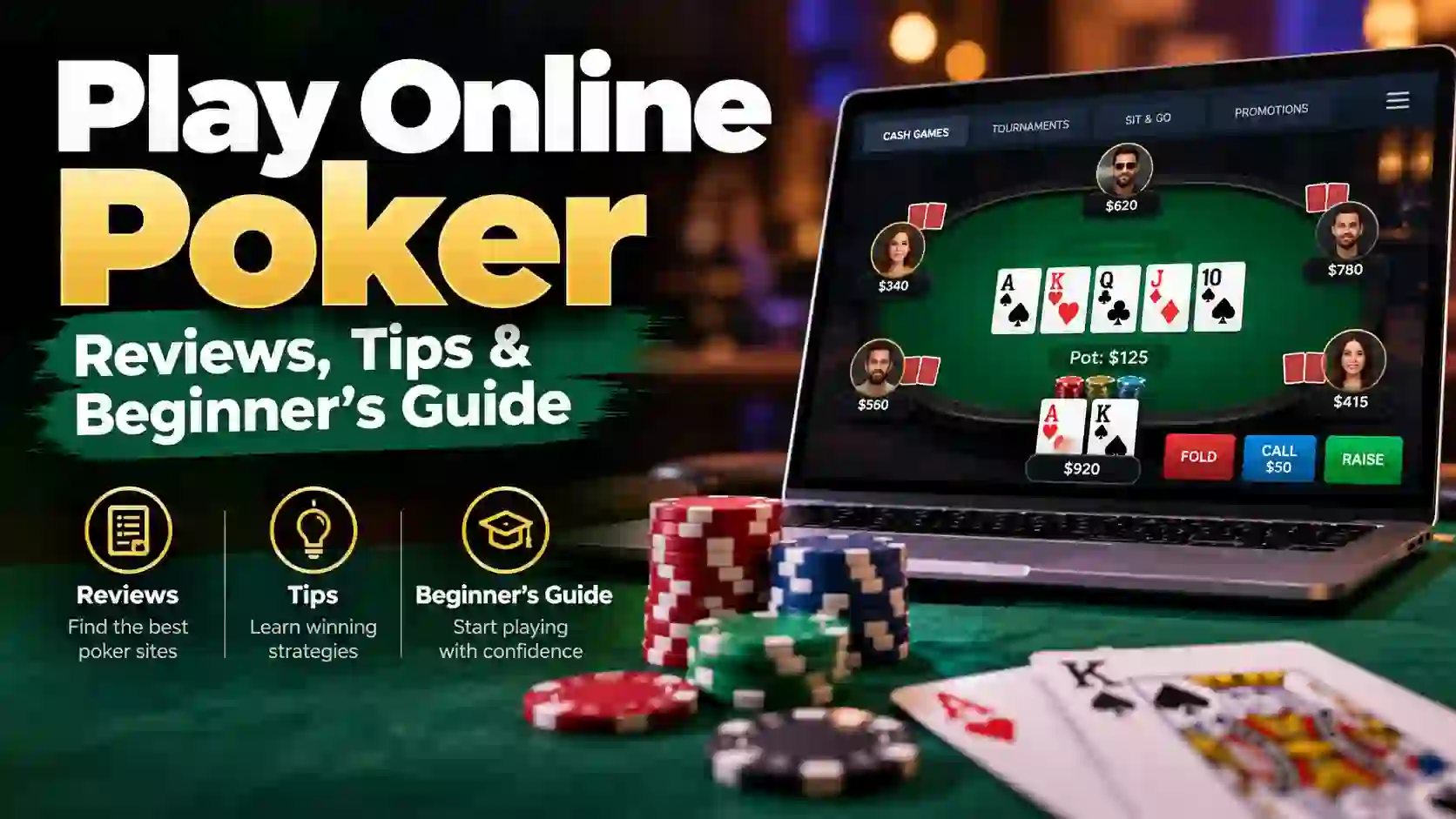
Online poker has transformed a traditional card game into an accessible digital experience. Today, players can explore Texas Hold’em, Omaha, poker tournaments and free practice games from a computer, smartphone or tablet. However, knowing how to play online poker involves much more than understanding which cards beat others.
Poker combines probability, decision-making, observation and strategic thinking. Unlike games where players simply compete against a casino, traditional poker places participants against one another. Every decision, from folding a weak hand to making a carefully considered raise, can influence how a game develops.
For beginners, online poker can initially seem complicated. Terms such as blinds, pot odds, community cards, rake and bankroll management may be unfamiliar. Fortunately, the fundamentals become easier to understand when you approach them systematically.
What Is Online Poker?
Online poker is a digital version of poker in which participants compete through internet-connected gaming platforms. Players join virtual tables, receive cards and make betting decisions according to the rules of their chosen poker variation.
The objective is to win the pot, which contains the chips or money wagered during a hand.
There are two primary ways to win a standard poker hand:
- Hold the strongest five-card hand when the remaining players reach a showdown.
- Make a bet or raise that causes every opponent to fold.
Online poker platforms automatically manage card dealing, betting order, pot calculations and the distribution of winnings.
Many websites offer different game types, including Texas Hold’em, Omaha, cash games, scheduled tournaments and Sit & Go competitions.
Some also provide free poker games where participants use virtual chips rather than real money.
How to Play Online Poker: Step-by-Step Guide
Learning online poker becomes considerably easier when you begin with Texas Hold’em, one of the best-known variations.
Step 1: Understand the Basic Rules
Texas Hold’em uses a standard deck of 52 cards.
Each player receives two private cards, called hole cards. Up to five additional cards are dealt face-up in the centre of the table.
These shared cards are known as community cards.
Your objective is to form the strongest possible five-card combination using any five of the seven cards available to you.
For example, if you receive an ace and king of hearts and three additional hearts appear among the community cards, you may be able to complete a flush.
However, other players may have stronger combinations, so understanding the board remains essential.
Step 2: Learn the Betting Rounds
A typical Texas Hold’em hand includes four possible betting rounds.
Pre-flop: Players receive their two private cards. The first betting round begins after the compulsory small blind and big blind have been posted.
Flop: Three community cards are revealed. Players remaining in the hand participate in another betting round.
Turn: A fourth community card appears, followed by further betting.
River: The fifth and final community card is dealt. Players have one final opportunity to bet before a showdown.
If every player except one folds before the showdown, the remaining player wins the pot immediately.
Step 3: Understand Poker Betting Actions
Poker involves several important betting actions.
Check: Continue without placing an additional bet when no bet is outstanding.
Bet: Place chips into the pot to begin betting during the current round.
Call: Match the amount of an existing bet.
Raise: Increase the current bet, requiring opponents to commit more chips if they wish to continue.
Fold: Give up the current hand and surrender any claim to the pot.
All-in: Commit your entire remaining chip stack to the hand.
Learning when each action is permitted is an essential part of understanding online poker.
Step 4: Memorise Poker Hand Rankings
Poker hand rankings establish which player wins when more than one participant remains at the showdown.
Here are the standard rankings from strongest to weakest:
- Royal Flush: Ace, king, queen, jack and ten of the same suit.
- Straight Flush: Five consecutive cards of the same suit.
- Four of a Kind: Four cards of identical rank.
- Full House: Three cards of one rank and two cards of another rank.
- Flush: Five cards of the same suit.
- Straight: Five consecutive cards, regardless of suit.
- Three of a Kind: Three cards of identical rank.
- Two Pair: Two separate pairs.
- One Pair: Two cards of the same rank.
- High Card: The highest-ranking cards when no stronger combination exists.
A full house always defeats a flush under standard Texas Hold’em rules, while a flush beats a straight.
If two players hold the same category of hand, the ranks of the relevant cards and any applicable kickers determine the winner.
In some situations, players have identical five-card hands and split the pot.
Step 5: Practise Before Considering Real-Money Poker
Beginners should become comfortable with poker rules before considering games involving financial stakes.
Free online poker provides opportunities to practise basic decisions, identify hand combinations and understand the pace of a game.
However, free-play participants sometimes behave differently from real-money players. As a result, winning virtual-chip games should not be interpreted as evidence that you will win money.
Popular Types of Online Poker Games
Online poker includes several variations with different rules, betting structures and levels of complexity.
Understanding these differences can help beginners select suitable practice games.
Texas Hold’em Poker
Texas Hold’em is a popular starting point for new players.
Every participant receives two private cards and uses up to five community cards to create their best five-card hand.
The game involves straightforward core rules but allows considerable strategic depth through betting decisions, positioning and the assessment of opponents.
Texas Hold’em is commonly available in cash-game and tournament formats.
Omaha Poker
Omaha resembles Texas Hold’em but features four private cards per player in its traditional four-card format.
Players must use exactly two private cards and three community cards to construct their final hand.
This requirement is particularly important because beginners familiar with Hold’em may incorrectly assume they can use any combination of available cards.
Omaha often produces more potential hand combinations, making it useful to study only after mastering poker fundamentals.
Seven-Card Stud
Seven-Card Stud is a traditional poker variation that does not use the same shared community-card structure as Texas Hold’em.
Instead, players receive a mixture of face-up and face-down cards across several dealing rounds.
Players construct their best five-card hand from the seven cards they receive.
The game requires attention to exposed cards, opponents’ actions and the possible hands still available.
Cash games involve players buying into a table with chips representing monetary value.
Unlike tournaments, blinds typically remain consistent for a particular cash-game table.
Players can generally join and leave between hands, subject to platform rules.
Nevertheless, the ability to buy additional chips creates a risk of spending more money than originally intended.
Poker tournaments usually require an entry fee that provides a starting stack of chips.
Players compete until they are eliminated, with prizes determined by the tournament payout structure.
Unlike ordinary cash games, tournament blinds normally increase over time.
This creates changing strategic situations as chip stacks become smaller relative to the blinds.
Some tournaments also permit re-entry or rebuy opportunities, which can increase the total cost of participation.
Sit & Go Poker
Sit & Go tournaments commonly begin when a specified number of players have registered.
They can be smaller than scheduled multi-table tournaments and may be convenient for players seeking a particular tournament format.
However, the time required depends on the number of participants, blind structure and game progression.
Online Poker Site Reviews: What Makes a Good Poker Website?
Choosing a trustworthy online poker website is an important part of the experience.
A platform should not be judged solely by welcome bonuses, promotional language or promises of large prizes.
A balanced online poker review should examine licensing, software quality, game variety, costs, customer support and safer-gambling facilities.
Licensing and Security
For UK readers, a key consideration is whether a real-money poker operator holds the relevant licence from the UK Gambling Commission.
The Commission maintains a public register containing information about licensed gambling businesses.
Before using a platform, verify that the business and website are associated with the correct regulatory authorisation.
A website displaying a licensing logo is not, by itself, sufficient evidence of legitimacy.
Poker Game Selection
A useful poker platform should provide clear information about its available games.
Look for popular variations such as Texas Hold’em and Omaha, alongside tournament and cash-game options.
For beginners, the availability of free educational games is particularly valuable.
Game availability can change depending on the number of active participants and the player’s location.
Software Quality and User Experience
Online poker software should make the game easy to follow.
Important features include readable playing cards, clear betting controls, understandable chip displays and reliable account navigation.
Unnecessary visual clutter can make it harder for inexperienced players to concentrate.
Mobile users should also consider whether the website or application works comfortably on smaller screens.
Poker Rake and Fees
One detail that beginners frequently overlook is the fee charged by poker operators.
In many cash games, the operator collects a small portion of qualifying pots, known as rake.
Tournament fees may instead be added to the amount contributing to the prize pool.
These costs affect the financial results of playing.
A transparent platform should clearly explain how its fees are calculated.
Payment and Withdrawal Policies
Before depositing money, review the available payment methods, minimum withdrawal requirements and any applicable charges.
Check the terms explaining account verification and withdrawal processing.
Avoid assuming that a platform offering quick deposits will necessarily provide equally quick withdrawals.
Responsible-Gambling Features
A trustworthy poker website should provide accessible information about player protection.
Important tools include deposit limits, time-outs and self-exclusion.
UK regulatory rules also require licensed online operators to provide appropriate financial-limit facilities.
These protections do not eliminate gambling risks, but they help players establish boundaries.
PokerStars Review: A Recognised Online Poker Platform
PokerStars is an established name in online poker and offers educational material explaining several popular poker formats.
Its published learning resources cover Texas Hold’em, Omaha, poker hand rankings and fundamental strategy.
The platform also describes play-money poker options that can help beginners become familiar with game mechanics.
From an educational perspective, its structured learning content is a useful reference for people who are new to poker.
However, current game availability, fees, account requirements and regulatory permissions should always be checked for the player’s jurisdiction.
This overview is based on publicly available platform information rather than a hands-on test of its software, customer support or withdrawal performance.
10 Online Poker Tips and Strategies for Beginners
Understanding the rules is only the beginning.
Developing sound poker habits involves making informed decisions and recognising situations where participating in a hand may not be worthwhile.
These ten beginner poker tips provide a foundation for learning.
- Start With Strong Hands
One of the most common beginner mistakes is entering too many pots.
Not every starting hand deserves to be played.
Pocket aces, pocket kings, pocket queens and ace-king suited are examples of relatively strong starting hands in Texas Hold’em.
However, their value depends on the circumstances, including table position, opponents’ actions and stack sizes.
Learning starting-hand selection helps beginners avoid making repeated decisions with weak cards.
- Understand Poker Position
Your position at the table affects how much information you have before acting.
Players in later positions can often observe what opponents do before making their own decisions.
For example, acting on the dealer button may provide an informational advantage after the flop.
Understanding position is important because the same starting hand may be worth playing in one situation but folding in another.
- Avoid Playing Every Hand
Receiving two cards does not mean you must participate.
Beginners sometimes call bets simply because they want to see the next community card.
Repeatedly continuing with weak holdings can increase unnecessary losses.
Learning to fold is just as important as understanding when to bet.
- Learn Basic Pot Odds
Pot odds describe the relationship between the cost of calling a bet and the amount available to win.
For example, imagine the pot contains £30 and an opponent bets £10.
The pot now contains £40, and calling costs you £10.
If you call, the final pot will contain £50.
Your required break-even equity is therefore:
£10 ÷ £50 × 100 = 20%
In a simplified situation with no further betting or fees, you need more than 20% equity for the call to have positive expected value.
Pot odds are a mathematical tool rather than a guarantee of winning a hand.
- Pay Attention to Betting Patterns
Opponents’ decisions can provide useful information.
Some players participate in many hands, while others enter pots only with comparatively strong starting cards.
Betting patterns may help you estimate possible ranges of hands.
However, individual decisions are not always reliable indicators of a player’s cards.
Avoid assuming that one unusual bet reveals an opponent’s entire strategy.
- Use Bluffing Carefully
Bluffing is a recognised element of poker, but it is frequently misunderstood.
A successful bluff is not simply a large bet made with weak cards.
It depends on the situation, the betting history and the likelihood that an opponent will fold.
Beginners should concentrate on learning fundamental hand selection and betting rules before exploring advanced bluffing strategies.
Repeated bluffing without considering the circumstances can lead to substantial losses.
- Understand Bankroll Management
Bankroll management involves maintaining financial boundaries around poker participation.
For recreational players, the priority should be setting an affordable entertainment budget that does not interfere with essential expenses.
Money needed for rent, bills, groceries, debt payments or emergency savings should never be used for gambling.
It is also important to understand that maintaining a separate poker budget cannot guarantee profits or prevent losses.
- Recognise Emotional Decisions
Poker can produce frustrating outcomes.
For example, a strong hand may lose after an opponent receives a favourable final card.
When frustration influences future decisions, players may begin taking risks they would normally avoid.
This emotional state is commonly known as tilt.
Taking a break after difficult hands is more sensible than attempting to recover losses immediately.
- Review Your Decisions
A useful way to learn poker is to examine decisions after a session.
Consider which hands you played, how your position affected your choices and whether your decisions were supported by the available information.
Remember that winning an individual hand does not necessarily mean it was played well.
Likewise, losing does not automatically mean a decision was incorrect.
Poker involves uncertainty, so results should be considered alongside the quality of the decisions made.
- Keep Learning and Practising
Poker strategy is a broad subject.
After mastering the fundamentals, beginners can explore concepts such as expected value, drawing odds, betting ranges and tournament strategy.
Educational articles, practice games and hand-analysis exercises can help develop understanding.
There is no strategy capable of guaranteeing successful results.
Free Online Poker vs Real-Money Poker
Many beginners wonder whether they should start with free poker or real-money games.
Free poker allows participants to learn game mechanics using virtual chips rather than financial wagers.
It is particularly useful for understanding poker actions, identifying winning hands and practising table navigation.
Real-money poker introduces the possibility of financial loss.
Players may also behave differently when actual money is involved, which means free-play experience does not reliably predict real-money results.
For people who primarily want to learn the game, free poker is a practical choice.
Before joining any website, verify whether free games involve optional purchases, subscriptions or registration requirements.
Advantages of Playing Online Poker
Online poker offers several practical features that distinguish it from traditional card-room poker.
Convenient access: Players can explore available games from compatible internet-connected devices.
Different game variations: Platforms may offer Hold’em, Omaha, tournaments and other poker formats.
Learning opportunities: Free games and educational resources can help new players understand essential rules.
Flexible formats: Cash games and tournaments offer different structures for participants with different preferences.
Automated gameplay: Software handles dealing, betting order and pot calculations.
These features make online poker accessible, although accessibility should always be balanced against the risks of excessive play.
Disadvantages and Risks of Online Poker
Online poker also has important disadvantages.
Financial losses: Players can lose their entire allocated gambling budget.
Unpredictable outcomes: Strong cards and careful decisions do not guarantee success.
Operator fees: Rake and tournament charges can reduce financial returns.
Reduced face-to-face interaction: Players cannot rely on physical expressions and other live-poker observations.
Continuous availability: Convenient access may encourage longer sessions or repeated gambling.
Security concerns: Unlicensed or fraudulent websites may expose users to additional financial and personal-data risks.
Understanding these disadvantages is necessary when evaluating any online poker platform.
Common Online Poker Mistakes to Avoid
Beginners often repeat the same mistakes while learning.
The first is overvaluing starting hands. A strong initial pair may become less valuable when community cards create possible straights, flushes or other powerful combinations.
Another mistake is ignoring table position. Acting without enough information can make decisions more difficult.
A third mistake is calling too frequently. Remaining in a hand simply because you have already invested chips can result in additional losses.
Beginners may also misunderstand tournament costs by ignoring the possibility of rebuys or re-entries.
Perhaps the most harmful mistake is chasing losses.
Poker should never become an attempt to recover money needed for everyday living.
Establish financial boundaries before playing, and stop when those boundaries are reached.
Is Online Poker Legal in the UK?
Online poker involving real money is legal for eligible adults in Great Britain when offered by operators holding the necessary gambling licences.
The minimum legal age for online gambling in Great Britain is 18.
The UK Gambling Commission regulates licensed gambling businesses and maintains an official register that consumers can consult.
Licensed online operators must also conduct age and identity verification before allowing customers to gamble.
Players should verify the operator’s licensing status rather than relying exclusively on marketing material.
Importantly, regulatory oversight does not remove the financial risks associated with poker.
UK Gambling Rules and Deposit Limits
As of October 2026, updated Gambling Commission requirements include provisions for gross deposit limits on online gambling accounts.
From 30 September 2026, operators covered by these rules must offer gross deposit limits, which restrict how much money can be deposited within a defined period.
Players should familiarise themselves with the financial-limit controls available through their accounts.
Relevant information is available through the official UK Gambling Commission website.
How to Play Online Poker More Safely
Real-money poker should be approached as entertainment, not as an income opportunity.
Before playing, decide how much money you can afford to lose without affecting financial responsibilities.
Set time and spending limits, and avoid using gambling to manage stress or financial difficulties.
Do not borrow money to play poker.
If gambling begins affecting your finances, relationships, employment or wellbeing, stopping and seeking assistance is more important than finding a new strategy.
UK residents can access free support through organisations including GamCare and GAMSTOP.
GamCare provides gambling-related information and confidential support through its services and the National Gambling Helpline.
GAMSTOP offers free self-exclusion from participating licensed online gambling operators.
Both services provide information for people who want to reduce gambling-related harm.
FAQs
What is the easiest online poker game for beginners?
Texas Hold’em is generally a suitable starting point because it uses two private cards, five community cards and standard poker hand rankings. Beginners can learn its basic rules relatively quickly, although developing strategic skill takes longer.
Can I play online poker for free?
Yes. Some poker websites offer free games using virtual chips. These provide opportunities to practise poker rules without making real-money wagers. Always check whether the platform includes optional purchases or other charges.
What are the best starting hands in poker?
In Texas Hold’em, pocket aces, pocket kings, pocket queens and ace-king suited are among the strongest starting hands. However, position, stack sizes and opponents’ actions influence how those hands should be played.
Is online poker a game of skill or luck?
Online poker involves both skill and luck. Strategic decisions can influence long-term results, but random card distribution creates uncertainty. Even experienced players can experience substantial losses.
How do online poker websites make money?
Many online poker platforms earn revenue by charging rake on qualifying cash-game pots or fees on tournament entries. Exact fee structures vary by operator and game type.
Is online poker safe in the UK?
Playing through an appropriately licensed operator provides regulatory protections, including identity verification requirements and player-protection measures. However, gambling still carries financial risks, and licensing does not guarantee winning results.
Can online poker be played on mobile devices?
Yes. Many platforms support mobile poker through websites or dedicated applications. Device compatibility, game availability and regional restrictions depend on the operator.
Can you win real money playing online poker?
Real-money poker games may award winnings, but losing money is also possible. Results are influenced by opponents, random card distribution, fees and decisions. Poker should not be considered a dependable source of income.
What is the difference between online poker and casino poker?
Traditional player-versus-player online poker involves participants competing against one another, with the operator generally charging fees. Some casino poker products instead involve playing against the house under separate game rules.
How long does it take to learn online poker?
The essential rules of Texas Hold’em can be learned through a relatively small amount of study and practice. Developing a deeper understanding of probability, table position and strategic decisions requires considerably more experience.
Final Verdict
Online poker offers a convenient way to learn a traditional card game that combines probability, observation and strategic decision-making.
Its variety of formats makes it possible for newcomers to explore Texas Hold’em, Omaha and tournament structures while developing an understanding of the rules.
However, learning poker should not be confused with earning money. Strong cards can lose, careful decisions can produce disappointing outcomes, and gambling fees can affect financial results.
For beginners, the most sensible starting point is to study poker hand rankings, understand betting actions and practise using free games.
Anyone considering real-money poker should first verify the operator’s licensing status, understand the financial risks and establish clear personal limits.
Ultimately, the most valuable poker skills are not limited to knowing when to bet or raise. They also include recognising uncertainty, making informed decisions and knowing when to stop.
If you want to play online poker, learn the rules first, practise without financial stakes and prioritise safety over promotional promises. A solid understanding of poker fundamentals will make the game easier to follow, but no system can guarantee winning results.
ADVERTISEMENT

18+ | Affiliate link | Terms apply | Please gamble responsibly.


