

18+ | Affiliate link | Terms apply | Please gamble responsibly.
Last Updated on October 31, 2026 by Maurya
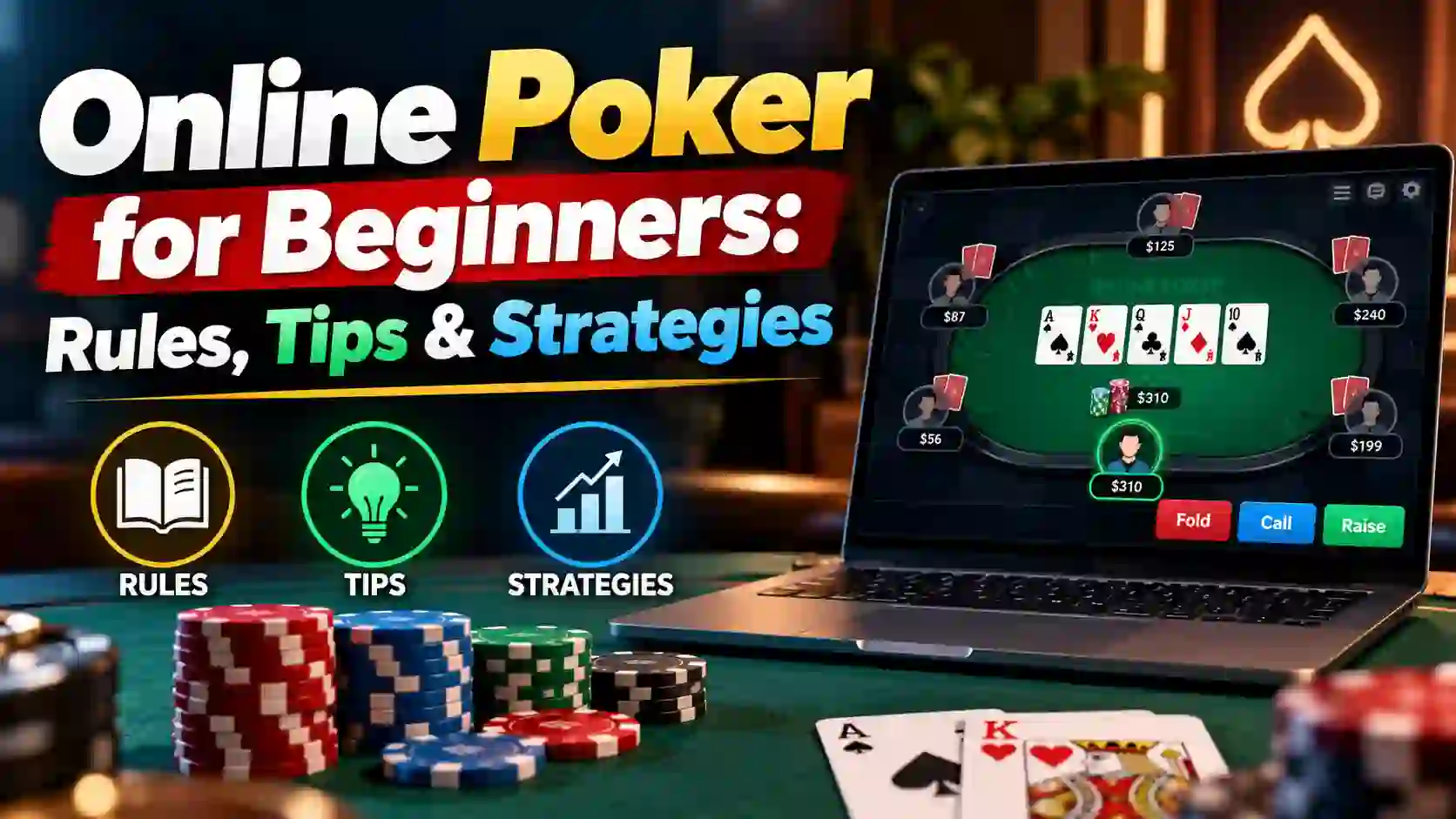
Online poker might look complicated when you first sit at a virtual table. Cards appear, players raise their bets, and unfamiliar terms such as big blind, flop, kicker, and all-in fill the screen. Yet the fundamentals are easier to understand than they initially appear.
The real challenge is not learning which hand beats another. It is learning how to make sensible decisions when you cannot see your opponents’ cards.
Whether you want to understand Texas Hold’em, practise with free poker games, or learn the basics of poker strategy, this guide explains the essential rules in straightforward language.
You will discover how poker hands are ranked, how betting rounds work, why table position matters, and which common mistakes beginners should avoid. We will also explore online poker safety, bankroll management, and the importance of treating real-money gambling as entertainment rather than a source of income.
What Is Online Poker?
Online poker is a digital version of traditional poker played through websites, computer software, or mobile applications. Instead of sitting around a physical table, participants compete against other players using virtual cards and chips.
The most widely played variation is Texas Hold’em, although online platforms may also offer Omaha, Seven-Card Stud, and other poker formats.
Unlike many casino games where players compete directly against the house, traditional online poker involves players competing against one another. The operator generally earns revenue through fees, such as rake on cash-game pots or tournament entry fees.
Poker combines probability, decision-making, psychological judgement, and chance. Skilled decisions can influence long-term results, but the outcome of any individual hand remains uncertain. Even experienced players can lose with exceptionally strong cards.
How Do You Play Online Poker?
In Texas Hold’em, every player receives two private cards. Up to five shared community cards are then revealed across four betting rounds. Players try to form the strongest possible five-card poker hand or win the pot by making everyone else fold.
The main stages are:
- Players post the small blind and big blind.
- Each player receives two private cards.
- The first betting round begins.
- Three community cards are revealed on the flop.
- A fourth card appears on the turn.
- The fifth community card appears on the river.
- Remaining players reveal their hands at showdown, unless everyone except one player has folded.
Understanding this sequence is the foundation of learning online poker.
Understanding Poker Hand Rankings
Before studying advanced strategies, every beginner needs to learn the poker hand rankings.
These determine which five-card combinations win when two or more players reach the showdown.
Poker Hands Ranked From Highest to Lowest
| Rank | Poker Hand | Explanation |
| 1 | Royal Flush | A, K, Q, J and 10 of the same suit |
| 2 | Straight Flush | Five consecutive cards of the same suit |
| 3 | Four of a Kind | Four cards of identical rank |
| 4 | Full House | Three cards of one rank and two of another |
| 5 | Flush | Five cards of the same suit |
| 6 | Straight | Five cards in numerical sequence |
| 7 | Three of a Kind | Three cards of identical rank |
| 8 | Two Pair | Two separate pairs |
| 9 | One Pair | Two cards of identical rank |
| 10 | High Card | The highest available card when no combination is formed |
Example: If one player has three queens and another has two pairs, the player holding three queens wins.
However, hand rankings are only part of the calculation. When two players have the same category of hand, their card ranks and, where relevant, their kickers determine the winner.
A kicker is an additional card used to separate otherwise similar hands. For instance, a pair of aces with a king kicker beats a pair of aces with a queen kicker when the other relevant cards are equal.
If two players form exactly the same best five-card hand, the pot is divided between them.
An important Texas Hold’em rule is that you can use both, one, or neither of your private cards to form your final hand.
How to Play Texas Hold’em Poker Step by Step
Texas Hold’em is an excellent starting point because its rules are relatively straightforward and educational resources are widely available.
Let’s examine a complete round.
Step 1: The Small Blind and Big Blind
Before the dealer distributes any cards, two players must make compulsory bets known as blinds.
The player immediately to the left of the dealer button places the small blind, while the next player places the big blind.
For example, a practice game might use:
- Small blind: 5 chips
- Big blind: 10 chips
These compulsory bets create an initial pot and encourage players to participate.
The dealer button moves clockwise after each hand, ensuring that blind positions rotate.
Step 2: Receiving Your Hole Cards
Every player receives two private cards, commonly called hole cards.
Only you can see your own hole cards.
For example, you might receive:
A♠ K♠
This is called ace-king suited because both cards belong to the same suit.
The cards offer several possibilities, including making a high pair, a straight, or a flush. However, they do not guarantee that you will win.
Step 3: Pre-Flop Betting
The first betting round occurs before any community cards are revealed.
In a standard multi-player game, the player immediately to the left of the big blind acts first.
Players choose whether to fold, call, or raise. The big blind may also check if no player has raised.
Your starting cards, table position, and previous actions should influence your decision.
Step 4: The Flop
After the first betting round, three community cards are dealt face up.
Imagine the flop shows:
A♥ 7♣ 2♦
If you hold A♠ K♠, you have a pair of aces with a king kicker.
You now need to consider whether your opponent may have a stronger combination, such as two pair or three of a kind.
Another betting round follows.
Step 5: The Turn
The dealer reveals a fourth community card.
Suppose the turn is:
9♣
You still hold a pair of aces, but your opponent’s range of possible hands may have changed.
You should reassess the strength of your cards before deciding whether to check, call, bet, raise, or fold.
Step 6: The River
The river is the fifth and final community card.
No more cards will be dealt after the river.
Players must now evaluate their strongest five-card hand and decide how to approach the final betting round.
Step 7: The Showdown
If at least two players remain after the final betting round, the hand reaches showdown.
The best five-card combination wins.
Alternatively, if one player bets and everyone else folds, that player wins without needing to show their cards.
This distinction explains why poker involves more than simply collecting strong hands.
Basic Poker Betting Actions Explained
Online poker uses a small number of betting actions that every beginner should recognise.
Check: Remain in the hand without placing a bet, provided no active bet needs to be matched.
Bet: Place the first wager in a betting round.
Call: Match the amount necessary to continue.
Raise: Increase the existing bet.
Fold: Give up your hand and any chips you have already committed to the pot.
All-in: Commit your entire remaining stack.
An all-in player may still win the portion of the pot they are eligible for. If other players continue betting beyond that amount, a separate side pot is created.
Learning these terms before entering a game prevents avoidable confusion.
Different Types of Online Poker Games
Not every online poker game follows the same structure.
Understanding the differences helps beginners select an appropriate learning environment.
Texas Hold’em
Texas Hold’em uses two private cards and five community cards.
It is generally the best place to begin because educational material, hand examples, and strategy explanations are readily available.
Omaha Poker
Omaha normally gives each player four private cards.
Players must use exactly two private cards and three community cards to make their five-card hand.
This creates different combinations and strategic considerations from Hold’em.
Online Poker Tournaments
Tournament participants receive a starting stack of chips and compete as blinds increase.
Players are eliminated when they lose all their chips, unless a particular tournament format permits re-entry.
Tournaments may continue for several hours, and the entry fee can be lost.
Cash Games
Cash games use chips representing real monetary value when played for money.
Blinds typically remain consistent at a given table, and players can usually leave between hands.
Operators may deduct rake from eligible pots, which affects the economics of the game.
Free-to-Play Poker
Free poker games use play-money chips instead of real-money stakes.
They are particularly useful for learning how betting rounds, hand rankings, and poker software work.
However, players may behave very differently when virtual chips have no financial value, so free games are not a perfect simulation of real-money poker.
10 Essential Online Poker Tips for Beginners
Once you understand the rules, the next step is developing a disciplined approach to decision-making.
These beginner poker strategies are educational principles, not guarantees of winning.
- Play Fewer Starting Hands
One of the most common beginner mistakes is playing almost every hand.
Weak starting cards can create difficult situations, particularly when you are out of position.
Instead, begin by learning which hands are generally stronger.
Examples include:
- Pocket aces (A-A)
- Pocket kings (K-K)
- Pocket queens (Q-Q)
- Ace-king suited (A-K of the same suit)
- Ace-queen suited (A-Q of the same suit)
These hands are often playable in many situations, but their value still depends on position, stack sizes, previous betting, and opponents.
A strong starting hand can become weak after the community cards appear.
- Understand Your Table Position
Position is one of the most important concepts in poker strategy.
Your position determines when you act relative to your opponents.
Players acting later usually have more information because they can observe what others have done.
Early position: You act before most opponents and should generally be more selective about starting hands.
Middle position: You have some information but must still consider players acting behind you.
Late position: You can observe more actions before making a decision. The dealer button is particularly valuable after the flop.
Late position does not guarantee an advantage in every hand, but it can make decisions easier.
- Learn When to Fold
Folding is a fundamental poker skill.
Beginners sometimes continue with weak hands simply because they have already contributed chips.
This is an example of the sunk-cost problem.
Money already committed to the pot cannot be recovered by folding, but placing additional chips at risk is a new decision.
Ask yourself whether continuing makes sense based on the current situation, not on what you have already spent.
- Avoid Bluffing Too Frequently
Bluffing means betting or raising with a hand that is unlikely to be the strongest, hoping that better hands will fold.
It can be an important part of poker strategy, but random bluffing is rarely sensible.
Before attempting a bluff, consider:
- Whether your opponent is capable of folding.
- Whether the board supports the strong hand you are representing.
- Whether your previous betting tells a believable story.
- How much you risk compared with the pot.
New players should generally focus on understanding value betting before attempting elaborate bluffs.
- Understand the Importance of Bet Sizing
Bet sizing affects how opponents respond and how much is at risk.
A small bet may encourage calls from weaker hands, while a larger bet can put greater pressure on an opponent’s decision.
However, bigger bets are not automatically better.
Your bet should have a purpose, whether that involves seeking value from worse hands or making a carefully considered bluff.
Avoid changing bet sizes purely because you feel confident or frustrated.
- Pay Attention to Your Opponents
Even though you cannot see your opponents physically, online poker reveals useful information through betting behaviour.
Some players enter many pots and call frequently.
Others fold most hands and become aggressive only when holding strong cards.
Observe whether opponents regularly raise before the flop, make unusually large bets, or continue betting after being called.
These observations can help you think about their likely range of hands.
However, avoid treating a handful of actions as proof of a particular playing style.
- Learn Basic Poker Probability
Poker involves making decisions without complete information.
Understanding probability helps you evaluate whether a call is worthwhile.
For example, a standard flush draw has nine remaining cards that can complete the flush, assuming the relevant cards are unseen.
With one card to come, the probability of completing that flush is approximately 19.6%.
If you are on the flop and get to see both the turn and river, the chance of completing the flush by the river is approximately 35%.
These percentages describe the chance of completing the draw, not necessarily the chance of winning. An opponent could still make a stronger hand.
- Avoid Playing Too Many Tables
Online poker software may allow players to participate at several tables simultaneously.
Although experienced players sometimes do this, beginners can find it difficult to follow multiple games.
Playing one table gives you more time to understand betting patterns, recognise mistakes, and think through decisions.
Improving the quality of your decisions is more valuable than increasing the number of hands you play.
- Keep Emotions Out of Decisions
Poker players sometimes experience tilt, a term describing emotionally driven play following frustration, excitement, or disappointment.
For example, losing with a strong hand may tempt someone to make an unusually large bet on the next hand.
This is not a reliable strategic response.
If frustration starts influencing decisions, stop playing and return to studying or another activity.
Never attempt to recover losses through larger bets.
- Review Your Decisions
A useful way to develop poker knowledge is to examine hands after a session.
Rather than focusing only on whether you won or lost, ask:
- Was my starting hand appropriate for my position?
- What range of hands could my opponent have held?
- Did my bet size serve a clear purpose?
- Were the pot odds favourable?
- Did I make a reasonable decision with the information available?
Reviewing decisions helps separate the quality of your play from short-term luck.
Understanding Pot Odds in Online Poker
Pot odds describe the relationship between the amount you must call and the potential reward.
They help you decide whether the price of continuing is reasonable compared with your estimated chance of winning.
A Simple Pot Odds Example
Imagine you are playing a practice hand using virtual chips.
There are 100 chips in the pot.
Your opponent bets another 50 chips.
The pot now contains 150 chips, and you must call 50 chips to continue.
If you call, the final pot becomes 200 chips.
The calculation is:
Required equity = Amount to call ÷ Final pot after calling × 100
Therefore:
50 ÷ 200 × 100 = 25%
You need approximately 25% equity for the call to break even in this simplified situation.
If your estimated chance of winning is lower, calling is generally unfavourable on immediate pot odds alone.
If it is higher, the call may be mathematically reasonable.
However, future betting, rake, the possibility of splitting the pot, and whether you can actually realise your equity can change the result.
The Rule of 4 and 2
Another useful beginner concept is the Rule of 4 and 2.
This provides a quick approximation of the probability of completing a drawing hand.
After the flop, multiply your number of outs by four to estimate the probability of improving by the river.
After the turn, multiply the number of outs by two to estimate the probability of improving on the river.
For a nine-out flush draw:
- Flop: 9 × 4 = approximately 36%
- Turn: 9 × 2 = approximately 18%
These are approximations, not exact calculations.
Furthermore, the flop estimate assumes you can see both remaining cards. When facing a bet on the flop, calling does not automatically guarantee that you will see the river without another payment.
This distinction is especially important for beginners.
Online Poker Bankroll Management
Bankroll management means controlling the amount of money allocated to poker.
It is essential to distinguish between practising poker strategy and managing gambling-related financial risk.
A separate poker budget should never include money needed for rent, bills, groceries, debt repayments, or savings goals.
If you choose to play real-money poker, set a strict entertainment budget that you can afford to lose entirely.
Establish both spending limits and session-time limits before starting. Avoid increasing them in response to losses.
Poker outcomes can vary considerably over short periods, even when players make reasonable decisions. No bankroll strategy eliminates the possibility of losing money.
There is also an important difference between a cash-game buy-in and a tournament entry fee.
In a cash game, your chips represent money you have brought to the table. In a tournament, your entry fee generally purchases participation and a starting stack; it does not guarantee any return.
For someone learning the game, free poker exercises and non-monetary practice games remove the financial exposure of real-money play.
Common Online Poker Mistakes Beginners Should Avoid
Many poker mistakes come from misunderstanding basic concepts rather than from complicated strategic errors.
Playing Every Ace
An ace can look attractive, but not every ace-high starting hand is strong.
For example, A-3 offsuit may be dominated by an opponent holding A-K.
If an ace appears on the flop, both players could make top pair, while the opponent holds a stronger kicker.
Overvaluing One Pair
A pair of aces is a useful hand, but it is not unbeatable.
If the community cards create possible straights, flushes, or full houses, a single pair may be vulnerable.
Ignoring the Board
Players sometimes focus entirely on their private cards.
Instead, consider what the shared cards allow opponents to make.
A coordinated board containing three cards of the same suit, for example, creates different risks from a dry board with unrelated ranks and suits.
Calling Without a Plan
Calling simply because you are curious about an opponent’s cards can become expensive.
Before calling, identify what hands you may beat and whether the price of the call makes sense.
Assuming Every Loss Means Bad Play
Poker includes unavoidable short-term randomness.
A good decision can lose, while a poor decision can occasionally win.
Evaluate the reasoning behind your actions rather than judging every decision solely by the final result.
Chasing Losses
Trying to win back lost money by increasing stakes is particularly dangerous.
A losing session does not make a winning session more likely to follow.
Each new poker hand presents a separate decision under uncertainty, and past losses do not create an entitlement to future winnings.
How to Choose a Safer Online Poker Platform in the UK
Online poker involves financial and personal-data considerations, so platform selection deserves attention.
In Great Britain, operators providing real-money online gambling must hold the appropriate Gambling Commission licence.
Before creating an account, examine the operator’s licensing information and verify its status using the UK Gambling Commission public register.
Other considerations include:
Transparent game rules: You should be able to find information about the available poker formats and betting structures.
Clear fees: Understand how cash-game rake and tournament fees work before participating.
Account security: Look for secure account access and use a strong, unique password. Enable multi-factor authentication when supported.
Responsible gambling controls: Check the availability of deposit limits, spending controls, session reminders, breaks, and self-exclusion.
Straightforward withdrawal rules: Review identity-verification requirements and withdrawal terms rather than relying on promotional descriptions.
Customer support: Confirm how to contact the operator if you encounter a technical or account-related problem.
In Great Britain, real-money online gambling is restricted to adults aged 18 and over.
Regulatory licensing offers important consumer protections, but it does not guarantee that a player will win or avoid financial harm.
Free Online Poker vs Real-Money Poker
Both formats use similar rules, but the incentives are different.
| Feature | Free Poker | Real-Money Poker |
| Financial stakes | No real-money stake | Money can be lost |
| Learning the rules | Suitable | Possible, but financially risky |
| Player behaviour | Often experimental | May be more cautious or competitive |
| Financial risk | None from play-money chips | Potentially significant |
| Best educational use | Learning controls and hand decisions | Not necessary for learning fundamentals |
For complete beginners, practising without financial stakes is a sensible starting point.
You can also improve through hand-ranking exercises, poker books, strategy articles, and discussion of hypothetical hands without gambling.
A Practical Poker Learning Plan for Beginners
Developing an understanding of poker does not require rushing into real-money competition.
A simple learning sequence can make the fundamentals easier to remember.
Stage 1: Learn the rules. Study poker hand rankings, betting actions, and the four Texas Hold’em betting rounds.
Stage 2: Practise with virtual chips. Use free games to become familiar with the interface and the sequence of play.
Stage 3: Study starting hands. Learn why certain combinations are stronger and why position changes their value.
Stage 4: Understand post-flop decisions. Consider board texture, opponent ranges, and the purpose of betting.
Stage 5: Learn probability. Work through simple examples involving outs, pot odds, and expected value.
Stage 6: Review example hands. Examine what information was available at each decision point and how alternative actions might have changed the outcome.
There is no need to progress to gambling with money to continue developing poker knowledge.
Responsible Online Poker
Although poker includes strategy and skill, real-money poker remains gambling.
No betting system, starting-hand chart, or advanced strategy can guarantee a profit.
Set financial and time boundaries, avoid gambling under stress or while intoxicated, and never regard poker as a solution to money problems.
In Great Britain, licensed online gambling operators are required to offer financial limit controls. You can read more about gambling safeguards through the UK Gambling Commission.
If gambling is becoming difficult to control, the following resources provide support:
- GamCare offers confidential advice and support.
- GAMSTOP provides free self-exclusion from online gambling operators licensed in Great Britain.
- The National Gambling Helpline can be contacted on 0808 8020 133 in England and Scotland.
- In Wales, the relevant free gambling helpline number listed by the Gambling Commission is 0808 2819 265.
These helplines are available 24 hours a day.
Taking a break, setting restrictions, or stopping completely is always a legitimate decision.
FAQs
Is online poker easy for beginners?
The fundamental rules of Texas Hold’em are relatively easy to learn. Most beginners can understand the betting sequence and hand rankings with some practice. Developing strong decision-making skills, however, takes considerably more study because poker involves probability, incomplete information, and changing circumstances.
What is the best poker game for beginners?
Texas Hold’em is a common starting point because of its straightforward rules and wide availability of educational resources. Free-to-play Texas Hold’em allows beginners to practise without putting real money at risk.
Can you play online poker for free?
Yes. Some platforms offer play-money poker, while other websites provide free educational simulations or practice exercises. Always check whether an advertised free game involves optional purchases, registration requirements, or conditions attached to promotional tournaments.
Is online poker based on luck or skill?
Both influence poker outcomes. Chance determines which cards are dealt, while players make strategic decisions about betting, folding, and evaluating incomplete information. Skill may influence outcomes over many hands, but this does not guarantee profitability, particularly after fees and against strong opponents.
What is the strongest hand in poker?
The royal flush is the strongest traditional high-poker hand. It consists of an ace, king, queen, jack, and ten, all of the same suit. No other poker hand can beat it, although players can tie when their best five-card hands are identical.
What are the best starting hands in Texas Hold’em?
Pocket aces, pocket kings, pocket queens, and ace-king suited are among the strongest starting hands. Nevertheless, the correct action depends on betting history, table position, effective stack sizes, and the other players involved.
What does all-in mean in online poker?
Going all-in means committing all your remaining chips to a hand. In a no-limit game, a player can wager their entire stack, subject to the relevant betting rules. An all-in player cannot contribute more chips to the hand and may be eligible for a main pot while other players compete for a separate side pot.
How important is bluffing in poker?
Bluffing is one element of poker strategy, but it is not necessary to bluff constantly. Beginners benefit more from understanding hand strength, position, and sensible betting decisions before attempting complex bluffs.
Can you make money playing online poker?
Some players achieve profitable results over extended periods, but many lose money. The combination of variance, player competition, and operator fees makes sustained profitability difficult. Poker should not be considered a dependable income source or a way to recover financial losses.
Is online poker legal in the UK?
Real-money online poker can legally be offered to adults aged 18 or over in Great Britain by appropriately licensed operators. Players should check the operator’s current Gambling Commission licence and applicable terms. Rules and regulatory arrangements may differ by jurisdiction, including Northern Ireland.
What is the biggest mistake beginners make in poker?
A frequent mistake is continuing with weak hands without considering position, opponents’ likely holdings, or the cost of calling. Other important errors include ignoring pot odds, playing emotionally, and chasing gambling losses.
Final Thoughts
Online poker for beginners becomes much easier to understand once the game is divided into clear components.
Start with the basic rules, memorise poker hand rankings, and learn how the blinds and betting rounds work. Then build your understanding of starting-hand selection, table position, pot odds, and decision-making after the flop.
The most useful poker lesson is that a good decision and a winning result are not always the same thing.
A strong hand can lose, a weak hand can occasionally win, and no strategy removes uncertainty from the game.
For beginners, free practice, patient study, and realistic expectations provide a practical way to learn without taking unnecessary financial risks.
ADVERTISEMENT

18+ | Affiliate link | Terms apply | Please gamble responsibly.


