

18+ | Affiliate link | Terms apply | Please gamble responsibly.
Last Updated on November 8, 2026 by Maurya
Online gambling has grown from a niche activity into a major part of the global entertainment industry. Today, people can place sports bets, play poker, enter lotteries, or access casino games from a smartphone within seconds.
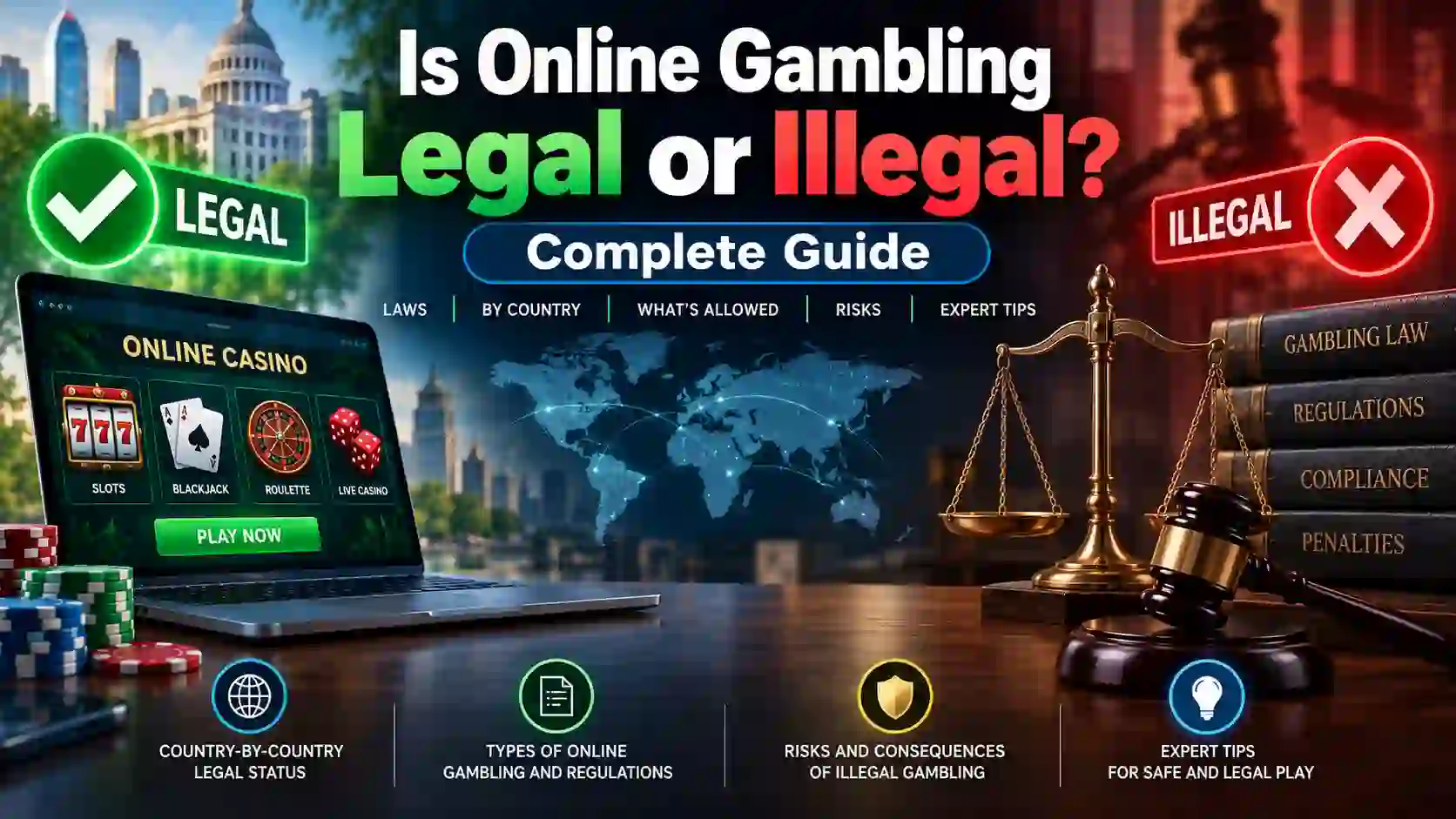
But one important question remains: Is online gambling legal or illegal?
There is no universal yes-or-no answer.
Online gambling can be completely legal in one country, legal only through licensed operators in another, and prohibited altogether somewhere else. Rules may even change from one state or province to another within the same country.
The type of gambling also matters. A jurisdiction may permit online sports betting while prohibiting online casino games. Another may allow lotteries and poker but restrict slot games. Governments can also impose licensing, location, age-verification, advertising, payment, and responsible-gambling requirements.
What Is Online Gambling?
Online gambling, sometimes called remote gambling, generally refers to wagering money or something of value through the internet or another electronic communication system.
The UK Gambling Commission, for example, defines remote gambling as gambling in which people participate through remote communication, including the internet, telephone, television, radio, and other electronic technologies.
Common forms of online gambling include:
- Online casino games
- Slots
- Blackjack
- Roulette
- Baccarat
- Online poker
- Sports betting
- Horse-racing betting
- Esports betting
- Bingo
- Lotteries
- Virtual sports
- Betting exchanges
However, regulators do not necessarily treat every category in the same way.
That distinction is one reason searching simply for “is gambling legal?” can produce misleading answers.
Is Online Gambling Legal or Illegal?
Online gambling is legal in many jurisdictions when it is provided by an operator that holds the licences required by the player’s jurisdiction. In other places, some or all forms of online gambling are prohibited.
Three broad legal models exist around the world.
- Regulated and Legal Online Gambling
Some jurisdictions permit online gambling under a comprehensive licensing system.
Licensed companies typically have to meet requirements covering areas such as:
- Player funds
- Identity verification
- Anti-money-laundering controls
- Game fairness
- Advertising
- Responsible gambling
- Complaints
- Cybersecurity
- Financial reporting
Great Britain is one clear example.
The Gambling Commission states that an operator providing remote gambling facilities to consumers in Great Britain needs a Gambling Commission licence. This requirement can apply even when the company itself is based outside Britain.
- Partially Legal or Restricted Online Gambling
Some countries allow certain gambling products but prohibit others.
A government might permit:
- Sports betting but not online casinos
- State lotteries but not private gambling websites
- Poker but not slots
- Locally licensed operators but not offshore sites
Australia illustrates this model particularly well.
The Australian Communications and Media Authority says the Interactive Gambling Act 2001 makes it illegal for providers to offer certain services to Australians. Prohibited services include online casinos and some forms of in-play sports betting, while appropriately licensed wagering services can operate within the regulatory framework.
- Prohibited Online Money Gambling
Other jurisdictions prohibit broad categories of real-money online gambling.
India provides an important modern example. Under the Promotion and Regulation of Online Gaming Act, 2025, online money games are prohibited regardless of whether the underlying game involves chance, skill, or a combination of the two. The framework also restricts advertising and financial transactions connected with prohibited online money gaming. Its 2026 rules came into force on May 1, 2026.
This demonstrates why older articles discussing online gambling laws can quickly become inaccurate.
Is Online Gambling Legal in the UK?
Online gambling is generally legal in Great Britain—England, Scotland, and Wales—when conducted through appropriately licensed businesses.
The Gambling Commission regulates remote gambling under the country’s gambling framework. Companies wishing to offer online casino games to British consumers require the relevant operating licence.
For example, the Commission’s remote casino licence covers online games such as:
- Roulette
- Blackjack
- Poker
- Slots
- Other casino games
An overseas company’s foreign licence alone does not automatically give it the right to target British consumers. The Gambling Commission states that operators supplying remote gambling to consumers in Great Britain require its licence regardless of where the operator itself is based.
Consumers can check an operator’s status using the Gambling Commission’s public business register. The register includes licence status and other licensing information and was updated as recently as September 6, 2026.
Age and Identity Verification in Britain
Being in a country where online gambling is legal does not mean anyone can participate.
The Gambling Commission requires online gambling companies to verify a customer’s age and identity before allowing them to gamble. Verification may involve database checks or documents such as passports and driving licences.
These checks are an important difference between regulated gambling and anonymous, unlicensed websites.
Are UK Gambling Winnings Taxed?
For ordinary customers in the UK, gambling winnings are generally tax-free.
In a 2026 response, the Gambling Commission confirmed that customers’ gambling winnings in the UK are not taxed, regardless of the amount won; gambling duties instead apply to operators.
Tax rules can be very different elsewhere, however.
Is Online Gambling Legal in the United States?
Online gambling law in the United States is more complicated because the legal position depends heavily on the state and the specific gambling product.
There is no simple rule that makes every online casino or betting website legal across the entire country.
Some states operate regulated online gambling markets, while others permit only certain products or prohibit forms of internet gambling.
Michigan, for example, regulates both internet gaming and sports betting. The Michigan Gaming Control Board lists authorized gambling operators and states that online gaming and sports betting are forms of gaming legally regulated within the state.
Pennsylvania similarly maintains official lists of regulated:
- Online sports wagering operators
- Interactive gaming operators
- Online poker operators
The Pennsylvania Gaming Control Board encourages consumers to verify that a site is regulated before placing bets.
New Jersey also has specific statutory provisions governing internet gaming within its casino regulatory framework.
The important point for US players is therefore:
A gambling website being legal in one US state does not automatically make it legal in another.
Players should check their own state’s gaming regulator rather than relying solely on what an operator says on its homepage.
Are US Gambling Winnings Taxable?
Yes, generally.
The Internal Revenue Service states that gambling winnings are taxable income and must be reported. Gambling income can include winnings from casinos, sports betting, lotteries, raffles and horse racing.
This is another example of how gambling regulations differ internationally: winnings that are normally tax-free for individual UK gamblers can generate tax obligations in the United States.
Is Online Gambling Legal in Canada?
Canadian online gambling is also influenced by provincial regulation rather than being identical nationwide.
Ontario is one of the most developed examples of a regulated competitive online gambling market.
iGaming Ontario operates a directory of regulated operators and explains that legal private operators in Ontario must obtain registration from the Alcohol and Gaming Commission of Ontario and, except for the provincially operated OLG.ca, enter into an operating agreement with iGaming Ontario.
As of September 1, 2026, iGaming Ontario’s directory listed 49 operators and 84 gaming websites in its regulated market. Players must be at least 19 and physically located in Ontario to play through that market.
Again, the key lesson is that legal status depends on local authorization, not simply whether a website can be accessed.
Is Online Gambling Legal in Australia?
Australia has a particularly important distinction between online wagering and online casino gambling.
According to the Australian Communications and Media Authority, the Interactive Gambling Act makes it illegal for providers to offer several types of services to Australians, including:
- Online casino games
- Certain in-play sports betting
- Unlicensed sports betting services
- Certain lottery betting services
Licensed wagering services can operate, but consumers are advised to verify them through Australia’s official register.
Australian regulators actively enforce these restrictions.
In July 2026, ACMA reported requesting internet service providers to block additional illegal gambling and affiliate websites. At that point, 1,774 illegal gambling and affiliate websites had been blocked since website blocking began in November 2019, according to the regulator.
This is a useful reminder that being able to find or open a gambling website does not necessarily mean that it is authorized.
Is Online Gambling Legal in India?
India’s legal environment changed significantly with the Promotion and Regulation of Online Gaming Act, 2025 and the associated 2026 rules.
The national framework prohibits online money games. According to the Indian government’s Press Information Bureau, the prohibition applies whether a game is based on:
- Chance
- Skill
- A combination of chance and skill
The legislation also prohibits the advertising, promotion and facilitation of online money games and restricts payment processing connected with them.
The Promotion and Regulation of Online Gaming Rules, 2026 came into force on May 1, 2026 and created a framework distinguishing prohibited money games from permitted areas such as qualifying esports and online social games.
Anyone researching Indian gambling law should therefore be cautious about relying on articles written before these changes.
What About Online Gambling in the European Union?
There is no single EU-wide gambling licence that automatically determines the legality of gambling throughout every EU country.
The European Commission states explicitly that there is no sector-specific EU legislation governing gambling services. Individual EU countries largely decide how gambling services are organized within their territories, while remaining subject to applicable EU law.
As a result, European systems vary significantly.
Some countries permit multiple licensed commercial operators. Others maintain monopolies or restrict particular forms of gambling.
The European Commission notes that most EU countries allow at least some internet gambling, but the permitted categories differ.
Therefore, a casino licence issued in one European jurisdiction should never automatically be interpreted as permission to offer gambling in every European country.
Why Can a Gambling Site Be Licensed but Still Illegal Where You Live?
This is one of the most misunderstood areas of online gambling law.
Imagine an online casino holds a legitimate licence issued by Regulator A.
That licence proves it has authorization under Regulator A’s jurisdiction. It does not necessarily mean the company has permission to serve customers in Jurisdiction B.
Local laws may require:
- A separate domestic licence.
- Specific approval to advertise.
- Local technical certification.
- Geolocation controls.
- Local responsible-gambling measures.
- Tax registration.
- Restrictions on particular gambling products.
Great Britain illustrates this clearly: even companies based overseas require Gambling Commission authorization when supplying remote gambling to British consumers.
Similarly, Michigan has repeatedly taken enforcement action against offshore gambling websites that accepted bets from Michigan residents without appropriate state authorization. In April 2026, the Michigan Gaming Control Board announced cease-and-desist orders against 45 offshore operators it said were unlawfully offering gambling to state residents.
An offshore licence, therefore, should never be treated as proof that gambling is legal in the player’s country or state.
How to Check Whether an Online Gambling Site Is Legal
Players should conduct several checks before depositing money.
Check the Gambling Regulator
Start with the official government or regulatory website for your location.
Examples include:
- Gambling Commission in Great Britain
- State gaming regulators in the United States
- Provincial regulators in Canada
- ACMA and state/territory authorities in Australia
Do not rely solely on a licence logo displayed by the casino itself.
Search the Official Licence Register
Legitimate regulators often maintain public databases.
The UK Gambling Commission, for example, allows users to search gambling businesses by company name, trading name or domain.
Pennsylvania likewise encourages consumers to verify regulated online operators through its official listings.
Check the Exact Website Domain
Some gambling groups operate multiple websites, and authorization may apply to particular domains or brands.
Confirm that the actual domain you intend to use appears in the regulator’s records.
Check Whether the Licence Is Active
Finding an operator’s name is not always enough.
Its licence might have been:
- Suspended
- Surrendered
- Revoked
- Expired
Look for its current status.
Confirm That the Gambling Product Is Authorized
A sportsbook licence does not necessarily authorize online slots.
Likewise, authorization for lotteries does not necessarily authorize poker or roulette.
Make sure the licence covers the activity you want to use.
What Are the Risks of Using Illegal Gambling Sites?
Playing with an unregulated operator introduces risks beyond the legal issue itself.
No Guaranteed Protection of Player Funds
A regulated operator may have obligations concerning customer funds and financial controls.
An illegal gambling website may provide much weaker protection if the company disappears or refuses withdrawals.
Limited Dispute Resolution
Licensed gambling markets generally provide regulatory processes or approved dispute mechanisms.
With an offshore unlicensed website, obtaining help after a payment dispute can be much more difficult.
Unverified Games
Regulated operators are commonly subject to technical requirements relating to gambling software and game integrity.
Illegal websites may operate outside those controls.
Personal and Financial Data Risks
Customers typically provide gambling companies with sensitive information such as:
- Name
- Date of birth
- Address
- Identity documents
- Bank details
- Payment information
Giving this information to an unknown unregulated company can create additional risks.
Michigan’s Gaming Control Board has specifically warned that unlicensed platforms can expose consumers to manipulated games, withheld winnings and misuse of personal or financial information.
Does Using Cryptocurrency Make Online Gambling Legal?
No.
Bitcoin, Ethereum, stablecoins or other cryptocurrencies do not determine whether a gambling activity is legal.
The legal issue is generally based on factors such as:
- Where the player is located
- Where the operator is licensed
- Which games are being offered
- Whether local authorization is required
- Whether the operator complies with applicable gambling laws
Calling a website a “crypto casino” does not create an exemption from gambling regulation.
The same principle applies to decentralized platforms and offshore sites.
Can You Use a VPN to Gamble From a Restricted Country?
A VPN does not change the law applicable to a person or gambling operator.
Attempting to hide your location can also violate the gambling site’s terms and interfere with required geolocation controls.
Possible consequences may include:
- Account restrictions
- Additional identity checks
- Withdrawal disputes
- Account closure
- Regulatory or legal issues depending on local law
The safer approach is to use gambling services specifically authorized for your real jurisdiction rather than attempting to bypass location restrictions.
Does Paying Tax Make Online Gambling Legal?
Not necessarily.
Tax law and gambling law are separate questions.
For example, the IRS requires US taxpayers to report gambling winnings, but that tax obligation does not by itself determine whether a particular gambling website was legally authorized in a given state.
Similarly, the absence of personal gambling tax does not mean every gambling website is legal.
Licensing should always be checked separately.
Legal Online Gambling vs Illegal Online Gambling
| Factor | Regulated Legal Gambling | Unlicensed/Illegal Gambling |
| Regulatory approval | Normally required | Missing or insufficient |
| Licence verification | Usually publicly searchable | Often unclear |
| Player protection | Regulatory safeguards apply | Limited or uncertain |
| Identity checks | Normally required | May be weak or absent |
| Responsible gambling | Usually mandatory | May be limited |
| Game standards | Subject to applicable rules | Harder to verify |
| Complaints process | Regulatory route may exist | Often limited |
| Local authorization | Yes | Frequently absent |
The important word here is local.
A business being licensed somewhere is not the same as being authorized everywhere.
Why Do Governments Regulate Online Gambling?
Online gambling regulation is not simply about determining whether people may place a bet.
Regulators also address issues involving:
Consumer Protection
Rules can require gambling operators to protect customer funds, provide clear terms and operate games fairly.
Preventing Underage Gambling
Age verification is a central requirement in many regulated markets.
In Great Britain, online gambling companies must confirm a customer’s age and identity before they gamble.
Responsible Gambling
Licensed companies may have obligations involving:
- Self-exclusion
- Deposit controls
- Safer-gambling information
- Customer monitoring
- Marketing restrictions
Preventing Financial Crime
Gambling companies can be subject to anti-money-laundering and identity-verification requirements.
Protecting Market Integrity
Licensing gives regulators mechanisms to investigate operators, impose penalties, suspend licences and take enforcement action.
These protections explain why choosing a locally regulated operator can matter even where numerous offshore alternatives are accessible.
FAQs
Is online gambling legal everywhere?
No. Online gambling law varies by country, state, province and gambling product. Some jurisdictions permit licensed gambling, others allow only certain categories, and some prohibit real-money online gambling.
Are online casinos legal?
Online casinos are legal in certain regulated markets but prohibited in others. For example, licensed remote casino gambling is available in Great Britain, while Australia prohibits providers from offering online casino services to people in Australia.
Is sports betting legal online?
It depends on local law. A jurisdiction may legalize online sports betting while continuing to restrict casino gambling.
Does an offshore gambling licence make a casino legal?
Not necessarily. An operator may need authorization from the jurisdiction where its customers are located.
How do I know whether a gambling website is legitimate?
Check the official regulator’s public register and verify the company’s licence status, website domain and authorized activities before depositing money.
Is it illegal to gamble on an unlicensed site?
The consequences differ by jurisdiction. Some laws primarily target operators, while others may also restrict participation, payments, advertising or other activities. Check local legislation rather than assuming the rules are the same everywhere.
Are gambling winnings taxable?
Tax treatment varies. UK customers’ gambling winnings are generally tax-free, while US gambling winnings generally must be reported as taxable income.
Is crypto gambling legal?
Cryptocurrency does not determine legality. A crypto gambling platform still needs to comply with applicable gambling laws.
Final Verdict
So, is online gambling legal or illegal?
The most accurate answer is:
It depends on where you are, what type of gambling you are doing and whether the operator has the authorization required by your jurisdiction.
Great Britain has an established licensing system for legal remote casinos and betting companies. US laws vary substantially by state. Ontario operates a regulated competitive iGaming market. Australia allows certain regulated wagering services while prohibiting online casinos. India now prohibits online money games under its national framework. Across the European Union, individual countries continue to operate different gambling regimes rather than following one single EU gambling law.
The safest way to determine whether an online gambling site is legal is not to trust advertising, search rankings or an offshore licence logo.
Instead:
- Identify the gambling regulator responsible for your location.
- Search its official operator register.
- Verify the exact website and licence status.
- Confirm that the specific gambling product is permitted.
- Check age, location and tax requirements.
- Avoid websites that cannot demonstrate appropriate local authorization.
Online gambling laws continue to evolve as governments respond to new technology, payment methods, cryptocurrency, consumer-protection concerns and the growth of offshore gambling platforms.
For that reason, legality should always be checked using current official regulatory information before playing for real money.
ADVERTISEMENT

18+ | Affiliate link | Terms apply | Please gamble responsibly.


