

18+ | Affiliate link | Terms apply | Please gamble responsibly.
Last Updated on September 27, 2026 by Maurya
Online gambling has changed dramatically over the past decade. What once required a trip to a physical casino can now be accessed through computers, smartphones, and tablets, giving adults access to a wide variety of digital casino and gambling games.
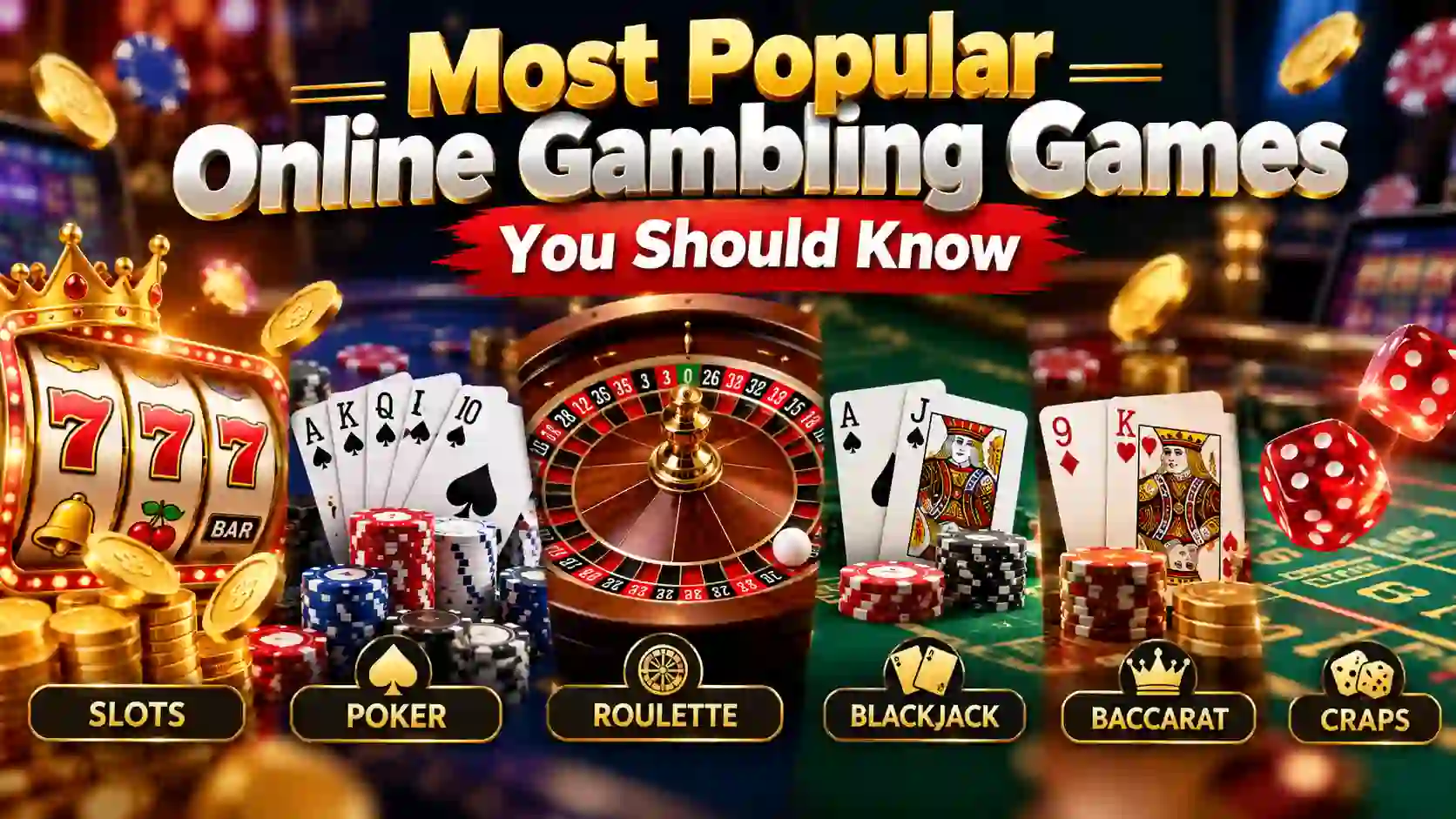
Among the most popular online gambling games are slots, blackjack, roulette, baccarat, poker, bingo, and live dealer casino games. Each offers a different experience. Some depend almost entirely on chance, while others involve decisions, mathematical probabilities, or competition between players.
The size of the online gambling market also demonstrates how established digital gaming has become. According to the UK Gambling Commission’s latest industry statistics for the financial year April 2025 to March 2026, remote casino, betting, and bingo generated £8.3 billion in gross gambling yield in Great Britain. Online casino games accounted for £5.7 billion of that total, including approximately £4.8 billion from slots.
Popularity, however, should never be confused with profitability for the player. Gambling products are designed with mathematical advantages, probabilities, or prize structures that mean losing money is always possible. Anyone considering gambling should understand both how a game works and the financial risk involved.
Here are the major online gambling games worth knowing.
Online slots are arguably the most recognizable category of internet casino game.
Traditional slot machines used physical reels and mechanical components. Online slots recreate the basic idea digitally while adding animations, themes, bonus features, multiple paylines, free-spin rounds, and sometimes progressive jackpots.
The popularity of online slots is also reflected in industry data. UK Gambling Commission figures for April 2025 to March 2026 show that slots generated £4.8 billion of the £5.7 billion in online casino gross gambling yield recorded in Great Britain.
More recent operator data also demonstrates the scale of slot activity. In December 2025, major operators included in the Commission’s dataset recorded roughly 4.9 million active slot players. The regulator notes that its dataset covers approximately 70% of the online gambling market and that individuals can appear in more than one product category.
How Online Slots Work
Most modern online slots use a random number generator, commonly known as an RNG, to determine results. Players choose a stake, start a spin, and the software generates an outcome according to the game’s programmed mathematical model.
Regulated markets generally impose technical standards on this process. In Great Britain, for example, the Gambling Commission requires RNG-driven online gambling software to be tested before games can be made available to players. Operators must also monitor games after launch to ensure they continue performing according to their designed characteristics.
Common slot features include:
- Wild and scatter symbols
- Free spins
- Multipliers
- Bonus rounds
- Expanding or cascading symbols
- Progressive jackpots
- Multiple paylines or “ways to win”
Every slot can have a different mathematical structure, so understanding concepts such as RTP and volatility is more useful than judging a game solely by its graphics or jackpot size.
- Online Blackjack
Blackjack remains one of the best-known card games in both physical and online casinos.
The fundamental goal is simple: create a hand with a value closer to 21 than the dealer’s without exceeding 21.
Numbered cards generally count at their face value, face cards count as 10, and an ace can usually count as either 1 or 11 depending on the hand.
Why Blackjack Is Popular Online
Unlike a slot machine, blackjack involves player decisions. Depending on the situation and the rules of the particular game, a player may be able to:
- Hit
- Stand
- Double down
- Split matching cards
- Take other game-specific actions
That decision-making element makes blackjack attractive to people who prefer games that involve more interaction than simply initiating a random outcome.
However, blackjack should not be considered a guaranteed “skill game.” Chance remains central because cards are randomly distributed, and casino rules create a long-term mathematical advantage for the operator.
Different blackjack versions can also have substantially different rules. Deck numbers, dealer rules, blackjack payouts, splitting restrictions, and other conditions may affect the game’s mathematics. Players should therefore read the rules of a specific version instead of assuming every blackjack table works identically.
- Online Roulette
Few casino games are as visually recognizable as roulette.
A roulette game revolves around a numbered wheel and a ball. Players place wagers on possible outcomes, after which the ball eventually settles into one of the numbered pockets.
Online casinos generally offer digital RNG roulette, live dealer roulette, or both.
Common Types of Online Roulette
The two versions players most frequently encounter are:
European Roulette: Traditionally uses numbers 1 through 36 plus a single zero.
American Roulette: Traditionally contains numbers 1 through 36, a zero, and a double zero.
This difference matters because adding another zero changes the underlying probabilities.
Roulette betting options can also include individual numbers, groups of numbers, red or black, odd or even, ranges, columns, and dozens.
Although roulette may appear easy to understand, previous spins do not reliably predict future independent outcomes. A long sequence of red results, for example, does not mean black must appear on the following spin.
- Baccarat
Baccarat was historically associated with high-end casino rooms, but online casinos have made the game significantly more accessible.
The objective centers on two hands: the Player hand and the Banker hand. A third option, Tie, may also be available.
The aim is to determine which hand finishes closest to a value of nine under baccarat’s scoring system. When totals exceed nine, only the final digit is generally used. For example, a total of 15 effectively has a baccarat value of five.
Why Baccarat Works Well Online
One reason baccarat translates effectively to online platforms is that players do not need to make many decisions after placing the initial wager. Drawing rules are generally determined automatically according to the game’s predefined rules.
Live baccarat has also become common, allowing users to watch cards being dealt from a studio or casino table through a video stream.
Its combination of straightforward gameplay and traditional casino presentation helps explain why baccarat remains an important part of many online casino catalogues.
- Online Poker
Poker differs from many other casino games because players frequently compete against one another instead of simply playing against the house.
Texas Hold’em is perhaps the most internationally recognizable poker format, although online platforms can offer numerous versions, including Omaha and tournament variations.
What Makes Poker Different?
Poker incorporates chance because nobody controls which cards are dealt. However, decision-making also plays a major role.
Players make choices involving factors such as:
- Whether to fold
- Whether to call
- Whether to raise
- Bet sizing
- Position
- Hand strength
- Opponent behaviour
This means poker results are influenced by a combination of random card distribution and player decisions.
Online poker may be offered through cash games, scheduled tournaments, sit-and-go events, and other formats.
UK Gambling Commission operator data illustrates that poker represents a smaller online category than slots or broader casino gaming. The regulator’s December 2025 data recorded roughly 209,500 active poker players among the major operators included in its dataset.
- Live Dealer Casino Games
Live casino gaming attempts to combine the accessibility of online gambling with elements of a physical casino.
Instead of displaying only computer-generated animations, a live casino streams a real table and dealer over video. Players interact using an online interface while cards, roulette wheels, or other physical equipment determine results.
Popular live dealer games include:
- Live blackjack
- Live roulette
- Live baccarat
- Live poker-style table games
- Game-show-inspired casino products
Live casino platforms have become particularly prominent because they add a human and social element that standard RNG casino games cannot completely reproduce.
The Gambling Commission distinguishes these products from conventional RNG-driven games, noting that live dealer games use physical equipment such as roulette wheels and card decks. Fair dealing, shuffling procedures, equipment integrity, and related controls therefore become important parts of ensuring fair operation.
- Online Bingo
Bingo has moved successfully from community halls and dedicated venues into websites and mobile applications.
Players normally receive cards containing a selection of numbers. Numbers are then drawn, with prizes awarded for completing specified patterns or combinations according to the rules of the particular game.
Online bingo can automate much of this process. Some platforms automatically mark numbers, meaning users do not necessarily need to identify every number manually.
Common formats include:
- 90-ball bingo
- 75-ball bingo
- 80-ball bingo
- Faster bingo variants
Social features are another characteristic of the online format. Some bingo products provide chat rooms and community functions designed to reproduce part of the social experience traditionally associated with bingo halls.
Remote bingo generated approximately £147.8 million in gross gambling yield in Great Britain during the financial year ending March 2026, according to Gambling Commission industry statistics.
- Video Poker
Video poker sits somewhere between a slot-style digital interface and traditional card poker.
A common version is Jacks or Better. Players receive a five-card hand and choose which cards to keep before replacement cards are drawn. A paytable then determines the payout associated with different final poker hands.
Unlike multiplayer poker, there is generally no need to beat another person.
Video poker attracts players who like card games but prefer a faster, individual format. It also involves decisions about which cards to hold, meaning player choices can affect the mathematical return.
Paytables and rules vary, however, so two machines that look similar may not offer identical game conditions.
- Online Craps and Dice Games
Craps is strongly associated with traditional casino floors, where players gather around a table while dice determine outcomes.
Digital casinos have recreated the game through both RNG-based software and live formats.
At first glance, craps can appear complicated because a table contains numerous betting options. At its core, however, the game revolves around the outcomes of dice rolls.
Simpler digital dice games also exist, offering streamlined versions that can be easier for new players to understand.
As with every casino game, individual wager types can carry different probabilities and operator advantages. A bet should therefore not be judged simply by the size of the possible payout.
- Instant-Win Games
Instant-win games provide outcomes almost immediately and can include digital scratchcards and other short-form games.
Rather than completing multiple rounds of cards or waiting for a tournament, the player buys or initiates a game and discovers the result quickly.
These products are popular partly because of their simplicity.
Official Gambling Commission participation statistics covering September 2025 to January 2026 found that online instant-win games were among the most commonly reported online gambling activities in Great Britain, with 8% of respondents reporting participation during the previous four weeks. Lottery draws remained more widely used.
The speed of instant games is also a reason to keep firm control over spending and playing time.
- Virtual Sports and Racing
Virtual sports use software-generated sporting or racing events rather than real-world competitions.
Examples can include:
- Virtual horse racing
- Virtual greyhound racing
- Football simulations
- Other computer-generated sporting events
Unlike betting on a real football match, the result is determined by the system responsible for generating the virtual event.
Regulated operators are expected to ensure that outcomes correspond appropriately with the designed probabilities. The UK Gambling Commission notes that virtual sports products may be monitored by examining outcome frequencies and distributions against their expected probabilities.
Virtual sports should therefore not be confused with real sporting events merely because the visual presentation may look realistic.
What Does RTP Mean in Online Gambling?
Anyone researching popular online casino games will eventually encounter the term RTP, or Return to Player.
RTP represents a theoretical percentage of money wagered that a game is designed to return as prizes over a very large number of plays.
For example, a theoretical RTP should not be interpreted as a promise about what will happen during an individual session.
The UK Gambling Commission specifically explains that RTP is an average measured across a significant number of game plays. A player should not expect a machine with an advertised RTP percentage to return that percentage of each individual amount staked.
This distinction is crucial.
Short-term gambling outcomes can vary dramatically. One person may experience a winning sequence while another may lose repeatedly, even when both are playing the same game.
RTP is therefore a statistical long-term measurement—not a prediction of an individual’s result.
What Is an RNG?
An RNG, or Random Number Generator, is software used to generate unpredictable results in many digital gambling products.
In regulated markets, RNG systems may be subject to independent technical testing.
The UK Gambling Commission states that gambling businesses offering RNG-driven online games in Great Britain must have software and gameplay tested according to its testing framework before the products are released.
Its technical guidance says an acceptable RNG should produce outcomes that are sufficiently random and unpredictable according to recognized testing and statistical methods.
RNGs are commonly used in products such as digital slots and computer-generated casino games, although live dealer games may instead use real cards, wheels, or similar physical equipment.
RNG Casino Games vs. Live Casino Games
Both formats are widely available, but the experience differs.
RNG casino games generally use software to determine outcomes and can offer quick gameplay without waiting for a human dealer.
Live casino games use streaming technology to connect players to a physical table, dealer, cards, wheel, or related casino equipment.
Neither format changes the basic reality that gambling involves financial risk. Preference usually comes down to whether someone values speed and digital convenience or prefers the atmosphere and human interaction of a live table.
How to Evaluate an Online Gambling Game
Popularity alone should not determine whether a game is appropriate to play.
Adults who choose to gamble should first understand:
The rules: Never stake money on a game whose basic mechanics you do not understand.
RTP or probability information: Look for transparent information about the likelihood of winning, house edge, margin, or theoretical return where applicable. Gambling Commission remote technical standards require licensed operators to provide information explaining rules and the likelihood of winning in relevant games.
Volatility: Particularly with slots, volatility describes how prize frequency and prize size can vary. Higher volatility does not automatically mean better returns.
Game speed: Faster games can allow someone to place substantially more wagers in a limited period.
Licensing: Regulations differ between countries. Adults should check whether an operator is legally permitted to offer gambling where they live.
Personal limits: Decide how much money and time you are prepared to spend before beginning, rather than adjusting limits after losses.
Responsible Gambling Matters
Online gambling should be viewed as paid entertainment involving financial risk, not as a dependable source of income.
Gambling outcomes can be unpredictable, and attempts to recover losses by increasing stakes can lead to greater losses.
GambleAware advises people who choose to gamble to consider steps that help them stay in control of their spending and recognize when gambling begins affecting finances, relationships, work, or other areas of life.
Recent official statistics also underline why the issue matters. The Gambling Commission’s 2025 Gambling Survey for Great Britain found that participants in several activities—including online slots, online casino games, and online bingo—had higher proportions of elevated Problem Gambling Severity Index scores than the overall population of people who had gambled during the previous 12 months. This does not mean those games automatically cause gambling problems in every player, but it demonstrates why gambling risk should be taken seriously.
Practical safer-gambling principles include setting spending limits, avoiding borrowed money, taking breaks, not chasing losses, and stopping when gambling is no longer enjoyable.
Only adults who meet the legal gambling age in their jurisdiction should participate.
FAQs
What are the most popular online gambling games?
Slots are among the largest online casino categories, while blackjack, roulette, baccarat, poker, bingo, instant-win games, and live dealer games are also widely available. In Great Britain, official industry data shows that online slots accounted for £4.8 billion of online casino gross gambling yield during the financial year ending March 2026.
What is the easiest online casino game to understand?
Slots and many instant-win games generally require fewer player decisions than games such as poker or blackjack. However, simplicity does not mean lower financial risk or a greater chance of winning.
Are online casino games random?
Many digital casino games rely on RNG technology. In regulated jurisdictions, operators may be required to have RNG systems and games tested. Live dealer games instead commonly use physical cards, roulette wheels, or other equipment.
Can you consistently make money from online gambling?
There is no reliable method that guarantees long-term profits from gambling. Casino games generally contain a mathematical house advantage or prize structure, while poker involves competition against other players plus fees or commissions. Gambling should never be treated as guaranteed income.
Is RTP the same as my chance of winning?
No. RTP represents a theoretical return calculated across a very large number of plays. It does not guarantee what an individual will win or lose during one gambling session.
Which online gambling games involve skill?
Poker involves substantial player decision-making, while blackjack and video poker also allow choices that can affect outcomes or expected returns. Chance remains an important part of all these games because cards are randomly distributed.
Are live casino games better than digital casino games?
Neither format is inherently “better.” Live casino games offer interaction with human dealers and physical equipment, whereas RNG games generally provide faster digital gameplay. The right format is a matter of personal preference, and both involve financial risk.
Final Thoughts
The most popular online gambling games range from simple digital slots and instant-win products to traditional table games such as blackjack, roulette, baccarat, and poker. Live dealer technology has also blurred the line between online and land-based casino experiences by bringing real tables, dealers, cards, and roulette wheels to digital platforms.
Slots remain particularly significant in today’s online casino market, while blackjack, roulette, baccarat, poker, bingo, video poker, dice games, and virtual sports each appeal to different types of players.
Understanding how these games work is more important than simply knowing which ones are popular.
Before gambling, adults should understand the rules, probabilities, RTP information where relevant, licensing arrangements, and the amount of money they are prepared to lose. RNGs and regulatory testing can help ensure games operate according to their stated design, but fair operation does not mean a player is guaranteed to win.
Ultimately, online gambling should remain entertainment rather than a financial plan. Setting clear limits, treating every stake as money that could be lost, and knowing when to stop are just as important as understanding the games themselves.
Responsible Gambling : Gambling involves financial risk and can become harmful. Only gamble if you meet the legal age requirements in your location. Never gamble with money needed for essential expenses, and seek professional support if gambling begins affecting your finances, relationships, work, or wellbeing.
ADVERTISEMENT

18+ | Affiliate link | Terms apply | Please gamble responsibly.


