

18+ | Affiliate link | Terms apply | Please gamble responsibly.
Last Updated on October 30, 2026 by Maurya
Starting an online casino in 2026 requires much more than building an attractive website and adding a collection of slot games. A legitimate casino operator must combine regulatory approval, suitable technology, secure payments, game-supplier agreements, anti-money-laundering controls, responsible-gambling tools and a sustainable customer-acquisition plan.
The most important decision is not your casino’s name or welcome bonus. It is deciding where the casino will accept players. Gambling laws are market-specific, and a licence issued in one jurisdiction does not automatically authorise an operator to advertise or accept customers everywhere.
For example, a business offering remote casino games to consumers in Great Britain generally needs a remote casino operating licence from the UK Gambling Commission, regardless of where the company itself is based. Malta has its own B2C Gaming Service Licence for qualifying EU or EEA entities operating from or through Malta. Ontario operates a separate registration and authorisation framework, while legal online casino operations in the United States are governed at state level.
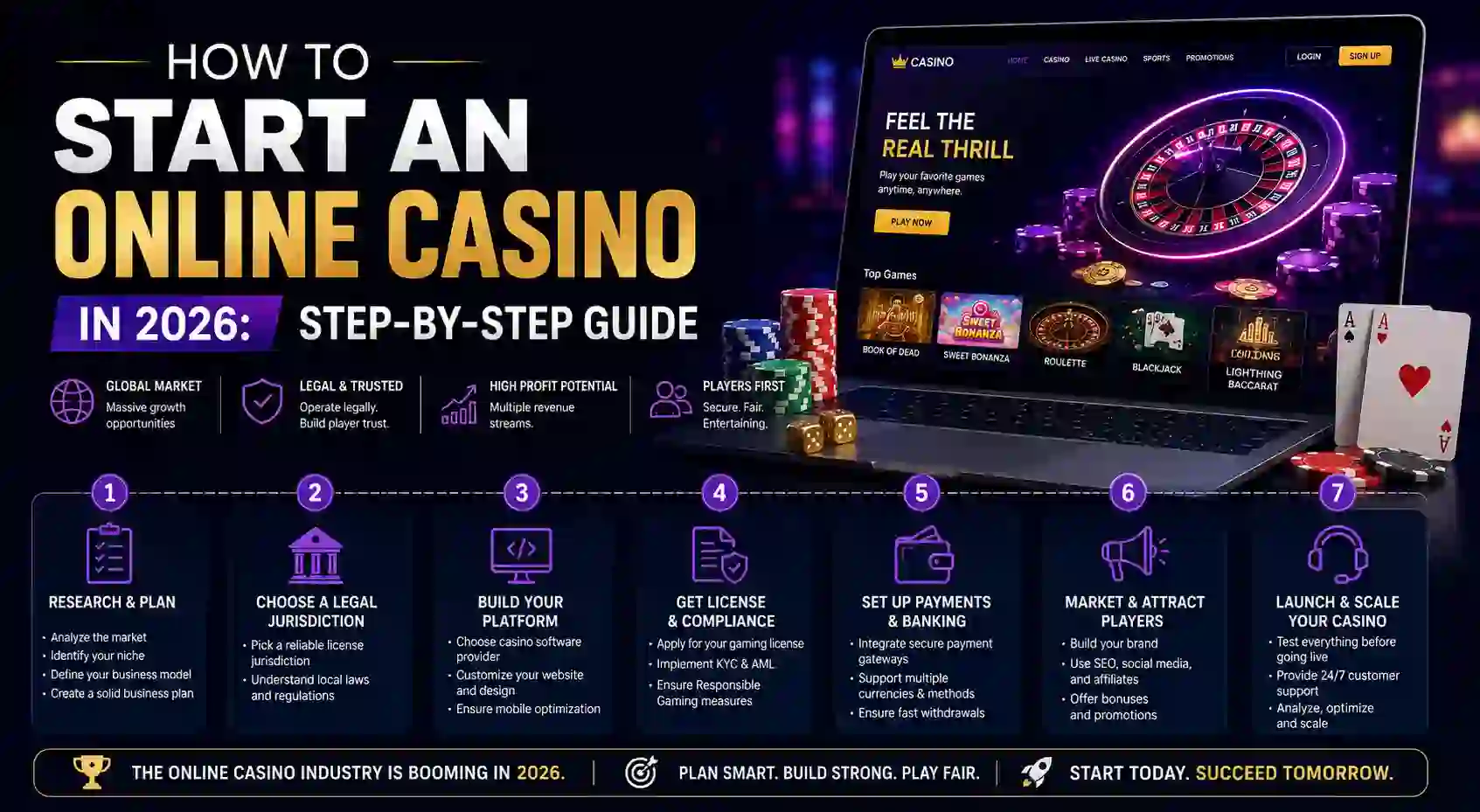
How to Start an Online Casino
A professional online casino launch generally follows these stages:
- Select your target countries or regulated markets.
- Choose an operating model.
- Prepare a detailed business plan and budget.
- Incorporate the correct legal entity.
- Apply for the required gambling licence.
- Select a casino platform and technology stack.
- Sign agreements with approved game providers.
- Integrate payments, KYC and fraud controls.
- Implement responsible-gambling safeguards.
- Prepare legal documents and operating procedures.
- Test the complete casino environment.
- Launch gradually and maintain ongoing compliance.
Each step affects the others. Your licence determines which suppliers you can use, your target market determines which payment methods you need, and your technology must support the regulator’s reporting and player-protection requirements.
Step 1: Choose Your Target Market
Before approaching a software provider or designing a casino website, decide exactly where you want to operate.
Avoid vague plans such as “international players” or “the global market.” Instead, create a country-by-country market-access document covering:
| Area | Questions to answer |
| Gambling law | Is online casino gambling locally regulated, prohibited or unregulated? |
| Licensing | Does the country require a domestic licence? |
| Advertising | Can offshore or foreign operators market to residents? |
| Payments | Will banks and payment providers support the market? |
| Tax | Is gambling tax based on revenue, stakes, profit or player location? |
| Player protection | Which limits, self-exclusion systems and affordability controls apply? |
| Data protection | Where may player data be stored and processed? |
| Game rules | Are particular games, features or stake levels restricted? |
Great Britain illustrates why market-based planning matters. The UK Gambling Commission states that operators providing remote gambling to British consumers need its licence even when the business is located elsewhere. Ontario similarly requires operators and relevant suppliers to comply with its provincial gaming framework.
Obtain a written legal opinion for every planned market. Your legal adviser should also create a restricted-country list that can be enforced through registration controls, IP checks, payment screening and geolocation technology.
Step 2: Select an Online Casino Business Model
There are three main ways to start an online casino.
White-Label Casino
A white-label supplier provides most of the underlying infrastructure. Depending on the agreement, this may include the platform, games, payments, compliance tools, customer support and operation under the supplier’s regulatory arrangements.
This is generally the fastest model, but the operator sacrifices control. White-label agreements commonly include setup charges, revenue sharing, minimum monthly fees and restrictions on suppliers, markets and branding.
Most importantly, never assume that a provider’s licence automatically covers your brand or intended countries. Ask a gambling lawyer to confirm the exact legal relationship between the licence holder, platform owner and branded website.
Turnkey Casino
A turnkey provider supplies a complete casino platform, but the founder operates through their own company and usually holds their own licence.
This approach offers more control over branding, payments, customer data, game selection and marketing. However, the operator becomes directly responsible for regulatory compliance, reporting, player complaints and financial controls.
Proprietary Casino Platform
A custom platform gives the operator maximum control over the product and intellectual property. It may be suitable for experienced gaming groups, technology companies or operators planning multiple brands.
Building proprietary gambling software is expensive and technically complex. The platform must support wallet reconciliation, regulatory reporting, game integrations, bonuses, KYC, AML monitoring, security, audit logs, responsible-gambling controls and high transaction volumes.
In Great Britain, gambling software and remote operators must comply with the UK Gambling Commission’s Remote Gambling and Software Technical Standards. The standards address technical controls, security and testing requirements.
For most first-time founders, a reputable turnkey platform provides the best balance between launch speed and long-term control.
Step 3: Create a Detailed Business Plan
A gambling regulator will normally expect more than an ambitious revenue forecast. Your business plan must demonstrate that the operation is properly funded, commercially realistic and capable of protecting players.
The plan should cover:
- Target countries and customer profiles
- Ownership and management structure
- Source of startup funds
- Three- to five-year financial forecasts
- Expected deposits, withdrawals and gross gaming revenue
- Marketing strategy and acquisition costs
- Platform and supplier agreements
- Compliance staffing
- Player-fund arrangements
- Payment-provider reserves
- Responsible-gambling procedures
- Disaster recovery and business continuity
- Exit or insolvency planning
The Malta Gaming Authority, for example, evaluates whether applicants are fit and proper, have a viable business strategy, possess the necessary operational capacity and have correctly implemented their proposed technical environment. It also assesses shareholders, ultimate beneficial owners, key persons, source of wealth and source of funds.
How Much Does It Cost to Start an Online Casino?
There is no universal online casino startup cost. The correct figure depends on the licence, markets, platform, payment methods, game catalogue and acquisition strategy.
Your budget should separately account for:
| Cost category | Typical components |
| Corporate setup | Incorporation, local office, directors, accounting and tax advice |
| Licensing | Application fees, annual fees, regulatory contributions and legal counsel |
| Technology | Platform setup, hosting, integrations, development and support |
| Games | Aggregator fees, supplier minimums and revenue share |
| Compliance | MLRO, compliance officers, audits, testing, KYC and transaction monitoring |
| Payments | Integration fees, rolling reserves, chargebacks and processing costs |
| Marketing | Affiliates, SEO, paid media, sponsorships, CRM and promotions |
| Operations | Customer support, finance, fraud, risk, content and management |
| Working capital | Player liabilities, withdrawals, supplier invoices and operating runway |
Regulatory fees can vary substantially. As of August 2026, the UK Gambling Commission’s remote casino application fees are linked to projected annual gross gambling yield. New, higher fee bands are scheduled to take effect on 1 October 2026.
The Malta Gaming Authority’s published fact sheet lists a €5,000 gaming-licence application fee, a €25,000 fixed annual B2C licence fee for most B2C operators, additional compliance contributions and minimum share-capital requirements. For B2C Type 1 casino games, the published minimum share capital is €100,000.
These are regulatory charges rather than total startup costs. Platform fees, staff, professional services, payment reserves and marketing will frequently represent a larger part of the budget.
Step 4: Establish the Company and Governance Structure
Once the target market and licence have been selected, establish the appropriate legal entity.
Regulators normally investigate the entire ownership chain rather than only the operating company. Be prepared to disclose:
- Directors and senior managers
- Shareholders
- Ultimate beneficial owners
- Group companies
- Sources of investment
- Criminal and regulatory history
- Bank statements and audited accounts
- Relevant professional experience
- Existing gambling interests
Do not create an unnecessarily complicated ownership structure. Unexplained holding companies, nominee arrangements or transfers between unrelated entities can delay due diligence.
The MGA requires personal declarations from relevant beneficial owners, directors and key persons and conducts fitness, propriety and funding reviews. Its published process includes confirmation that beneficial owners are financially capable of supporting the licensed business and that invested funds come from legitimate sources.
Depending on the jurisdiction, you may also need approved individuals for functions such as compliance, AML, finance, technology, legal affairs and responsible gambling.
Step 5: Apply for the Correct Online Casino Licence
There is no single “best” online casino licence. The correct licence is the one that legally supports your intended markets, products, banking arrangements and commercial strategy.
Great Britain
Operators accepting British customers need the appropriate UK Gambling Commission licence. The application process examines ownership, finances, business plans, operational controls, technical systems and the suitability of key individuals.
The Commission also requires remote operators to follow its Licence Conditions and Codes of Practice and technical standards.
Malta
An MGA B2C Gaming Service Licence may suit businesses establishing a substantial EU or EEA-based operation. Casino and live-casino products generally fall within the Type 1 category.
The MGA application process includes fit-and-proper checks, source-of-funds analysis, business-plan review, policies and procedures, technical review and, where required, an independent system audit. The MGA states that its B2C licence may cover multiple approved gaming verticals under one licence.
An MGA licence should not be treated as an automatic passport into every European country. Local gambling, advertising, tax and consumer laws must still be reviewed before accepting players.
Curaçao
Curaçao’s online gaming framework has undergone significant reform under the National Ordinance on Games of Chance, commonly known as the LOK. Operators and relevant suppliers can apply through the Curaçao Gaming Authority’s licensing portal.
Founders considering Curaçao should examine the current LOK requirements rather than relying on information about the older master-licence and sublicense system.
United States and Canada
The United States does not have one national online casino licence. Operators must analyse each state separately. New Jersey, for example, regulates internet gaming through its casino and internet-gaming licensing structure.
Canada is also market-specific. Ontario requires eligible operators to register with the Alcohol and Gaming Commission of Ontario and operate through the province’s regulated framework.
Step 6: Choose the Casino Platform
The platform is the operational core of the casino. It should not be selected solely on price or the number of games advertised by the vendor.
A professional casino platform should include:
- Player account management
- Multi-currency wallet
- Game aggregation
- Bonus and loyalty engine
- Payment orchestration
- KYC and document management
- AML and transaction monitoring
- Fraud and chargeback controls
- Responsible-gambling tools
- Affiliate tracking
- CRM and player segmentation
- Customer-support integration
- Financial reconciliation
- Regulatory reporting
- Role-based administrative access
- Immutable audit logs
- API access and data export
- Mobile-responsive front end
Ask the platform provider which components are owned, licensed from third parties or hosted externally. You should also confirm who controls the domain, source code, player database and payment contracts if the commercial relationship ends.
Your agreement should contain measurable service levels for uptime, incident response, backups, security patches and withdrawal-critical failures.
Step 7: Integrate Games from Approved Suppliers
An online casino needs more than a large game lobby. Its content must be legally approved, commercially suitable and technically stable.
Your game strategy may include:
- Video slots
- Classic slots
- Live blackjack
- Live roulette
- Baccarat
- Game shows
- Video poker
- Table games
- Instant-win games
- Progressive jackpots
Review every supplier’s licence status, distribution rights and game certifications. Do not assume a game approved in one country can automatically be offered in another.
Contracts should define revenue share, minimum fees, jackpot liabilities, settlement schedules, game availability, maintenance, regulatory changes and ownership of player-facing content.
Regulated markets may require testing of games, random-number generators and critical systems. In Great Britain, licensed remote and software operators must meet the Commission’s technical and security requirements and follow the required testing procedures.
Step 8: Build Payments, KYC and AML Controls
Payments are one of the most difficult parts of launching an online casino. Gambling is treated as a higher-risk industry by many banks, card acquirers and payment service providers.
Your payment strategy should include several compliant deposit and withdrawal options, but it should not create unnecessary complexity. Every additional method adds reconciliation, fraud and AML risks.
Before signing a payment agreement, confirm:
- Supported gambling jurisdictions
- Accepted currencies
- Deposit and withdrawal fees
- Rolling-reserve requirements
- Chargeback procedures
- Settlement frequency
- Transaction limits
- Restricted countries
- Refund handling
- Source-of-funds capabilities
- Tokenisation and card-data responsibilities
Businesses that store, process or transmit payment-card account data must determine their responsibilities under the applicable Payment Card Industry Data Security Standard. PCI DSS v4.0.1 is the active version supported by the PCI Security Standards Council and provides baseline technical and operational controls for protecting card-account data.
Know Your Customer
KYC should be integrated into registration rather than added after launch.
In Great Britain, operators must obtain and verify sufficient information to establish a customer’s identity before allowing that person to gamble. Required information includes the customer’s name, address and date of birth.
The onboarding process may also require:
- Age verification
- Address verification
- Sanctions screening
- Politically exposed person screening
- Duplicate-account detection
- Device and IP analysis
- Source-of-funds checks
- Source-of-wealth checks
- Ongoing transaction monitoring
The MGA states that relevant B2C licensees must apply a risk-based approach to AML and counter-terrorist-financing controls.
Automated checks are useful, but difficult cases should be reviewed by trained compliance personnel. The casino should also have clear rules for suspending accounts, requesting documents and reporting suspicious activity.
Step 9: Implement Responsible Gambling by Design
Responsible gambling is not a footer link. It must be built into the product, customer journey and management culture.
Core controls should include:
- Deposit limits
- Loss or spending controls where applicable
- Session reminders
- Time-outs
- Cooling-off periods
- Self-exclusion
- Reality checks
- Access to account and transaction history
- Suppression of marketing to excluded players
- Behavioural-risk monitoring
- Escalation to trained safer-gambling staff
The UK Gambling Commission requires operators to identify customers who may be at risk of gambling-related harm, interact with them and assess the effectiveness of those interventions.
British operators should also prepare for the deposit-limit requirements taking effect on 30 September 2026. These include offering gross deposit limits with at least equal prominence to other financial limits and using the term “deposit limit” specifically for gross deposit limits.
The MGA requires B2C licensees to make self-exclusion available and to prevent excluded players from accessing gaming services during the exclusion period.
Ontario introduced centralised self-exclusion standards in May 2026, demonstrating the direction in which major regulated markets are moving: stronger, system-wide player protection rather than controls limited to a single brand.
Step 10: Prepare Legal Documents and Marketing Rules
Before launch, prepare player-facing documents that accurately reflect the casino’s operations.
These commonly include:
- General terms and conditions
- Bonus terms
- Privacy notice
- Cookie notice
- Responsible-gambling policy
- AML and verification notices
- Withdrawal rules
- Complaints procedure
- Dispute-resolution information
- Game rules
- Restricted-country policy
- Underage-gambling policy
Terms should be written clearly. Important restrictions must not be hidden in lengthy legal language or contradicted by promotional banners.
Data-protection compliance is particularly important because casinos process identity documents, financial records, device data, payment information and behavioural indicators. UK-facing operators must comply with the UK GDPR and Data Protection Act 2018, including principles such as transparency and data protection by design.
Marketing rules must be programmed into affiliate and CRM systems. In the UK, gambling advertisements must be socially responsible and must not be directed at under-18s. CAP guidance also places responsibility on advertisers to target age-restricted advertising away from younger audiences.
Affiliates should be contractually required to use approved claims, display material terms and stop promoting campaigns immediately when instructed.
Step 11: Recruit an Experienced Operating Team
An online casino cannot be managed entirely by software. Even highly automated platforms require experienced staff.
Important functions include:
| Function | Main responsibilities |
| General management | Strategy, budgets, regulator and supplier relationships |
| Compliance | Licensing conditions, reporting, policies and regulatory changes |
| AML | Risk assessments, investigations and suspicious-activity processes |
| Finance | Reconciliation, player liabilities, tax and supplier settlements |
| Payments and fraud | Deposits, withdrawals, chargebacks and account abuse |
| Responsible gambling | Risk detection, interventions and self-exclusion |
| Customer support | Account, payment, bonus and verification queries |
| CRM | Segmentation, retention and compliant communications |
| Marketing | SEO, affiliates, content, paid media and partnerships |
| Technology | Platform monitoring, integrations, security and incident response |
Compliance, AML and responsible-gambling teams must have sufficient authority and resources. Their decisions should not be overridden merely to preserve a high-value customer.
All employees should receive role-specific training before launch and regular refresher training afterwards.
Step 12: Test the Casino Before Launch
A casino should never go live immediately after the final integration.
Create a complete prelaunch testing plan covering:
- Registration
- Age and identity verification
- Duplicate accounts
- Deposits
- Failed deposits
- Withdrawals
- Manual reviews
- Bonus eligibility
- Wagering calculations
- Game launches
- Wallet updates
- Currency conversion
- Self-exclusion
- Deposit limits
- Marketing suppression
- Complaints
- Financial reconciliation
- Regulatory reports
- Cybersecurity incidents
- Platform failover
- Mobile and browser compatibility
For an MGA application, the technical environment may be reviewed through an external system audit performed by an approved independent service provider before the operation goes live.
Start with a controlled soft launch. Limit customer numbers and marketing expenditure while the team confirms that deposits, gameplay, withdrawals and reporting work correctly.
What Happens After the Casino Launches?
Receiving a licence is the beginning of regulatory responsibility, not the end.
The operator must continuously monitor:
- Customer-verification performance
- Suspicious transactions
- Responsible-gambling alerts
- Player-fund balances
- Payment failure rates
- Chargebacks
- Withdrawal times
- Customer complaints
- Supplier outages
- Security events
- Affiliate compliance
- Bonus abuse
- Regulatory reporting deadlines
The MGA, for example, imposes ongoing reporting requirements that can include gaming-tax, player-fund, compliance and alternative-dispute-resolution reports.
Significant changes in ownership, management, platform infrastructure, payment arrangements or game suppliers may require notification or prior regulatory approval.
Common Mistakes to Avoid
Choosing a Licence Based Only on Price
A low-cost licence is of little value if it does not support your target market, banking relationships or suppliers.
Underestimating Working Capital
Operators need sufficient liquidity to pay withdrawals, processors, game providers, staff and taxes even during weak revenue periods.
Launching Without Reliable Withdrawal Processes
Fast deposits combined with slow or unpredictable withdrawals will produce complaints, chargebacks and regulatory risk.
Treating Compliance as a One-Time Project
KYC, AML, responsible gambling, privacy and advertising controls require continuous monitoring.
Using Uncontrolled Affiliates
Operators may remain responsible when affiliates publish misleading bonus claims or target restricted audiences.
Offering Too Many Markets at Once
Each additional country increases legal, payment, language, tax and operational complexity. A focused launch is usually easier to manage.
FAQs
Is it legal to start an online casino?
Yes, provided the business is appropriately licensed and operates only in markets where it is legally authorised. Requirements vary by country, province and state.
Can I start an online casino without a licence?
A business should not accept real-money casino bets until it has obtained all required approvals. In regulated markets such as Great Britain and Ontario, operators must receive the relevant local authorisation.
Is a white-label casino legal?
A white-label arrangement can be legal when it is structured correctly and the licence genuinely covers the relevant activities and market. The agreement should be reviewed by specialist gambling counsel.
What is the best online casino licence?
There is no single best licence. The correct choice depends on target countries, ownership, product type, banking requirements, taxes and long-term strategy.
How long does it take to launch an online casino?
The timeline depends on licence complexity, ownership due diligence, funding evidence, technical readiness and supplier integrations. A white-label project may move faster than a newly licensed proprietary operation, but no provider can guarantee a regulator’s approval date.
Do online casinos need independent game testing?
Many regulated jurisdictions require games, random-number generators or critical systems to be tested or certified. The exact testing procedure depends on the market and licence.
Can an online casino accept cryptocurrency?
That depends on the regulator, payment structure and target market. Crypto payments do not remove KYC, sanctions, source-of-funds or AML responsibilities.
Final Thoughts
Starting an online casino in 2026 is a regulated financial and technology project, not simply a website launch.
The strongest operators begin with legal market access, transparent ownership and sufficient capital. They then select technology that supports compliance, integrate reputable game and payment suppliers, protect player funds and build responsible-gambling controls directly into the customer experience.
A reliable launch sequence is:
Market research → legal opinion → business plan → company formation → licence application → technology build → supplier integration → testing → soft launch → ongoing compliance.
Skipping one of these stages may save time initially, but it can create expensive licensing, payment or reputational problems later. Build the casino around compliance and player trust from the beginning, and commercial growth will have a much stronger foundation.
ADVERTISEMENT

18+ | Affiliate link | Terms apply | Please gamble responsibly.


