

18+ | Affiliate link | Terms apply | Please gamble responsibly.
Last Updated on September 28, 2026 by Maurya
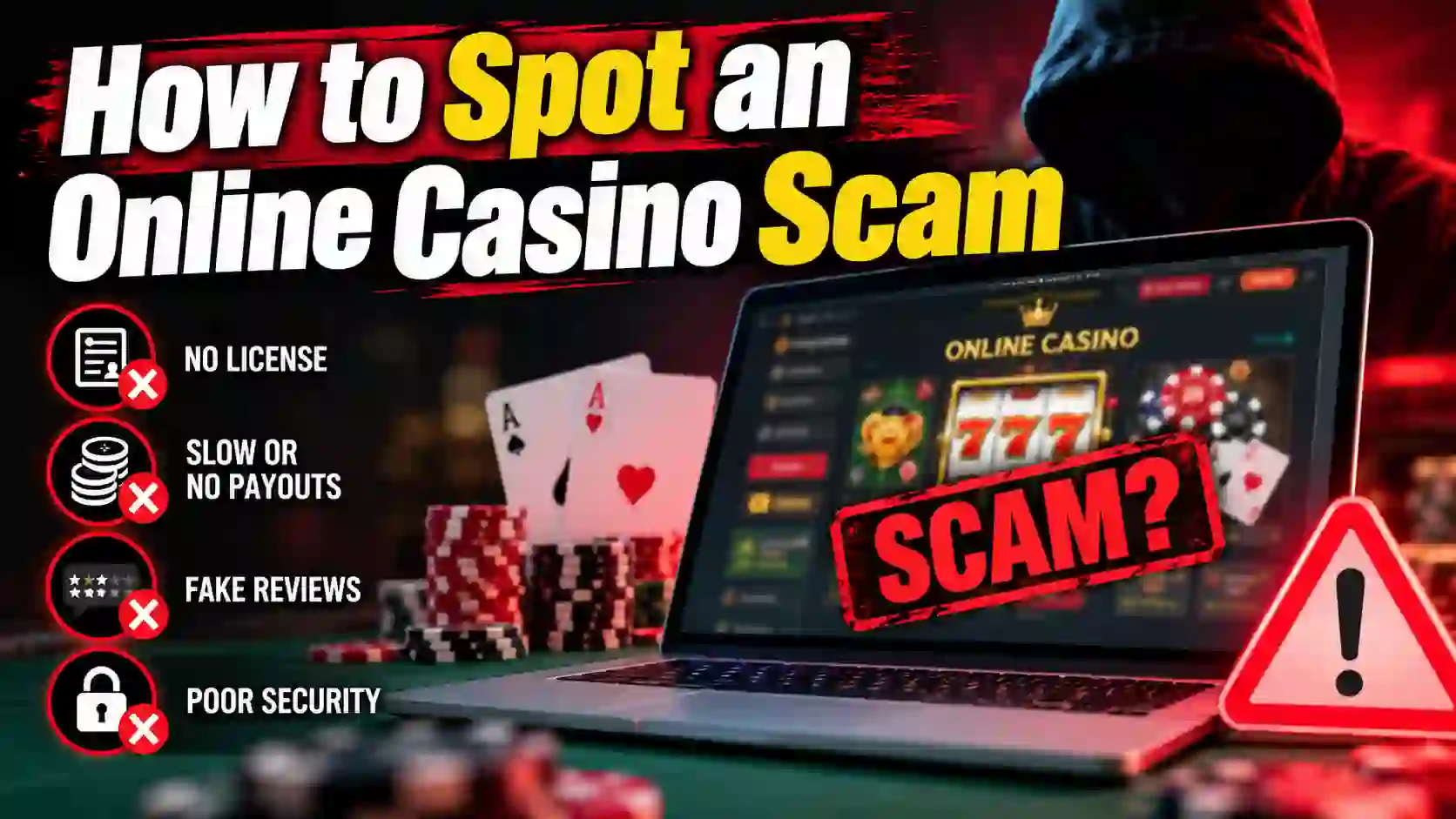
Online casinos have become easier to access, but that convenience has also created opportunities for fraudulent websites, cloned casino brands, fake licences, misleading bonuses, and withdrawal scams.
A professional-looking website does not necessarily mean a casino is legitimate. Scam operators can copy logos, game screenshots, regulatory badges, payment icons, and even the design of genuine gambling sites. Some fraudulent platforms operate normally while players are depositing and only create problems when someone tries to withdraw money.
That makes knowing how to spot an online casino scam important before you enter payment information, upload identity documents, or deposit funds.
The most reliable way to evaluate an online casino is not to judge it by its graphics, welcome bonus, or advertising. Instead, verify the company behind the website, confirm its gambling licence independently, read its withdrawal and bonus rules, examine its payment practices, and look for signs that the operator is accountable to a recognised regulator.
This guide explains the major warning signs and how to check an online casino more carefully.
What Is an Online Casino Scam?
An online casino scam is a gambling website or scheme designed to obtain money, personal information, or financial details through deception.
Some fake casinos have no valid gambling licence at all. Others may falsely claim to be connected to a legitimate operator or regulator. In more sophisticated cases, scammers may copy the branding of an established casino and register a similar-looking domain name.
This is not merely theoretical. In July 2026, the Malta Gaming Authority warned consumers about websites impersonating MGA-licensed operators and falsely giving visitors the impression that they were licensed or authorised. The regulator specifically advised consumers to verify gambling websites through its official licence register rather than trusting claims made on the casino website itself.
The most important lesson is simple: a licence logo is not proof of a licence.
You need to verify the casino using the regulator’s own records.
- The Casino’s Gambling Licence Cannot Be Independently Verified
Licence verification should be one of your first checks.
Legitimate gambling operators normally provide information about the company operating the casino and the regulatory authority responsible for licensing it. Depending on your jurisdiction, that information may include a legal company name, licence number, registered address, and regulator.
Do not stop after seeing a regulator’s logo in the footer.
Visit the regulator’s official website independently and search for the casino.
For example, the UK Gambling Commission maintains a public register that lets users search gambling businesses by company name, trading name, domain name, or account number. The register also provides licence status information and regulatory records.
The Malta Gaming Authority similarly provides a licence register and URL checker that consumers can use to determine whether a gaming website is associated with an authorised operator.
Pay close attention to the exact domain name.
A legitimate licence belonging to examplecasino.com does not automatically cover example-casino.net. Scam websites sometimes display genuine licence information belonging to an unrelated or similarly named business.
If the company, licence number, domain, or regulatory details do not match, do not deposit until you can independently establish who operates the website.
- The Casino Uses Fake Regulatory Logos or Licence Claims
One of the clearest online casino scam warning signs is a regulatory badge that cannot be verified.
A fraudulent website may display official-looking statements such as “Licensed and Regulated,” accompanied by a regulator’s logo. The logo itself means very little because images can easily be copied.
There have been documented cases of websites falsely claiming connections with recognised gambling regulators. The Malta Gaming Authority has repeatedly published notices stating that particular websites had falsely or misleadingly referred to MGA licences.
When checking a licence, confirm that the regulator actually exists, the licence number belongs to the named business, the licence is currently valid, and the casino’s exact website address appears in the appropriate regulatory records where applicable.
Never rely solely on a clickable licence badge supplied by the casino. A fraudulent website can make that button lead anywhere it wants.
- The Company Behind the Casino Is Difficult to Identify
A trustworthy gambling operator should not make it unnecessarily difficult to discover who owns or operates the website.
Look at the casino’s footer, terms and conditions, privacy policy, contact page, and responsible gambling information.
You should normally be able to determine which legal company operates the casino and under which regulatory framework it provides gambling services.
In Great Britain, for example, the Gambling Commission says gambling websites and apps must provide information about the company’s licensed status. Consumers can then compare that information with the Commission’s public register.
Be cautious if the website repeatedly uses a casino brand name while avoiding any mention of the legal company responsible for player accounts.
A missing company name does not automatically prove fraud, but combined with an unverifiable licence and unclear contact details, it becomes a significant warning sign.
- The Bonus Looks Unrealistically Generous
Huge bonuses are one of the easiest ways to attract new players.
That does not mean every large promotion is fraudulent. However, an offer becomes suspicious when the headline sounds extraordinary while the conditions are hidden, confusing, contradictory, or almost impossible to satisfy.
Before accepting a casino bonus, read the rules governing wagering requirements, eligible games, maximum bets, withdrawal limits, expiry periods, excluded payment methods, and any restrictions on winnings.
The rules vary by jurisdiction. In Great Britain, for example, gambling operators must present promotional terms clearly and transparently. Regulatory requirements that came into force on January 19, 2026 also prevent licensed operators from applying wagering requirements above 10 times bonus funds.
That 10x limit is a Great Britain-specific requirement rather than a worldwide standard, which highlights why checking the rules in your own jurisdiction matters.
A promotion deserves additional scrutiny when the attractive headline is everywhere but the conditions needed to withdraw the resulting winnings are extremely difficult to locate.
- Terms and Conditions Are Hidden or Constantly Changing
Terms and conditions are not interesting reading, but they become extremely important when money is involved.
Look specifically for rules about deposits, withdrawals, bonuses, account suspension, inactive accounts, identity verification, prohibited activity, dispute resolution, and the circumstances under which winnings may be withheld.
Vague wording that effectively allows the casino to confiscate balances for almost any reason deserves caution.
Players should also be suspicious when an operator claims that important restrictions existed even though those rules were not visible when the player accepted the offer.
For operators licensed in Great Britain, the Gambling Commission requires contractual terms and consumer notices to be fair and transparent, while promotional terms must be accessible rather than unnecessarily complex or hidden.
Taking screenshots or saving copies of important promotional conditions before depositing can also provide useful evidence if a dispute later arises.
- The Casino Demands More Money Before Releasing Your Withdrawal
This is one of the strongest red flags.
Imagine that you request a £2,000 withdrawal and receive a message saying your funds have been approved, but you must first pay a £250 “tax,” “clearance charge,” “processing fee,” or “account unlocking fee.”
Sending the extra payment may simply lead to another demand.
Legitimate casinos can have genuine fees disclosed in their terms, and tax rules differ between jurisdictions. But an unexpected demand to send additional money directly to supposedly unlock existing winnings is very different.
The broader scam pattern is well recognised by consumer authorities. The U.S. Federal Trade Commission warns that scammers commonly demand payment through methods that make transactions difficult to reverse and that recovery scammers may request upfront “processing,” “administrative,” or similar fees before supposedly releasing money.
If an online casino unexpectedly requests another deposit before allowing you to withdraw an existing balance, stop and verify the operator before sending anything else.
- Withdrawal Rules Are Very Different From Deposit Rules
Fraudulent casinos often make depositing extremely easy.
Withdrawals are where the problems begin.
Warning signs can include repeatedly cancelled withdrawals without explanation, constantly changing document requirements, unexplained withdrawal limits, pressure to reverse a withdrawal and continue gambling, or demands for additional deposits before processing funds.
However, it is important to distinguish suspicious behaviour from legitimate regulatory checks.
Licensed casinos may have obligations relating to identity verification, fraud prevention, and anti-money-laundering controls. A request for identification therefore does not automatically mean the casino is a scam.
In Great Britain, online gambling businesses must verify age and identity before a customer gambles. The Gambling Commission also states that operators should not delay identification requests until withdrawal when the information could reasonably have been requested earlier, although additional checks can sometimes become necessary because of legal obligations or unusual account activity.
The important question is whether the verification process is reasonable, clearly explained, consistent with published rules, and connected to a verifiably licensed business.
- The Casino Accepts Only Hard-to-Reverse Payments
Payment options should always be considered alongside the rest of the evidence.
Cryptocurrency itself does not prove that an online casino is fraudulent. Legitimate gambling businesses in some jurisdictions may legally accept digital assets or other alternative payment methods.
The warning sign is when an unknown operator insists that you use a payment method that is difficult to reverse while providing little company information and no verifiable licence.
Scammers generally prefer payment methods that make recovery more difficult. Consumer protection authorities therefore advise people to be especially cautious when an unknown party insists on payment through cryptocurrency, wire transfers, payment apps, or gift cards.
A professional-looking checkout page should never substitute for checking who will actually receive your money.
- Customer Support Becomes Unreachable When You Request Money
Customer service quality can tell you a great deal about how an operator handles problems.
Before making a significant deposit, check whether the casino provides functioning support channels and a documented complaints procedure.
Try asking a straightforward question about licensing or withdrawals.
A legitimate business should be able to explain its rules rather than repeatedly avoiding basic questions.
Be particularly cautious if customer support is active and enthusiastic before a deposit but suddenly becomes difficult to reach after a withdrawal request.
For regulated operators, there should normally be an escalation route for unresolved complaints. In Great Britain, gambling businesses must maintain complaints procedures and have arrangements allowing unresolved disputes to be referred to an approved Alternative Dispute Resolution provider after the applicable internal process.
A casino with no identifiable complaints procedure and no regulator-backed dispute mechanism offers players considerably less recourse if something goes wrong.
- Online Reviews Look Artificial
Reviews can be useful, but they should never be your only method of deciding whether an online casino is safe.
Both positive and negative reviews can be manipulated.
A suspicious casino may have hundreds of vague five-star reviews posted within a short period. Conversely, legitimate businesses can receive angry reviews from customers who lost money fairly or misunderstood promotion rules.
Look for patterns rather than individual ratings.
Detailed reports describing the same withdrawal issue repeatedly are more informative than dozens of comments simply saying “great casino.”
Search the casino name together with terms such as “withdrawal problem,” “licence,” “complaint,” “scam,” or “not paying.” Then compare what you discover with official regulator records.
Independent reviews should support your investigation, not replace regulatory verification.
How to Check an Online Casino Before Depositing
A careful casino safety check does not need to take hours. The following process can substantially reduce avoidable risk:
- Find the legal operator. Identify the company name, registered information, licence number, and regulator shown on the casino website.
- Verify the licence independently. Visit the regulator’s official website rather than relying on a casino-supplied link.
- Check the exact domain. Make sure the website you are using is actually associated with the licensed company.
- Read withdrawal rules first. Check processing procedures, verification requirements, payment limits, and fees before depositing.
- Examine bonus conditions. Understand wagering requirements, maximum stake rules, eligible games, expiry dates, and withdrawal restrictions.
- Test customer support. Ask a specific question and see whether you receive a clear response.
- Research complaints. Look for repeated patterns involving frozen balances, withheld withdrawals, or changing terms.
- Start cautiously. Never deposit more money simply because an unknown website pressures you to increase your balance.
- Protect your documents. Upload identity documents only after verifying the operator and ensuring you are using the correct website.
- Save evidence. Keep copies of transaction records, emails, chats, promotional conditions, and withdrawal requests.
HTTPS Does Not Mean an Online Casino Is Legitimate
One common mistake is assuming that the padlock symbol in your browser proves a casino is trustworthy.
It does not.
HTTPS indicates that the connection between your browser and the website is encrypted. That is important for security, but scammers can also obtain HTTPS certificates.
Treat HTTPS as a basic technical requirement rather than evidence of legitimacy.
A safer casino should combine appropriate website security with a verifiable licence, transparent ownership information, understandable terms, functioning support, and legitimate dispute procedures.
What Should You Do If You Think an Online Casino Has Scammed You?
If you suspect fraud, avoid sending additional money in an attempt to recover your original deposit or winnings.
Save as much evidence as possible first. That can include screenshots, transaction references, account balances, chat messages, emails, terms and conditions, bonus pages, identity verification requests, and withdrawal histories.
If you paid through a bank, card issuer, payment service, or another financial provider, contact that provider promptly and explain what happened. Available protections depend on the payment method, jurisdiction, transaction circumstances, and provider, so do not assume recovery is guaranteed.
The FTC similarly recommends contacting the company responsible for the payment method as quickly as possible when money has been sent to a scammer and asking whether the transaction can be reversed where appropriate.
You should also report the website to the relevant gambling regulator or consumer protection authority.
If the operator claims to hold a UK licence, for example, compare it against the Gambling Commission’s official register. The Commission’s register also contains information about regulatory actions involving licensed businesses.
If personal documents or account credentials have been exposed, change reused passwords and consider contacting relevant financial institutions immediately.
Be cautious about anyone who subsequently contacts you promising to recover your casino losses for an upfront fee. Victims of one scam are sometimes targeted again through so-called recovery scams.
Licensed Does Not Automatically Mean Risk-Free
There is another important point to understand.
Finding a genuine gambling licence does not mean you are guaranteed to have a perfect experience or that gambling becomes financially safe.
Licensed operators can receive complaints and face regulatory action. The UK Gambling Commission’s public registers, for example, include enforcement and regulatory information alongside licence records.
Licensing matters because it establishes rules, oversight, and potential avenues of recourse. It is not a guarantee that every transaction will be dispute-free.
Likewise, gambling itself always involves financial risk. No casino can legitimately promise that a player will consistently make money from games of chance.
FAQs
How can I tell if an online casino is legitimate?
Start by identifying the legal company behind the casino and checking its licence directly with the regulator named on the website. Confirm that the licence is active and corresponds to the actual casino or domain you are visiting. Then review withdrawal rules, bonus terms, customer support, and complaint procedures.
Can a fake casino display a real gambling licence number?
Yes. A scam website can copy the licence number, logo, company information, or branding of a genuine operator. That is why the licence number should be checked directly against the regulator’s official records and matched with the appropriate company and website.
Is a casino a scam if it asks for identification?
Not necessarily. Licensed gambling businesses may be legally required to verify identity, age, payment information, or the source of funds. The warning sign is unreasonable or constantly changing verification demands from an operator whose identity or licence cannot be established.
Is a delayed casino withdrawal proof of a scam?
No. Withdrawals may occasionally be delayed because of payment processing, fraud prevention, identity verification, or regulatory checks. However, unexplained repeated cancellations, unexpected payment demands, changing conditions, and an unverifiable licence should be treated much more seriously.
Are online casino bonuses scams?
Not automatically. Legitimate casinos use bonuses as marketing tools. The important issue is whether the conditions are clearly disclosed and reasonable under the rules governing that operator. Read wagering requirements and withdrawal restrictions before accepting a promotion.
Can I trust casino review websites?
Reviews can provide additional information, but they should not replace licence verification. Affiliate relationships, fake reviews, outdated information, and individual disputes can all affect online ratings. Official regulator databases are generally a stronger starting point when establishing whether an operator is licensed.
Final Thoughts
Learning how to spot an online casino scam comes down to verification rather than appearance.
Do not assume a casino is safe because its website looks professional, it advertises famous game providers, or it displays a regulatory logo.
Confirm who operates the website. Verify its gambling licence through the regulator’s own database. Check that the exact domain is authorised where that information is available. Read withdrawal and bonus conditions before depositing, and pay attention to unexplained requests for additional payments.
The strongest warning signs usually appear in combination: an unverifiable licence, hidden ownership, unrealistic promotions, unclear terms, unusual payment demands, repeated withdrawal problems, and customer support that disappears when money is requested.
Most importantly, never send additional money simply because an unknown casino claims that another payment is required to release your winnings.
A few minutes spent verifying an operator before depositing can be far easier than trying to recover money from a fraudulent casino afterward.
ADVERTISEMENT

18+ | Affiliate link | Terms apply | Please gamble responsibly.


