

18+ | Affiliate link | Terms apply | Please gamble responsibly.
Last Updated on October 22, 2026 by Maurya
Learning how to play poker online might seem complicated at first. There are unfamiliar terms, different betting options, and players who appear to know exactly what they’re doing. But here’s the good news: you don’t need years of experience to understand how the game works.
Poker is a card game that combines strategy, decision-making, psychology, and luck. Unlike games based entirely on chance, poker gives you opportunities to make decisions that influence your results. That doesn’t mean winning is guaranteed, though. Even experienced players lose hands, sessions, and sometimes much more.
The easiest way to get started is with Texas Hold’em, one of the most widely played poker variations. Its basic rules are straightforward, and you can practise without risking real money.
How to Play Poker Online
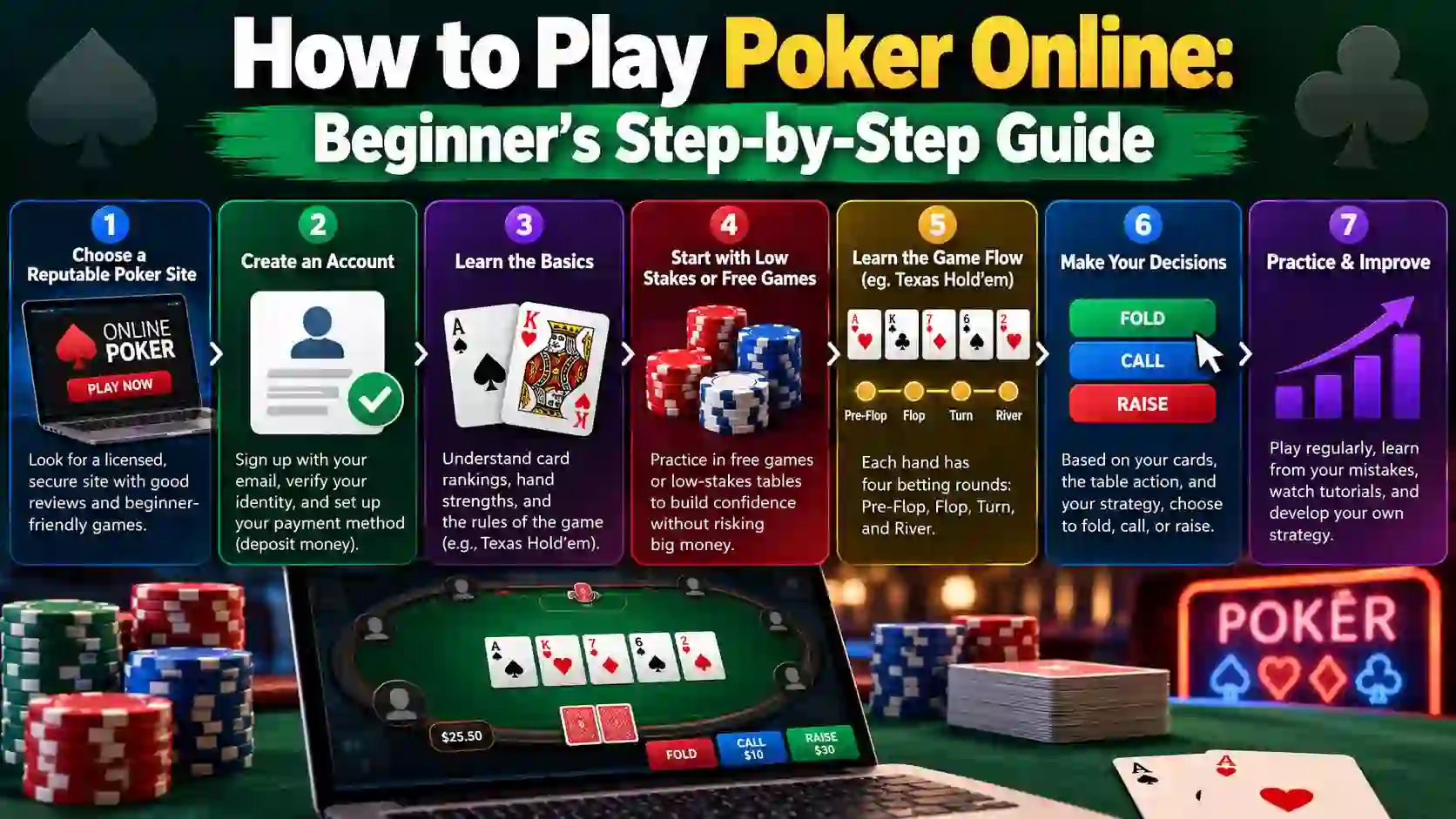
To play poker online, choose a legal poker platform, learn the basic rules, and join a beginner-friendly Texas Hold’em table. Each player receives two private cards and uses up to five shared community cards to make the strongest five-card poker hand. Players can check, bet, call, raise, or fold during betting rounds. You win by having the best hand at showdown or by making every opponent fold.
If you’ve never played before, start with free-to-play poker games to understand the process before considering real-money play.
What Is Online Poker and How Does It Work?
Online poker is the digital version of traditional poker. Instead of gathering around a physical table, players compete using websites, desktop software, or mobile applications.
The rules are essentially the same as those used in live poker. The main difference is that the software handles the cards, chip calculations, betting order, and pot distribution automatically.
A typical online poker table contains:
- Players: Usually between two and ten, depending on the game format.
- A virtual dealer button: Identifies the dealer position for each hand.
- Hole cards: Private cards visible only to the individual player.
- Community cards: Cards placed face up for everyone to use.
- A pot: The total chips committed during the hand.
- Betting controls: Buttons that allow players to check, call, raise, or fold.
In Texas Hold’em, players try to create the strongest five-card hand using their two private cards and the shared cards on the table.
However, there’s another important detail.
You don’t always need the strongest cards to win. If your opponents fold because they don’t want to continue, you can collect the pot without showing your hand.
That combination of probability, strategic betting, and incomplete information makes poker different from many other card games.
Step 1: Learn the Basic Rules of Texas Hold’em Poker
Before playing online poker, it’s essential to understand the rules.
Texas Hold’em uses a standard deck of 52 cards. Each player receives two private cards, and up to five community cards are dealt throughout the hand.
Your goal is to make the best possible five-card combination using any five of the seven available cards. You can use both hole cards, one hole card, or neither.
Understanding Poker Hand Rankings
Poker hand rankings determine which player wins when two or more participants reach the showdown.
Here are the ten standard poker hands, ranked from strongest to weakest.
| Rank | Poker Hand | Description |
| 1 | Royal Flush | A, K, Q, J, and 10 of the same suit |
| 2 | Straight Flush | Five consecutive cards of the same suit |
| 3 | Four of a Kind | Four cards of identical rank |
| 4 | Full House | Three cards of one rank and two of another |
| 5 | Flush | Five cards of the same suit |
| 6 | Straight | Five consecutive cards of any suits |
| 7 | Three of a Kind | Three cards of identical rank |
| 8 | Two Pair | Two separate pairs |
| 9 | One Pair | Two cards of the same rank |
| 10 | High Card | The highest five-card hand without another combination |
For example, a pair of kings beats a pair of queens, while three of a kind beats two pair.
When players have the same type of hand, the ranks of the cards determine the winner. Additional cards, called kickers, can break certain ties.
Remember that suits have equal value in standard Texas Hold’em. Hearts do not outrank spades, and clubs do not outrank diamonds.
One other detail worth knowing: an ace can count as the lowest card in an A-2-3-4-5 straight.
Beginner tip: Keep a poker hand rankings chart beside you during your first few practice sessions. Learning these combinations will make every other aspect of poker easier to understand.
Step 2: Choose a Safe and Legal Online Poker Platform
Once you understand the basic rules, the next step is finding a suitable place to practise.
There are different types of online poker platforms, including free-play applications, social poker games, and regulated real-money websites.
For a complete beginner, free-play options provide a useful introduction because you can learn the betting controls without putting your finances at risk.
What Should You Look for in an Online Poker Website?
Before registering, consider these factors:
- Licensing and regulation
Check whether the operator is legally permitted to offer online poker in your country or region.
In Great Britain, for example, real-money gambling websites must hold the appropriate Gambling Commission licence. You can verify an operator through the UK Gambling Commission’s public register.
- Game availability
Look for beginner-friendly Texas Hold’em tables and, ideally, free-play games.
- Website security
Choose a platform with a secure connection, clear privacy policies, appropriate account verification, and reliable account-security features.
- Transparent fees
Read the platform’s information about tournament fees and cash-game rake. These charges affect the cost of playing.
- Withdrawal policies
If considering real-money poker, review withdrawal methods, processing rules, identity requirements, and the protection of customer funds.
- Responsible gambling tools
A suitable regulated platform should provide ways to manage deposits, take breaks, and restrict gambling activity.
Online poker laws vary by location. You must meet the minimum legal gambling age and comply with applicable local regulations. In Great Britain, the minimum age for online gambling is 18.
Step 3: Create an Account and Explore Free Poker Games
After choosing an appropriate platform, familiarise yourself with its interface.
Registration requirements differ between services, but a regulated real-money platform will typically request personal information and verify your age and identity.
In Great Britain, licensed online gambling businesses must verify age and identity before allowing customers to gamble.
Once your account is ready, explore the poker lobby.
This is the main area where available games, tables, tournaments, and participation requirements are displayed.
Start With Play-Money Poker
If your platform offers free poker tables, begin there.
Play-money poker uses virtual chips rather than real cash. It helps you understand:
- How cards are dealt.
- When it is your turn to act.
- How to use betting buttons.
- What happens when another player raises.
- How pots are awarded.
- When a poker hand ends.
There’s no need to rush through this stage.
A few practice sessions can help you recognise common situations and avoid mistakes caused by unfamiliar controls.
However, keep in mind that play-money games may encourage different decisions because participants aren’t risking real funds. They’re excellent for learning mechanics, but they don’t perfectly reproduce real-money strategy.
Step 4: Understand Different Types of Online Poker Games
Not every online poker game follows the same format.
Before joining a table, you’ll need to understand whether you’re entering a cash game or a tournament.
Cash Games vs Poker Tournaments
| Feature | Cash Games | Tournaments |
| Entry | Buy in for table chips | Pay an entry fee |
| Chip value | Represents real monetary stakes in real-money games | Tournament chips determine your stack |
| Blind levels | Usually remain fixed | Increase over time |
| Leaving | Generally possible between hands | Players compete until eliminated or the event ends |
| Objective | Compete for individual pots | Finish in a prize-paying position |
Cash Games
In a cash game, the chips represent the stakes at the table.
For example, a $0.01/$0.02 Texas Hold’em game has a small blind of $0.01 and a big blind of $0.02.
These are commonly called micro-stakes games.
Cash games offer more flexible session lengths than tournaments, although players can still lose their full table buy-in.
Poker Tournaments
In a poker tournament, players usually pay an entry fee and receive a predetermined number of tournament chips.
As the event progresses, the blinds increase. Players are eliminated when they lose all their chips, unless the tournament allows re-entry or rebuying.
Prizes are awarded according to the tournament’s payout structure.
Sit & Go Tournaments
Sit & Go tournaments are smaller events that generally begin once the required number of players has registered.
They offer a structured poker experience without requiring participants to join a large scheduled tournament.
Which format is best for beginners?
For learning the rules, free-play Texas Hold’em tables are a sensible starting point. Once you’re comfortable, you can explore different formats and understand their costs and risks before deciding whether real-money poker is appropriate.
Step 5: Understand the Online Poker Table
When you join a poker table, the screen may initially appear crowded.
Fortunately, most of the information is straightforward once you know where to look.
Important Elements of an Online Poker Table
Your chip stack: Shows the number of chips you currently have available at the table.
Hole cards: Your two private cards in Texas Hold’em.
Community cards: Cards displayed in the centre of the table as the hand progresses.
Dealer button: A marker indicating the dealer position.
Pot size: Displays the total chips committed to the current pot.
Action buttons: Allow you to select your next move.
Betting slider: Lets you choose a bet or raise amount when that action is available.
Action timer: Shows how much time remains before you must make a decision.
Some platforms also provide a time bank, hand history, chat features, and player notes.
Before playing, make sure you understand which button performs each action. An accidental all-in or mistaken call can be costly in real-money games.
Step 6: Learn How Betting Works in Online Poker
Betting is a central part of poker.
A player’s decisions affect how many chips enter the pot, whether opponents continue, and how much information becomes available during the hand.
There are five fundamental poker actions.
- Check
Checking means staying in the hand without adding chips.
You can check only when there is no outstanding bet for you to match.
For example, if everyone checks to you after the flop, you can also check and continue playing.
- Bet
Betting means placing chips into the pot when no other player has made a bet during the current betting round.
Other players must then decide whether to call, raise, or fold.
- Call
Calling means matching the current bet to remain in the hand.
Suppose another player bets $2. If you want to continue without raising, you call by matching the $2 amount, assuming you haven’t already committed chips during that round.
- Raise
Raising means increasing the current bet.
For example, if someone bets $2, you might raise the total amount to $6.
The minimum permitted raise depends on the game’s rules and previous betting action.
- Fold
Folding means giving up your cards and withdrawing from the current hand.
You lose any chips you’ve already contributed to that pot, but you don’t have to commit additional chips.
Many beginners underestimate the value of folding.
You don’t need to participate in every hand. Sometimes, recognising that your cards are unlikely to justify further investment is the most sensible decision.
What Does All-In Mean?
Going all-in means committing your entire remaining chip stack to the hand.
In no-limit Texas Hold’em, players can generally bet up to the amount of chips they have at the table.
If an all-in player cannot match another player’s full bet, a side pot may be created. The all-in player can win only the pot or portion of the pot they were eligible to contest.
Step 7: Follow the Four Betting Rounds in Texas Hold’em
Now that you know the available actions, it’s time to understand how a complete poker hand develops.
Texas Hold’em has four betting rounds: pre-flop, flop, turn, and river.
Round 1: Pre-Flop
The hand begins when two players post compulsory bets called blinds.
The player immediately to the dealer’s left posts the small blind. The next player posts the big blind.
Each participant then receives two private cards.
The first betting decision usually belongs to the player directly to the left of the big blind.
At this stage, you decide whether your starting cards are worth playing.
For example, pocket aces (A-A) are an exceptionally strong starting hand. By contrast, an unsuited 7-2 is generally one of the weakest.
Once all required betting decisions are complete, the hand moves to the flop if at least two players remain.
Round 2: The Flop
The dealer reveals three community cards.
These cards can be used by every remaining player.
For example, suppose you hold:
A♠ Q♠
And the flop is:
Q♦ 7♣ 2♥
You now have a pair of queens with an ace kicker.
That’s a reasonable hand in many situations, but it isn’t unbeatable.
Another player could have three of a kind, two pair, or a different holding that may improve later.
A new betting round begins, with the first active player to the left of the dealer button acting first.
Round 3: The Turn
The fourth community card is revealed.
Suppose the turn is:
9♠
The board now reads:
Q♦ 7♣ 2♥ 9♠
You still hold a pair of queens.
But the additional card may strengthen another player’s hand or create new possibilities.
Another round of betting follows.
This is where paying attention to bet sizes, previous actions, and possible opponent hands becomes increasingly important.
Round 4: The River
The fifth and final community card is revealed.
Suppose the river is:
4♦
The completed board is:
Q♦ 7♣ 2♥ 9♠ 4♦
No more cards will be dealt.
Players now complete the final betting round.
If two or more players remain after the betting is finished, the hand proceeds to the showdown.
Showdown: Who Wins the Pot?
At showdown, the remaining players compare their best five-card hands.
Continuing the example, suppose you hold A♠ Q♠ and your opponent reveals Q♥ J♣.
Both players have a pair of queens. However, your ace kicker beats your opponent’s jack kicker, so you win.
If both players make exactly the same best five-card hand, the pot is generally split equally.
Remember, showdown isn’t always necessary. When all other players fold, the remaining player wins the pot immediately.
Step 8: Learn Basic Online Poker Strategies for Beginners
Knowing the rules is only the beginning.
Once you understand how poker works, your next challenge is deciding which hands to play and how to respond to different situations.
You don’t need complex mathematics or advanced tournament theory to begin developing better habits.
Start with these fundamentals.
Play Strong Starting Hands
One of the most common beginner mistakes is playing too many hands.
Not every combination of two cards deserves your attention.
Strong starting hands include:
- A-A (Pocket Aces)
- K-K (Pocket Kings)
- Q-Q (Pocket Queens)
- J-J (Pocket Jacks)
- A-K (Ace-King)
These hands are generally more promising than disconnected, low-value cards.
However, even premium hands can lose. Their strength also depends on the number of opponents, community cards, stack sizes, and betting action.
Understand Poker Table Position
Your position determines when you act relative to other players.
This matters because players who act later often have more information.
For example, the dealer button is a valuable position after the flop because the player on the button acts last during those betting rounds.
If several opponents have already checked, you know something about their actions before making your decision.
Beginners should generally play a tighter selection of hands from early position and can consider a wider range from later positions.
Avoid Bluffing Too Often
Bluffing involves betting or raising to convince an opponent to fold a stronger hand.
It’s a genuine part of poker strategy, but beginners sometimes assume bluffing is necessary to play well.
It isn’t.
Random bluffs can become expensive, particularly against opponents who frequently call.
Before attempting one, consider whether your opponent is likely to fold, whether your betting pattern makes sense, and how much you’re risking.
For now, focus on recognising good starting hands, understanding the board, and making thoughtful decisions.
Pay Attention to Your Opponents
Online poker doesn’t provide the same physical clues as live poker.
You can’t watch someone’s facial expressions or body language.
However, you can observe betting behaviour.
Consider questions such as:
- Does this player enter almost every pot?
- Do they regularly make large raises?
- Do they rarely bet without a strong hand?
- Do they frequently call even when the board looks dangerous?
These observations can help you evaluate decisions.
Still, avoid treating one hand as proof of a player’s habits. Patterns become more meaningful with repeated observations.
Learn the Basics of Pot Odds
Pot odds help you compare the price of calling a bet with the potential reward.
Imagine the pot contains $10 before an opponent bets $5.
There is now $15 in the pot, and you must call $5 to continue.
If you call, the final pot will be $20.
Your $5 call represents 25% of that pot, meaning you would generally need more than 25% equity for the call to be profitable under this simplified calculation, before considering rake and future action.
You don’t need to memorise dozens of equations immediately. Just recognise that calling a large bet requires stronger justification than calling a small one.
Stay Patient
Poker naturally contains periods when you’re dealt weak cards.
That’s normal.
Trying to force action because you’re bored can lead to unnecessary losses.
Sometimes, the most disciplined decision is to fold several hands in a row and wait for a more suitable situation.
Step 9: Avoid Common Online Poker Mistakes
Most beginners make similar mistakes during their first few sessions.
Understanding these problems early can help you build better playing habits.
Mistake 1: Playing Every Hand
It can feel disappointing to fold repeatedly, especially when you’re eager to participate.
But playing weak cards too often puts you in difficult situations.
Better approach: Be selective about the hands you enter, particularly from early positions.
Mistake 2: Calling Without a Clear Reason
Some beginners keep calling because they’ve already invested chips.
This is known as falling into the sunk-cost trap.
Money already committed to the pot cannot be recovered simply by continuing.
Better approach: Evaluate the current situation rather than trying to justify earlier decisions.
Mistake 3: Ignoring Bet Sizes
A large bet and a small bet create different risk-and-reward situations.
Calling both without considering the amount can quickly become expensive.
Better approach: Compare the cost of continuing with your hand’s likely strength and potential to improve.
Mistake 4: Playing Too Many Tables
Online poker platforms may allow you to participate in several games simultaneously.
Although experienced players sometimes use this feature, it can overwhelm beginners.
Better approach: Start with one table so you can concentrate on the cards, betting sequence, and opponent behaviour.
Mistake 5: Chasing Losses
After losing several hands, you might feel tempted to increase your stakes to recover quickly.
This can turn a disappointing session into a much larger financial loss.
Better approach: Set limits before playing and stop when those limits are reached. Never treat poker as a reliable way to recover money.
Mistake 6: Playing While Distracted
Checking social media, watching videos, or switching between applications can cause you to miss important information.
Better approach: Choose a quiet environment and give the game your attention during practice.
How Much Money Do You Need to Play Poker Online?
You don’t necessarily need any money to learn online poker.
Free-play games allow beginners to practise rules and betting decisions using virtual chips.
If you’re legally eligible and later consider real-money poker, the amount required depends on the platform, game type, and minimum buy-in.
For instance, a $0.01/$0.02 cash-game table may offer relatively small buy-in options, although the exact limits vary.
It’s also important to understand rake, the fee collected by the poker operator.
In cash games, rake is commonly taken as a percentage of eligible pots, sometimes subject to a maximum cap. Tournament fees are normally included in the entry cost.
These charges matter because they reduce the amount available to players overall.
Poker should never be viewed as a dependable source of income. Even strong decision-making cannot eliminate variance, and beginners should expect to make mistakes while learning.
Only consider money you can afford to lose completely, without affecting essential expenses or financial commitments.
How to Play Poker Online Responsibly
Online poker can be accessible at almost any time, making it especially important to establish boundaries.
Before playing real-money games, decide whether gambling fits your personal circumstances.
Practical safeguards include:
- Set a fixed spending limit before starting.
- Establish a clear time limit for each session.
- Never gamble with money needed for rent, bills, food, or savings.
- Avoid playing when stressed, angry, exhausted, or under the influence.
- Do not borrow money to gamble.
- Never increase stakes simply to recover losses.
- Take regular breaks and monitor your gambling activity.
Many regulated operators offer deposit limits, time-outs, and self-exclusion tools.
If gambling starts affecting your finances, relationships, work, or emotional well-being, stopping and seeking support is more important than improving your strategy.
In Great Britain, GamCare provides free and confidential support through the National Gambling Helpline at 0808 8020 133, available 24 hours a day.
Can You Play Poker Online on a Mobile Phone?
Yes. Many online poker platforms provide mobile applications or browser-based games compatible with smartphones and tablets.
Mobile poker generally follows the same rules as desktop poker.
The main differences relate to screen size, navigation, and the number of tables comfortably displayed.
When learning on mobile:
- Use a stable internet connection.
- Check betting amounts before confirming actions.
- Avoid unnecessary distractions.
- Learn where each control appears on the screen.
- Keep sufficient battery power for your session.
A desktop interface may make it easier to review table information, but the best learning setup is one where you can clearly see the cards and controls.
FAQs
Is online poker easy to learn for beginners?
Yes. The basic rules of Texas Hold’em are relatively straightforward. Most beginners can learn the hand rankings, betting options, and order of play through a few guided practice sessions. Developing consistently strong strategy takes considerably longer.
Can I play poker online for free?
Yes. Some poker websites and applications offer free-play tables using virtual chips. These are useful for learning the rules and practising decisions without risking real money. Availability and age requirements depend on the service.
What is the best poker game for beginners?
Texas Hold’em is a practical starting point because it has simple core rules, widely available learning resources, and familiar betting rounds. No-limit Texas Hold’em is common, although its unrestricted betting sizes require careful attention.
Is online poker based on luck or skill?
Online poker involves both luck and skill. Random card distribution affects individual outcomes, while decisions about hand selection, position, betting, and folding influence long-term performance. Skill never guarantees a profit or removes financial risk.
How many cards do you get in online poker?
In Texas Hold’em, each player receives two private hole cards. Five community cards may then be dealt face up. Players make their strongest five-card hand from these seven available cards.
Other poker variations may use different numbers of cards.
What happens if everyone folds in poker?
When all opponents fold, the last remaining player wins the pot. They generally do not need to reveal their cards.
Can I play online poker against real people?
Yes. Many online poker games connect real players competing at the same virtual table. Some free-play applications also offer computer-controlled opponents, so check the game description to understand who you’re playing against.
How do beginners improve at online poker?
Start by memorising the hand rankings, playing fewer weak starting hands, understanding position, observing opponents, and reviewing difficult decisions after practice sessions.
Learning resources, hand examples, and free games can also help reinforce the fundamentals.
Is it safe to play poker online?
The level of protection depends on the platform and its regulatory status. Use appropriately licensed operators, review the terms, protect your account information, and understand that real-money poker involves financial risk. Even regulated poker games cannot guarantee winnings.
Final Thoughts
Learning how to play poker online doesn’t require mastering every advanced strategy on your first day.
Start with the essentials: understand poker hand rankings, learn how betting works, recognise the different stages of Texas Hold’em, and become comfortable using the online table controls.
Once those fundamentals feel natural, concentrate on making thoughtful decisions rather than trying to win every hand.
Remember that folding is part of poker, strong cards can still lose, and good decisions don’t always produce immediate rewards.
For beginners, free-play tables are the most practical place to develop familiarity without financial pressure.
With patience, structured practice, and a clear understanding of the risks, you can build your knowledge of online poker at a pace that suits you.
The best first goal isn’t to win a big pot. It’s to understand why you’re making each decision.
ADVERTISEMENT

18+ | Affiliate link | Terms apply | Please gamble responsibly.


