

18+ | Affiliate link | Terms apply | Please gamble responsibly.
Last Updated on October 22, 2026 by Maurya
Poker is one of those card games that looks complicated until you understand what is happening at the table. Players study their cards, place chips in the middle, make bets, and sometimes win without even revealing their hands. To a newcomer, it can seem like everyone knows a secret set of rules.
The good news? Learning how to play poker is easier than you might think.
You don’t need to memorise dozens of strategies or become an expert at reading people’s expressions. Start by understanding the basic poker rules, learning which card combinations are strongest, and knowing when to bet, call, raise, or fold.
Poker combines chance, decision-making, probability, and observation. The cards you receive are random, but your choices influence how you play each hand. That’s what makes the game interesting, whether you’re enjoying a casual evening with friends or learning through a free online poker game.
What Is Poker and How Does It Work?
Poker is a family of card games in which players compete to win a collection of chips or bets called the pot. Depending on the poker variant, players receive cards, make betting decisions, and try to form a stronger hand than their opponents.
Unlike games where winning depends entirely on the cards dealt, poker also involves understanding betting patterns, evaluating risk, and choosing when to continue or fold.
There are several variations of poker, including Texas Hold’em, Omaha, Seven-Card Stud, and Five-Card Draw.
Texas Hold’em is one of the most widely played poker variations, making it an excellent starting point for beginners. This guide primarily focuses on No-Limit Texas Hold’em because its rules are straightforward and its gameplay introduces the fundamental concepts used in many other poker games.
How Do You Play Poker? A Quick Answer
To play Texas Hold’em poker, each player receives two private cards. Five community cards are gradually revealed in the middle of the table. Players use the best combination of five cards from their private cards and the community cards to make a poker hand.
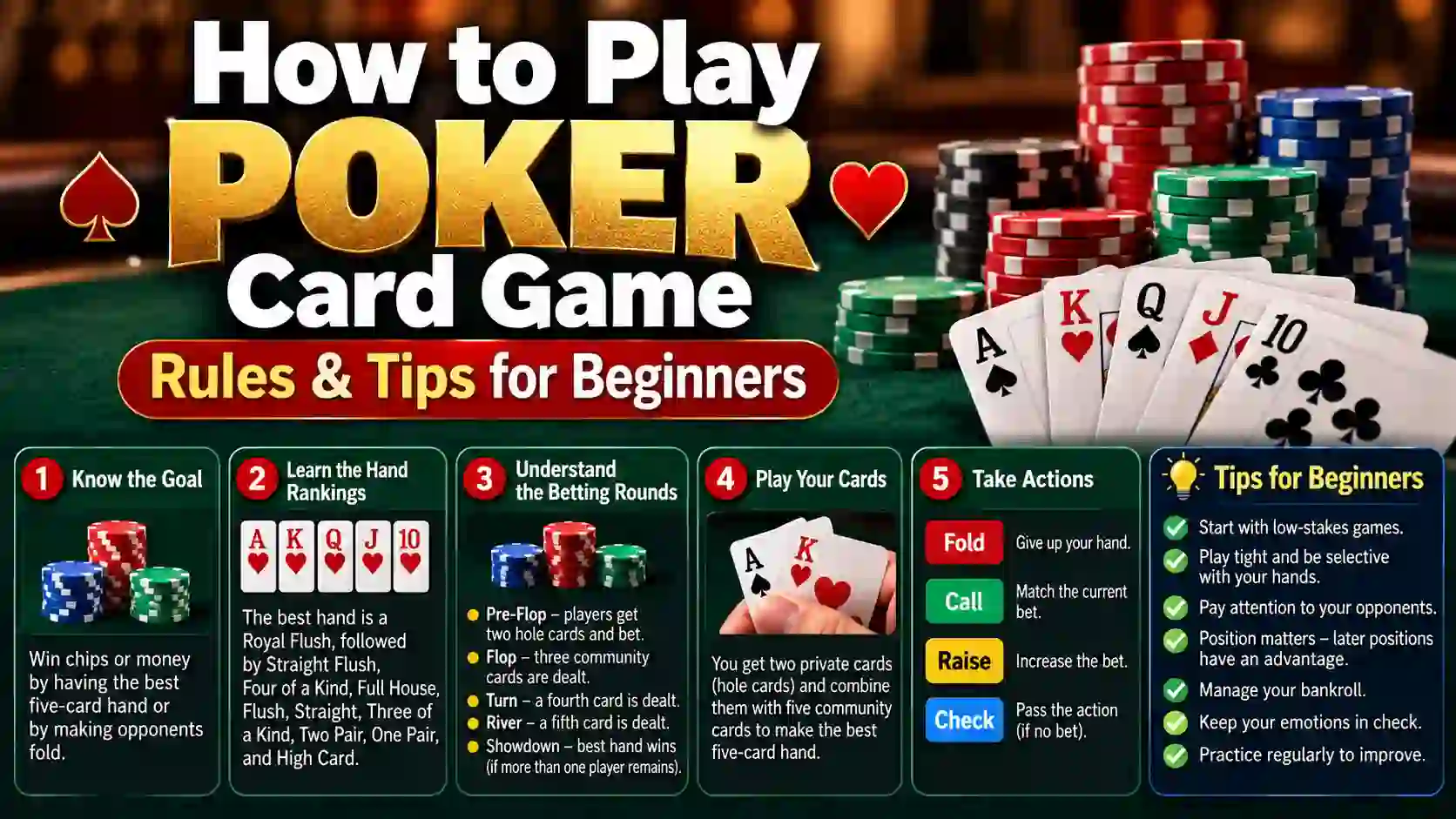
Players bet during four rounds: pre-flop, flop, turn, and river. The player with the strongest five-card hand wins if the game reaches a showdown. Alternatively, a player can win the pot by betting when every opponent folds.
Once you understand this basic structure, the rest of the game becomes much easier to follow.
What Do You Need to Play Poker?
You don’t need expensive equipment to get started. A simple home poker game requires only a few essentials.
- Standard deck of cards: A regular 52-card deck without jokers.
- Poker chips: Used to represent betting amounts.
- Players: Texas Hold’em commonly accommodates two to ten players at a table.
- Dealer button: A small marker identifying the dealer position.
- Playing surface: A table with enough space for cards, chips, and players.
For your first game, consider using chips without assigning them monetary value. This allows everyone to practise betting decisions without financial pressure.
Before dealing cards, agree on the poker variation, starting chip stacks, blind amounts, and any house rules. Clear expectations prevent confusion later.
Poker Hand Rankings: What Beats What in Poker?
Understanding poker hand rankings is the most important first step in learning poker.
Every poker hand is evaluated using five cards. The ranking determines which hand wins when two or more players reach the showdown.
Here are the 10 standard poker hands, ranked from strongest to weakest.
| Rank | Poker Hand | Description |
| 1 | Royal Flush | A, K, Q, J, 10 of the same suit |
| 2 | Straight Flush | Five consecutive cards of the same suit |
| 3 | Four of a Kind | Four cards of identical rank |
| 4 | Full House | Three matching cards plus a pair |
| 5 | Flush | Five cards of the same suit |
| 6 | Straight | Five consecutive cards of any suits |
| 7 | Three of a Kind | Three cards of the same rank |
| 8 | Two Pair | Two separate pairs |
| 9 | One Pair | Two cards of matching rank |
| 10 | High Card | The highest five-card combination without a stronger hand |
Understanding Poker Hands With Simple Examples
Royal Flush: A♠ K♠ Q♠ J♠ 10♠
This is the strongest possible poker hand. All five cards belong to the same suit and run consecutively from ten through ace.
Straight Flush: 9♥ 8♥ 7♥ 6♥ 5♥
A straight flush contains five consecutive cards of the same suit. A royal flush is the highest possible straight flush.
Four of a Kind: Q♠ Q♥ Q♦ Q♣ 5♠
Four queens make an exceptionally strong hand. The fifth card serves as the kicker.
Full House: 8♠ 8♥ 8♦ 3♣ 3♥
A full house combines three cards of one rank with two cards of another rank.
Flush: A♦ J♦ 8♦ 6♦ 2♦
A flush consists of five cards of the same suit, without requiring a consecutive sequence.
Straight: 7♠ 8♦ 9♣ 10♥ J♠
Five cards in numerical order create a straight. The suits do not need to match.
Three of a Kind: K♠ K♥ K♦ 9♣ 4♥
Three matching kings form three of a kind.
Two Pair: J♠ J♦ 6♥ 6♣ A♠
Two jacks and two sixes make two pair, with the ace acting as the kicker.
One Pair: 10♠ 10♥ A♦ 7♣ 3♠
One pair consists of two matching cards and three other cards.
High Card: A♣ J♦ 9♠ 6♥ 2♣
When you cannot form a pair or stronger combination, the highest cards determine your hand’s strength.
How Are Ties Decided in Poker?
When two players hold the same category of hand, the ranks of their cards determine the winner.
For example, a pair of aces beats a pair of kings. When both players have a pair of aces, their remaining cards, called kickers, may decide who wins.
If both players have exactly the same best five-card combination, they split the pot.
Remember that suits do not have different strengths in standard Texas Hold’em. A spade does not automatically beat a heart.
Another useful rule concerns the ace. It can be high in a straight such as 10-J-Q-K-A, or low in A-2-3-4-5. However, it cannot connect a sequence such as Q-K-A-2-3.
How to Play Poker Card Game Step by Step
Now that you understand poker hand rankings, let’s walk through a complete Texas Hold’em hand.
The game follows a consistent sequence, from posting the blinds to revealing the winning hand.
Step 1: Set Up the Dealer and Blinds
Before the cards are dealt, a dealer button identifies the dealer position.
The two players immediately to the left of the button normally place compulsory bets called blinds.
The first player posts the small blind, while the next player posts the big blind.
For example, in a game with £1/£2 blinds:
- Small blind: £1
- Big blind: £2
These initial bets create a pot and encourage players to participate.
The dealer button moves clockwise after each hand, allowing players to take turns occupying different positions.
In two-player poker, the button posts the small blind, and the other player posts the big blind.
Step 2: Deal Two Cards to Each Player
Each player receives two cards face down, known as hole cards.
Only you can see your own hole cards.
Suppose you’re dealt A♠ and K♠. These are promising starting cards because they are high-ranking and suited, meaning they can potentially contribute to a strong pair, straight, or flush.
However, even powerful starting cards do not guarantee a winning hand.
The next task is deciding whether to play them.
Step 3: Start the Pre-Flop Betting Round
The first betting round happens before any community cards are revealed. This is called pre-flop betting.
In a game with three or more players, the first person to act is normally seated immediately to the left of the big blind.
Players can generally fold, call, or raise. The big blind may also check if nobody raises.
Let’s say the big blind is £2. A player who wants to continue may call £2, or make a legal raise. In a standard no-limit game, the minimum opening raise would be to £4 unless a different rule applies.
Players make their decisions in clockwise order until the betting round is complete.
Step 4: Reveal the Flop
After pre-flop betting, the dealer reveals three community cards face up.
These cards are called the flop.
Suppose the flop is:
A♦ 7♣ 2♠
If your hole cards are A♠ K♠, you now have a pair of aces.
A new betting round begins, starting with the first active player to the left of the dealer button.
Players assess their hands, consider possible combinations their opponents might hold, and decide whether to check, bet, call, raise, or fold.
Step 5: Reveal the Turn
Once flop betting ends, the dealer reveals a fourth community card.
This card is called the turn.
For example, the board might now show:
A♦ 7♣ 2♠ 9♥
You still hold a pair of aces, but another card has been introduced.
The turn can improve someone’s hand, create a possible straight or flush draw, or change how strongly players believe their cards compare with their opponents’.
Another betting round follows.
Step 6: Reveal the River
The dealer reveals the fifth and final community card, known as the river.
The completed board might look like this:
A♦ 7♣ 2♠ 9♥ 3♣
Every player who remains in the hand now has access to seven cards: two private cards and five community cards.
From these seven cards, each player chooses the strongest possible five-card combination.
A final round of betting takes place.
Because no additional community cards will be revealed, players must make their final decisions using the information available.
Step 7: The Showdown and Winning the Pot
If two or more players remain after the final betting round, the hand reaches the showdown.
The players reveal their cards according to the applicable showdown rules, and the strongest five-card poker hand wins the pot.
For example:
Player A holds A♠ K♠.
Player B holds Q♥ Q♦.
The community cards are A♦ 7♣ 2♠ 9♥ 3♣.
Player A wins with a pair of aces, defeating Player B’s pair of queens.
But remember, you do not always need the best cards to win a poker hand.
If one player makes a bet and every other player folds, the remaining player wins the pot without having to reveal their cards.
This possibility makes betting and bluffing an important part of poker strategy.
Basic Poker Betting Rules Every Beginner Should Know
Poker becomes much easier once you understand the language used during betting rounds.
Here are the most common poker actions.
| Action | What It Means |
| Check | Stay in the hand without betting when no bet needs to be matched |
| Bet | Place the first voluntary wager in the current betting round |
| Call | Match the current bet |
| Raise | Increase the current bet |
| Fold | Give up your cards and leave the hand |
| All-in | Commit all your remaining chips |
What Does Check Mean in Poker?
Checking means passing the action to the next player without placing a new bet.
You can only check when there is no outstanding bet you need to match.
If another player bets, you must respond by calling, raising, or folding unless you’re already all-in.
What Is a Raise in Poker?
Raising means increasing the amount other players must contribute to continue.
A raise may help build the pot when you hold a strong hand. It may also put pressure on opponents who are uncertain about their cards.
In No-Limit Texas Hold’em, a player may wager up to their entire available stack. Minimum raise rules still apply, except in certain all-in situations.
What Happens When a Player Goes All-In?
Going all-in means betting every chip you have remaining.
An all-in player can still win the portion of the pot they are eligible for, even if other players continue betting larger amounts.
When necessary, the dealer creates a main pot and one or more side pots.
For beginners, the key point is simple: a player cannot be forced to contribute chips they no longer have in front of them.
Best Poker Strategies and Tips for Beginners
Learning the rules allows you to join a game. Learning a few basic strategies helps you make more thoughtful decisions once you’re playing.
There is no system that guarantees a poker win, but the following principles can help beginners avoid common mistakes.
- Start With Strong Poker Hands
One of the biggest beginner mistakes is playing almost every hand.
Not all starting cards deserve the same attention.
Strong starting hands include:
- A-A (Pocket Aces)
- K-K (Pocket Kings)
- Q-Q (Pocket Queens)
- A-K suited
- J-J (Pocket Jacks)
- A-Q suited
These hands are generally more promising than weak, disconnected cards such as 8-3 offsuit.
That doesn’t mean you should only play premium cards. It means choosing your starting hands carefully, especially while you’re still learning.
- Understand Your Position at the Table
Your position influences how much information you receive before making a decision.
Players in an early position must act before seeing what most opponents will do.
Players in a late position, especially the dealer button, usually have more information because they act after others on post-flop betting rounds.
This can make decisions easier.
As a beginner, consider playing fewer marginal hands from early positions and being somewhat more flexible in late positions.
- Learn When to Fold
Folding may not feel exciting, but it is an essential poker skill.
Imagine you hold a weak pair while another player makes a large bet on a board showing several potential straights or flushes.
Continuing simply because you’ve already invested chips can be a costly mistake.
A useful mindset is to evaluate the current decision rather than focusing on money or chips you’ve already committed.
Those earlier bets cannot be recovered by stubbornly calling again.
- Avoid Bluffing Too Frequently
Bluffing is one of poker’s most recognisable features.
It involves betting or raising with a hand that may not win at showdown, hoping your opponents will fold.
However, bluffing is not simply pretending to have better cards.
A successful bluff depends on factors such as your position, opponents’ tendencies, previous betting actions, and the cards on the board.
Beginners often bluff too much because they believe it is essential to playing well.
In reality, straightforward betting with good hands and selective bluffing is usually a more manageable approach while learning.
- Pay Attention to Other Players
Your cards are only part of the story.
Observe how opponents behave during different betting rounds.
Do they frequently enter pots? Do they raise with many hands or mostly strong ones? Are they willing to call large bets?
These patterns can help you estimate what kinds of hands they might hold.
Avoid assuming that one physical gesture always reveals whether someone is bluffing. Reliable decisions usually come from considering multiple clues rather than relying on a single facial expression or movement.
- Understand Basic Poker Odds
You don’t need advanced mathematics to get started, but basic probability can improve your decisions.
Suppose you hold two hearts, and the flop contains another two hearts.
You have a flush draw because one additional heart would complete your flush.
A standard 52-card deck contains 13 hearts. Since four are already visible to you, nine hearts remain unseen.
These nine cards are called your outs.
A simple estimation method is the Rule of 4 and 2:
- With two cards still to come, multiply your outs by four.
- With one card still to come, multiply your outs by two.
With nine outs, that gives approximately 36% with two cards to come, or 18% with one card to come.
The more precise figures for completing a standard flush draw are approximately 35% by the river from the flop and 19.6% on the river from the turn.
These estimates describe the chance of completing the flush, not necessarily the chance of winning. An opponent could still hold a stronger hand.
You can also compare your estimated winning probability against pot odds, which describe the cost of calling relative to the pot you could win.
For example, if £80 is in the pot and an opponent bets £10, calling costs you £10 to contest a final pot of £100. You would need approximately a 10% chance of winning to break even on that call, assuming no further betting.
Understanding this relationship can help you avoid calling simply because a promising card might appear.
- Stay Patient and Control Your Emotions
Not every hand will go your way.
You may make a sensible decision and still lose because an opponent receives a fortunate card.
This is a normal part of poker.
Try not to react by playing recklessly or increasing your bets to recover losses. Emotional decision-making, sometimes called tilt, can lead to unnecessary mistakes.
Focus on the quality of your decisions rather than expecting to win every hand.
Common Poker Mistakes Beginners Should Avoid
Even after learning the basic poker rules, new players can develop habits that make the game more difficult.
Here are several mistakes worth recognising early.
Playing too many hands: Weak starting cards often create difficult situations. Be selective rather than entering every pot.
Calling without a plan: Before calling, think about what cards could improve your hand and whether the potential reward justifies the risk.
Ignoring position: Acting early means making decisions with less information. Adjust your starting-hand selection accordingly.
Overvaluing one pair: A high pair can be strong, but it is not unbeatable. The community cards may give opponents straights, flushes, or better combinations.
Bluffing against everyone: Some opponents rarely fold, making certain bluffs ineffective.
Misreading the board: Always consider whether the community cards create a stronger hand for someone else.
Chasing losses: Trying to recover money quickly can lead to poor decisions and financial harm.
Improvement comes from recognising these situations and learning how to respond, not from memorising one supposedly unbeatable strategy.
Different Types of Poker Games You Should Know
Although Texas Hold’em is a great place to begin, it isn’t the only poker variation.
Texas Hold’em
Each player receives two private cards and shares five community cards with the table.
Players may use both, one, or neither of their hole cards when constructing their best five-card hand.
Omaha Poker
Omaha typically gives each player four private cards.
Unlike Texas Hold’em, players must use exactly two hole cards and three community cards to form their hand.
This difference creates more possible hand combinations.
Five-Card Draw
In Five-Card Draw, players receive five private cards and can generally exchange a permitted number of cards during a draw round.
There are no shared community cards in the standard version.
This is a familiar choice for casual home games.
Seven-Card Stud
Seven-Card Stud does not use the community-card structure found in Texas Hold’em.
Players receive a combination of face-up and face-down cards over several betting rounds, eventually forming their strongest five-card hand.
Learning Texas Hold’em first can make these other variations easier to understand, although each has its own rules.
How to Practise Poker as a Complete Beginner
Reading poker rules is helpful, but practice makes the concepts more familiar.
A good starting approach is to play a few hands using a deck of cards and non-monetary chips.
Begin by dealing everyone two cards and revealing the five community cards in their proper sequence. Let each player identify their best possible hand.
Next, introduce the betting rounds and practise using terms such as check, call, raise, and fold.
Once everyone is comfortable, play complete games with small, fixed chip stacks that have no cash value.
You can also use free-play poker applications or educational poker simulators where available. These provide opportunities to become familiar with game mechanics without staking real money.
After each practice session, review a few interesting hands.
Ask yourself what information you had, why you made each decision, and whether another action might have been reasonable.
This reflective approach can help you develop understanding rather than relying only on trial and error.
Basic Poker Etiquette: Rules Beyond the Cards
Poker is a social game, and good table etiquette matters.
Always act when it’s your turn, keep your cards secure, and make your betting intentions clear.
Avoid discussing a live hand when you’re no longer participating, since your comments might influence other players’ decisions.
Never reveal another player’s cards, and don’t deliberately slow down a game to frustrate opponents.
If you’re unfamiliar with a particular house rule, ask the dealer or host before the action proceeds.
Finally, treat other players respectfully, regardless of whether they are beginners or experienced players.
Good etiquette makes poker more enjoyable for everyone at the table.
Can You Play Poker Without Real Money?
Yes. Poker can be played entirely for fun using chips that have no monetary value.
In fact, beginners may find this the most comfortable way to learn.
You can organise a friendly game, assign everyone an equal stack of chips, and play until a predetermined number of hands has been completed.
If you later choose to participate in real-money poker, follow the applicable local laws and age restrictions.
Set a strict entertainment budget, avoid money needed for essential expenses, and never treat poker as a dependable source of income.
The Responsible Gambling Council recommends setting financial and time limits before participating in gambling activities and avoiding attempts to chase losses.
FAQs
Is poker easy to learn for beginners?
Yes. The basic rules of Texas Hold’em are relatively easy to understand. Beginners mainly need to learn poker hand rankings, betting actions, and the four betting rounds. Developing more advanced strategy takes considerably longer.
What is the main objective of poker?
The objective is to win the pot. You can achieve this by holding the strongest five-card hand at showdown or by making a bet that causes all remaining opponents to fold.
How many cards are dealt in poker?
It depends on the variation. In Texas Hold’em, every player receives two private cards, while five community cards are revealed during the hand. Players make their strongest five-card combination from the seven available cards.
What is the strongest hand in poker?
A royal flush is the strongest hand in standard high-hand poker. It consists of an ace, king, queen, jack, and ten, all belonging to the same suit.
What is the weakest hand in poker?
High card is the lowest hand category in standard poker rankings. It applies when a player cannot make a pair, straight, flush, or any stronger combination.
How many people can play poker?
Player counts depend on the poker variation and table rules. Texas Hold’em commonly supports between two and ten players at one table, although different formats and venues may use smaller table sizes.
Can you win poker without having the best hand?
Yes. When you bet and every other player folds, you win the pot without having to show the strongest hand. This is one reason bluffing exists in poker.
What is the difference between a call and a raise?
Calling means matching the current bet to remain in the hand. Raising means increasing that bet, requiring other players to contribute more chips if they want to continue.
Is an ace high or low in poker?
An ace is normally high, but it can also act as the lowest card in a five-high straight: A-2-3-4-5. It cannot be used to wrap around from high to low within another straight.
Is poker a game of luck or skill?
Poker involves both luck and skill. Random card distribution affects individual hands, while decisions involving betting, probability, position, and opponent behaviour influence results over time. Skill cannot eliminate variance or guarantee profits.
What is the best poker strategy for beginners?
A useful starting approach is to choose strong starting hands, pay attention to table position, avoid unnecessary bluffs, and fold when the situation does not justify continuing. Practising with non-monetary chips can help build these habits.
Final Thoughts
Learning how to play the poker card game doesn’t require mastering every advanced tactic immediately.
Begin with the essentials: understand the hand rankings, learn how betting works, and become familiar with the pre-flop, flop, turn, river, and showdown.
Once those rules feel natural, concentrate on choosing better starting hands, observing your opponents, and making decisions based on the situation rather than emotions.
Remember that good poker isn’t about winning every hand. It’s about understanding the choices available to you and recognising that even sensible decisions sometimes lead to losses.
For beginners, the most useful first step is simple: gather a few friends, use a standard deck and non-monetary chips, and practise a complete game of Texas Hold’em.
With regular practice, the terminology will become familiar, the betting rounds will make more sense, and you’ll begin to appreciate the decision-making that makes poker such an engaging card game.
ADVERTISEMENT

18+ | Affiliate link | Terms apply | Please gamble responsibly.


