

18+ | Affiliate link | Terms apply | Please gamble responsibly.
Last Updated on October 31, 2026 by Maurya
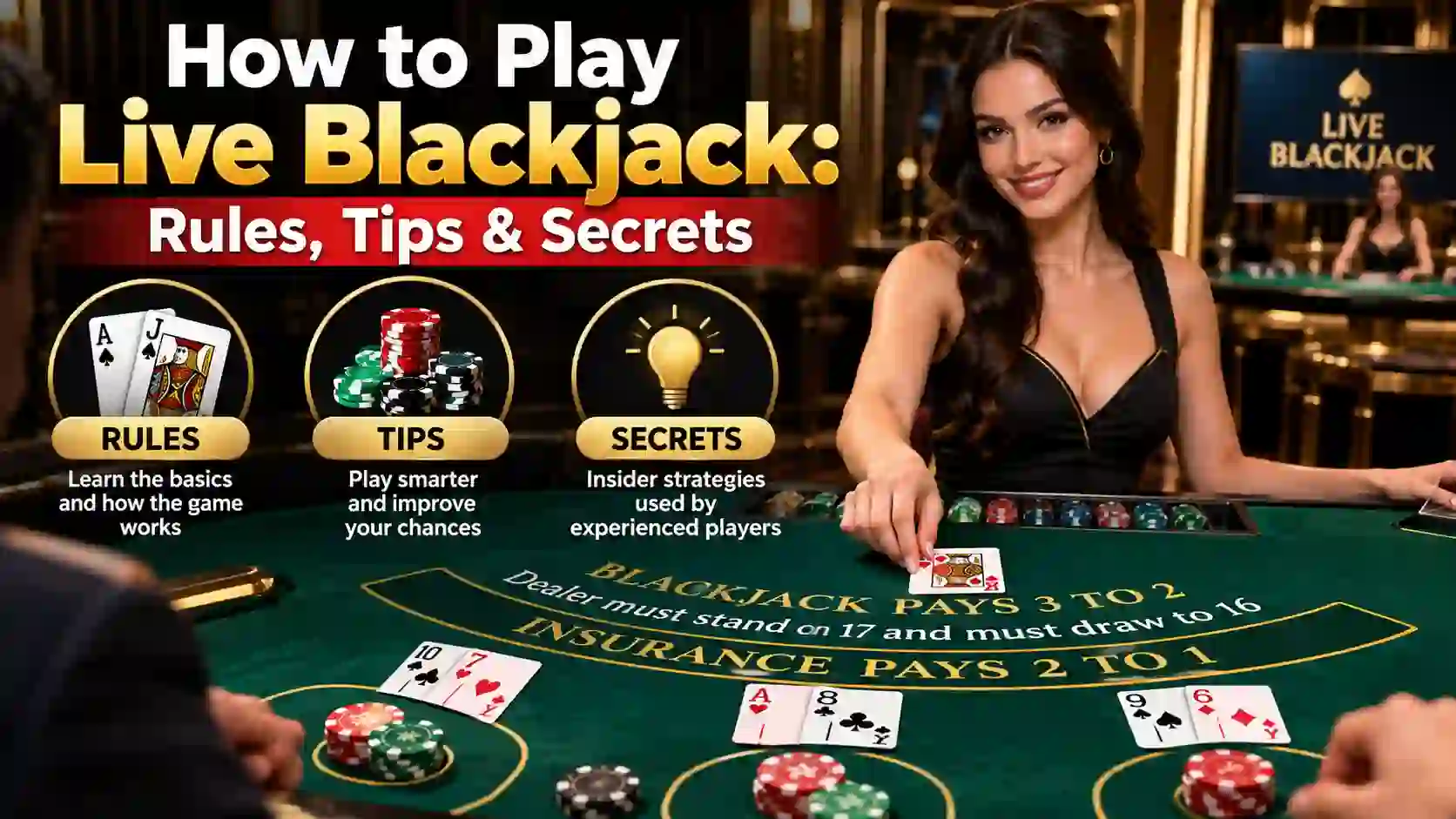
Live blackjack brings the atmosphere of a traditional casino directly to your computer, tablet or smartphone. Instead of playing against computer-generated cards, you watch a professional dealer handle real cards in a live-streamed casino studio. The experience combines classic blackjack rules with the convenience of online gaming.
However, understanding how to play live blackjack involves more than knowing that 21 is a good score. Successful decision-making requires knowledge of card values, dealer rules, betting options, basic strategy and the mathematical advantage held by the casino.
For beginners, live blackjack can initially seem complicated. Terms such as double down, soft 17, insurance and splitting pairs may sound unfamiliar. Fortunately, the fundamentals are straightforward once you understand how a typical round works.
What Is Live Blackjack?
Live blackjack is an online casino game hosted by a real dealer and broadcast through live video technology.
Unlike standard digital blackjack, where software generates the cards and outcomes, a conventional live dealer blackjack game uses physical cards dealt from a shoe. Players interact through an online interface, selecting actions such as hit, stand, double down or split.
The dealer follows the table’s published rules, and players make their decisions within a specified time limit.
A typical live blackjack table includes:
- A professional dealer dealing real playing cards.
- High-definition video streaming from a casino studio.
- Digital betting chips for placing wagers.
- Interactive controls for choosing playing actions.
- An on-screen display showing card totals and betting information.
- Optional chat features for communicating with the dealer.
Some games also offer additional features, including side bets, multiple camera angles and alternative table formats.
The primary objective remains identical to traditional blackjack: beat the dealer without exceeding 21.
You do not need to reach exactly 21 to win. A total of 18 can beat a dealer’s 17, while a total of 12 can win if the dealer exceeds 21.
Understanding this distinction is essential because blackjack is about making the best decision against the dealer’s hand, not simply collecting the highest possible total.
How to Play Live Blackjack: Step-by-Step Guide
Learning how to play live blackjack becomes much easier when you understand the sequence of a standard round.
Step 1: Choose a Live Blackjack Table
Start by examining the live blackjack tables offered by a legally authorised casino operator.
Different tables may have different minimum wagers, maximum betting limits, deck counts and playing rules.
Before joining, review the game’s information panel. Look for the blackjack payout, dealer’s soft-17 rule, doubling restrictions and splitting options.
Beginners should prioritise understanding the rules rather than selecting a table based on appearance or advertised jackpots.
Step 2: Understand the Card Values
Blackjack uses an easy-to-understand scoring system.
| Card | Value |
| 2 through 9 | Face value |
| 10, Jack, Queen, King | 10 points |
| Ace | 1 or 11 points |
An ace is particularly useful because its value can change depending on which total benefits the hand without causing it to exceed 21.
For example, an ace and a seven can count as 18. If the player draws a nine, the ace is counted as one, making the new total 17 instead of 27.
A hand containing an ace counted as 11 is known as a soft hand. A hand without that flexibility is called a hard hand.
Step 3: Place Your Bet
Before the dealer distributes the cards, players choose a betting amount using the on-screen chips.
For example, a player might place a £5 wager at a table where £5 is permitted.
Once the betting countdown ends, no additional initial wagers can normally be placed for that round.
Remember that doubling down and splitting can require additional money beyond the original stake. Your total financial exposure may therefore be higher than the amount initially bet.
Step 4: Receive Your First Two Cards
The dealer distributes two cards to each participating hand.
In a conventional blackjack game, the dealer also receives two cards, with at least one visible to players. However, the exact dealing procedure depends on whether the table uses American-style or European-style blackjack rules.
Suppose your first cards are:
- 8 and 7: Your total is 15.
- Ace and King: You have a natural blackjack.
- 10 and 9: Your total is 19.
A natural blackjack consists of an ace and a 10-value card as the original two cards. It is generally stronger than an ordinary three-card or four-card 21.
Step 5: Choose Your Playing Action
Once the cards are dealt, you select how to play your hand.
Most live blackjack games offer the following core decisions.
Hit: Request another card to increase your total. You may generally continue hitting unless you bust or another rule prevents further cards.
Stand: Keep your current hand and end your turn.
Double Down: Increase your initial wager by the permitted amount, normally matching it, and receive exactly one additional card.
Split: Separate two initially dealt cards of equal rank or value, where the rules permit, into two hands with separate wagers.
Surrender: At certain tables, surrender allows you to forfeit part of your original wager, commonly half, and end the hand early.
Not every blackjack variant provides all these options.
Step 6: Watch the Dealer Complete Their Hand
Once the players finish making decisions, the dealer completes the dealer hand.
The dealer cannot choose freely whether to hit or stand. Instead, the table rules determine the action.
Common rules require the dealer to:
- Draw another card on a total of 16 or lower.
- Stand on a hard total of 17 or higher.
- Follow the table’s specific rule for soft 17.
Some games require the dealer to stand on all 17s, while others require another card on soft 17.
Step 7: Check the Final Result
After the dealer finishes, each surviving hand is settled individually.
You win when your hand beats the dealer without busting, or when the dealer busts and your hand has not already exceeded 21.
You lose when your hand busts, or when the dealer finishes with a higher valid total.
If both hands have the same total, the result is normally a push, and your original wager is returned.
A natural blackjack normally receives its own special payout and settlement rules.
Essential Live Blackjack Rules Every Beginner Should Know
Although blackjack is relatively simple to learn, specific rules significantly affect the mathematics of the game.
Blackjack Payouts: 3:2 vs 6:5
One of the most important details to examine is the payout for a natural blackjack.
Consider a £10 original wager:
| Payout | Profit on Blackjack | Total Returned |
| 3:2 | £15 | £25 |
| 6:5 | £12 | £22 |
| 1:1 | £10 | £20 |
The difference may appear small for one hand, but it matters over repeated play.
A 3:2 table generally provides better mathematical conditions than an otherwise identical 6:5 table. According to blackjack mathematics published by Wizard of Odds, changing the payout from 3:2 to 6:5 increases the house edge by approximately 1.39 percentage points when the other rules remain unchanged.
That is why checking the paytable matters more than simply choosing the lowest available stake.
Dealer Stands or Hits on Soft 17
A soft 17 contains an ace counted as 11, such as Ace-6.
If the dealer stands on soft 17, the dealer cannot draw another card in this situation.
If the dealer hits soft 17, another card must be drawn.
All else being equal, the rule requiring the dealer to hit soft 17 generally increases the casino’s mathematical advantage.
Rules for Splitting Aces
Most blackjack tables permit players to split two aces into separate hands.
However, many tables restrict each split ace to one additional card.
Furthermore, an ace followed by a 10-value card after splitting is usually treated as an ordinary 21 rather than a natural blackjack.
Always check the rules rather than assuming that all blackjack games settle split hands identically.
Understanding Blackjack Basic Strategy
Blackjack basic strategy is a mathematically developed decision-making system.
It identifies the play with the highest expected value, or lowest expected loss, for a particular player hand against a specific dealer upcard under defined table rules.
It does not predict the next card or guarantee a winning result.
Instead, basic strategy helps players avoid unnecessary mathematical disadvantages caused by inconsistent decisions.
The strategy changes depending on factors such as the number of decks, whether the dealer hits soft 17, whether doubling after splitting is permitted and how dealer blackjacks are handled.
Simple Blackjack Strategy Chart for Beginners
The following examples provide a useful starting point for a common multi-deck game in which the dealer stands on soft 17. They are not a replacement for a complete, table-specific strategy chart.
| Your Hand | Dealer’s Upcard | Typical Basic Strategy |
| Hard 8 | Any | Hit |
| Hard 9 | 3–6 | Double if allowed |
| Hard 10 | 2–9 | Double if allowed |
| Hard 12 | 4–6 | Stand |
| Hard 13–16 | 2–6 | Stand |
| Hard 17 or more | Any | Stand |
| Pair of Aces | Any | Split |
| Pair of 8s | Any | Split |
| Pair of 10s | Any | Stand |
| Soft 18 (Ace-7) | 9, 10 or Ace | Hit |
If doubling is unavailable, the usual alternative in the hard 9 and hard 10 examples is to hit.
For hard 16 against a dealer 10, surrender may be preferred when permitted; otherwise, hitting is commonly the basic-strategy decision.
More advanced situations require a complete chart. For example, soft totals and pairs have different rules from ordinary hard totals.
The key is to use a strategy designed for the exact game you are playing.
10 Live Blackjack Tips and Secrets Worth Knowing
Many online guides promise secret methods for winning blackjack consistently. In reality, the most useful insights involve understanding the mathematical structure of the game and avoiding unnecessary risks.
- Learn the Dealer’s Upcard Strategy
The dealer’s visible card influences how players should approach their hands.
Dealer cards between 2 and 6 are commonly called weaker upcards because they create more opportunities for the dealer to bust while following the mandatory drawing rules.
Dealer cards between 7 and ace are generally stronger.
However, the correct playing action still depends on your own total.
For example, standing on 12 against a dealer 4 is often mathematically appropriate, even though 12 seems like a low score.
- Avoid Taking Insurance Without a Mathematical Reason
Insurance is offered when the dealer’s visible card is an ace.
The insurance wager is generally limited to half the original stake and pays 2:1 if the dealer has a natural blackjack.
For ordinary basic-strategy players, insurance is generally an unfavourable wager.
It should not be viewed as automatic protection for a valuable hand. The correct decision depends on the likelihood of the dealer holding a 10-value card, not how confident the player feels.
- Understand When to Split Pairs
Splitting allows players to turn two matching cards into separate hands.
For example, a pair of eights creates a total of 16, which is often difficult to play effectively.
Basic strategy generally recommends splitting eights because separating them offers a better mathematical outcome than playing the original 16.
However, splitting requires an additional wager and increases the amount at risk.
If that additional stake exceeds your budget, avoiding the wager is more important than following an otherwise optimal strategy.
- Never Assume a Winning Streak Will Continue
One of the most misleading blackjack beliefs is that recent results predict what will happen next.
A dealer who has won several hands is not automatically likely to lose the next round.
Similarly, a player who has received several weak hands is not guaranteed a strong hand soon.
In shoe-dealt games, previous cards can influence the remaining card composition. However, a simple record of wins and losses does not provide the information needed to calculate that effect.
Winning and losing streaks should never be treated as reliable betting signals.
- Use the Correct Basic Strategy Chart
Not every blackjack chart applies to every live table.
For example, a strategy intended for a dealer who stands on soft 17 may differ slightly from one designed for a dealer who hits soft 17.
European no-hole-card rules can also affect optimal decisions, especially when additional wagers have been made through doubling or splitting.
Read the table information and choose an appropriate chart before playing.
- Understand the True Cost of Side Bets
Live blackjack tables often feature optional wagers such as Perfect Pairs and 21+3.
Perfect Pairs pays for specified matching combinations of the player’s first two cards.
The 21+3 wager uses the player’s first two cards and the dealer’s upcard to form poker-style combinations.
These bets may offer larger individual payouts, but their mathematical house edges are often substantially higher than the main blackjack game’s house edge.
A large advertised prize does not necessarily mean a favourable wager.
- Avoid Doubling Down Just Because You Feel Confident
Doubling down increases your exposure and generally limits you to one additional card.
It should therefore be treated as a mathematical decision, not an emotional reaction.
Basic strategy commonly recommends doubling a hard 11 against many dealer upcards, but the exact recommendation depends on the table rules.
Doubling simply because the previous hand was successful provides no mathematical advantage.
- Treat Your Gambling Budget as an Expense
Before playing, decide how much money you can afford to lose without affecting essential expenses.
For example, someone who has allocated £40 for entertainment should not interpret that amount as money that must be recovered if lost.
Setting spending limits before entering a game helps prevent decisions driven by frustration or excitement.
A gambling budget is a limit on potential loss, not an investment fund or a strategy for generating income.
- Avoid Chasing Losses
Chasing losses occurs when a player increases wagering or continues gambling in an attempt to recover previous losses.
A common example is doubling the next wager after losing a hand.
Such betting systems do not remove the house edge. They can also produce rapidly increasing financial exposure.
A losing streak can continue longer than expected, and table limits may prevent the next proposed wager.
The most practical response to reaching a predetermined spending limit is to stop.
- Remember That the House Edge Never Disappears
Even when a player follows mathematically correct basic strategy, conventional blackjack generally retains a casino advantage.
At some favourable tables, the theoretical house edge for basic-strategy play can be around 0.5%, although the actual figure depends heavily on the rules and may be considerably higher.
For illustration, a 0.5% house edge corresponds to a theoretical average loss of 50p for every £100 wagered over a very large number of hands.
That does not mean a player will lose exactly 50p in a session. Short-term outcomes can vary dramatically in either direction.
The house edge describes a long-run statistical expectation, not an individual session result.
Live Blackjack vs Online Blackjack: What’s the Difference?
Both live blackjack and conventional online blackjack use similar underlying rules, but their presentation and pace can differ.
| Feature | Live Blackjack | Standard Online Blackjack |
| Dealer | Real person | Computer-generated |
| Cards | Physical cards in conventional live games | Software-generated outcomes |
| Video | Live stream | Digital graphics |
| Game speed | Generally tied to live dealing | Often faster |
| Player interaction | Dealer chat may be available | Usually limited |
| Table availability | May depend on seat format | Usually no physical seat limit |
| Rules | Vary by provider and table | Vary by software and game |
Live blackjack may appeal to players who prefer watching cards dealt in real time.
Standard digital blackjack may be more convenient for players who want to practise the basic rules at their own pace.
Neither format guarantees better results. The mathematical return depends primarily on the specific game rules, payouts and decisions.
Popular Types of Live Blackjack Games
Modern live casino providers offer several blackjack variations.
Classic Live Blackjack
Classic live blackjack typically uses a conventional table with a limited number of seats.
Players receive their own cards and make individual decisions against the dealer.
This is generally the easiest format for learning traditional blackjack.
Infinite Blackjack
Infinite Blackjack allows more players to participate without being restricted to the normal number of table seats.
In some versions, all participants receive the same initial hand but make their own subsequent decisions.
Certain Infinite Blackjack games also introduce special features such as the Six Card Charlie rule.
These variations can change the mathematics and must be assessed separately from standard blackjack.
Speed Blackjack
Speed Blackjack is designed to reduce waiting between player decisions.
Depending on the provider, players may make certain decisions simultaneously rather than waiting for every other seat to complete its turn.
The faster pace can also result in more hands being played during a given period.
VIP Live Blackjack
VIP blackjack tables typically have higher betting limits.
The core objective is the same, but the minimum financial commitment may be considerably larger.
A premium studio environment or higher table limit does not, by itself, improve the underlying odds.
Common Live Blackjack Mistakes to Avoid
Even experienced players can make avoidable errors when they rely on intuition rather than the table’s rules and mathematical probabilities.
Mistake 1: Always trying to reach 21. The objective is to beat the dealer, not necessarily reach the maximum score.
Mistake 2: Standing on every total above 12. Some hands require another card, depending on the dealer’s upcard.
Mistake 3: Taking insurance automatically. Insurance is not usually recommended for players following standard basic strategy.
Mistake 4: Ignoring the blackjack payout. A 6:5 payout can significantly worsen the mathematical return compared with 3:2.
Mistake 5: Treating side bets as part of basic strategy. Side bets have separate probability distributions and house edges.
Mistake 6: Copying another player’s decisions. Each hand should be evaluated against the dealer using the relevant rules.
Mistake 7: Increasing bets after losses. Changing the bet size does not eliminate the game’s mathematical advantage.
Mistake 8: Playing without understanding the time limit. Live games often require decisions within a short countdown.
Reviewing these mistakes can be more valuable than learning complicated betting systems.
Is Card Counting Possible in Live Blackjack?
Card counting is a technique that attempts to estimate the composition of cards remaining in a blackjack shoe.
In some traditionally dealt blackjack games, tracking previously revealed cards can provide information about whether the remaining shoe contains relatively more high-value or low-value cards.
However, card counting is often misunderstood.
It does not predict the exact next card and does not automatically guarantee profitability.
Live blackjack operators may use frequent shuffling, limited shoe penetration, multiple decks and game procedures that make obtaining a meaningful mathematical advantage difficult or impractical.
Some online variations do not follow the same dealing structure as conventional blackjack.
Furthermore, casinos may impose terms and restrictions concerning play.
For most beginners, learning basic strategy and understanding the house edge are far more useful than attempting advanced counting techniques.
How to Choose a Live Blackjack Table in the UK
Players in Great Britain should examine both the individual game rules and the operator’s regulatory status.
The UK Gambling Commission maintains a public register that allows users to check gambling operators and their licence status.
Before using an online gambling service, consider the following factors.
Licensing and Security
Check whether the operator holds an appropriate, active licence from the UK Gambling Commission for offering gambling services to customers in Great Britain.
Do not assume that a professionally designed website or a familiar game supplier automatically means an operator is properly licensed.
Transparent Game Rules
A suitable table should provide clear information about:
- Blackjack payout rates.
- Dealer hitting and standing rules.
- The number of decks.
- Splitting and doubling options.
- Any surrender rules.
- Insurance and optional side-bet payouts.
Betting Limits
Choose a table where the minimum and maximum stakes are clearly disclosed.
Remember that the advertised minimum wager does not necessarily represent the maximum amount you could commit during a single round if doubling or splitting is available.
Responsible Gambling Controls
Look for deposit limits, account activity information, time reminders, time-outs and self-exclusion facilities.
These features are particularly important because live casino games are easily accessible and may encourage extended sessions.
For online gambling in Great Britain, customers must generally be at least 18 years old and complete the operator’s required age and identity verification before gambling.
Responsible Gambling
Live blackjack is a gambling activity, not a reliable method of making money.
Even when a player understands the rules and follows basic strategy, chance remains central to the outcome.
It is therefore important to establish boundaries before playing.
Set a financial limit that does not interfere with housing, food, bills or other essential expenses. Decide how much time you are comfortable spending and avoid gambling when emotionally distressed or under pressure.
Do not borrow money to gamble, attempt to recover losses through larger stakes or treat gambling winnings as expected income.
If gambling starts affecting your finances, relationships or wellbeing, taking a break or seeking support is a sensible step.
In Great Britain, services such as GamCare offer confidential gambling-related support. The National Gambling Helpline is available free on 0808 8020 133, 24 hours a day.
FAQs
How do you play live blackjack for beginners?
To play live blackjack, first learn the card values and choose a table with clearly published rules. Place a permitted wager, receive your initial two cards and select hit, stand, double down or split as appropriate. Your objective is to beat the dealer without exceeding 21.
What is the best strategy for live blackjack?
The standard mathematical approach is basic strategy, which provides decisions based on the player’s hand, the dealer’s upcard and the table rules. It can reduce avoidable errors but cannot guarantee profits or eliminate the house edge.
Can you win real money playing live blackjack?
Real-money live blackjack can pay winnings when a player’s wager succeeds. However, losses are also possible, and the casino generally retains a mathematical advantage. Winning outcomes in individual sessions should not be mistaken for a dependable source of income.
Is live blackjack better than regular online blackjack?
Neither version is automatically better mathematically. Live blackjack provides interaction with a real dealer, while standard online blackjack usually uses computer-generated gameplay. The rules, payout structure and house edge are more important than the presentation format.
What does 3:2 mean in blackjack?
A 3:2 blackjack payout means that a winning natural blackjack earns £3 in profit for every £2 wagered. For example, a £10 stake produces £15 in winnings, plus the return of the original £10 stake.
Should you always hit on 16 in blackjack?
No. The mathematically recommended action depends on the dealer’s upcard and whether surrender is available. For example, standing on a hard 16 against a dealer 6 is generally appropriate, while a hard 16 against a dealer 10 is commonly surrendered if permitted or otherwise hit.
What is the difference between hard and soft blackjack hands?
A soft hand includes an ace that can be counted as 11 without exceeding 21. A hard hand has no ace that can currently count as 11. This difference affects playing decisions because a soft hand offers more flexibility when drawing another card.
Is insurance a good bet in live blackjack?
Insurance is generally an unfavourable choice for ordinary players following basic strategy. Although it pays 2:1 when the dealer has blackjack, the probability usually does not justify the wager.
Can live blackjack be played on mobile phones?
Yes. Many live blackjack games are designed for smartphones and tablets. Players can view the live stream, place permitted wagers and choose playing actions through mobile-friendly controls, although availability depends on the operator and device.
What is the biggest secret to playing live blackjack?
The most important insight is that blackjack rewards understanding the game’s mathematics rather than relying on superstition. Knowing the rules, using appropriate basic strategy and recognising the limitations of betting systems leads to more informed decisions. None of these methods guarantees winning.
Final Thoughts
Understanding how to play live blackjack begins with a few essential principles: know the value of the cards, understand the dealer’s rules and make decisions based on the strength of your hand and the dealer’s visible card.
Basic strategy provides a useful framework for avoiding common errors, while careful examination of payouts helps players distinguish between different table conditions.
The most valuable blackjack secrets are not hidden tricks or guaranteed winning systems. They are practical lessons about probability, dealer behaviour, card values, splitting, doubling and the long-term house edge.
For beginners, the best starting point is learning the rules thoroughly, using free practice opportunities where available and approaching real-money play with clear financial boundaries.
ADVERTISEMENT

18+ | Affiliate link | Terms apply | Please gamble responsibly.


