

18+ | Affiliate link | Terms apply | Please gamble responsibly.
Last Updated on October 1, 2026 by Maurya
Blackjack is one of the most popular casino card games in the world, and learning how to play blackjack online is surprisingly straightforward. The basic objective is simple: build a hand that beats the dealer without going over 21.
What makes blackjack different from many other casino games is that players make decisions during every hand. You can hit, stand, double down, split pairs and, at some tables, surrender. Those decisions matter. Although no strategy can guarantee that you will win, understanding the rules and using mathematically informed basic strategy can help you avoid unnecessary mistakes.
What Is Online Blackjack?
Online blackjack is the digital version of the classic casino game also known as 21. You play against the dealer rather than against other players at the table.
Your goal is to finish with a hand worth more than the dealer’s without exceeding 21. If your total goes above 21, you “bust” and normally lose the hand immediately.
Traditional blackjack uses standard playing cards. Number cards are worth their printed value, Jacks, Queens and Kings are worth 10, while an Ace can usually count as either 1 or 11 depending on which value benefits the hand.
For example, an Ace and a 6 can be counted as 17. Because the Ace is being valued as 11, this is called a soft 17. If another card would push the total above 21, the Ace can normally change to a value of 1.
A starting hand containing an Ace and any 10-value card is a natural blackjack. Under traditional rules, blackjack commonly pays 3:2, while an ordinary winning hand pays 1:1. However, some games use different payouts, making it important to read the rules before betting.
How to Play Blackjack Online Step by Step
A typical online blackjack round begins by choosing your stake and placing a wager.
You and the dealer then receive cards. In many versions, you receive two cards while one of the dealer’s cards is visible. Depending on whether you are playing American, European, RNG or live dealer blackjack, the precise dealing procedure can vary.
After seeing your cards and the dealer’s exposed card, you decide how to play your hand.
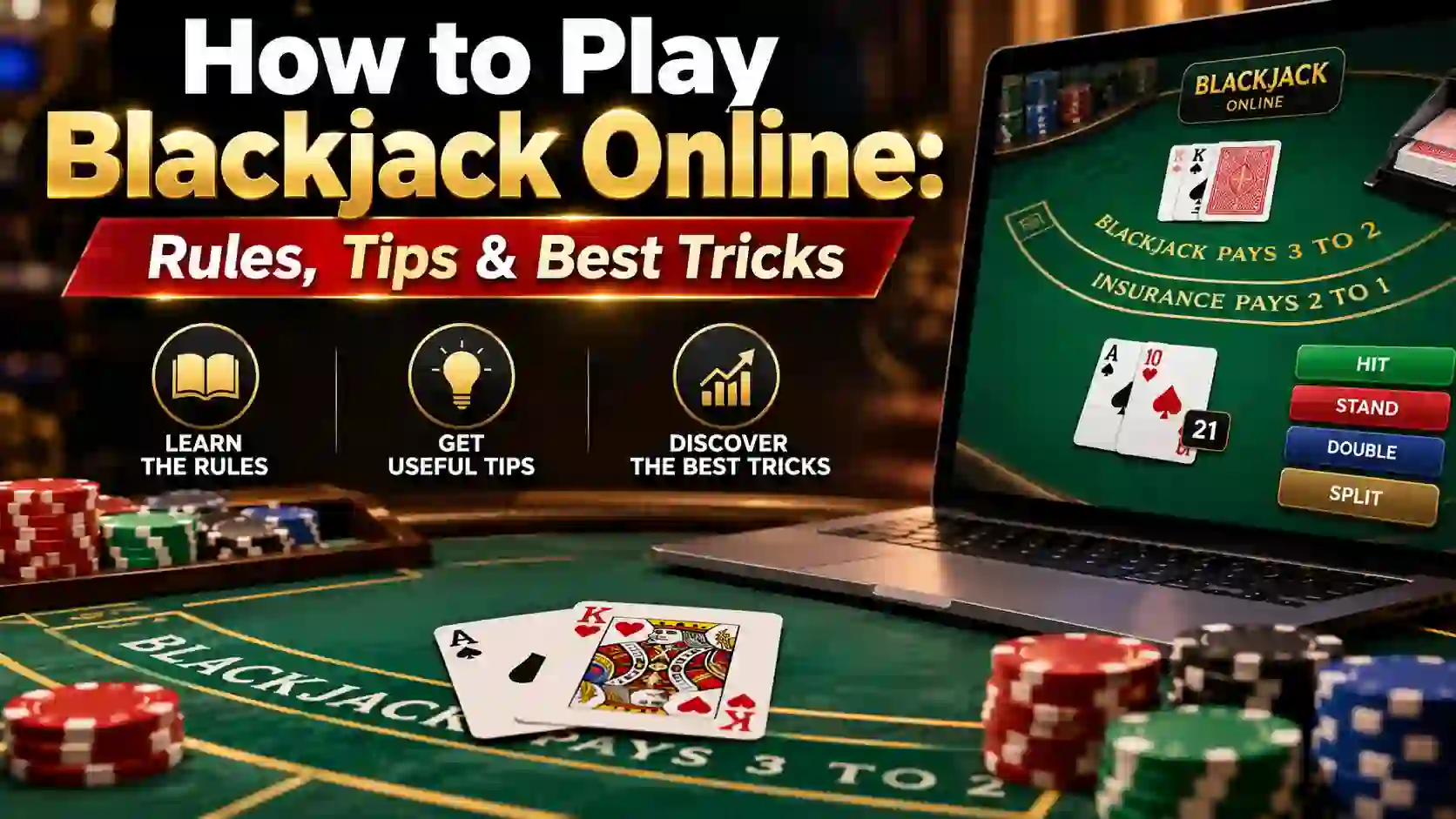
The main actions are:
- Hit: Receive another card.
- Stand: Keep your current hand and end your turn.
- Double Down: Usually double your original wager, receive one additional card and then stand.
- Split: Turn an eligible pair into two separate hands by placing an additional wager equal to the original bet.
- Surrender: At tables offering the option, give up the hand and recover part of the original wager.
- Insurance: A separate side bet sometimes offered when the dealer shows an Ace.
Once you have completed your decisions, the dealer finishes their hand according to fixed table rules. Dealers normally have to draw on totals of 16 or lower and continue until reaching at least 17. Whether a dealer must hit or stand on a soft 17 depends on the specific game.
If you bust, your hand loses. If the dealer busts while your hand remains at 21 or below, you normally win. If neither side busts, the higher total wins. Equal totals generally result in a push, meaning your original wager is returned.
Understanding Blackjack Card Values
Card values are one of the easiest parts of blackjack to learn.
Cards from 2 through 10 are worth their face value. Jacks, Queens and Kings are each worth 10 points. An Ace is flexible and can normally count as either 1 or 11.
Suppose your first cards are a King and a 7. Your total is 17.
If you receive an Ace and a 7, your hand is a soft 18 because the Ace can count as 11. If you then draw a 9, the Ace automatically becomes worth 1, making the hand 17 instead of 27.
Understanding this distinction between hard and soft hands is important because optimal blackjack decisions often change depending on whether an Ace can safely be counted as 11.
What Is a Blackjack?
A blackjack is normally an Ace plus a 10-value card received as your first two cards.
For example, Ace-King is blackjack. So are Ace-10, Ace-Jack and Ace-Queen.
However, reaching 21 with three or more cards is generally considered an ordinary 21 rather than a natural blackjack. This distinction matters because a natural blackjack can receive a higher payout.
Traditional 3:2 blackjack means a £10 blackjack would generate £15 in winnings plus the return of the original £10 stake.
Some online games instead advertise 6:5 blackjack. That sounds similar, but it is significantly less favourable to the player. Mathematical analysis by Wizard of Odds estimates that changing a traditional 3:2 blackjack payout to 6:5 increases the house advantage by about 1.39 percentage points under its reference rules.
That makes the payout printed in the game rules one of the most important details to check before playing.
Hit or Stand: How Do You Decide?
Knowing when to hit and when to stand is at the heart of blackjack strategy.
Beginners sometimes focus only on their own total. Experienced players also consider the dealer’s visible card.
Imagine you have 16 while the dealer shows a 6. Your hand looks weak, but drawing another card creates a substantial risk of busting. Because 6 is also a relatively vulnerable dealer card, basic strategy commonly tells you to stand in many such situations.
Now imagine you have 16 while the dealer shows a 10. Standing leaves you with a hand that will frequently lose to a stronger dealer total, so basic strategy will generally recommend hitting, assuming surrender is unavailable.
The important lesson is that blackjack decisions depend on both hands, not simply on whether your total feels high or low.
What Is Basic Blackjack Strategy?
Basic strategy is a mathematically calculated system showing the decision with the best expected result for each combination of player hand and dealer up-card under a defined set of rules.
It does not predict which card will appear next. It does not guarantee a winning session. Instead, it aims to minimise the casino’s statistical advantage by reducing avoidable playing mistakes.
For example, mathematical analysis cited by Wizard of Odds calculates a house edge of around 0.41% for one specific six-deck game where the dealer stands on soft 17 when correct basic strategy is used. That figure should not be treated as universal because deck count, blackjack payouts, doubling rules, surrender, splitting rules and whether the dealer hits soft 17 can all change the mathematics.
This rules dependence is why downloading a random blackjack strategy chart without checking its assumptions can be a mistake. A chart designed for an eight-deck game where the dealer hits soft 17 may contain different decisions from one designed for a single-deck, stand-on-soft-17 game.
How to Use a Blackjack Basic Strategy Chart
A blackjack strategy chart typically places your hand down one side and the dealer’s exposed card across the top.
You find your hand, locate the dealer’s card, and follow the recommended action where the two intersect.
Charts normally separate hands into three categories: hard totals, soft totals and pairs.
Hard totals do not contain an Ace valued as 11. Soft totals do. Pairs create additional splitting decisions.
Before relying on any strategy chart, confirm important table conditions such as how many decks are used, whether the dealer hits or stands on soft 17, whether doubling after splitting is allowed and whether surrender is available.
Those details may appear minor, but they affect mathematically optimal play.
Best Blackjack Tips for Beginners
The most useful blackjack tips are usually less exciting than supposed secret betting systems. They are also much more defensible mathematically.
Learn Basic Strategy Before Increasing Your Stakes
If you regularly have to guess whether to hit, stand, split or double, increasing your wager simply increases the amount of money exposed to those mistakes.
Learning the core decisions first is a more rational approach.
Basic strategy calculators and charts can be configured around particular rule sets. Wizard of Odds, for example, maintains blackjack strategy tools that distinguish factors including deck count, soft-17 rules, doubling after splitting and surrender.
Look for 3:2 Blackjack Rather Than 6:5
Payout rules can matter more than flashy graphics, speed or side bets.
When otherwise comparable games are available, a 3:2 blackjack payout is generally more favourable than 6:5. Always confirm the actual rules because an attractive-looking table may have weaker payouts or restrictions elsewhere.
Pay Attention to Soft 17
Look for wording such as “Dealer Stands on All 17s” or “Dealer Hits Soft 17.”
A dealer standing on soft 17 is generally more favourable to the player than a dealer hitting it. Under the reference rules analysed by Wizard of Odds, changing from dealer-stands-soft-17 to dealer-hits-soft-17 costs the player about 0.22 percentage points in expected return.
Think Carefully Before Taking Insurance
Insurance is a side wager offered when the dealer shows an Ace. It normally pays 2:1 if the dealer’s hidden card completes blackjack.
Despite the name, insurance does not truly “protect” your main hand. It is a separate wager.
Standard basic-strategy guidance generally recommends declining insurance for players who are not using information unavailable in ordinary online play. Wizard of Odds explicitly advises basic-strategy players against insurance and even money.
Treat Side Bets Separately
Online blackjack tables may offer Perfect Pairs, 21+3 and numerous other side bets.
They can make a game more entertaining, but their probability structure differs from the main blackjack hand. Do not assume that because blackjack itself can offer a comparatively low house edge under favourable rules, every side bet attached to the table offers similar mathematics.
Check each paytable independently.
Best Blackjack Tricks That Actually Make Sense
Search online for “best blackjack tricks” and you will encounter dozens of systems claiming to beat the casino. Most confuse short-term winning streaks with long-term mathematical advantage.
The genuinely useful “tricks” are really habits.
One is checking the rules before sitting down. A player who carefully chooses a 3:2 table with favourable doubling and dealer rules may start in a better mathematical position than someone who chooses purely by table design.
Another is using the correct strategy for the actual game. Blackjack strategy changes according to the rules, so accuracy matters more than memorising generic slogans.
A third is keeping stakes consistent with a predetermined budget. Increasing bets simply because you have just lost several hands does not cause the next hand to become more likely to win.
And perhaps the most important trick is understanding that previous hands do not create a guarantee about the next one. In regulated RNG blackjack, previous digital results are not supposed to create predictable future outcomes.
For example, Great Britain’s Gambling Commission requires regulated random-number generators to produce outcomes that are acceptably random and computationally unpredictable. Its technical standards also require remote gambling operators to meet testing requirements covering game and RNG results.
Therefore, a streak such as dealer-player-player-dealer does not provide a reliable formula for predicting the next digital blackjack result.
Do Blackjack Betting Systems Work?
Popular systems include the Martingale, Fibonacci, Paroli and various positive or negative progression strategies.
These systems change the size of the bet after wins or losses. They do not change the underlying probability of the cards.
Consider the Martingale system, where a player increases the next stake after a loss in an attempt to recover previous losses with a later win. A losing sequence can cause the required stake to escalate quickly, while both bankroll limits and table maximums eventually restrict how far the progression can continue.
A betting pattern therefore should not be confused with a strategy for changing the mathematical house edge.
Basic strategy affects how the hand is played. Betting systems primarily affect how much money is exposed to each hand.
That distinction is essential for anyone learning how to play blackjack online responsibly.
RNG Blackjack vs Live Dealer Blackjack
Online players will commonly encounter both computer-generated blackjack and live dealer blackjack.
RNG blackjack uses software to determine the cards and generally allows rounds to be completed quickly. Because there is no physical dealer waiting for every player, these games can be convenient for practising the mechanics.
Live dealer blackjack uses real dealers and video streaming to recreate more of the traditional casino-table experience. Cards may be dealt physically, while players use the website or app interface to place bets and select actions.
Neither format automatically offers better rules.
A live table can have an unattractive payout, while an RNG game can have favourable rules—or vice versa. Compare the actual game conditions rather than assuming one category is inherently superior.
How to Choose an Online Blackjack Game
Start with the rules rather than the graphics.
Check the blackjack payout, dealer soft-17 rule, number of decks if disclosed, doubling restrictions, pair-splitting rules and surrender availability. Also look at the minimum and maximum stakes so that the table fits your intended budget.
When gambling for real money, use an operator authorised for gambling in your jurisdiction and review its responsible-gambling facilities.
Regulation differs by country. In Great Britain, for example, licensed remote gambling operators must comply with Gambling Commission technical standards, including requirements concerning game information, random outcomes and testing.
If you simply want to understand the rules, free or demo blackjack can also be useful where legally available. It allows you to practise decisions without attaching real-money consequences to beginner mistakes.
Common Blackjack Mistakes to Avoid
One common mistake is playing every 16 the same way. Whether you should hit, stand or surrender depends partly on the dealer’s visible card and the table rules.
Another is splitting every pair. Two cards of equal value do not automatically mean splitting is beneficial. For example, a pair of 10s already produces a strong total of 20 and standard basic strategy usually keeps that hand together.
Players may also double down because they feel “due” for a winning card. Doubling should be based on the mathematical situation rather than recent results.
Ignoring table rules is another costly error. Someone may carefully memorise basic strategy but then choose a blackjack game paying 6:5, undermining part of the advantage gained through better decisions.
Finally, attempting to recover losses by increasing stakes can turn an ordinary losing session into a much larger financial loss. No run of previous cards makes the next hand owe you a win.
Can You Count Cards in Online Blackjack?
Card counting is associated primarily with blackjack games in which dealt cards affect the composition of the remaining physical shoe.
Traditional counting techniques are generally not useful for standard RNG blackjack where cards may effectively be reshuffled between rounds.
Live dealer games can work differently, but factors such as deck penetration, shuffling procedures and continuous shuffling devices affect whether past cards contain meaningful information about future cards.
More importantly, card counting should not be confused with basic strategy. A beginner can learn basic strategy without attempting to track deck composition.
For most people learning how to play online blackjack, mastering correct hit, stand, double and split decisions is much more relevant.
How to Manage Your Blackjack Bankroll
Bankroll management cannot turn a negative-expectation game into guaranteed profit, but it can help control how much money you expose during a session.
Decide your maximum entertainment budget before opening the game rather than while you are playing. That amount should be money you can afford to lose without affecting bills, savings or essential spending.
It is also sensible to decide in advance when the session ends instead of using losses as a reason to continue.
Where available, account-level financial limits can add an extra barrier. In Great Britain, Gambling Commission standards require licensed remote operators to provide facilities allowing customers to establish financial limits, with current rules designed to make these controls readily accessible.
The key principle is simple: blackjack should be treated as paid entertainment, not as a dependable way to make money.
Is Online Blackjack Fair?
Fairness depends heavily on where you play.
Legitimate regulated gambling jurisdictions impose requirements on licensed operators and their software. For example, Great Britain’s Gambling Commission specifies that random-number generation and game results must be acceptably random, including requirements designed to prevent predictable RNG output.
That does not mean the player and casino have equal odds. A game can be completely fair in the sense that it follows its published mathematical rules while still giving the operator a statistical advantage.
This is why house edge and fairness are not the same thing.
A regulated blackjack game can operate exactly as advertised while still producing a long-term mathematical advantage for the casino.
FAQs
Is blackjack easy to learn?
Yes. The core rules can be learned quickly because the main objective is simply to beat the dealer without exceeding 21. Becoming comfortable with basic strategy takes longer because optimal decisions depend on your cards, the dealer’s card and the specific table rules.
Is blackjack based on luck or skill?
Both are involved. You cannot control which cards appear, so chance determines individual outcomes. However, unlike many casino games, blackjack gives the player meaningful decisions such as hitting, standing, doubling and splitting. Making mathematically stronger decisions can reduce avoidable errors.
What is the best blackjack strategy?
For ordinary players, basic strategy is the standard mathematical starting point. The correct chart should match the table rules, including deck count and whether the dealer hits or stands on soft 17.
Should I always hit on 16?
No. The correct decision varies according to the dealer’s up-card, surrender availability and sometimes the specific blackjack rules. This is precisely why basic strategy considers both the player’s hand and dealer’s card.
Should I split Aces?
Under common blackjack rules, basic strategy normally recommends splitting a starting pair of Aces. However, restrictions on drawing, re-splitting and doubling after a split can vary, so always check the table rules.
Can I guarantee a profit from blackjack?
No legitimate blackjack strategy can guarantee profit. Basic strategy attempts to improve decision quality and reduce the house advantage under particular rules; it cannot control which cards are dealt or eliminate normal variance.
Is online blackjack rigged?
A properly regulated game should follow the rules and technical requirements imposed by its licensing jurisdiction. In Great Britain, licensed remote operators and gambling software are subject to technical standards and RNG testing requirements. Players should verify which regulator licenses an operator rather than assuming every gambling website is subject to the same standards.
Is live blackjack better than RNG blackjack?
It depends on what you value and, importantly, on the table rules. Live blackjack provides the atmosphere of a real dealer and physical cards, while RNG blackjack is typically quicker. Compare payouts and playing conditions before deciding.
Final Thoughts
Learning how to play blackjack online begins with a simple rule: beat the dealer without going over 21. From there, success in terms of better decision-making comes from understanding card values, knowing when to hit or stand, recognising when splitting or doubling makes mathematical sense and checking the rules before placing a bet.
The best blackjack “tricks” are not secret systems.
Choose favourable rules where possible. Prefer traditional 3:2 blackjack payouts over less favourable alternatives when the rest of the conditions are comparable. Use a basic strategy chart matched to the game. Be cautious with insurance and side bets. Ignore betting systems claiming that a losing streak somehow guarantees an approaching win.
Most importantly, maintain realistic expectations.
Even excellent strategy does not guarantee winnings. Blackjack remains gambling, and short-term results can move sharply in either direction regardless of how well a hand is played.
If you decide to play for real money, establish your spending limit beforehand, never chase losses and use the responsible-gambling controls available through licensed operators. The smartest blackjack decision is always one that keeps the game within an affordable entertainment budget.
ADVERTISEMENT

18+ | Affiliate link | Terms apply | Please gamble responsibly.


