

18+ | Affiliate link | Terms apply | Please gamble responsibly.
Last Updated on October 22, 2026 by Maurya
If you’ve ever watched a game of poker and thought it looked complicated, 3 Card Poker might change your mind. There are no lengthy betting rounds, no community cards to follow, and no complicated bluffing decisions. You receive three cards, evaluate your hand, and decide whether to challenge the dealer.
The game moves quickly, which is part of its appeal. But don’t mistake simple rules for guaranteed profits. Three Card Poker is still a casino game with a mathematical house advantage.
The good news is that you don’t need years of poker experience to understand how it works. Once you know the hand rankings, the dealer’s qualification rule, and the basic strategy, you can make informed decisions at the table.
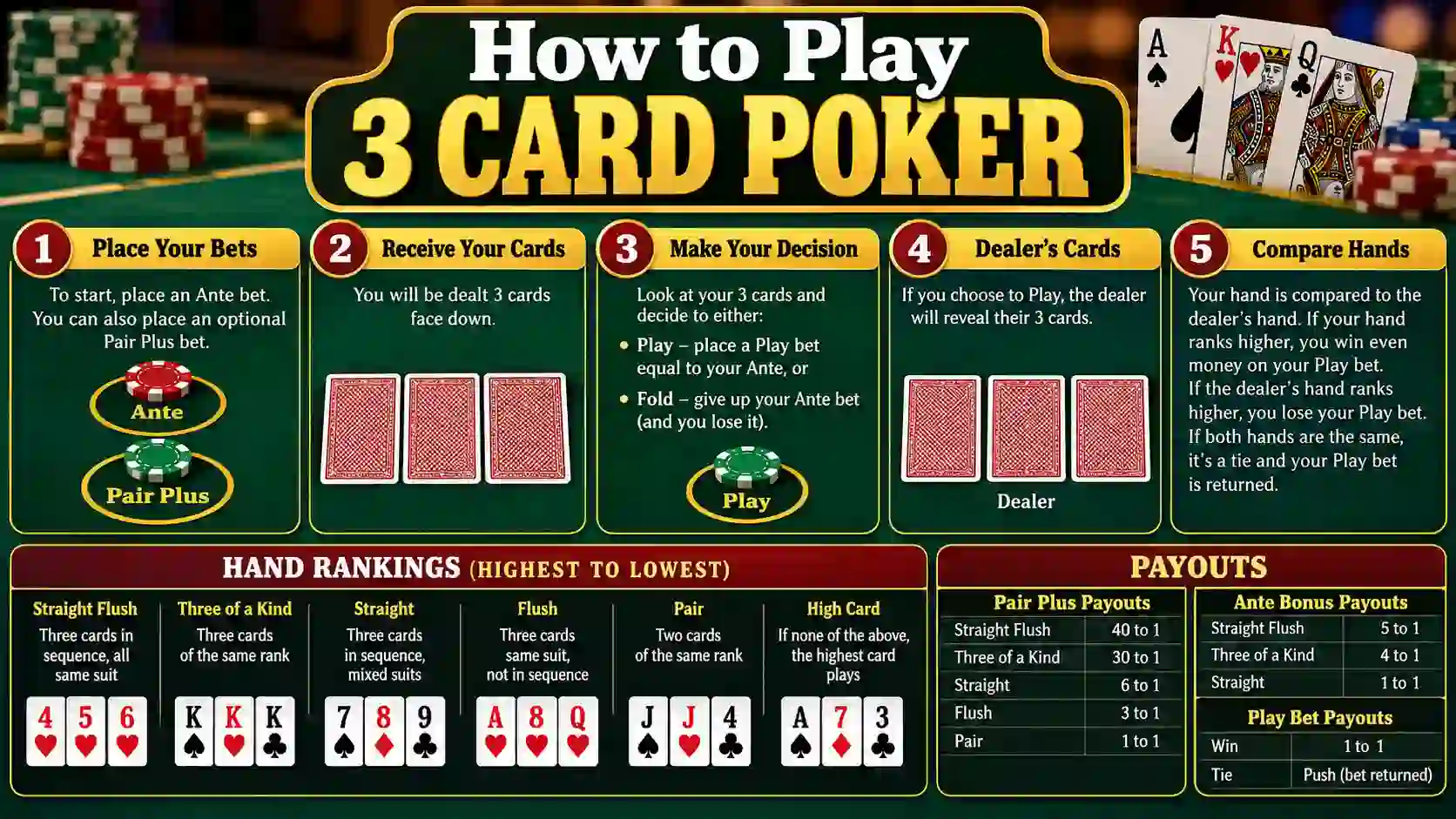
How Do You Play 3 Card Poker?
Quick Answer: To play 3 Card Poker, place an Ante bet before receiving three cards. After examining your hand, either fold and lose your Ante or continue by placing a Play bet equal to your Ante. The dealer reveals three cards and must have Queen-high or better to qualify. If the dealer qualifies, the stronger poker hand wins. If the dealer doesn’t qualify, your Ante wins even money and your Play bet is returned.
The most important basic strategy is to continue with Queen-6-4 or better and fold weaker hands.
That’s the fundamental gameplay. Understanding why particular hands are worth playing will help you make better decisions.
What Is 3 Card Poker?
Three Card Poker is a casino table game played between individual players and the dealer. Unlike traditional poker, where participants compete against one another, your objective is to beat the dealer’s three-card hand.
The game uses a standard 52-card deck without jokers. Each participant receives three cards, and the outcome depends on their poker hand ranking.
One of the biggest differences between Three Card Poker and Texas Hold’em is the absence of community cards. You cannot exchange your cards or improve your hand after the initial deal.
The game also features several betting opportunities:
- Ante Bet: Your initial wager against the dealer.
- Play Bet: An additional wager required to continue after seeing your cards.
- Pair Plus Bet: An optional side wager that pays when your hand contains a pair or better.
- Ante Bonus: An additional payout for certain premium hands, typically a straight or higher.
- 6 Card Bonus: An optional side bet offered at some tables, based on combining your cards with the dealer’s cards.
Not every casino offers the same side bets or payout schedules. Always check the posted rules before playing.
How to Play 3 Card Poker Step by Step
Learning 3 Card Poker becomes much easier when you understand what happens during a typical round.
Step 1: Place Your Ante Bet
Before the dealer distributes the cards, you place your starting wager in the Ante betting area.
For example, suppose you choose a £10 Ante. This establishes your initial stake for the hand.
Some tables also allow a Pair Plus wager, although participation requirements vary. You can generally play the main Ante and Play game without adding optional side bets.
Step 2: Receive Three Cards
After all initial wagers are placed, the dealer distributes three cards to every participating player and three cards to themselves.
You can examine your cards, but the dealer’s hand remains concealed until players have made their decisions.
Imagine receiving:
King of Hearts – 8 of Clubs – 4 of Diamonds
You have a King-high hand. There is no pair, straight, or flush, but it is still strong enough to continue under the recommended basic strategy.
Step 3: Decide Whether to Play or Fold
This is the main decision in Three Card Poker.
You have two choices.
Fold: Give up your hand and lose your original Ante wager.
Play: Place an additional wager equal to your Ante to challenge the dealer.
If you initially wagered £10, continuing requires another £10. Your total commitment to the main game is now £20.
Importantly, the Play bet cannot normally be increased or reduced independently. It must match your original Ante.
Step 4: The Dealer Reveals Their Cards
Once the betting decisions are complete, the dealer turns over their hand.
However, the dealer cannot automatically compete against you.
Under the standard rules, the dealer needs at least Queen-high to qualify.
For example:
- Queen–8–3 qualifies.
- King–5–2 qualifies.
- Jack–9–4 does not qualify.
A pair or any stronger ranked hand also qualifies.
Step 5: Determine the Winner
If the dealer fails to qualify, your Ante pays 1:1 and your Play bet is returned.
If the dealer qualifies, the hands are compared.
When your hand is stronger, both the Ante and Play wagers pay 1:1.
If the dealer has the stronger hand, both wagers lose.
When both hands have exactly the same poker value, the result is a push, meaning both bets are returned.
Step 6: Collect Any Applicable Bonus Payout
Some hands qualify for an Ante Bonus.
For example, a straight, three of a kind, or straight flush may receive an additional payout under the standard bonus schedule.
This bonus is generally paid even if the dealer has a stronger hand, provided you continued with the Play bet.
Side bets such as Pair Plus are settled separately according to their own paytables.
3 Card Poker Hand Rankings: Highest to Lowest
Before deciding whether to play a hand, you must understand the ranking system.
Three Card Poker uses familiar poker combinations, but their order is slightly different from conventional five-card poker.
The most important difference is that a straight beats a flush in 3 Card Poker.
Here are the standard hand rankings.
| Rank | Poker Hand | Example | Probability |
| 1 | Straight Flush | 7♥ 8♥ 9♥ | 0.22% |
| 2 | Three of a Kind | J♠ J♥ J♦ | 0.24% |
| 3 | Straight | 5♣ 6♦ 7♥ | 3.26% |
| 4 | Flush | A♠ 9♠ 4♠ | 4.96% |
| 5 | Pair | 8♣ 8♦ K♥ | 16.94% |
| 6 | High Card | K♠ 10♦ 5♣ | 74.39% |
Straight Flush
A straight flush contains three consecutive cards of the same suit.
An example is 9♥ 10♥ J♥.
It is the highest-ranking hand in Three Card Poker and is exceptionally rare.
A suited Ace–King–Queen is the highest possible straight flush and is sometimes called a Mini Royal. Some casino variations offer a separate payout for this combination.
Three of a Kind
Three of a kind consists of three cards with identical ranks.
For example, 6♣ 6♦ 6♥.
It ranks above a straight but below a straight flush.
Straight
A straight contains three cards in consecutive order, regardless of their suits.
For example, 8♠ 9♦ 10♣.
An Ace can be used in A–2–3 or Q–K–A, but it cannot wrap around to form combinations such as K–A–2.
Flush
A flush consists of three cards of the same suit that are not consecutive.
For example, 3♦ 8♦ K♦.
Although flushes beat straights in standard five-card poker, Three Card Poker reverses that ranking because three-card flushes occur more frequently than three-card straights.
Pair
A pair contains two cards with the same rank.
For example, Q♣ Q♠ 5♥.
When two players have pairs, the higher pair wins. If both pairs have the same value, the remaining card, known as the kicker, determines the winner.
High Card
If your three cards do not create any of the combinations above, your hand is ranked by its highest card.
For example, Ace–10–4 beats King–Jack–9 because Ace outranks King.
If the highest cards are identical, the second-highest and then third-highest cards determine the winner.
Suits do not break ties in the standard game.
Understanding 3 Card Poker Bets and Payouts
The betting system is one of the most important parts of learning how to play Three Card Poker correctly.
Different wagers serve different purposes, and their payouts should not be confused.
Ante and Play Bets
The Ante and Play wagers make up the main dealer-versus-player game.
Here is how they are settled:
| Result | Ante Bet | Play Bet |
| Dealer does not qualify | Pays 1:1 | Returned |
| Dealer qualifies; player wins | Pays 1:1 | Pays 1:1 |
| Dealer qualifies; dealer wins | Lost | Lost |
| Exact tie | Returned | Returned |
| Player folds | Lost | Not placed |
Consider a simple example.
You place a £10 Ante and receive a pair of Queens. You continue with a £10 Play bet.
The dealer qualifies with Ace-high, but your pair beats the dealer’s high-card hand.
Your Ante wins £10, and your Play bet wins another £10.
You receive your £20 in original stakes plus £20 in winnings, giving you a total return of £40.
Your net profit is £20.
Ante Bonus Payouts
The Ante Bonus rewards certain premium hands without requiring a separate bonus wager.
A commonly used paytable is:
| Hand | Ante Bonus Payout |
| Straight Flush | 5:1 |
| Three of a Kind | 4:1 |
| Straight | 1:1 |
Suppose you place a £10 Ante and receive a straight.
You continue by adding your £10 Play wager.
Even if the dealer reveals a stronger straight, your hand still qualifies for a £10 Ante Bonus under the standard rules.
You would lose £20 on your Ante and Play bets but receive £10 in bonus winnings, leaving a net loss of £10.
This example demonstrates why a bonus does not necessarily mean the entire round is profitable.
What Is the Pair Plus Bet?
Pair Plus is an optional wager that focuses exclusively on the strength of your three-card hand.
You don’t need to beat the dealer to win Pair Plus. The side bet pays if your cards form a pair or a stronger combination.
One established Pair Plus payout schedule is:
| Hand | Pair Plus Payout |
| Straight Flush | 40:1 |
| Three of a Kind | 30:1 |
| Straight | 6:1 |
| Flush | 4:1 |
| Pair | 1:1 |
For example, a £5 Pair Plus wager on three of a kind would generate £150 in winnings at 30:1, plus the return of your £5 stake.
However, casino payouts vary considerably.
Some tables pay only 3:1 for a flush, while others reduce the straight payout or introduce a separate Mini Royal prize.
Those differences directly affect the house edge, so checking the exact paytable matters more than simply looking at the biggest advertised prize.
Best 3 Card Poker Strategy: The Queen-6-4 Rule
If there is one strategy worth memorising before sitting at a Three Card Poker table, it is the Queen-6-4 rule.
Mathematical analysis of the standard game shows that the optimal Ante/Play decision is to continue with Queen–6–4 or any stronger hand.
Anything weaker should be folded.
The rule is easier to apply than it initially sounds.
When Should You Play?
Continue whenever you have a pair or better.
If you don’t have a pair, continue with any Ace-high or King-high hand.
With a Queen-high hand, examine the remaining two cards.
Continue if the second-highest card is greater than six.
If the second-highest card is exactly six, continue only when your lowest card is four or higher.
When Should You Fold?
Fold unpaired hands with Jack-high or lower.
Also fold Queen-high hands that fall below the Queen–6–4 threshold.
For example:
| Your Hand | Recommended Decision | Reason |
| A–7–2 | Play | Ace-high |
| K–5–3 | Play | King-high |
| Q–8–2 | Play | Second card exceeds six |
| Q–6–4 | Play | Meets the exact threshold |
| Q–6–3 | Fold | Below the threshold |
| Q–5–4 | Fold | Second card below six |
| J–10–4 | Fold | Jack-high |
These decisions are based on expected mathematical value rather than intuition.
The dealer’s qualification threshold should not be confused with your own playing threshold. A dealer qualifies with any Queen-high hand, but that does not mean every Queen-high player hand is profitable to continue.
Does this strategy guarantee winning? No. It reduces the expected cost of playing the standard game, but it cannot overcome the casino’s long-term advantage.
What Are the Odds of Winning at 3 Card Poker?
Understanding probability makes Three Card Poker easier to evaluate realistically.
There are 22,100 possible three-card combinations from a standard 52-card deck.
Most of those combinations are ordinary high-card hands.
According to the mathematical breakdown published by Wizard of Odds, the probability of receiving at least a pair is approximately 25.61%.
That means roughly three-quarters of initial hands contain no pair, straight, flush, or higher-ranking combination.
The house advantage also deserves attention.
House Edge on Ante and Play
Under the common Ante Bonus schedule of 5:1 for a straight flush, 4:1 for three of a kind, and 1:1 for a straight, optimal strategy produces a house edge of approximately 3.37% relative to the initial Ante.
This represents a long-term expected loss of approximately £3.37 per £100 in initial Ante wagers.
Because players also make additional Play wagers on qualifying hands, the expected loss relative to the total amount wagered is lower, at approximately 2.01%.
These are theoretical averages over many rounds, not predictions of what will happen during a particular session.
House Edge on Pair Plus
The Pair Plus house edge depends heavily on its payout table.
For example, the 40–30–6–4–1 payout schedule has a theoretical house edge of approximately 2.32%.
Reducing the flush payout from 4:1 to 3:1 increases that house edge to approximately 7.28%, assuming the other payouts remain unchanged.
This illustrates why two versions of the same casino game can offer noticeably different mathematical returns.
Pair Plus involves no meaningful strategic decision after the initial bet. Its outcome depends on the cards dealt, so increasing or changing your stake cannot improve the underlying probability of receiving a winning hand.
Can You Win at 3 Card Poker Consistently?
You can win individual hands and even finish some sessions with a profit. However, no standard strategy guarantees consistent long-term winnings.
Three Card Poker combines a small number of player decisions with outcomes determined by randomly dealt cards.
The Queen-6-4 strategy helps eliminate avoidable mistakes, but it does not make the game profitable in the long run.
It is also important to distinguish between playing correctly and predicting the next result.
A run of weak hands does not make a strong hand more likely on the next deal. Similarly, several dealer wins in a row do not mean the dealer is due to lose.
Each properly shuffled round is a new event.
Treating casino gambling as entertainment rather than a source of dependable income is a more realistic approach.
Common 3 Card Poker Mistakes Beginners Should Avoid
Even though the rules are straightforward, certain misunderstandings can make the game more expensive than necessary.
Playing Every Hand
Some beginners continue with every hand because they dislike losing their Ante.
This approach forces additional Play bets onto weak combinations and increases expected losses.
Folding is not a failure. It is an essential part of optimal strategy.
Folding a Playable Queen-High Hand
Other players become overly cautious and fold hands such as Queen–8–2.
Although this hand may look unimpressive, it is above the Queen–6–4 threshold.
Folding playable hands can also increase your expected losses.
Confusing Straights and Flushes
In Three Card Poker, a straight ranks above a flush.
Players familiar with Texas Hold’em sometimes assume the opposite, which can lead to incorrect hand evaluations.
Ignoring Side-Bet Paytables
Two casinos may offer Pair Plus wagers with different payouts.
Choosing a side bet based only on its maximum prize ignores the frequency of smaller winning hands and the overall mathematical return.
Chasing Previous Losses
Increasing your stake to recover money from earlier rounds does not improve the probability of winning.
It simply places more money at risk.
A fixed entertainment budget and a predetermined stopping point are more useful than attempting to predict when a losing streak will end.
How to Play 3 Card Poker Online
Online Three Card Poker generally follows the same core rules as its land-based counterpart.
The main differences involve how cards are dealt and how you interact with the game.
Standard Online Three Card Poker
In a digital version, software handles the deal, evaluates hands, and settles wagers automatically.
The interface typically displays your cards alongside controls for Play and Fold.
This can make it easier for beginners to understand the sequence of each round without worrying about table etiquette.
Live Dealer Three Card Poker
Live dealer games use a real dealer and physical cards streamed from a gaming studio.
You place wagers through an online interface while watching the cards being dealt.
The standard Ante, Play, and dealer qualification rules remain familiar, although individual providers may offer different side bets or bonus payouts.
For instance, PokerStars’ published Live Three Card Poker rules describe Ante, Pair Plus, and 6 Card Bonus options, with their own payout schedules.
Before playing online, confirm that the operator is authorised in your jurisdiction, review the game rules, and check the available account spending controls.
Does 3 Card Poker Have a 6 Card Bonus?
Some versions of Three Card Poker offer an optional 6 Card Bonus wager.
Unlike the main game, which evaluates only three cards, this wager uses the player’s three cards and the dealer’s three cards together.
The game then identifies the strongest possible five-card poker hand from those six cards.
Qualifying combinations can include three of a kind, a straight, a flush, a full house, four of a kind, or a straight flush.
Some paytables also offer a much larger prize for a royal flush.
The 6 Card Bonus is independent of the main Ante and Play result, and its payout structure varies by casino.
Although its maximum rewards may appear attractive, this wager can carry a substantially higher house edge than the standard Ante/Play game.
It is an optional addition, not a requirement for learning or enjoying Three Card Poker.
Practical Tips for First-Time 3 Card Poker Players
Before playing for real money, spend some time learning the basic decisions.
A free demonstration game, where available, can help you practise hand recognition without financial risk.
Remember that an initial £10 Ante can become a £20 commitment if you continue with a Play bet. Optional side wagers increase the total amount at risk.
Choose stakes based on the complete potential wager rather than the Ante alone.
It is also worth reviewing the table’s minimum bets, Ante Bonus payouts, dealer qualification rule, and any special Mini Royal conditions.
Most importantly, decide in advance how much money and time you are comfortable spending. Avoid increasing bets after losses, and stop if the game no longer feels recreational.
As the UK Gambling Commission advises, time and money limits are useful tools for managing gambling activity.
FAQs
Is 3 Card Poker easy to learn?
Yes. Three Card Poker is relatively simple compared with traditional poker variations. You receive three cards and make one main decision: fold or place an additional Play bet. Learning the hand rankings and Queen-6-4 strategy covers the most important rules.
What is the best strategy for 3 Card Poker?
The mathematically optimal basic strategy for the standard Ante/Play game is to play Queen–6–4 or better and fold weaker hands. This minimises expected losses under the usual rules, but it does not guarantee a profit.
Does a straight beat a flush in 3 Card Poker?
Yes. A straight beats a flush in Three Card Poker. This differs from standard five-card poker because three-card flushes are statistically more common than three-card straights.
What happens if the dealer doesn’t qualify?
If the dealer’s hand is weaker than Queen-high, the Ante pays 1:1 and the Play wager is returned. The dealer does not need to beat your hand for this qualification rule to apply.
What is the strongest hand in 3 Card Poker?
The strongest hand is a straight flush. The highest possible combination is Ace–King–Queen of the same suit, often referred to as a Mini Royal.
Can you play 3 Card Poker without Pair Plus?
Yes. Pair Plus is optional in the standard Ante/Play game. You can make an Ante wager, receive your cards, and decide whether to fold or continue without placing a Pair Plus bet.
How many decks are used in 3 Card Poker?
Standard Three Card Poker uses one 52-card deck without jokers. Casinos may use automatic shuffling equipment, but the basic game is based on a single standard deck.
Should you always play with a Queen?
No. Not every Queen-high hand is worth playing. The recommended threshold is Queen–6–4. A hand such as Queen–6–3 falls below that level and should be folded under optimal basic strategy.
Is 3 Card Poker better than Texas Hold’em for beginners?
It depends on what you want from the game. Three Card Poker has fewer decisions and is quicker to learn. Texas Hold’em offers more strategic depth, including betting, bluffing, positional decisions, and reading opponents.
Can you make money playing 3 Card Poker?
Individual sessions may end in profit, but the standard game has a built-in house advantage. Even with correct strategy, the mathematical expectation remains negative over the long term. It should not be treated as a dependable way to earn money.
Final Thoughts
Three Card Poker offers a straightforward introduction to casino poker-style games. Its appeal lies in a simple format: three cards, one central decision, and a clear comparison against the dealer.
Learning the rules doesn’t take long. Understanding the different wagers, dealer qualification, and hand rankings helps avoid confusion when real money is involved.
The most useful strategy to remember is equally simple: play Queen–6–4 or better and fold anything weaker.
Beyond that, pay attention to the posted payout tables, recognise that optional side bets come with their own risks, and keep your spending within predetermined limits.
Whether you’re learning at home or exploring a casino table, understanding how 3 Card Poker works allows you to approach the game with realistic expectations and informed decisions.
ADVERTISEMENT

18+ | Affiliate link | Terms apply | Please gamble responsibly.


