

18+ | Affiliate link | Terms apply | Please gamble responsibly.
Last Updated on October 31, 2026 by Maurya
Bingo may look like one of the simplest games around, but anyone who has tried managing several cards while numbers are being called quickly knows there is more to the experience than marking squares. Staying organised, recognising winning patterns, understanding the rules and keeping up with the pace of play all take practice.
Whether you enjoy traditional bingo halls, online bingo rooms or friendly games with family, developing a few practical habits can make the game easier to follow and more enjoyable.
But there is an important distinction worth understanding from the beginning: bingo is fundamentally a game of chance. Learning better techniques will not change which numbers are drawn or guarantee a winning ticket. What you can improve is your ability to follow the game accurately, avoid mistakes, manage your cards and make informed decisions.
What Are Bingo Skills, and Can You Really Improve Them?
Bingo skills are the practical abilities that help players participate confidently and accurately. These include recognising called numbers, managing tickets, understanding winning combinations and responding correctly when a card is complete.
Unlike games involving strategic decisions, such as chess, traditional bingo does not allow players to influence the random draw through skill.
According to the UK Gambling Commission, bingo is an equal-chance game in which individual tickets or chances must have equally favourable probabilities of success.
Nevertheless, experience and practice can improve several aspects of participation:
- Concentration: Following numbers without becoming distracted.
- Number recognition: Finding called numbers more quickly.
- Card management: Handling several tickets without losing your place.
- Rule awareness: Understanding different winning patterns and prize conditions.
- Decision-making: Selecting appropriate games and recognising their costs.
- Self-control: Setting sensible limits for entertainment spending and playing time.
The real purpose of improving your bingo skills is to become a more confident, informed and organised player—not to create a guaranteed winning system.
Understanding the Different Types of Bingo
Before exploring specific bingo strategies, it helps to understand the formats you are likely to encounter.
Although they share the same basic idea, different bingo variations use different ticket layouts, number ranges and winning conditions.
| Bingo Type | Ticket Format | Common Winning Conditions |
| 90-ball bingo | 3 rows and 9 columns, containing 15 numbers | One line, two lines or full house |
| 75-ball bingo | 5×5 grid, usually with a free centre square | Lines, shapes or specified patterns |
| 80-ball bingo | 4×4 grid containing 16 numbers | Lines, shapes and other announced patterns |
| 30-ball bingo | Commonly a 3×3 grid | Full-card wins or other game-specific conditions |
90-ball bingo is particularly popular in the United Kingdom. Its familiar structure makes it a good starting point for learning how to track multiple tickets.
75-ball bingo is widely associated with North American bingo and is also available online. It often introduces more varied winning patterns, requiring players to pay attention to the objective announced before each game.
Other formats, including 80-ball and speed bingo, can provide different playing experiences. Specific rules vary between operators, so always check the instructions for the game you intend to play.
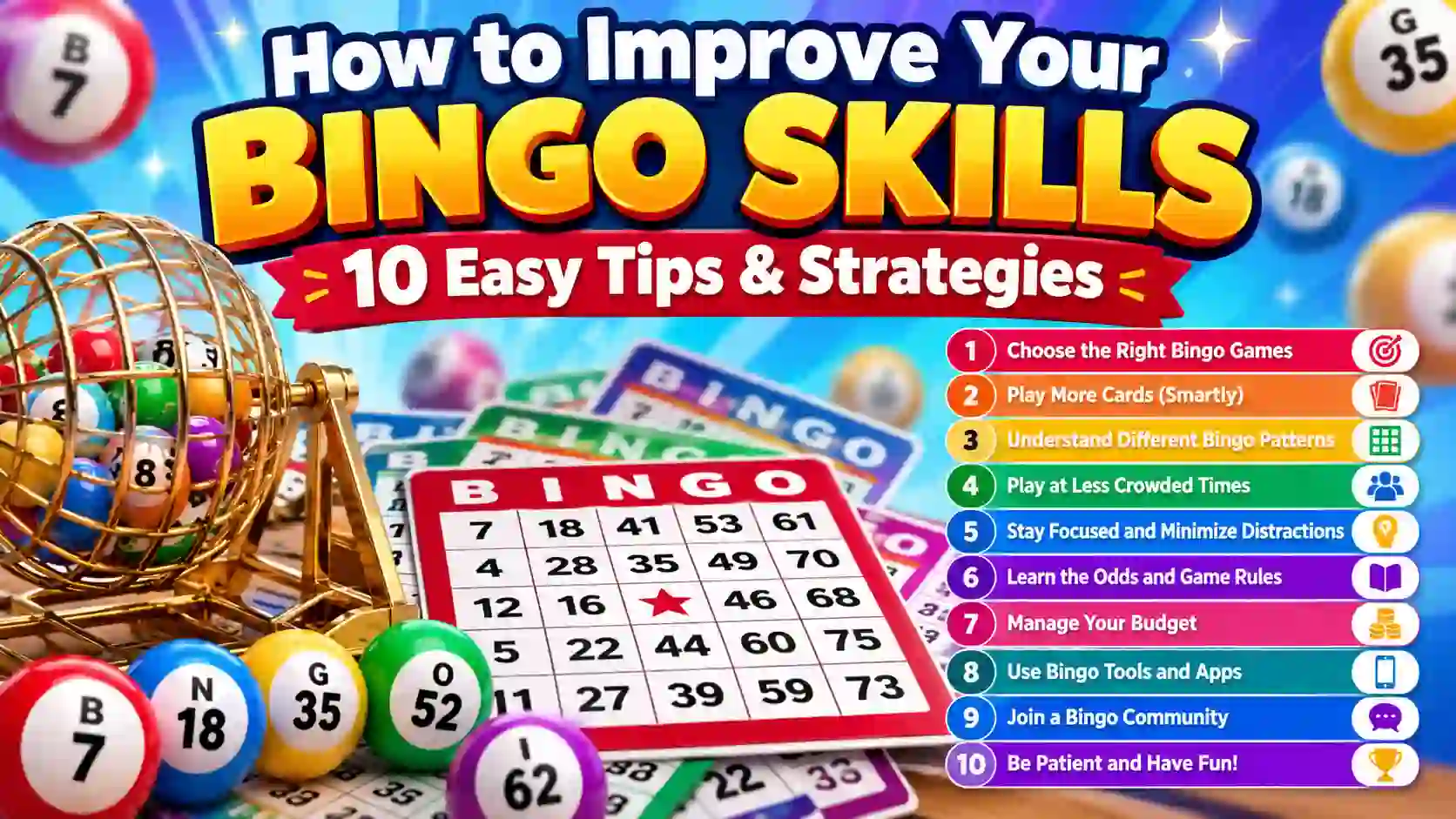
10 Easy Tips to Improve Your Bingo Skills
- Learn the Bingo Rules Before Playing
The most useful bingo tip for beginners is also the most straightforward: understand the game before joining.
Players who know the rules can concentrate on following the calls rather than trying to work out what they are supposed to achieve.
For example, a typical 90-ball bingo game has three possible prize stages:
- One line: Complete all five numbers in any horizontal row.
- Two lines: Complete two horizontal rows on the same ticket.
- Full house: Mark all 15 numbers on a ticket.
In contrast, a 75-ball game might require a diagonal line, four corners, a letter-shaped pattern or another specified arrangement.
A winning combination in one game may not qualify in another.
How to put this tip into practice:
Before a session starts, read the rules and identify the winning pattern. Check whether you must call out a win, press a claim button or rely on the game’s electronic verification process.
If you are uncertain, ask the bingo caller, venue staff or online customer support for clarification.
Key takeaway: Knowing the rules helps prevent confusion and reduces the chance of overlooking a valid winning combination.
- Start With Fewer Bingo Cards
One common beginner mistake is attempting to manage more tickets than they can comfortably follow.
Playing multiple cards means monitoring more numbers simultaneously. In a fast-moving session, this can quickly become overwhelming.
Imagine trying to follow six paper tickets while the caller announces numbers in quick succession. If you lose your place on one ticket, you may miss subsequent calls while trying to catch up.
A better approach is to begin with a single ticket or a small, manageable number of cards.
Once you can follow the game accurately, you can assess whether you are comfortable handling additional tickets.
However, there is an important financial consideration. More paid tickets mean higher spending. Although holding additional entries can increase your share of the chances in a given game, it does not improve the probability of any individual ticket or guarantee a return.
Practical exercise: Play a free practice round with two cards. If you can consistently identify every called number without errors, try a slightly more demanding practice session.
Focus on accuracy rather than the number of tickets you can handle.
- Develop an Organised Card-Marking System
In traditional paper bingo, marking numbers accurately is an essential practical skill.
Bingo players often use special markers known as daubers. These help make called numbers easy to identify without covering the surrounding information.
However, the tool itself is less important than the consistency of your technique.
Try these simple improvements:
- Arrange your tickets neatly before the first call.
- Keep the complete playing area visible.
- Use a marker that clearly identifies called numbers.
- Follow the same scanning order on each ticket.
- Avoid placing personal items or other distractions over your cards.
When checking several paper tickets, an organised scanning method can make a noticeable difference.
For instance, you might examine the cards from left to right each time a number is announced. Repeating the same process can reduce unnecessary searching.
For players using electronic tickets, organisation is still valuable. Learn how the device displays completed numbers, remaining numbers and active tickets.
Key takeaway: A reliable marking routine helps improve accuracy and reduces unnecessary distractions.
- Practise Listening and Recognising Numbers Quickly
Bingo requires concentration, particularly in a busy hall where background conversations and announcements may compete for your attention.
Traditional bingo callers also use distinctive phrases that may initially sound unfamiliar.
Some well-known British bingo calls include:
- Two little ducks: 22
- Legs eleven: 11
- Two fat ladies: 88
- Top of the shop: 90
- Kelly’s eye: 1
Learning these expressions can make a traditional bingo session easier to follow.
You do not need to memorise every bingo call immediately. Start with frequently used expressions and build familiarity gradually.
Another useful exercise is practising number recognition away from real-money games.
Create a mock bingo card, ask someone to read numbers aloud and practise identifying them quickly.
For example, have a friend announce 20 randomly selected numbers at a comfortable pace. Mark each one on your practice cards before moving on.
As your accuracy improves, you can gradually increase the speed.
This kind of exercise develops familiarity with the ticket layout and the process of following calls.
It does not influence the outcome of future bingo draws, but it can make participation feel less demanding.
- Understand Winning Patterns and Claiming Procedures
Recognising a winning pattern is one of the most important aspects of playing bingo correctly.
A player may follow every number accurately yet still become confused about whether a particular ticket qualifies for a prize.
This is especially relevant in games featuring multiple winning stages or unusual patterns.
Consider a 75-ball bingo game requiring players to complete an X-shaped pattern. Filling an ordinary horizontal line would not necessarily qualify, even though it might have been sufficient in a different game.
Always pay attention to the announced objective.
In a physical bingo hall, a winning claim may need to be made at the appropriate moment, according to the venue’s rules.
Online bingo can operate differently. Some games automatically recognise a qualifying ticket, while others involve additional player actions.
Before playing, establish:
- Which pattern must be completed?
- Can more than one player receive a prize?
- What happens if several tickets complete the pattern together?
- How is a winning claim verified?
- Is there a deadline for making a claim?
The answers depend on the particular bingo game and operator.
Practical advice: Never assume that a pattern or claiming procedure is identical across every bingo room.
Understanding these details improves your ability to participate correctly and confidently.
- Use Online Bingo Features Wisely
Online bingo has introduced tools that can make participation more accessible and convenient.
One of the most useful features is automatic number marking, commonly called auto-daub.
Where offered, this feature marks called numbers on eligible electronic tickets without requiring players to locate each number manually.
Other features may include:
- Visual displays of recently called numbers.
- Notifications about completed winning combinations.
- Clear ticket layouts.
- Adjustable audio settings.
- Game information and prize details.
- Accessibility options, depending on the platform.
These functions can reduce the risk of manual marking mistakes.
However, electronic tools should not be confused with winning strategies.
Auto-daub does not make a ticket luckier or influence the random number selection. It simply handles an aspect of gameplay.
A useful approach for beginners: Spend some time learning the interface through free practice or demonstration options, where available.
Find out how tickets are displayed, how wins are checked and whether any actions are required to complete participation.
For UK players, it is also important to verify that an online bingo operator holds the appropriate Gambling Commission licence.
You can check the operator’s details using the official Gambling Commission public register.
- Understand Bingo Odds and Avoid Common Myths
One of the most valuable improvements a bingo player can make is learning how probability works.
Bingo numbers are selected randomly. No legitimate strategy can predict which number will be drawn next.
Nevertheless, myths about lucky numbers and winning streaks remain popular.
Some players believe certain numbers appear more frequently, while others prefer specific ticket colours or number arrangements.
There is no reliable evidence that these personal preferences make an individual equal-chance bingo ticket more likely to win.
Does buying more bingo tickets increase your chances?
In a game where each ticket represents an equal entry, holding a greater proportion of the tickets in play can increase your chance of winning a prize.
For a simple example, imagine a hypothetical game with 100 equally likely ticket entries and one winning ticket.
If you own one entry, your chance of winning is 1%.
If you own five entries, your chance is 5%.
This simplified example illustrates the relationship between entries and probability. Actual bingo games may involve multiple prizes, shared wins and more complicated prize conditions.
Crucially, buying five entries also costs five times as much as buying one entry at the same ticket price.
Therefore, buying additional tickets should not be treated as a profitable strategy.
Can you predict hot or cold bingo numbers?
No.
A number appearing frequently in previous games does not mean it is more likely to appear in a future independent draw.
Similarly, a number that has not appeared recently is not automatically due to be called.
This mistaken belief is closely related to the gambler’s fallacy: assuming past random outcomes must influence future independent outcomes.
Key takeaway: Understanding probability helps players avoid unrealistic expectations and misleading bingo systems.
- Compare Bingo Games Before Choosing a Session
Not every bingo session offers the same experience.
Some games move quickly, while others allow more time between calls. Ticket prices, prize structures and participation levels can also differ.
Instead of automatically selecting a game because it advertises a large prize, compare the details that affect your enjoyment and spending.
Consider the following factors.
Game speed: Beginners may prefer a slower pace that provides enough time to follow each call.
Ticket cost: The price of participating should fit comfortably within an entertainment budget.
Prize structure: Understand whether the game offers fixed prizes, pooled prizes or special conditions.
Winning patterns: Choose a format you understand and enjoy.
Number of tickets in play: This can influence the competition between entries, although the relationship depends on the game’s structure.
A quieter bingo room may contain fewer competing tickets, but this is not guaranteed. A room with fewer players can still have many tickets in circulation.
Moreover, smaller participation levels can sometimes mean smaller prizes in games where payouts depend on ticket sales.
For these reasons, the best session is not necessarily the one with the fewest people or the largest advertised jackpot.
Practical advice: Choose games based on clear rules, manageable costs and a comfortable pace rather than predictions of easy wins.
- Practise With Free Bingo and Review Your Mistakes
Practice is valuable when developing any activity that involves recognition, attention and coordination.
Bingo is no exception.
However, improving your practical playing ability does not require spending money.
Free bingo exercises, printable cards and non-cash social games can provide opportunities to become familiar with the format.
You can create a simple practice routine:
- Select a bingo format you want to learn.
- Prepare one or two practice cards.
- Use randomly selected numbers to simulate calls.
- Mark each number as it is announced.
- Check your cards for missed or incorrectly marked numbers.
- Repeat the activity at a comfortable pace.
After each exercise, identify what caused difficulty.
Did you struggle to recognise numbers quickly?
Were your cards arranged awkwardly?
Did you misunderstand the winning pattern?
Was the caller moving too quickly for your current level?
These observations can help you make targeted improvements.
For example, if you frequently overlook numbers on the right-hand side of a ticket, practise a consistent scanning routine.
If you have trouble remembering a pattern, study the layout before beginning the next exercise.
The objective is not to develop a method for defeating random outcomes. It is to become more familiar with the rules and reduce avoidable mistakes.
Key takeaway: Free practice is one of the most sensible ways to build bingo confidence without increasing gambling expenditure.
- Set Limits, Take Breaks and Keep Bingo Enjoyable
The final bingo strategy is arguably the most important: treat paid bingo as entertainment rather than a way to earn money.
Because bingo is based on chance, losing sessions are possible regardless of how knowledgeable or experienced a player becomes.
A responsible approach begins before purchasing any tickets.
Decide how much money you can comfortably afford to spend on entertainment and how long you intend to play.
Your limits should never interfere with essential expenses such as housing, food, bills or savings commitments.
Useful habits include:
Set a spending limit. Decide on your maximum entertainment expenditure before starting and do not increase it to recover losses.
Set a time limit. Avoid allowing a planned short session to become an extended activity.
Take regular breaks. Stepping away can help you assess whether you still want to participate.
Avoid chasing losses. Losing money does not mean a future win is approaching.
Do not rely on winnings. Any prize should be considered an uncertain bonus rather than expected income.
Stop when playing is no longer enjoyable. Entertainment should not create ongoing financial pressure, stress or conflict.
The gambling support organisation GamCare provides information about safer gambling, self-exclusion and confidential support.
For people experiencing gambling-related difficulties, the NHS also offers guidance and information about specialist treatment services.
Remember, improved bingo skills cannot eliminate financial risk. Sometimes, the best decision is simply not to play.
Common Bingo Mistakes to Avoid
Even experienced players can make unnecessary mistakes. Understanding these errors can make your bingo experience smoother.
Playing without reading the rules
Assuming all bingo games use the same winning conditions may cause confusion. Check the rules whenever you encounter a new format.
Using too many tickets
Managing additional paper tickets can make it harder to follow each call accurately. Start with a manageable number rather than treating more tickets as a sign of skill.
Assuming a winning streak will continue
A previous win does not guarantee that another prize will follow. Random draws do not reward players simply because they have recently been successful.
Ignoring ticket prices
It is easy to concentrate on advertised prizes without considering the total cost of participation. Compare the complete cost of a session, including additional tickets and optional extras.
Misunderstanding special promotions
Promotional games may contain restrictions, eligibility conditions or particular prize arrangements. Read the terms before participating, and avoid spending more simply to qualify for an offer.
Continuing after reaching a limit
Trying to recover losses often leads to unnecessary financial harm. A predetermined spending limit is only useful when it is respected.
Online Bingo vs Traditional Bingo: Which Is Better for Beginners?
Both online and traditional bingo can offer enjoyable experiences, but they place different demands on players.
| Feature | Online Bingo | Traditional Bingo Hall |
| Number marking | Often automated | Commonly manual on paper tickets |
| Game information | Displayed on screen | Announced by caller or displayed in venue |
| Playing environment | Accessible through supported devices | In-person and social |
| Game pace | Varies and can be fast | Varies by session |
| Card management | Electronic tools may assist | Requires more manual attention |
| Social interaction | Chat rooms may be available | Face-to-face interaction |
Online bingo may suit people who prefer electronic card management, particularly where automatic marking is offered.
Traditional bingo can appeal to players who enjoy the atmosphere of a live venue and the hands-on process of marking tickets.
Neither format inherently provides better winning chances. The probability of success depends on the actual game rules, ticket entries and prize structure.
For beginners, the better choice is whichever environment makes it easiest to understand the game and remain comfortable.
How to Build Better Bingo Habits in Seven Days
If you are interested in improving your understanding of bingo, a short practice schedule can help.
The following seven-day plan focuses entirely on learning and free exercises.
Day 1 — Understand the basics: Learn the rules of 90-ball and 75-ball bingo, including ticket structures and winning combinations.
Day 2 — Recognise numbers: Practise matching randomly called numbers to paper tickets.
Day 3 — Improve card organisation: Experiment with different ticket arrangements to discover a comfortable scanning routine.
Day 4 — Learn winning patterns: Study full-house, line and pattern-based objectives using sample cards.
Day 5 — Practise concentration: Follow a simulated session without distractions, checking for any missed numbers afterwards.
Day 6 — Study probability: Review the difference between random chance, individual ticket odds and the number of competing entries.
Day 7 — Review your progress: Identify the areas that feel easier and continue practising any skills that still require attention.
This approach encourages learning without suggesting that regular gambling is necessary or desirable.
FAQs
How can I improve my bingo skills quickly?
The fastest practical improvements usually come from learning the rules, organising your cards and practising number recognition. Start with one or two free practice tickets and focus on accuracy before increasing the difficulty.
Is bingo a game of skill or luck?
Bingo is primarily a game of luck because numbers are selected randomly. Concentration, familiarity with rules and card management can improve participation, but they cannot determine which ticket wins.
What is the best bingo strategy for beginners?
A sensible beginner strategy is to learn the game format, use a manageable number of tickets, check the winning pattern and practise without spending money. When playing for money, establish firm time and spending limits.
Can experienced players improve their chances of winning bingo?
Experience alone does not increase the probability of an individual ticket winning a fair bingo game. Experienced players may be better at following calls and avoiding marking or claiming mistakes, but they cannot influence the draw.
Do lucky bingo numbers actually work?
No particular number is inherently luckier than another in a fair draw. Choosing favourite numbers can be part of the entertainment, but it does not provide a mathematical advantage.
Is 90-ball or 75-ball bingo easier to learn?
Both are relatively straightforward. Some beginners find 90-ball bingo easier because its standard winning stages are simple to recognise. The wider variety of patterns in 75-ball bingo may require additional attention.
Does playing more bingo cards guarantee a win?
No. Additional entries can increase a player’s share of the available chances, but they also increase the cost of participating. There is no guarantee that any particular ticket will win.
Is online bingo easier than paper bingo?
Online bingo can be easier to manage when automatic marking and clear ticket displays are provided. Paper bingo involves more manual attention. Neither approach removes the element of chance.
Are smaller bingo rooms better for winning?
A game with fewer total entries can offer a larger share of winning chances to an individual entry, depending on its rules. However, fewer players do not necessarily mean fewer tickets, and prize values may also vary. No room size guarantees a favourable financial outcome.
Can I become an expert bingo player?
You can become highly knowledgeable about bingo rules, ticket formats, number recognition and game procedures. However, expertise should not be confused with an ability to predict random draws or consistently make money from bingo.
Final Thoughts
Learning how to improve your bingo skills is about much more than memorising numbers or searching for winning tricks.
The most useful improvements come from understanding the game, recognising patterns, following calls accurately and developing an organised approach to card management.
Whether you prefer 90-ball bingo, 75-ball bingo or another variation, a little preparation can make the experience easier to understand.
Start with the basics. Practise using free materials. Learn the rules before joining a new game, and remember that no system can control random outcomes.
Most importantly, keep paid bingo within sensible entertainment limits.
The best bingo player is not necessarily the person who buys the most tickets or wins the largest prize. It is someone who understands the game, avoids preventable mistakes and knows when to stop.
With those principles in mind, you can enjoy bingo with greater knowledge, confidence and a healthier perspective on the role of chance.
ADVERTISEMENT

18+ | Affiliate link | Terms apply | Please gamble responsibly.


