

18+ | Affiliate link | Terms apply | Please gamble responsibly.
Last Updated on October 22, 2026 by Maurya
Dealing poker might look simple when an experienced dealer is running the table. Cards move smoothly, betting rounds follow naturally, and the game rarely pauses. However, anyone who has tried dealing poker for the first time knows that keeping everything organised takes more than a good shuffle.
You need to understand who receives the first card, when players can bet, why certain cards are discarded, and how to determine the winning hand. One small mistake can interrupt the game or create confusion about the pot.
The good news? Learning how to deal poker is easier than it first appears.
Whether you’re organising a friendly poker night, learning Texas Hold’em, or interested in becoming a professional poker dealer, this guide walks you through the process from start to finish.
You’ll also discover the most common poker dealing mistakes, how to handle unexpected situations, and practical techniques for dealing cards confidently.
How Do You Deal Poker?
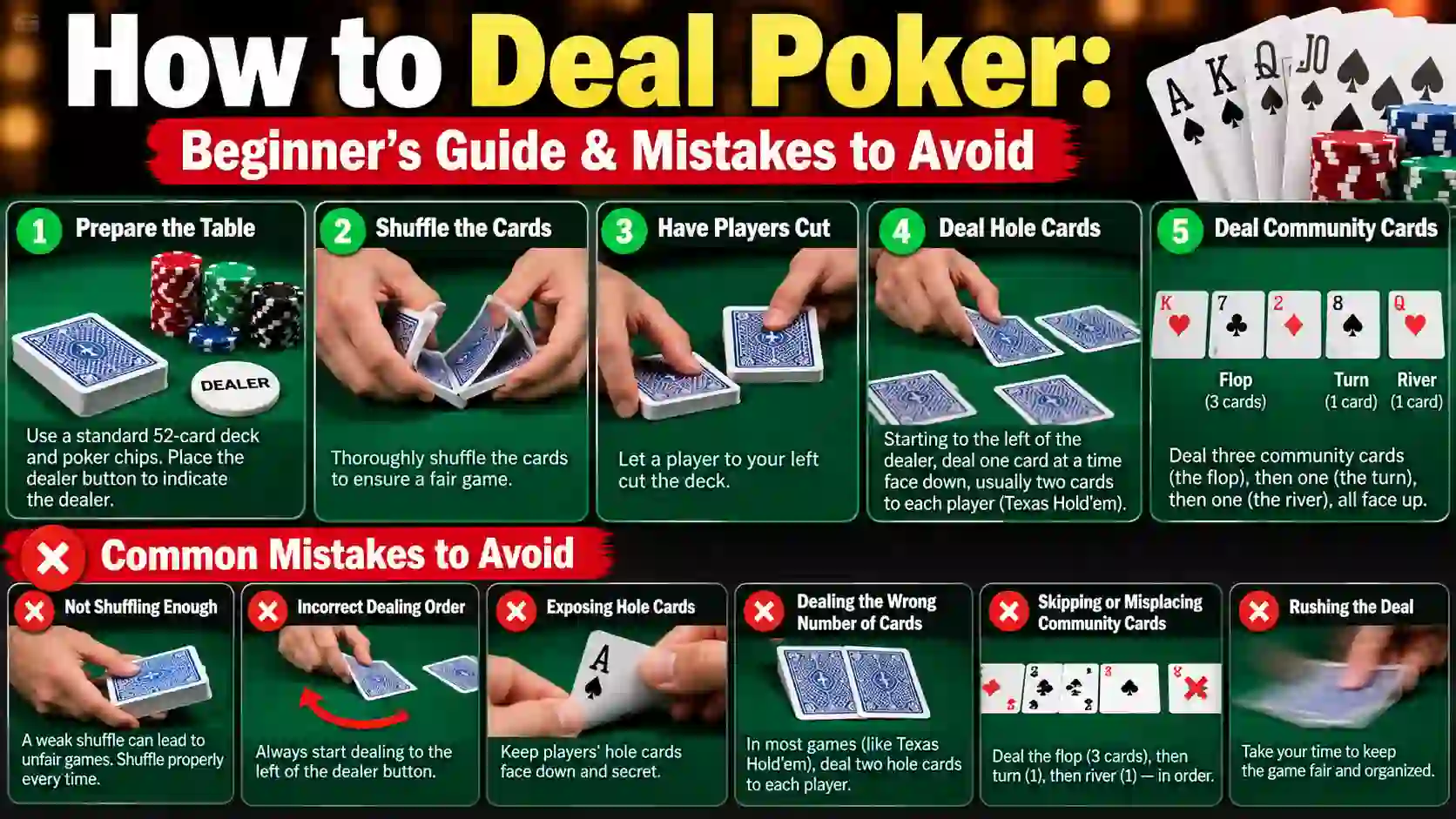
To deal Texas Hold’em poker, shuffle a standard 52-card deck, establish the dealer button and blinds, and give each player two face-down cards, one at a time, moving clockwise. After the first betting round, deal three community cards (the flop), followed by one card (the turn) and another (the river), burning one card before each stage. Complete the betting rounds, compare the remaining hands, and award the pot to the winner.
This is the basic dealing sequence used in Texas Hold’em, one of the world’s most widely played poker variations.
Once you understand this process, learning other poker formats becomes much easier.
What Do You Need to Deal Poker?
Before dealing your first hand, make sure the table is properly prepared.
You don’t need professional casino equipment to host a good poker game. A few basic items are enough.
Essential Poker Equipment
- Standard 52-card deck: Use a complete deck without jokers for traditional Texas Hold’em.
- Poker chips: Chips represent betting amounts and make it easier to track the pot.
- Dealer button: A small marker identifies the dealer position for each hand.
- Suitable table: Choose a clean, flat surface with enough space for players and community cards.
- Cut card: An opaque card placed underneath the deck helps prevent the bottom card from being exposed.
A dedicated poker table and professional playing cards can make dealing more comfortable, but they aren’t necessary for beginners.
Before starting, everyone should agree on the poker variation, chip values, blind amounts, and house rules.
For practice, consider playing with chips that have no monetary value. This allows beginners to concentrate on dealing correctly without financial pressure.
How to Deal Poker Step by Step
The following instructions explain how to deal Texas Hold’em poker, including the correct order of cards, betting rounds, and dealer responsibilities.
Step 1: Understand the Dealer Button and Player Positions
The first thing you need to identify is the dealer button.
This small marker indicates the dealer position, commonly called the button.
In a casual home game, the player holding the button usually deals the cards. In a casino, a professional dealer handles the cards while the button moves between players.
The button moves clockwise after each completed hand.
Two positions immediately following the button are particularly important:
Small Blind (SB): The first player clockwise from the dealer button posts a compulsory bet called the small blind.
Big Blind (BB): The next player clockwise posts the big blind, which is commonly twice the small blind.
For example, in a game with blinds of 1 and 2 chips:
- The small blind contributes 1 chip.
- The big blind contributes 2 chips.
These compulsory bets create an initial pot and encourage players to participate.
The player immediately clockwise from the big blind is called under the gun (UTG). In a game with three or more players, this person acts first during the initial betting round.
Getting these positions correct is essential because they determine both dealing order and betting order.
Step 2: Shuffle the Deck Properly
A proper shuffle ensures the cards are sufficiently randomised and no player can predict their order.
Professional poker dealers often use a combination of riffle shuffles, strips, and cuts. Beginners can start with a simpler technique.
A practical approach is to:
- Gather all 52 cards and keep their faces hidden.
- Mix the cards thoroughly using a comfortable shuffling method.
- Perform additional shuffles to randomise the deck.
- Cut the deck according to your game’s procedure.
- Keep the bottom card concealed before dealing.
Avoid shuffling in a way that exposes card faces to other players.
You should also inspect the deck occasionally for missing, damaged, or noticeably marked cards.
Beginner tip: Accuracy matters more than impressive card-handling tricks. A slow, thorough shuffle is better than a flashy technique that accidentally reveals cards.
Step 3: Collect the Blinds Before Dealing
After shuffling, confirm that the small blind and big blind have posted their required chips.
For instance, suppose five friends are playing Texas Hold’em with blinds of 5 and 10 chips.
The small blind places 5 chips forward, while the big blind contributes 10.
If your game uses antes, make sure these are posted according to the agreed rules as well.
The dealer should verify the required contributions before distributing the cards.
This simple habit prevents arguments about missing blinds and incorrect starting pots.
Step 4: Deal Two Hole Cards to Each Player
Now it’s time to deal the first cards.
In Texas Hold’em, every player receives two private cards, known as hole cards.
These cards are dealt face down so opponents cannot see them.
Start with the player immediately clockwise from the dealer button, normally the small blind.
Deal one card to each eligible player, continuing clockwise around the table.
Once everyone has received one card, repeat the same sequence.
At the end, every player should have exactly two hole cards.
Do not give a player both cards together. The correct process is to complete one full dealing round before distributing the second card.
Keep the cards low to the table as you slide or pitch them toward each player.
This reduces the chance of accidentally exposing a card.
Step 5: Manage the First Betting Round (Preflop)
After everyone receives their hole cards, the first betting round begins.
This stage is called preflop.
In games with three or more players, action starts with the player immediately clockwise from the big blind.
Each player has several possible actions, depending on the betting situation.
| Action | Meaning |
| Fold | Give up the hand and stop competing for the pot. |
| Call | Match the current required bet. |
| Raise | Increase the current betting amount. |
| Check | Remain in the hand without adding chips, when permitted. |
| Bet | Make the opening wager in a betting round. |
For example, if the big blind is 10 chips, a player who wants to call must match a total contribution of 10 chips for that round.
A player can also raise, subject to the game’s minimum-raise rules.
If no one raises preflop, the big blind normally has the opportunity to check or raise when action returns.
The dealer’s responsibility is to follow the action, keep betting amounts clear, and ensure players act in the proper order.
Only move to the next stage when the betting round is complete.
Step 6: Burn One Card and Deal the Flop
Once preflop betting finishes, the dealer reveals the first community cards.
However, before dealing them, you must burn one card.
Burning means taking the top card from the deck and placing it face down in the designated discard area without revealing it.
This procedure adds protection against information being gained from a marked or exposed card on top of the deck.
After burning one card, deal three cards face up in the centre of the table.
These three cards are called the flop.
Every active player can use these community cards when forming a poker hand.
Once the flop appears, another betting round begins.
This time, action starts with the first active player clockwise from the dealer button.
The same postflop betting order applies to the remaining betting rounds.
Step 7: Burn One Card and Deal the Turn
After all flop betting is complete, the dealer burns another card.
Next, place one additional card face up beside the flop.
This fourth community card is called the turn, sometimes referred to as Fourth Street.
Players now have four shared cards available.
Another betting round follows, beginning with the first active player clockwise from the button.
Remember that dealing the turn before flop betting has finished is a serious procedural mistake.
Always confirm that all required betting decisions have been completed before revealing another card.
Step 8: Burn One Card and Deal the River
The river is the fifth and final community card in Texas Hold’em.
After the turn betting round finishes:
- Burn one card face down.
- Deal the river face up.
- Place it beside the other four community cards.
- Begin the final betting round.
At this stage, five community cards are visible on the table.
Each player who remains in the hand can make their best five-card poker combination from their two hole cards and the five community cards.
In Texas Hold’em, a player may use both hole cards, one hole card, or neither.
After the final betting round, the remaining players proceed to the showdown unless only one player remains.
Step 9: Conduct the Showdown and Determine the Winner
The showdown is when the remaining players reveal their hands to determine who wins the pot.
Under standard tournament procedures, the last player who bet or raised on the river generally shows first.
If there was no river bet, the first active player clockwise from the dealer button shows first.
The dealer then compares the best five-card hands.
Here are the standard Texas Hold’em poker hand rankings, from strongest to weakest.
| Poker Hand | Description |
| Royal Flush | A, K, Q, J, 10, all in the same suit |
| Straight Flush | Five consecutive cards of the same suit |
| Four of a Kind | Four cards of identical rank |
| Full House | Three of a kind plus a pair |
| Flush | Five cards of the same suit |
| Straight | Five consecutive cards |
| Three of a Kind | Three cards of identical rank |
| Two Pair | Two separate pairs |
| One Pair | Two cards of identical rank |
| High Card | A hand without a stronger combination |
A Royal Flush is the highest possible straight flush.
When two players have the same category of hand, the values of their cards and relevant kickers determine the winner.
If the best five-card hands are identical, the pot is split.
Important: Poker suits do not determine which player wins a tie in standard Texas Hold’em.
Step 10: Award the Pot and Move the Dealer Button
Once the winning hand is confirmed, award the pot to the correct player.
If two or more players tie for the best hand, divide the eligible pot according to the game’s split-pot rules.
Before awarding chips, double-check the board, hole cards, and any side pots.
If everybody except one player folds, the remaining player wins without needing to reveal their hole cards in an ordinary non-showdown pot.
After the pot has been awarded, collect the cards.
In a home game, move the dealer button one eligible position clockwise, prepare the blinds, shuffle the deck, and begin the next hand.
Tournament games may use additional button-movement rules when players are eliminated or seats become vacant.
Texas Hold’em Dealing Order: Easy Reference Chart
Here is the complete Texas Hold’em dealing sequence at a glance.
| Stage | Dealer’s Action | What Happens Next |
| Setup | Shuffle, establish button, collect blinds | Prepare the hand |
| Hole cards | Deal two cards face down per player | Preflop betting |
| Flop | Burn one card, reveal three cards | Flop betting |
| Turn | Burn one card, reveal one card | Turn betting |
| River | Burn one card, reveal one card | River betting |
| Showdown | Compare eligible hands | Award the pot |
| Next hand | Collect cards and advance the button | Start again |
Memorising this sequence will help you avoid many beginner dealing mistakes.
A Simple Poker Dealing Example for Four Players
Let’s put everything together with a practical example.
Imagine four players sitting clockwise around a table:
- Player A: Dealer button
- Player B: Small blind
- Player C: Big blind
- Player D: Under the gun
The blinds are 5 and 10 chips.
Player B posts 5 chips, and Player C posts 10.
The dealer shuffles and cuts the cards.
The first card goes to Player B, followed by Player C, Player D, and Player A.
The dealer repeats the sequence to give everybody their second hole card.
Preflop action begins with Player D, followed by A, B, and C, assuming everyone remains in the hand.
Once betting is complete, the dealer burns a card and reveals the flop.
After the flop betting round, the dealer burns another card and reveals the turn.
The same procedure is followed for the river.
If two or more players remain after the final betting round, their hands are compared at showdown.
Once the winner receives the pot, the button moves to Player B for the next hand.
Practising this example with four seats is an effective way to understand dealing and betting order.
10 Common Poker Dealer Mistakes and How to Avoid Them
Even experienced dealers can occasionally make mistakes. The important difference is knowing how to prevent errors and handle them correctly.
Here are ten common problems beginners should watch for.
- Dealing Cards in the Wrong Direction
One of the easiest mistakes is dealing counterclockwise or starting from the wrong player.
In standard Texas Hold’em, cards are distributed clockwise, starting with the first eligible player to the left of the button.
How to avoid it: Check the dealer button before dealing and mentally identify the first three positions.
- Forgetting to Burn Cards
Some beginners reveal the flop, turn, or river directly from the top of the deck.
This skips an important part of the standard dealing procedure.
How to avoid it: Remember the sequence: burn one, deal three; burn one, deal one; burn one, deal one.
Don’t try to repair a forgotten burn by randomly removing cards after play has begun. Tournament rules contain specific procedures for these situations.
- Revealing Hole Cards Accidentally
A card may flip over while being dealt, exposing private information.
That exposure can affect the integrity of the hand.
How to avoid it: Keep cards flat and use a smooth, controlled dealing motion rather than throwing them aggressively.
If an exposure occurs, stop and follow the applicable rules. Depending on which card was exposed and when, the correct response may involve replacing a card or declaring a misdeal.
- Giving a Player Too Many or Too Few Cards
In Texas Hold’em, each player should receive exactly two hole cards.
An incorrect number can create confusion and may require a ruling.
How to avoid it: Deal one card at a time in complete rounds and confirm the card count before betting begins.
- Allowing Players to Act Out of Turn
Betting order matters because a player’s decision can influence everyone who acts afterward.
Allowing somebody to act early may provide unfair information to other players.
How to avoid it: Follow the betting sequence carefully. If necessary, briefly indicate whose turn it is.
- Dealing the Next Community Card Too Early
A dealer might accidentally reveal the turn before the flop betting round has finished.
This is known as a prematurely dealt card.
How to avoid it: Before dealing another street, verify that every active player has completed the required action.
If a card is exposed prematurely, don’t automatically reshuffle the entire deck. Ask the game organiser or tournament floor staff to apply the relevant procedure.
- Miscounting Bets and Chips
Incorrect pot calculations can lead to arguments and unfair payouts.
This becomes particularly important when players raise, call with large chips, or go all-in.
How to avoid it: Keep each player’s current betting-round chips identifiable until the amounts have been verified. Announce clear bet and raise amounts, and avoid mixing chips prematurely.
- Mixing Folded Cards With Live Hands
Folded cards belong in a separate discard area called the muck.
If live cards become mixed with discarded cards, a player’s hand may become impossible to identify.
How to avoid it: Keep the muck organised and separate from active hands, the remaining deck, and the community cards.
- Declaring the Wrong Winning Hand
New dealers sometimes overlook kickers, full houses, or straights formed using community cards.
For example, two players may both have a pair of aces, but one could win because of a stronger kicker.
How to avoid it: Compare the complete best five-card hands rather than focusing only on the first pair or highest card.
- Moving the Button Incorrectly
The dealer button determines blind positions and influences betting order.
Forgetting to move it, or moving it to the wrong position, can cause players to post blinds incorrectly.
How to avoid it: Make checking the button part of your routine after every completed hand.
What Happens If You Make a Mistake While Dealing Poker?
A dealing error doesn’t always mean the entire hand must be restarted.
The appropriate response depends on the error, when it is discovered, and the rules governing the game.
A misdeal is a dealing error significant enough to require the initial deal to be restarted under the applicable rules.
Examples may include dealing the first card to the wrong seat, failing to deal an eligible player, or exposing certain hole cards through dealer error.
However, the timing matters.
Under the Poker Tournament Directors Association’s 2026 rules, a misdeal generally cannot be declared after substantial action has occurred, unless the deck itself is fouled.
Substantial action has a specific technical definition; it does not simply mean that one person has made a decision.
This is why dealers should identify errors immediately.
For a friendly home game, establish a clear process for disputes before play begins.
For an organised tournament or casino game, follow the venue’s procedures and call the floor when needed.
Never improvise a correction that could unfairly change a player’s hand.
How to Handle All-In Bets and Side Pots
One of the more challenging situations for a beginner dealer occurs when players have different chip stacks.
Suppose three players remain:
- Player A goes all-in for 20 chips.
- Player B contributes 50 chips.
- Player C contributes 50 chips.
Each player has contributed at least 20 chips, so the main pot contains 60 chips.
The additional 30 chips from Player B and 30 from Player C form a side pot worth 60 chips.
Player A is eligible to win the main pot but cannot win the side pot because they did not contribute to it.
The side pot can only be won by an eligible player who contributed to it.
Dealer tip: Keep the main pot and side pots clearly separated. Resolve each pot independently at showdown.
In a tournament following Poker TDA procedures, eligible hands must be exposed once all-in players are involved and all betting action is complete.
How to Deal Poker When Only Two Players Remain
A two-player poker game is called heads-up poker.
Heads-up dealing has a special rule that beginners frequently overlook.
When only two players remain:
- The dealer button is also the small blind.
- The other player posts the big blind.
- The big blind receives the first hole card.
- The button receives the last hole card.
- The button acts first before the flop.
- The big blind acts first after the flop.
This differs from the usual preflop betting order at a table with three or more players.
The Poker TDA rules explicitly establish this heads-up arrangement.
Understanding it prevents one of the most common mistakes when a full table eventually becomes a two-player game.
How to Deal Different Types of Poker
Although Texas Hold’em is an excellent starting point, not every poker game follows the same dealing structure.
Five-Card Draw Poker
In traditional Five-Card Draw, players receive five private cards rather than two.
After the initial deal and betting round, remaining players may discard selected cards and receive replacements according to the game’s rules.
A final betting round and showdown determine the winner.
Unlike Texas Hold’em, the standard Five-Card Draw game doesn’t use a shared flop, turn, and river.
Omaha Poker
Omaha uses a community-card structure similar to Texas Hold’em.
However, each player receives four hole cards instead of two.
The most important distinction is how players form their hands.
In Omaha, a player must use exactly two hole cards and exactly three community cards to create a five-card hand.
This is different from Texas Hold’em, where players can use zero, one, or two of their hole cards.
Seven-Card Stud
Seven-Card Stud doesn’t use the same community-card or blind structure as Texas Hold’em.
Players receive a combination of face-down and face-up cards over several dealing rounds.
Betting order is determined by the game’s stud rules rather than a moving dealer button.
If you’re completely new to dealing, learn one poker variation thoroughly before attempting another.
Professional Tips for Dealing Poker Smoothly
Knowing the rules is only part of becoming a capable dealer. Good table management also makes a significant difference.
Develop a consistent routine. Follow the same sequence for every hand: check the button, shuffle, confirm the blinds, deal, manage betting, and reveal community cards.
Keep the table organised. Maintain separate areas for the deck, folded cards, burn cards, community cards, and betting chips.
Communicate clearly. When appropriate, state important actions and betting amounts so everyone understands what’s happening.
Stay neutral. The dealer should never influence a player’s decision, reveal private information, or favour one participant.
Don’t rush. Dealing faster doesn’t make you a better dealer if it increases mistakes. Concentrate on consistent, accurate movement.
Practice reading hands. Spend time comparing seven-card combinations and learning how kickers determine winners.
Understand the rules before disputes occur. Knowing when to stop and request a ruling is just as important as knowing how to deal correctly.
Finally, remember that a professional dealer’s job is not simply to distribute cards. It is to help maintain an orderly, fair game.
FAQs
How many cards do you deal in poker?
The number depends on the poker variation. In Texas Hold’em, each player receives two private cards. Five community cards are then dealt across the flop, turn, and river. In traditional Five-Card Draw, each player initially receives five private cards.
Who gets the first card when dealing poker?
In standard Texas Hold’em with at least three players, the first card goes to the small blind, immediately clockwise from the dealer button. Cards are then dealt one at a time around the table. In heads-up play, the big blind receives the first card.
Do you deal poker clockwise or counterclockwise?
Poker is normally dealt clockwise. Start with the appropriate player to the left of the dealer button and continue around the table until every eligible player has received the required cards.
How many cards do you burn in Texas Hold’em?
Under normal Texas Hold’em dealing procedures, three cards are burned during a complete hand: one before the flop, one before the turn, and one before the river. Burn cards remain face down and are not used as community cards.
Can the dealer play poker while dealing?
Yes. In a casual home game, players commonly take turns dealing while also participating in the hand. In a casino, the professional dealer manages the game rather than competing against the players.
What happens if everyone folds in poker?
If all players except one fold, the remaining player wins the pot. The hand ends immediately, and no further community cards need to be dealt. In an ordinary uncontested hand, the winner does not have to show their hole cards.
What happens if two players have the same poker hand?
If two players have identical best five-card hands, the eligible pot is divided between them. However, if their hands belong to the same category but have different kickers or card values, the stronger five-card combination wins.
Is dealing poker difficult for beginners?
Dealing poker requires concentration, but the fundamentals are straightforward. Most beginners can learn the basic Texas Hold’em dealing sequence with a deck of cards and regular practice. Managing complex betting situations and side pots generally takes more experience.
Can you deal poker without a dealer button?
Yes, a casual game can use another visible object to indicate the dealer position. However, the position must be clear to every player because it determines the blinds and betting order.
How long does it take to learn how to deal poker?
You can understand the basic dealing sequence during a single practice session. Becoming consistently fast, accurate, and comfortable handling unexpected situations takes longer. Regular practice is more important than memorising complicated card tricks.
Final Thoughts
Learning how to deal poker is about much more than placing cards on a table. A good dealer understands player positions, betting rounds, community cards, hand rankings, and the importance of keeping the game fair.
For beginners, Texas Hold’em is a practical place to start because its dealing sequence is easy to follow once you understand the basics.
Begin by practising the shuffle and learning which player receives the first card. Then work through the preflop, flop, turn, river, and showdown stages until the order becomes familiar.
Pay particular attention to common mistakes such as forgetting burn cards, dealing out of turn, exposing private cards, or awarding a pot before checking the winning hand.
Don’t worry about looking like a professional casino dealer on your first attempt. Focus on accuracy, consistency, and understanding what happens at each stage.
With practice, the dealing process will become much more natural, allowing you to enjoy the game while helping everyone at the table have a smooth and fair experience.
ADVERTISEMENT

18+ | Affiliate link | Terms apply | Please gamble responsibly.


