

18+ | Affiliate link | Terms apply | Please gamble responsibly.
Last Updated on November 2, 2026 by Maurya
Play’n GO has created plenty of unconventional online slots, but Honey Rush remains one of the studio’s more distinctive grid-based releases. Instead of conventional reels and fixed paylines, this bee-themed game takes place across a 37-position hexagonal honeycomb where matching symbols connect to form winning clusters.
Originally released on 31 October 2019, Honey Rush was described by Play’n GO as its first hexagonal cascading grid slot. The unusual layout is more than a visual gimmick: it supports a Cluster Pays system, cascading wins, a progressive Rush Meter and special Colony mechanics that can transform substantial sections of the board.
There is also considerably more going on beneath the cheerful woodland artwork than its friendly appearance initially suggests. Honey Rush is a high-volatility slot, with independent game references listing maximum potential of 9,000x the stake. The commonly published RTP is 96.50%, although lower-RTP configurations are also available, making it particularly important to check the information screen at the casino where you intend to play.
Honey Rush Slot Overview
| Feature | Honey Rush Details |
| Developer | Play’n GO |
| Release Date | 31 October 2019 |
| Game Type | Grid / Cluster Pays Slot |
| Grid | 4-5-6-7-6-5-4 hexagonal layout |
| Total Positions | 37 |
| Winning Mechanic | Clusters of 5+ matching adjacent symbols |
| RTP | Up to approximately 96.50%, depending on version |
| Volatility | High / Very High |
| Maximum Win | Up to 9,000x stake |
| Bet Range | Commonly listed as 0.20–100 |
| Main Features | Cascades, Rush Meter, Colony features, Sticky Wild Multipliers |
| Traditional Free Spins | No traditional scatter-triggered free-spins round |
Play’n GO’s official description confirms the game uses 37 positions and requires at least five identical adjacent symbols to create a winning cluster. Independent sources list a 4-5-6-7-6-5-4 arrangement, 9,000x maximum win and very high volatility.
Keep in mind that betting limits, currencies and RTP settings may differ between operators and regulated markets.
Theme, Graphics and Presentation
Honey Rush takes the obvious visual route suggested by its name, but Play’n GO gives the theme enough personality to prevent it from feeling like a generic cartoon-bee slot.
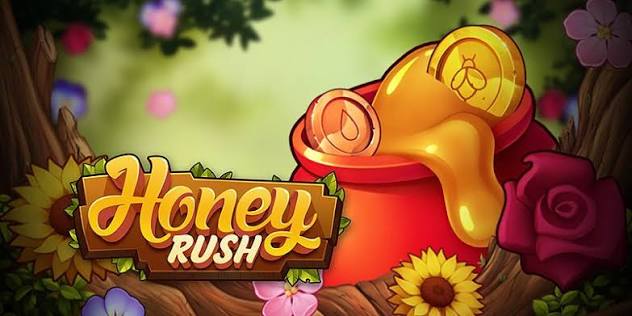
The action happens against a lush woodland backdrop. At the centre sits a large honeycomb composed of hexagonal cells, while flowers, coins and diamonds provide much of the symbol set. The warm yellows of the honey-themed features contrast nicely against the green natural environment.
Using hexagons also makes thematic sense. Rather than squeezing a bee theme onto a standard rectangular reel set, Play’n GO builds the entire interface around the appearance of a beehive.
The sound design is similarly light-hearted. Effects become livelier when cascades begin, helping longer chains of wins feel increasingly energetic without requiring a separate conventional bonus screen.
Honey Rush was released several years ago, yet its presentation has aged reasonably well because the graphical style is deliberately clean and cartoon-like rather than dependent on elaborate 3D rendering.
How Does the Honey Rush Slot Work?
Understanding Honey Rush requires forgetting about conventional paylines.
The grid contains 37 symbol positions spread across seven columns in a 4-5-6-7-6-5-4 formation. Winning combinations are created when at least five identical symbols touch one another in a connected cluster.
A cluster does not need to form a straight line.
Symbols can connect in irregular shapes as long as each relevant symbol is adjacent to another matching symbol in the group. The hexagonal layout means central positions can connect in more directions than they could on a traditional square grid.
When a winning cluster appears, the symbols involved are removed. New symbols then fall into the empty positions.
If that produces another qualifying cluster, another win occurs and the process repeats.
These are the game’s cascading wins, and they are crucial because Honey Rush’s most valuable mechanics depend on maintaining successful cascades long enough to fill the Rush Meter.
Play’n GO confirms that winning clusters disappear and new symbols drop onto the grid, creating the possibility of additional combinations from the same original wager.
Symbols and Cluster Payouts
Honey Rush’s regular symbols fit its nature-and-treasure theme.
At the lower end of the paytable are colourful flowers. Higher-value symbols are represented by bronze, silver and gold coins, followed by the diamond.
The exact reward depends on both the symbol and size of the cluster.
Independent game documentation identifies the diamond as the highest-paying regular symbol, with sufficiently large clusters capable of producing significantly higher base payouts than the lower-value flowers. Bigwinboard, for example, lists payouts of up to 200x the stake for the largest qualifying diamond clusters.
However, the basic symbol payouts are only part of Honey Rush’s appeal. The more interesting potential comes when cascades interact with the Rush Meter and multiplier Wilds.
Honey Rush Rush Meter Explained
The Rush Meter is the central feature around which the game is built.
Every symbol removed as part of a winning cluster contributes towards filling the meter during the current game round. Larger clusters therefore make faster progress.
The original Honey Rush contains four Rush Meter levels. A current UK operator rules page lists the thresholds as 20, 40, 80 and 160 winning symbols.
Reaching these stages queues additional features.
The first three levels activate Drone Colony effects and introduce Sticky Wilds to the board. At the fourth and highest stage, the significantly more powerful Queen Colony becomes available.
What makes the system entertaining is that progress happens during a chain of cascades. A routine cluster can lead to another win, which may lead to another, gradually pushing the meter towards the next feature.
That creates a clear sense of escalation without relying on a conventional free-spins bonus round.
Drone Colony Feature
The Drone Colony is triggered through the Rush Meter.
When activated, it focuses on the centre of the honeycomb. The central symbol is cloned into nearby positions, creating a new winning cluster and potentially restarting or extending the cascade sequence.
Play’n GO’s rules describe the Colony mechanics as transforming symbols surrounding the centre symbol so they match it. UK operator information specifies that the Drone version produces a cluster containing at least seven matching symbols.
An especially useful part of the system is that queued Colony features do not necessarily disappear simply because another win occurs first.
If natural winning combinations are still available, a queued feature can wait until the current cascade sequence reaches the appropriate point before activating.
As a result, a strong round can develop into several distinct stages rather than ending immediately after the first cascade.
Worker Colony Feature
The Worker Colony behaves differently from the Rush Meter-triggered Drone feature.
It can activate randomly on a non-winning spin, providing the game with a chance to transform what initially appears to be an unsuccessful round.
When triggered, the feature clones the central symbol and converts nearby positions to produce a cluster.
Current rules information lists the Worker Colony as producing a cluster of approximately 7 to 15 matching symbols.
The Worker Colony therefore acts almost like a rescue mechanic. It does not guarantee that a dramatic sequence will follow, but creating a qualifying cluster means the cascade system can begin and potentially generate further connections.
Queen Colony Feature
The Queen Colony is the feature players are likely to notice most.
It is reached at the fourth level of the original Rush Meter, after 160 winning symbols have been collected during the relevant sequence according to published rules.
Rather than building a relatively small cluster around the central symbol, the Queen Colony creates a cluster containing at least 20 symbols and potentially all 37 positions on the grid.
That makes it considerably more powerful than the Drone or Worker variants.
Reaching this stage is naturally difficult. Honey Rush is a highly volatile slot, and accumulating enough cascading winning symbols to reach the top of the meter requires an unusually strong sequence.
The Queen Colony should therefore be viewed as high-end feature potential rather than something players should expect regularly.
Sticky Honeypot Wilds and Multipliers
The Sticky Wild mechanic is arguably Honey Rush’s most interesting mathematical feature.
As the first three levels of the Rush Meter are reached, Honeypot Wilds can be introduced to the grid. Each carries a multiplier of 1x, 2x or 3x.
These Wilds can substitute for normal paying symbols when helping to complete clusters.
More importantly, if a Sticky Wild forms part of a winning cluster, it is not simply removed in the same manner as an ordinary symbol. Instead, it can move to an adjacent vacant position before new symbols cascade into the board.
This gives the Wild another opportunity to become involved in subsequent wins.
Multiple Honeypot multipliers combine multiplicatively rather than simply being added together. Play’n GO gives the example of two 3x Wilds resulting in a 9x multiplier on the applicable win. With three 3x Wilds involved, the theoretical combined multiplier reaches 27x.
That interaction between moving Wilds, cascading symbols and expanding Colony clusters is where Honey Rush becomes much more exciting than its simple bee theme initially suggests.
Honey Rush RTP
The commonly quoted RTP for Honey Rush is 96.50%.
A UK casino currently hosting the original game lists its RTP as 96.50%, while independent reviews also document alternative configurations including 94.50%, 91.50%, 87.50% and 84.50%. Play’n GO has separately confirmed that its portfolio can be certified at multiple RTP levels for different operators and jurisdictions.
This distinction matters.
Two casinos can offer what appears to be exactly the same Honey Rush slot while running versions with different theoretical returns.
The figure displayed inside the actual game information or help menu at the casino you are using should therefore take priority over a review, promotional page or database.
RTP is also a theoretical long-term statistical measure. A 96.50% RTP does not mean a player should expect to receive £96.50 back after wagering £100 during an individual session.
Short-term results can differ dramatically, particularly in a game with high volatility.
Honey Rush Volatility
Honey Rush is considered a high to very high volatility slot. Bigwinboard places the original game at the highest end of its volatility scale.
That means results can be uneven.
There may be stretches where little happens beyond modest clusters, followed by occasional cascade sequences where the Rush Meter builds, Wild multipliers arrive and Colony features begin interacting.
Anyone who prefers frequent, relatively predictable smaller wins may find Honey Rush demanding.
Players who enjoy grid slots because of their potential for dramatic chains of cascading features are more likely to appreciate its mathematical structure.
High volatility should not be interpreted as meaning a slot is more profitable. It describes how payouts tend to be distributed, not an advantage to the player.
Honey Rush Maximum Win
Independent game references list a maximum win of 9,000x the stake for the original Honey Rush.
For example, mathematically speaking, a 9,000x maximum at a £1 stake corresponds to £9,000 before any operator-specific payout restrictions are considered.
The presence of a large maximum should never be interpreted as a realistic target for an ordinary session. Maximum payouts in highly volatile slots normally represent extremely rare outcomes.
Casino-specific maximum payout policies can also apply independently of the slot’s theoretical maximum.
Is There a Honey Rush Free Spins Feature?
Honey Rush does not revolve around a conventional scatter-triggered free-spins bonus.
Instead, Play’n GO puts essentially all of the game’s feature progression directly into the main grid through cascades, the Rush Meter, Sticky Wild multipliers and Colony transformations.
This is an important distinction for players choosing a game.
If your favourite slot mechanic is triggering 10 or 15 dedicated free spins, Honey Rush may feel unusual.
If you prefer games where a single paid spin can continue developing through cascades and modifiers, the structure makes considerably more sense.
Mobile Gameplay
The simple hexagonal layout translates naturally to mobile screens.
Honey Rush’s interface does not require numerous tiny paylines or several side panels to understand what is happening. The 37-cell board remains the visual focus while the Rush Meter communicates feature progression.
Play’n GO’s official game page provides both desktop and mobile versions, reflecting the provider’s cross-device implementation of the title.
The cascading format also suits shorter touchscreen sessions because the player can quickly identify matching groups visually once familiar with the grid.
Honey Rush vs Honey Rush 100
Players searching for Honey Rush today may also encounter Honey Rush 100, but they are different games.
The original Honey Rush arrived in 2019, whereas Play’n GO released Honey Rush 100 on 17 August 2023 as a sequel. The newer title changes the progression system, includes an Overcharge Meter and uses different Wild mechanics.
There is now another entry as well: Honey Rush Black and Yellow, released on 2 April 2026, which incorporates Wiz Khalifa’s licensed “Black and Yellow” track and further modifies the formula.
Therefore, RTP figures, maximum wins and feature descriptions for those games should not be applied to the original Honey Rush.
This review specifically covers Play’n GO’s 31 October 2019 Honey Rush.
What Makes Honey Rush Different?
Honey Rush succeeds because its mechanics and theme reinforce one another.
The hexagonal honeycomb is not simply decorative. It fundamentally changes how clusters appear on screen. The Colony mechanic then expands matching symbols from the centre of that honeycomb, while Honeypot Wilds move around the board during cascades.
Everything feels connected.
The game also produces a satisfying progression curve. At the beginning of a round, you may simply be looking for a five-symbol cluster. Several cascades later, you may be watching the Rush Meter approach another threshold while multiplier Wilds move around the grid.
That growing momentum is the game’s strongest quality.
Its main limitation is equally clear: because Honey Rush is highly volatile, many rounds will never develop that far.
Can You Use a Strategy to Win Honey Rush?
There is no betting pattern or playing system that can force Honey Rush to produce winning clusters.
Slots use randomised game mathematics, and changing stakes after wins or losses does not make the next spin “due” to pay.
The most practical decision a player can make is therefore not attempting to predict results but checking the game’s RTP version and using a stake appropriate for their entertainment budget.
Demo play can also be useful for understanding how the Cluster Pays, Rush Meter and Colony mechanics function before risking real money.
Past results do not predict the outcome of the next spin.
Final Verdict
The original Honey Rush remains one of Play’n GO’s more memorable grid slots because it combines an unusual playing field with features that genuinely benefit from that design.
The 37-cell hexagonal grid immediately separates it from conventional reel slots. Cluster Pays and cascading symbols then provide the foundation for a feature system that becomes progressively more elaborate as winning symbols accumulate.
The Rush Meter is particularly well designed. Drone Colonies can extend rounds, the randomly triggered Worker Colony can revive otherwise unsuccessful spins, and reaching the Queen Colony can create an enormous 20-to-37-symbol cluster. Add up to three moving Honeypot Wilds carrying 1x, 2x or 3x multipliers and there is enough interaction to make exceptional cascade sequences genuinely eventful.
The trade-off is volatility.
Honey Rush can produce quiet stretches, and anyone expecting frequent access to its strongest features may find the experience frustrating. Its advertised 9,000x maximum potential sounds impressive, but it should be treated as an extreme mathematical possibility rather than a likely result.
The RTP situation also deserves attention. While 96.50% is the commonly documented higher configuration, lower-return versions exist. Checking the RTP displayed in the game’s information menu before playing for real money is therefore particularly worthwhile.
For fans of games such as Play’n GO’s other cascade and grid releases, Honey Rush still offers an engaging combination of cluster wins, feature progression and multiplier mechanics. It does not need a traditional free-spins round to create excitement; instead, the entire experience is built around the possibility that one cluster leads to another and transforms an ordinary spin into a prolonged Rush sequence.
Ultimately, Honey Rush is best suited to players who enjoy high-volatility Cluster Pays slots with cascading mechanics and feature meters rather than conventional reels and paylines. Its honeycomb layout remains distinctive even years after release, while the interaction between Colony features and Sticky Wild multipliers gives the original title enough depth to remain relevant despite the arrival of newer games in the Honey Rush series.
Responsible gambling note: Slots are games of chance. RTP is calculated across a very large number of rounds and does not guarantee returns during an individual session. Set limits you can comfortably afford, never chase losses and use responsible-gambling tools available through your operator when needed.
ADVERTISEMENT

18+ | Affiliate link | Terms apply | Please gamble responsibly.


