

18+ | Affiliate link | Terms apply | Please gamble responsibly.
Last Updated on September 27, 2026 by Maurya
Gambling can begin as entertainment: a lottery ticket, a sports bet, a few spins on a slot machine, or a night at a casino. For most people who gamble, it does not develop into a clinical disorder. For some, however, gambling can become increasingly difficult to control, continuing even when it is causing serious financial, emotional, professional, or relationship problems.
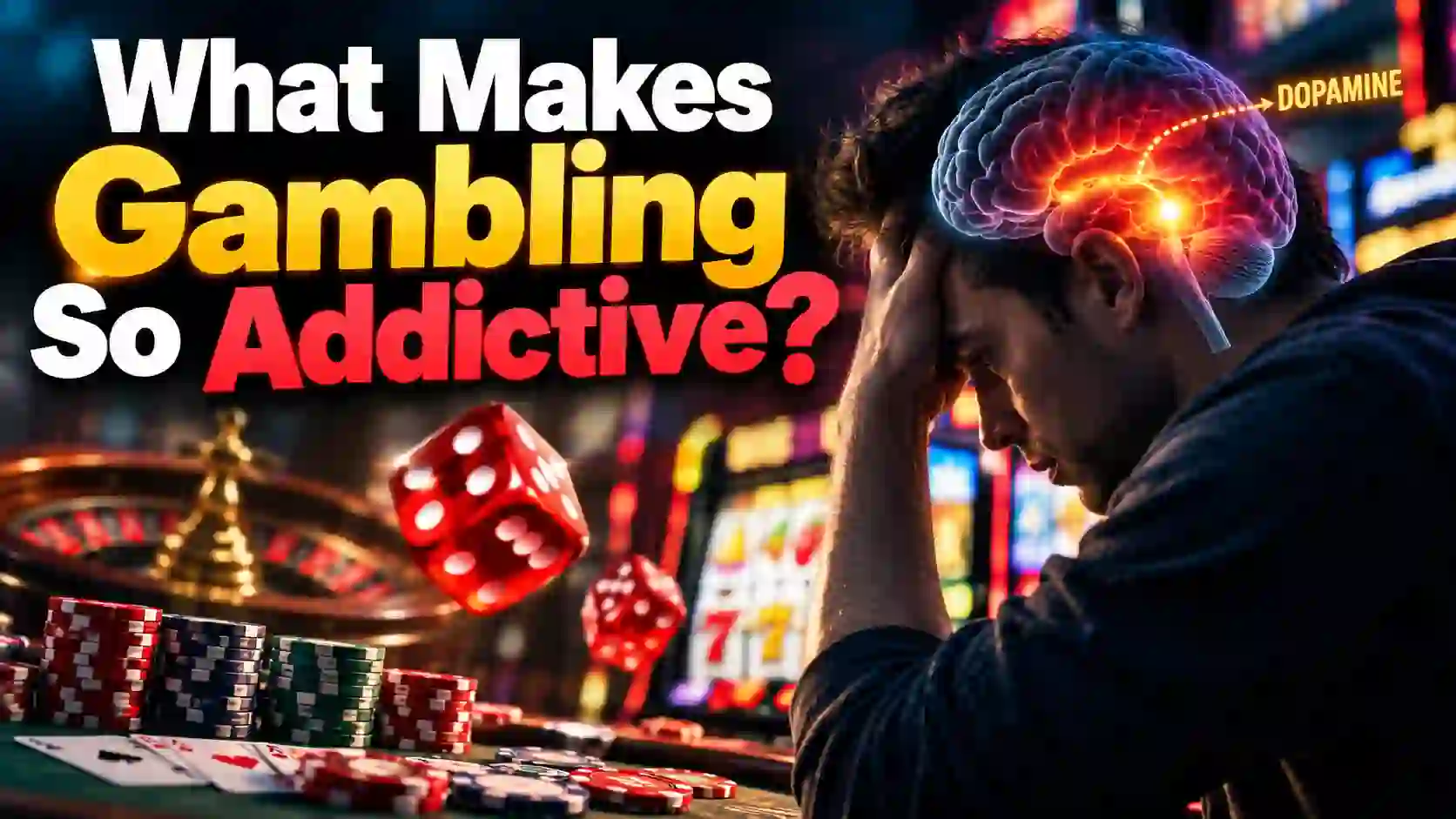
So, what makes gambling so addictive?
There is no single explanation. Gambling combines several unusually powerful psychological mechanisms: uncertain rewards, anticipation, risk, excitement, cognitive biases, easy access, and the temptation to recover previous losses. These mechanisms interact with the brain’s reward and learning systems and, in vulnerable individuals, can contribute to compulsive patterns of behaviour.
The World Health Organization recognizes gambling disorder as a disorder due to addictive behaviours. Under ICD-11, its central characteristics include impaired control over gambling, giving gambling increasing priority over other activities, and continuing despite negative consequences.
Understanding why gambling can become addictive requires looking beyond the simplistic idea that people are merely “chasing money.” Often, the process itself becomes the attraction.
Is Gambling Really an Addiction?
Yes. Gambling disorder is recognized by major medical classification systems as an addictive disorder, even though no drug or chemical has to be consumed.
That distinction is important.
Substance addictions involve an external substance such as alcohol, nicotine, or another drug. Gambling is a behavioural addiction. Yet research has identified meaningful similarities between gambling disorder and substance-use disorders, including patterns involving reward processing, decision-making, impaired control, continued behaviour despite consequences, and high rates of other mental health conditions.
This does not mean everyone who enjoys gambling is addicted. The WHO notes that many people gamble without developing significant health consequences. Gambling disorder occurs when the behaviour becomes persistent enough to cause meaningful distress or impairment.
The WHO’s 2024 gambling fact sheet estimated that around 1.2% of the world’s adult population has gambling disorder, while a wider group experiences gambling-related harm without necessarily meeting the diagnostic threshold for a disorder.
The question, therefore, is not simply whether gambling can be addictive. The more useful question is why a behaviour involving uncertain financial outcomes can become so compelling.
Unpredictable Rewards Can Make Gambling Hard to Stop
One of the most important answers to what makes gambling so addictive is uncertainty.
If every gambling attempt resulted in a predictable loss, the activity would quickly lose much of its appeal. Instead, gambling provides intermittent rewards. A person can lose several times, win unexpectedly, lose again, then experience another reward later.
Behavioural psychology describes many gambling activities as operating through random or variable patterns of reinforcement. The player does not know exactly when the next reward will arrive. Research into gambling behaviour has linked these unpredictable reinforcement patterns with persistent responding that can be difficult to extinguish.
Consider the difference between receiving £5 every time you press a button and receiving an unpredictable amount occasionally.
The first becomes boring because you know exactly what will happen. The second creates anticipation because every new attempt carries uncertainty.
That uncertainty matters.
The next spin could win. The next hand could change everything. The next football accumulator could come through. The next bet could supposedly recover the day’s losses.
Even after repeated losses, the possibility of the next reward remains.
This intermittent reinforcement is one reason gambling can remain psychologically compelling despite the fact that, over time, commercial gambling products are structured so that the operator retains an advantage.
Gambling Activates the Brain’s Reward-Learning Systems
Any explanation of why gambling is addictive eventually reaches dopamine, but dopamine is often described inaccurately.
It is sometimes called simply the brain’s “pleasure chemical.” In reality, its role is considerably more complicated. Dopamine is involved in motivation, learning, reinforcement, reward anticipation, and the processing of differences between expected and actual outcomes.
Research on gambling disorder has implicated the brain’s reward circuitry, including dopaminergic pathways involving areas such as the ventral striatum. Uncertain outcomes and reward-prediction errors appear to be particularly relevant to gambling-related learning. Researchers also emphasize that dopamine is only part of the picture; other neurotransmitter systems and brain regions involved in decision-making and behavioural control are relevant as well.
This helps explain an important feature of gambling: anticipation itself can become rewarding.
The excitement does not necessarily begin when a person wins. It may begin while waiting for the roulette ball to land, watching slot reels stop, following the final minutes of a sports match, or waiting for a card to turn.
For someone developing problematic gambling behaviour, those cues can become increasingly powerful.
Sounds, sports events, advertisements, casino imagery, betting apps, notifications, particular locations, payday, or even feelings such as boredom may become associated with gambling.
Eventually, the urge to gamble can appear before any money has been won.
Near-Misses Can Feel More Important Than Ordinary Losses
Imagine a slot machine displaying two jackpot symbols followed by a third symbol stopping just outside the winning position.
Financially, that is a loss.
Psychologically, however, it may not feel identical to an obvious losing combination.
This is known as the near-miss effect.
Research has found that near-miss outcomes can increase motivation to continue gambling in some settings, even though an “almost win” is still objectively a loss. A systematic review of electronic gaming-machine research found evidence that near-misses can encourage continued play, although their effects on emotions and betting behaviour vary. Other experimental research has challenged how consistently near-misses reinforce gambling responses, so the effect should not be treated as universal.
The broader psychological problem is that humans naturally search for patterns and meaning.
A player may interpret a near-miss as evidence that they are “getting closer,” even when each event is independent and the probability of the next outcome has not improved.
In a random game, almost winning does not necessarily mean an actual win is becoming more likely.
But emotionally, it can feel that way.
The Illusion of Control Changes How People Judge Chance
Gambling often creates a conflict between intellectual knowledge and emotional experience.
A person may know that roulette is governed by chance yet still prefer a particular number because it “feels lucky.” Someone playing a lottery may believe choosing their own numbers gives them a better chance than receiving randomly generated ones. A sports bettor may overestimate how much their knowledge can overcome uncertainty.
Psychologists refer to one aspect of this as the illusion of control: the tendency to behave as though personal choices, skills, rituals, or actions can influence outcomes that are largely or completely determined by chance.
The illusion of control has played a major role in decades of research into gambling-related cognitive distortions.
Other distortions can appear alongside it.
After several losses, someone might believe a win is “due.” After winning twice, they may believe they are on a hot streak. After narrowly losing, they may interpret the result as proof that their strategy is almost working.
These thoughts can make continued gambling feel rational even when the underlying probabilities have not changed.
Chasing Losses Creates a Dangerous Psychological Loop
Perhaps one of the most destructive characteristics of problematic gambling is chasing losses.
A gambler loses £50 and decides to continue until they win it back.
The loss becomes £150.
Now stopping feels even more difficult because walking away means accepting a larger loss. Another bet seems capable of solving the problem created by the previous bets.
This creates a powerful feedback loop.
Research on gambling disorder identifies loss chasing as an important gambling-related behaviour, while the NHS includes trying to win back lost money among the warning signs used when assessing gambling-related harm.
The underlying psychological problem is that people do not always treat gains and losses equally.
Losses can feel especially painful. Instead of thinking, “I have already lost this money, so my next decision should be independent,” a person may think, “I cannot stop until I recover it.”
But the next wager does not erase the probability or cost of the previous one.
A gambling session that began as entertainment can consequently transform into an urgent attempt to repair financial damage.
And urgency tends to produce worse decisions.
Winning Can Build Confidence That Outlasts the Money
Early or memorable wins can have a disproportionate psychological impact.
A large win creates a powerful story: “This can happen.”
After the money has been spent or lost, the memory remains.
People naturally remember emotionally significant events. A dramatic £1,000 win is more memorable than dozens of routine £10 or £20 losses, particularly when those losses occur gradually.
Wins can also encourage people to attribute success to skill while treating losses as bad luck.
This selective interpretation can reinforce confidence.
The result is not necessarily a conscious belief that gambling guarantees profits. Instead, someone may develop a persistent feeling that another major win is achievable if they keep playing long enough.
That feeling can matter more than a spreadsheet showing their actual lifetime losses.
Gambling Can Become an Escape From Stress or Difficult Emotions
Not everyone gambles primarily for money.
For some people, gambling temporarily changes how they feel.
The concentration, stimulation, uncertainty, and rapid decision-making involved can push everyday worries into the background. Someone who feels stressed, lonely, anxious, bored, frustrated, or emotionally overwhelmed may discover that gambling provides temporary psychological escape.
That relief can itself reinforce the behaviour.
The person is no longer gambling solely because winning feels good. They may also be gambling because not gambling means returning to uncomfortable thoughts or emotions.
Research shows substantial overlap between gambling disorder and other mental health conditions, including mood, anxiety, alcohol-use, and substance-use disorders. However, the relationship is complex: in some people another condition precedes gambling problems, while in others problematic gambling may occur earlier or contribute to worsening mental health. Association should therefore not be mistaken for a simple one-way cause.
This emotional dimension is one reason telling someone to “just stop betting” can misunderstand the problem.
If gambling has become someone’s primary coping strategy, stopping the behaviour without addressing the reason they rely on it can leave a significant psychological gap.
Online Gambling Has Removed Many Natural Barriers
Historically, gambling often required effort.
A person might have needed to travel to a casino, bookmaker, bingo hall, or racetrack. Opening hours, physical distance, and social circumstances created natural interruptions.
Smartphones have changed that environment.
Online gambling can make wagering available around the clock from a device people already carry everywhere.
The WHO identifies easy accessibility, digitization, high-speed wagering, and widespread promotion as important elements in the modern gambling environment. It notes that online products can be accessible almost anywhere and at almost any time.
This matters because friction can protect behaviour.
If acting on an impulse requires a 30-minute journey, there is time for the impulse to pass. If acting on it requires opening an app and tapping a screen, that protective delay largely disappears.
Digital gambling can also make money feel less tangible.
Cash physically leaves your hand. Digital balances, cards, stored payment methods, and instant deposits can make spending psychologically easier to separate from real-world money.
Meanwhile, faster games shorten the time between one outcome and the next.
The opportunity to repeat the behaviour increases dramatically.
Gambling Products Can Combine Multiple Psychological Stimuli
Modern gambling is not simply a financial transaction.
Many products include visual effects, sound, animation, rapid feedback, celebratory displays, progress indicators, and other features designed to create an engaging experience.
One particularly interesting phenomenon is a “loss disguised as a win.”
On some electronic gambling products, a player may receive a payout smaller than their original stake. Economically they have lost money, yet the machine may still provide audiovisual feedback associated with winning.
Research reviewing electronic gaming machines found that these outcomes can contribute to players overestimating how much they are actually winning.
For example, imagine staking £2 and receiving £1 back.
The account balance has fallen by £1.
But if the screen flashes and a celebratory sound plays, the event may feel more positive than an ordinary £1 loss.
Individually these details may seem minor. Repeated thousands of times, however, product design can influence how outcomes are perceived and remembered.
Gambling Can Escalate Gradually
Gambling problems do not always appear dramatically.
A person may begin with small occasional bets, then gamble more frequently. Over time, larger amounts may be needed to produce the same excitement.
The NHS specifically asks people concerned about gambling whether they need to gamble with larger amounts of money to achieve the same feeling, whether they have attempted to chase losses, and whether gambling has caused financial, health, or relationship problems.
The gradual nature of the progression can make it difficult to notice.
Each individual increase may seem reasonable:
£5 becomes £10.
Weekend gambling becomes several nights each week.
One betting account becomes four.
A small deposit becomes money intended for something else.
By the time the consequences become obvious, the person’s routines, emotions, finances, and reward expectations may have become deeply connected to gambling.
Why Do Some People Become Addicted While Others Do Not?
There is no single “gambling personality.”
Risk emerges from an interaction between the individual, their environment, their mental health, their financial circumstances, and the characteristics of the gambling products they use.
Systematic research has identified several factors associated with greater risk, while studies also show substantial variation between individuals.
Current Gambling Commission research similarly demonstrates that gambling-related harm is not distributed equally across the population. Recent British data have found differences by age, income, gender and other characteristics, while further analysis suggests that the types of gambling activities people participate in explain some—but not all—of these differences.
This is important because addiction should not be reduced to a failure of willpower.
Two people can encounter the same gambling product and respond differently because their psychological vulnerabilities, previous experiences, stress levels, social environments, financial situations, and patterns of play differ.
Product characteristics matter too. A monthly lottery ticket is behaviourally different from a rapid gambling product that allows repeated wagering within minutes or seconds.
What Are the Warning Signs of Gambling Addiction?
The clearest warning sign is not simply how much somebody gambles. It is whether control is being lost and whether gambling continues despite harm.
Possible warning signs include becoming preoccupied with gambling, increasing the amount of money risked, repeatedly trying and failing to cut down, chasing previous losses, borrowing or selling possessions to fund gambling, hiding gambling from other people, neglecting responsibilities, and continuing despite financial, relationship, occupational, or mental-health consequences.
The WHO’s ICD-11 framework emphasizes three central features: impaired control, increasing priority given to gambling, and continuation despite negative consequences.
Someone does not need to lose everything before gambling becomes a legitimate concern.
The UK Gambling Commission distinguishes between clinical or high-severity gambling problems and the wider concept of gambling-related harm, which can affect finances, relationships, physical health, mental health, employment, families, and communities.
Recognizing problems earlier can therefore be important.
Can Gambling Addiction Be Treated?
Yes. Gambling disorder is treatable.
Psychological treatment is an important part of care, particularly approaches that address behaviour, gambling-related beliefs, triggers, emotional regulation, and motivation for change.
Research reviews have found evidence supporting cognitive behavioural therapy (CBT) for reducing gambling symptoms, while motivational approaches and other psychological interventions may also be useful depending on the person and circumstances. Evidence varies across treatments, and long-term outcomes remain an important area of research.
Treatment may involve more than therapy.
Practical barriers can be extremely valuable because they reduce the opportunity to act on an urge. These can include self-exclusion, gambling-blocking software, financial transaction blocks offered by banks, handing financial control temporarily to a trusted person where appropriate, and getting professional help with gambling-related debt.
The NHS recommends measures including self-exclusion tools, blocking gambling websites and apps, asking banks about gambling-payment blocks, protecting essential household payments, and seeking specialist treatment when gambling is causing harm.
Recovery is not simply about resisting temptation forever. Effective support can help change the environment around gambling while also addressing the psychological processes that made gambling compelling in the first place.
FAQs
Why is gambling addictive even when you keep losing?
Repeated losses do not automatically eliminate the desire to gamble because gambling provides more than financial rewards. Anticipation, uncertainty, occasional wins, near-misses, emotional escape, and the belief that losses can be recovered may all encourage continued play. Unpredictable reinforcement can make the behaviour especially persistent.
Does gambling release dopamine?
Gambling is associated with activity in brain systems involving dopamine and reward learning. However, describing gambling addiction as simply a “dopamine rush” is misleading. Dopamine participates in motivation, reinforcement and learning from uncertain outcomes, while several other brain systems and psychological processes are involved.
What type of gambling is most addictive?
There is no product that will be equally addictive for every person. However, research and public-health guidance associate high-intensity products and rapid forms of gambling with greater potential for harm. Features such as fast repetition, immediate feedback, continuous availability and repeated opportunities to stake money can increase exposure.
Why do gamblers chase their losses?
Accepting a financial loss can be psychologically difficult. Continuing to gamble may feel like a way to reverse what has happened, turning another wager into an attempted solution to the previous loss. Unfortunately, further gambling can deepen the original financial damage rather than repair it.
Can you become addicted to gambling without gambling every day?
Yes. Frequency alone does not determine whether someone has gambling disorder. Loss of control, priority given to gambling, and continuing despite negative consequences are more clinically meaningful indicators. Someone can experience serious gambling-related harm without gambling every day.
Final Thoughts
So, what makes gambling so addictive?
The answer is not one chemical, one personality trait, or one bad decision.
Gambling combines uncertain rewards with anticipation, risk, intermittent reinforcement and emotionally powerful wins. Cognitive biases can make random events appear meaningful. Near-misses can make losing feel surprisingly close to winning. Chasing losses turns previous damage into a reason to continue. For some people, gambling also becomes a way to escape stress, anxiety, loneliness or other uncomfortable emotions.
Modern technology can intensify these mechanisms by making gambling faster, easier to access, and available almost continuously.
Most importantly, gambling disorder is a recognized health condition—not simply evidence that somebody lacks discipline. The WHO classifies it as a disorder due to addictive behaviours, and professional treatment and practical support are available.
Understanding the psychology behind gambling does not remove every risk, but it does expose an important truth: the attraction of gambling is often created by the interaction between uncertainty, learning, emotion, product design and human decision-making.
And once those mechanisms are understood, the seemingly irrational question—“Why would someone keep gambling when they are losing?”—becomes much easier to answer.
ADVERTISEMENT

18+ | Affiliate link | Terms apply | Please gamble responsibly.


