

18+ | Affiliate link | Terms apply | Please gamble responsibly.
Last Updated on October 1, 2026 by Maurya
Online gambling feels like an established part of the modern internet, but its history is surprisingly short. In little more than three decades, the sector has developed from primitive downloadable casino software and experimental payment systems into a global digital industry offering casino games, poker, sports betting, lotteries and live-dealer experiences across computers and smartphones.
The history of online gambling is not simply a story about putting traditional casino games on the internet. Its development has been shaped by advances in encryption, payment technology, mobile devices, regulation, identity verification and consumer-protection standards.
Several milestones stand out: the emergence of commercial internet gambling in the mid-1990s, the rise of online poker in the early 2000s, major regulatory changes in Europe and the United States, the smartphone revolution, and today’s shift toward increasingly sophisticated regulated platforms.
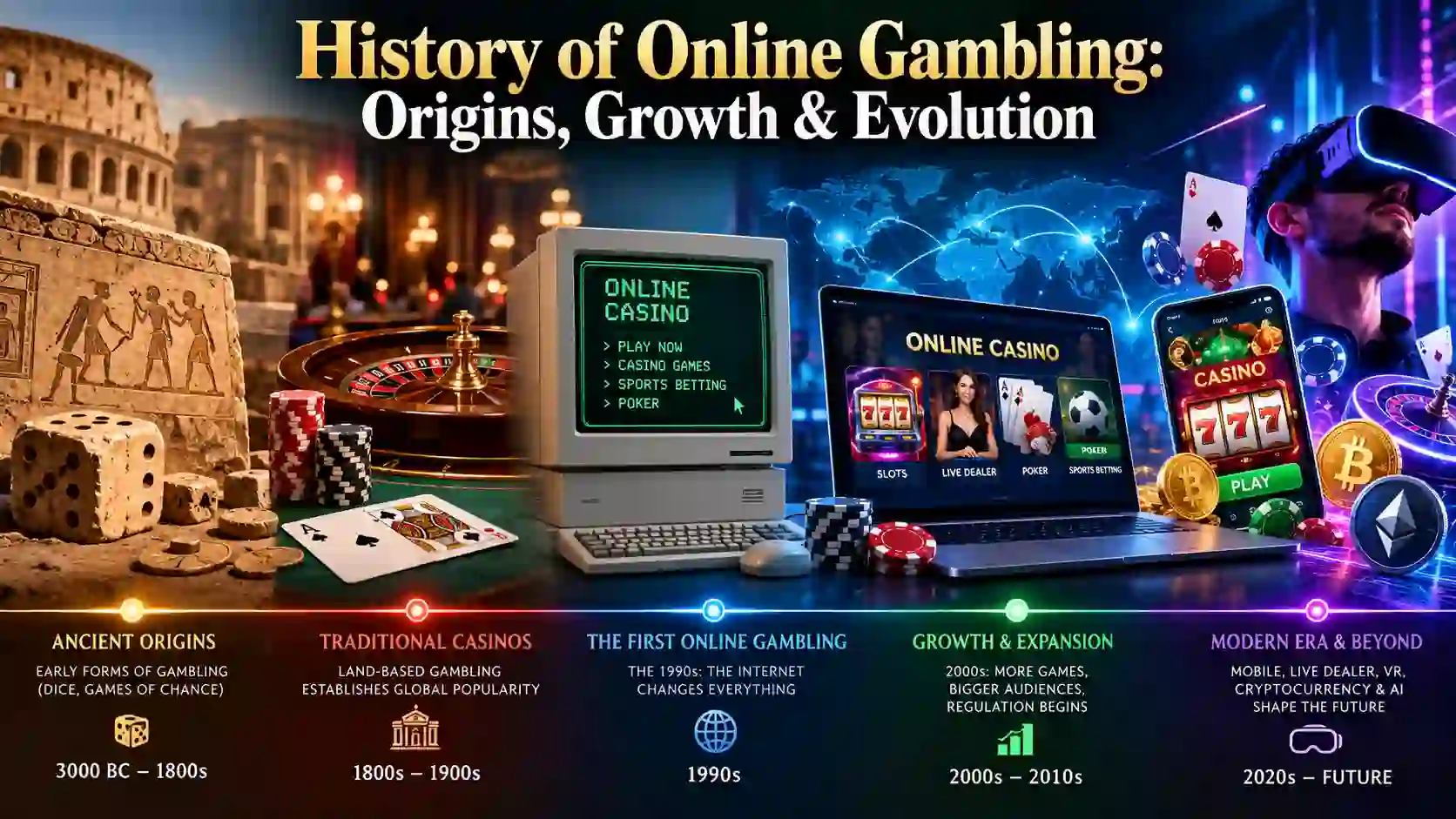
Here is how online gambling developed from an internet experiment into what is commonly known today as iGaming.
The Origins of Online Gambling
Before internet gambling existed, people could already gamble remotely in certain circumstances. Telephone betting, for example, allowed customers to place wagers without visiting a physical bookmaker.
Modern regulators still use the broader term remote gambling for gambling conducted through technology. Britain’s Gambling Commission defines remote gambling as participation using methods including the internet, telephone, television, radio or other forms of remote communication.
Online gambling, however, required something more complicated.
For a genuine internet casino or sportsbook to operate commercially, several pieces had to come together:
- widespread consumer access to the internet;
- gambling software capable of reproducing casino games digitally;
- secure communication and payment technology;
- servers capable of handling wagers and account balances;
- and jurisdictions willing to license or regulate operators.
Those conditions began to emerge during the first half of the 1990s.
1994: A Crucial Year for Internet Gambling
One of the most frequently cited starting points in the history of internet gambling is 1994.
That year, Antigua and Barbuda introduced its Free Trade and Processing Zone Act. The legislation established a free-trade and processing zone and gave its commission authority to issue licences to approved businesses operating within it. The framework subsequently became closely associated with the emergence of offshore internet gambling businesses.
At approximately the same time, software developers were experimenting with ways to deliver casino-style games through computers and the internet.
This combination was important. Software alone could create a virtual blackjack table or slot machine, but commercial online gambling also needed a practical legal structure and a way to move money securely between players and operators.
That second challenge—secure online payments—became one of the defining technological problems of the industry’s early years.
1995–1996: Real-Money Online Casinos Begin to Appear
By the middle of the 1990s, developers were building encryption, electronic-cash and client-server systems that could support real-money gambling.
InterCasino became one of the best-known names from this pioneering period.
A contemporary report published in September 1996 described InterCasino preparing to open for real-money wagering using technology developed by CryptoLogic. The system included casino games such as blackjack, roulette, slots, video poker and Caribbean Stud, while its operations were based in Antigua.
InterCasino is widely credited with accepting one of the first—and often described as the first fully integrated—real-money online casino wagers. However, claims surrounding the exact “first online casino” remain disputed because several businesses were experimenting with online games and remote payment arrangements during roughly the same period.
That distinction matters when discussing the history of online casinos. There was no single moment when every component of modern internet gambling suddenly appeared. Instead, gambling software, online payments, licensing and internet connectivity developed alongside one another.
By 1996, though, the basic online casino model had clearly arrived: a player could connect remotely, establish an account, deposit money, play digital casino games and potentially withdraw winnings.
That model remains the foundation of online casinos today.
Early Online Sports Betting and Poker
Casinos were only one part of the developing online gambling market.
Sportsbooks also recognised the internet’s potential. Traditional telephone betting companies began publishing odds online and gradually developed systems capable of accepting wagers digitally.
Poker followed.
Internet poker was particularly significant because it demonstrated one of the internet’s greatest advantages over physical gambling venues: global player liquidity.
Instead of requiring several people to gather around the same physical table, online poker software could connect players from different locations in real time. As broadband access improved, operators could support growing numbers of tables, tournaments and players simultaneously.
That capability would soon produce one of online gambling’s most important growth periods.
1996–1999: Regulation Begins Catching Up
As online operators multiplied, regulators faced a new challenge.
Traditional gambling laws had generally been written around physical casinos, racetracks, lotteries and bookmakers. Internet gambling ignored geographical boundaries. A company might have servers in one jurisdiction, a licence in another and customers located across dozens of countries.
New regulatory systems began to emerge in response.
The Kahnawà Gaming Commission was established in 1996 under the Kahnawake Gaming Law. In July 1999, it enacted its Regulations Concerning Interactive Gaming and began continuously licensing and regulating online gaming.
The development was important because online gambling increasingly required more than technical functionality. Operators also needed frameworks addressing issues such as game integrity, operator suitability and eventually player protection, anti-money-laundering controls and dispute handling.
This marked the beginning of the transition from the largely experimental internet gambling environment of the 1990s toward the more formalised regulated iGaming industry.
2000–2005: Online Gambling Enters a Major Growth Phase
The early 2000s dramatically accelerated the evolution of online gambling.
Internet access became faster. Home computers became more powerful. Digital payments improved. Online advertising expanded. Casino software became more visually sophisticated.
At the same time, online poker exploded in popularity.
The “Moneymaker Effect”
Few events illustrate the impact of online gambling better than the 2003 World Series of Poker Main Event.
Chris Moneymaker, then a recreational player, qualified for the $10,000 Main Event through an $86 online satellite tournament. He went on to win the championship and $2.5 million.
The World Series of Poker itself credits his victory with helping trigger the early-2000s “Poker Boom.” In 2004, Main Event participation surged past 2,000 entries after attracting 839 players the previous year.
For online poker companies, the story was extraordinarily powerful.
It demonstrated that an ordinary internet player could qualify online for one of poker’s most prestigious live tournaments and ultimately win it.
Online poker traffic expanded, televised poker grew in popularity, and poker websites became some of the most recognisable brands in internet gambling.
Europe Builds Formal Online Gambling Regulation
Another major development occurred in Europe.
Malta introduced its Remote Gaming Regulations in 2004. According to the Malta Gaming Authority, Malta became the first EU member state to introduce a dedicated remote-gaming regulatory framework of this kind.
Britain followed with the Gambling Act 2005, which established a broader modern framework for gambling regulation that explicitly recognised remote gambling.
Today, businesses providing remote gambling to consumers in Great Britain require a Gambling Commission licence, including overseas companies offering their services to British players.
These frameworks signalled an important change in the industry’s development.
Governments were increasingly moving away from treating internet gambling as an unusual technical loophole and toward regulating it as a distinct commercial activity requiring licensing, technical standards and consumer safeguards.
2006: The U.S. Market Changes Direction
The United States followed a very different path.
On October 13, 2006, the United States enacted the Unlawful Internet Gambling Enforcement Act (UIGEA).
The law focused heavily on financial transactions. As described by the U.S. Department of Justice, it made it a federal offence for gambling businesses to knowingly accept many forms of payment connected with unlawful internet gambling. A number of operators subsequently withdrew from the U.S. market.
The result was a major reshaping of online gambling in America.
Some companies exited. Others continued serving U.S. players. Payment processing became more difficult, and the legal environment grew increasingly complex.
Those tensions would eventually culminate in one of the most famous events in online poker history.
2011: Online Poker’s “Black Friday”
On April 15, 2011, U.S. authorities unsealed charges connected with PokerStars, Full Tilt Poker and Absolute Poker, three major online poker businesses serving American customers.
The event became known throughout the poker community as Black Friday.
The legal actions affected payment processing, domain names and access to player funds. Subsequent proceedings also exposed serious problems involving Full Tilt Poker’s management of customer money. U.S. authorities later established processes intended to compensate eligible affected players.
Black Friday became a turning point because it highlighted several issues that remain central to online gambling regulation today:
Licensing matters. Players need to know which authority supervises an operator.
Segregation and protection of customer funds matter. A balance displayed on a website must correspond to money that can actually be returned to the customer.
Payment processing matters. Gambling businesses depend on legitimate relationships with banks and payment providers.
Jurisdiction matters. The fact that a website is accessible from a country does not necessarily mean the operator is legally permitted to serve customers there.
These lessons helped shape later regulated markets.
2010s: The Smartphone Transforms Online Gambling
If desktop computers created online gambling, smartphones made it truly portable.
The transition changed how gambling products were designed.
Early online casinos frequently required players to download dedicated desktop software. Modern mobile platforms instead allowed people to access games through responsive websites and native apps.
Data from Britain’s Gambling Commission illustrates how significant that transition became. In 2019, 50% of online gamblers surveyed said they used a mobile phone to gamble, up from 44% in 2018. By 2021, the Commission reported mobile usage among online gamblers at 60%.
Mobile technology also changed sports betting.
Rather than placing a wager before leaving home, bettors could access markets during sporting events. Live statistics, instant account updates and in-play betting became central features of many sportsbooks.
A 2020 Gambling Commission survey found mobile phones were particularly important for in-play betting, with 74% of surveyed in-play bettors reporting that they had used a mobile phone to gamble.
The defining feature of this period was no longer simply internet access. It was continuous access.
State-Regulated iGaming Returns in the United States
The 2010s also saw regulated online casino gaming return to parts of the United States through individual state frameworks.
Delaware launched casino-style internet gaming in November 2013, offering games including poker, blackjack and roulette through regulated operators. The Delaware Lottery describes it as the first U.S. state to launch a comprehensive state-authorised iGaming system.
New Jersey also launched regulated internet gaming in November 2013 after legislation was signed earlier that year.
These systems introduced features now closely associated with regulated U.S. gambling, including:
- identity verification;
- age verification;
- geolocation technology;
- approved gaming platforms;
- regulatory testing;
- responsible-gambling controls;
- and formal operator licensing.
New Jersey’s market also became an important testing ground for newer formats. Its Casino Control Commission records that a U.S. online live-dealer studio opened in the state in 2016.
Meanwhile, the U.S. Supreme Court’s 2018 decision in Murphy v. NCAA struck down the federal law that had broadly prevented states from authorising sports betting. The ruling dealt specifically with sports wagering rather than online casino gambling, but it helped accelerate the development of regulated sports-betting markets across numerous states.
The Rise of Live-Dealer Casinos
One limitation of early internet casinos was that everything happened through computer-generated graphics.
Live-dealer technology changed that.
Instead of relying entirely on software simulations, live casinos use video streams showing real dealers operating games such as blackjack, baccarat and roulette. Players place their bets digitally while watching the physical game unfold through the interface.
The format helped blur the distinction between land-based and online gambling.
Today’s platforms may combine digital slots, computer-generated table games, live studios and sports betting under a single account.
That convergence is one of the clearest examples of how far the evolution of online gambling has progressed since the downloadable casino programs of the 1990s.
Regulation Becomes More Sophisticated
The first generation of online-gambling regulation focused heavily on whether an operator could legally offer gambling.
Modern regulation goes much further.
Regulated operators may have obligations covering areas such as:
- identity and age verification;
- anti-money-laundering checks;
- game testing and random-number generation;
- cybersecurity;
- advertising standards;
- protection of customer funds;
- self-exclusion systems;
- complaints and dispute procedures;
- gambling-harm prevention;
- and monitoring of customer behaviour.
Britain’s Gambling Commission, for example, maintains dedicated Remote Gambling and Software Technical Standards covering regulated remote gambling systems and software. Those standards continue to be updated as technology and regulatory expectations change.
Kahnawà has similarly expanded its framework over time, including dedicated anti-money-laundering and counter-terrorism-financing regulations introduced in 2021.
Online gambling’s history is therefore also a history of regulatory maturation.
The sector moved from an environment in which simply making a casino work online was an achievement to one where regulated operators may need complex compliance, security and player-protection infrastructure.
Online Gambling in the 2020s
Modern online gambling looks very different from its 1990s predecessor.
Players can now encounter:
Mobile-first platforms designed primarily for smartphones rather than desktop PCs.
Live casino studios combining physical dealers with digital interfaces.
In-play sports betting with markets updating throughout an event.
Instant payment systems that can process deposits far more quickly than early internet payment methods.
Advanced geolocation that helps regulated operators determine whether a customer is physically inside an authorised jurisdiction.
Integrated identity verification designed to confirm age and customer identity.
Responsible-gambling technology including deposit limits, self-exclusion options and behavioural monitoring.
Cross-platform accounts that may combine sportsbook, casino, poker and other products.
This technological sophistication brings benefits for regulated businesses and consumers, but it also creates challenges. Faster access and round-the-clock availability can increase gambling exposure, making responsible-gambling safeguards an increasingly important part of regulation.
For that reason, the evolution of online gambling cannot be measured only by faster software or more realistic graphics. Consumer protection has become an increasingly important measure of how mature a regulated market really is.
Online Gambling History Timeline
Here is a simplified timeline of some of the most important milestones:
1994: Antigua and Barbuda passes the Free Trade and Processing Zone Act, creating a licensing framework later associated with early internet gambling businesses.
Mid-1990s: Gambling software, encryption and electronic-payment technologies begin converging to make commercial internet wagering practical.
1996: InterCasino becomes one of the earliest fully developed real-money online casino operations.
1996: The Kahnawà Gaming Commission is established.
1999: Kahnawà introduces Regulations Concerning Interactive Gaming and begins licensing online gaming under that framework.
Early 2000s: Online poker grows rapidly as broadband access and multiplayer gambling software improve.
2003: Online qualifier Chris Moneymaker wins the WSOP Main Event, helping trigger the poker boom.
2004: Malta introduces a dedicated remote-gaming regulatory framework.
2005: Britain’s Gambling Act formally establishes a modern framework covering remote gambling.
2006: The United States enacts UIGEA, dramatically altering payment processing and the U.S. internet gambling market.
2011: U.S. authorities take action against several major online poker companies in the event known as Black Friday.
2013: Delaware and New Jersey launch regulated online casino gaming.
2010s: Smartphones become a dominant method of accessing online gambling.
2018: The U.S. Supreme Court overturns PASPA’s restrictions on state-authorised sports betting, accelerating the expansion of regulated sports wagering.
2020s: Mobile-first platforms, live dealers, advanced verification, geolocation and increasingly detailed responsible-gambling requirements define mature regulated markets.
What Comes Next for Online Gambling?
Predicting the exact future of online gambling is difficult because regulation varies significantly by country and can change quickly.
Technology, however, will almost certainly remain central.
Artificial intelligence may increasingly be used for fraud detection, customer verification and the identification of potentially risky gambling behaviour. Streaming improvements could make live casino products more immersive. Payment technology will continue evolving, while regulators are likely to place greater emphasis on data protection, affordability, marketing practices and harm prevention.
What seems unlikely is a return to the relatively unstructured environment of the 1990s.
Online gambling is no longer simply a technological experiment. In mature regulated markets, it sits at the intersection of entertainment technology, financial services, cybersecurity, consumer protection and gambling law.
That is perhaps the biggest change in its entire history.
FAQs
When did online gambling begin?
Commercial online gambling began emerging during the mid-1990s. Several companies experimented with internet casino games and remote wagering systems during this period, with real-money operations becoming practical around 1995–1996 as gambling software and secure payment technology improved.
What was the first online casino?
The answer is disputed because early operators used different definitions of what constituted a fully online casino. InterCasino, launched commercially in 1996 using CryptoLogic technology, is widely credited as one of the first fully integrated real-money online casinos. Contemporary reporting confirms it was preparing to offer real wagering from Antigua in September 1996.
Why was 1994 important in online gambling history?
Antigua and Barbuda passed its Free Trade and Processing Zone Act in 1994. The legislation established a framework that allowed approved businesses to be licensed within its free-trade zone and later became closely connected with early offshore internet-gambling operations.
When did online poker become popular?
Online poker existed before 2003, but its popularity accelerated dramatically during the early 2000s. Chris Moneymaker’s victory in the 2003 World Series of Poker Main Event after qualifying through an online satellite became a defining moment in the poker boom.
When did mobile gambling become popular?
Mobile gambling grew rapidly during the 2010s as smartphone ownership increased and gambling platforms adopted mobile-responsive websites and apps. By 2019, the British Gambling Commission reported that mobile phones had become the most popular device among surveyed online gamblers.
How has online gambling changed since the 1990s?
Early gambling sites offered relatively simple games through basic websites or downloadable software. Modern regulated platforms may offer thousands of games, live dealers, mobile apps, in-play sports betting, instant payments, identity checks, geolocation and responsible-gambling tools.
Regulation has evolved just as significantly. Licensing authorities increasingly impose detailed technical, financial, security and consumer-protection requirements on operators.
Final Thoughts
The history of online gambling is ultimately the story of several technologies developing at the same time.
The internet supplied connectivity. Software recreated casino games digitally. Encryption and electronic payments made real-money transactions possible. Smartphones removed the need to sit at a computer. Streaming brought live dealers onto screens. Regulators gradually created rules for an industry that could cross national borders almost instantly.
From experimental casino software in the mid-1990s to today’s mobile-first regulated platforms, online gambling has changed enormously in roughly three decades.
Yet its basic challenge remains the same: combining technology, money and gambling in a way that users can trust and regulators can effectively oversee.
As new technology continues to reshape the sector, the next stage in the evolution of online gambling is likely to be defined not simply by what platforms can offer, but by how securely, transparently and responsibly they offer it.
Responsible Gambling: Gambling involves financial risk and should be treated as paid entertainment rather than a way to earn money. Laws and minimum gambling ages vary by jurisdiction. Users should check local regulations and use licensed services where online gambling is permitted.
ADVERTISEMENT

18+ | Affiliate link | Terms apply | Please gamble responsibly.


