

18+ | Affiliate link | Terms apply | Please gamble responsibly.
Last Updated on September 27, 2026 by Maurya
The online gambling industry has always been closely connected to technological innovation. From the early browser-based casinos of the 1990s to mobile betting apps, live dealer games, instant payments and sophisticated digital sportsbooks, technology has continually changed how gambling platforms operate and how players interact with them.
Today, however, the pace of change is accelerating.
Artificial intelligence, machine learning, blockchain, cloud computing, augmented and virtual reality, advanced identity verification, biometrics and increasingly sophisticated cybersecurity systems are reshaping almost every layer of the online gambling ecosystem.
Importantly, the transformation is not limited to creating more visually impressive casino games. Emerging technologies are also being applied to fraud detection, regulatory compliance, age verification, responsible gambling, payment processing, customer support and data protection.
For operators, this creates opportunities to improve efficiency and security. For regulators, the same technologies introduce questions surrounding privacy, transparency and consumer protection. And for players, they can produce faster and more personalized digital experiences—but also make understanding how gambling platforms use data increasingly important.
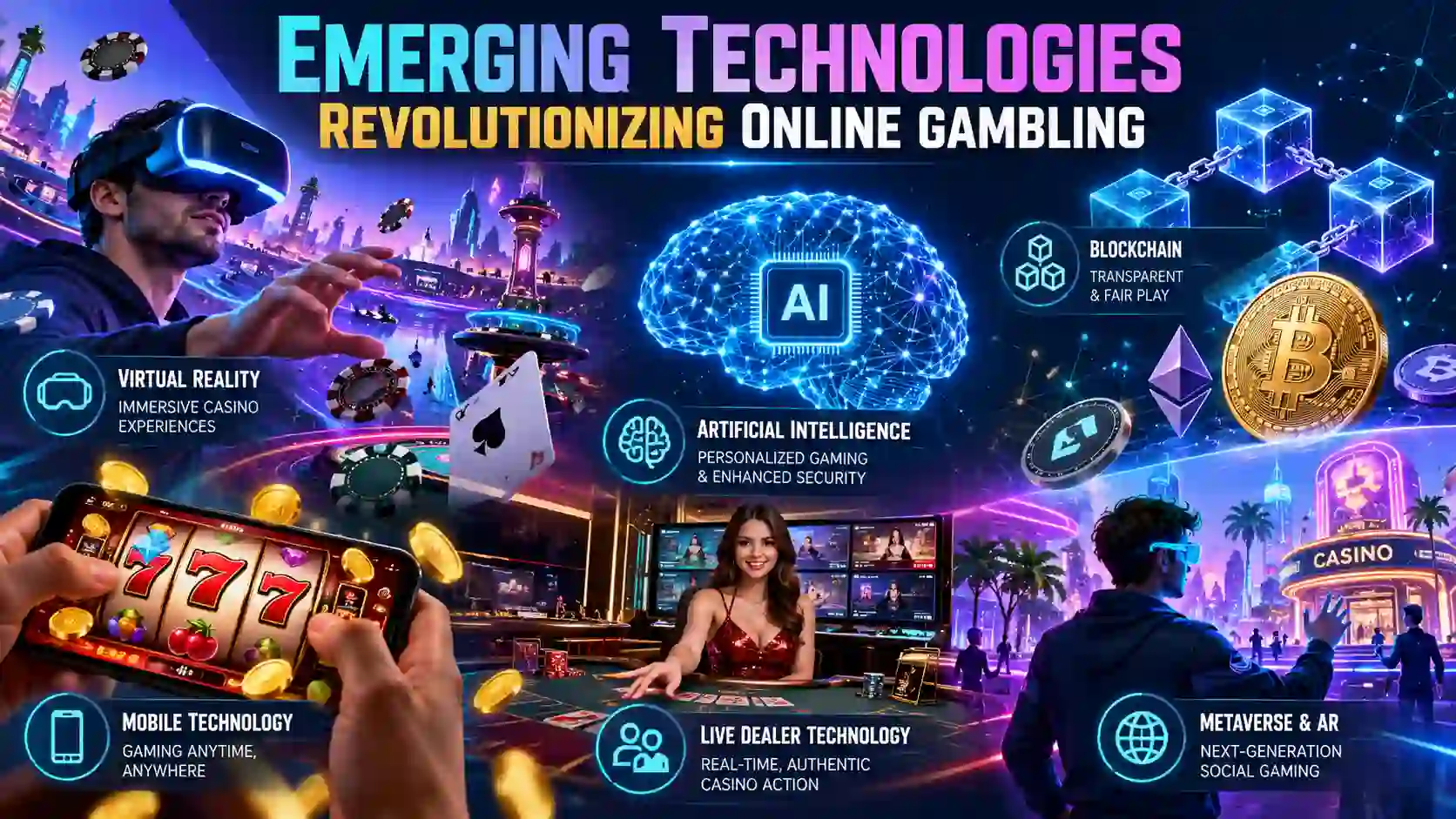
Here is a closer look at the emerging technologies revolutionizing online gambling and what they could mean for the future of the industry.
Artificial Intelligence Is Changing Online Gambling
Artificial intelligence is arguably one of the most significant technologies influencing the modern online gambling industry.
Online platforms generate enormous amounts of behavioral and transactional data. AI and machine-learning systems can analyze this information far faster than traditional manual processes.
This gives operators the ability to identify patterns, automate routine processes and respond to unusual activity in near real time.
AI-powered personalization
One obvious application is personalization.
Machine-learning systems can analyze factors such as:
- games previously played;
- preferred game categories;
- browsing behavior;
- session activity; and
- interactions with platform features.
The platform can then organize content or recommendations according to observed preferences.
Similar recommendation technologies are already widely used by streaming platforms, online retailers and social networks. Within gambling, however, personalization requires additional safeguards because gambling products carry financial and behavioral risks.
Responsible use therefore requires operators to balance convenience with consumer protection rather than simply optimizing engagement.
AI and responsible gambling
Perhaps the more important application of artificial intelligence is identifying potentially harmful gambling behavior.
Machine-learning models can examine combinations of behavioral indicators that may be difficult to recognize manually across millions of transactions.
These might include substantial changes in spending, unusually long sessions, rapid increases in deposits, changing gambling patterns or repeated use of account-management tools.
A 2026 systematic review published in Acta Psychologica found that advanced technologies including AI and data-driven models can contribute to real-time monitoring, pattern recognition and earlier identification of potentially problematic gambling behavior.
This approach is also increasingly relevant from a regulatory perspective.
The UK Gambling Commission requires remote operators to monitor multiple indicators of potential gambling harm, including customer spending, patterns of spending, time spent gambling, behavioral indicators and account activity. Its guidance specifically recognizes the role of automated processes where quick intervention is necessary.
AI therefore has the potential to become both a commercial technology and an important responsible gambling tool.
That does not mean automated systems should operate without oversight. Regulators increasingly emphasize accountability, human review and consumers’ ability to challenge consequential automated decisions. The UK Gambling Commission, for example, requires manual review where certain automated customer-protection processes are applied.
Machine Learning Is Strengthening Fraud Detection
Fraud has always been a major concern for digital gambling businesses.
Platforms can face threats involving:
- account takeover;
- stolen payment details;
- multiple fraudulent accounts;
- identity manipulation;
- bonus abuse;
- suspicious transaction patterns; and
- collusion between users.
Traditional fraud systems largely depend on predefined rules. If a transaction meets a particular condition, it is flagged.
Machine learning makes fraud detection more dynamic.
Instead of relying entirely on fixed rules, algorithms can evaluate large volumes of historical activity and identify patterns associated with legitimate or suspicious behavior.
This can help security teams prioritize unusual transactions and investigate them more efficiently.
The technology will become particularly important as fraud itself becomes more technologically advanced.
In its July 2026 assessment of money-laundering and terrorist-financing risks in the British gambling sector, the UK Gambling Commission highlighted challenges created by developments such as AI-generated fake identities, manipulated identification documents, advanced automation and rapidly evolving digital payment methods.
The result is something of a technological arms race: criminals gain access to more sophisticated tools, while regulated gambling businesses increasingly depend on advanced technology to detect them.
Blockchain Is Creating New Models of Transparency
Few technologies have generated as much debate in online gambling as blockchain.
A blockchain is essentially a distributed digital ledger in which records can be stored across a network. Once properly recorded, transactions are difficult to alter without detection.
For gambling platforms, potential blockchain applications extend beyond cryptocurrency payments.
They can include:
- transparent transaction records;
- verification of certain game outcomes;
- smart-contract-based processes;
- digital asset management; and
- auditable records between businesses.
Provably fair gaming
One frequently discussed concept is provably fair gambling.
Rather than asking users simply to trust that a game result was generated fairly, cryptographic systems can allow certain results to be independently verified.
This is particularly relevant to blockchain-native gambling applications.
However, blockchain technology does not automatically make a gambling website trustworthy.
A transparent transaction ledger cannot compensate for poor governance, weak licensing, inadequate consumer protection or unfair business practices.
Licensing and regulatory supervision therefore remain essential considerations regardless of which underlying technology an operator uses.
Regulators have also experimented cautiously with distributed-ledger technology. The Malta Gaming Authority, for example, previously established a sandbox framework addressing distributed ledger technologies and virtual financial assets within the remote gaming sector.
Cryptocurrency Payments Are Evolving—But So Are the Risks
Blockchain and cryptocurrency are often discussed together, but they are not interchangeable.
Blockchain is the underlying distributed-ledger technology, while cryptocurrencies are one potential application.
Some gambling platforms have explored digital currencies because blockchain-based payments can offer characteristics such as cross-border transfer capabilities and rapid settlement depending on the network involved.
Stablecoins may also become relevant where operators seek digital payments without the extreme price volatility associated with some cryptoassets.
However, regulatory and compliance challenges remain substantial.
In Great Britain, the Gambling Commission has classified cryptoassets as a high-risk payment method from a money-laundering and terrorist-financing perspective. It has emphasized that licensed operators accepting or interacting with crypto-related funds must properly assess the associated risks and conduct appropriate due diligence.
Its 2026 risk assessment also highlights the potential for cryptoassets to move large amounts rapidly and to interact with high-risk jurisdictions or anonymity-enhancing services.
Consequently, the future of cryptocurrency gambling will depend at least as much on compliance technology and regulation as it does on blockchain innovation itself.
Virtual Reality Could Create More Immersive Online Casinos
Online gambling has traditionally been a two-dimensional experience: players view digital games on smartphones, tablets or desktop screens.
Virtual reality could change that.
A VR gambling environment could allow users to enter a digitally recreated casino, move through virtual rooms, interact with game tables and communicate with other participants through avatars.
Instead of clicking a traditional roulette interface, for example, a user wearing a VR headset could potentially experience a simulated casino floor.
Possible VR applications include:
- virtual poker rooms;
- interactive casino floors;
- immersive slot environments;
- virtual sportsbooks; and
- social multiplayer casino experiences.
The biggest barriers have historically included headset cost, hardware adoption, development complexity and user comfort.
As headsets become lighter and spatial-computing technology improves, VR gambling may become technically easier to deliver.
Nevertheless, responsible product design will remain important. Immersive experiences should not eliminate information players need to make informed decisions or weaken controls designed to help users monitor gambling time and expenditure.
Augmented Reality Could Blend Gambling With the Physical World
Augmented reality takes a different approach.
Rather than replacing the user’s environment with a virtual one, AR places digital information over the physical world.
A smartphone camera or AR glasses could theoretically display interactive statistics, gaming elements or betting information alongside real-world objects.
Sports betting represents one possible area of development.
Imagine watching a sporting event while an AR interface displays live match statistics and other permitted information in the user’s field of view.
AR could also be applied to entertainment-oriented casino environments and interactive marketing experiences.
However, the same technology raises questions about advertising, distraction and responsible design.
As online and offline environments become increasingly connected, regulators may need to consider not only what information gambling platforms display, but also when, where and how intensely they display it.
Cloud Computing Is Making Gambling Platforms More Scalable
Cloud technology is one of the less visible innovations transforming online gambling.
Modern gambling platforms can experience enormous fluctuations in demand.
Major sporting events, new game launches and high-profile tournaments can create sudden increases in traffic.
Cloud infrastructure allows operators to allocate computing resources more dynamically instead of maintaining enough physical infrastructure to handle peak demand permanently.
This can improve:
- scalability;
- platform availability;
- disaster recovery;
- data processing;
- global service delivery; and
- software deployment.
Cloud-native infrastructure also enables development teams to update individual components of a platform more efficiently through microservices and automated deployment pipelines.
The trade-off is that operators become increasingly dependent on robust cloud-security architecture.
Gambling platforms process sensitive information including personal identity data, authentication credentials, transaction histories and account balances.
Cybersecurity therefore cannot be treated as an optional technical feature.
For licensed businesses in Great Britain, the Gambling Commission’s remote gambling security requirements are based on relevant sections of ISO/IEC 27001:2022, and certain operators are subject to independent security-audit requirements.
Biometrics and Digital Identity Are Transforming Player Verification
Identity verification is one of the most important operational challenges in regulated online gambling.
Operators may need to establish that customers are real people, confirm their age and prevent individuals from using fraudulent identities.
Traditional verification has often involved uploading passports, driving licences or other documents.
Newer systems can combine:
- automated document verification;
- facial matching;
- liveness detection;
- database checks;
- device intelligence;
- digital identity credentials; and
- biometric authentication.
The goal is to make legitimate verification faster while making impersonation and document fraud more difficult.
In Great Britain, online gambling businesses must verify a customer’s age and identity before allowing that individual to gamble.
The technology surrounding these checks continues to evolve.
Privacy-preserving digital identity could become particularly important. In April 2026, for example, the European Commission said its age-verification architecture was designed to allow people to prove their age without unnecessarily revealing other personal information.
That principle—verify what is necessary without collecting more information than required—could influence future online gambling verification systems.
Passwordless Authentication Can Improve Account Security
Passwords are another weak point in many online services.
People frequently reuse passwords, choose weak credentials or fall victim to phishing attacks.
Passkeys offer an alternative.
Instead of authenticating users through a reusable password, passkeys use public-key cryptography and can often be unlocked through a device PIN, fingerprint or face recognition.
This makes them substantially more resistant to conventional phishing and credential-reuse attacks.
In 2026, Britain’s National Cyber Security Centre moved toward recommending passkeys where services support them, according to material published by the FIDO Alliance.
For gambling platforms, stronger authentication could help reduce account takeover while simultaneously making the sign-in process easier for legitimate customers.
Over time, the familiar combination of usernames, passwords and SMS verification may increasingly give way to device-bound cryptographic credentials.
Advanced Cybersecurity Is Becoming Essential
As online gambling systems become more sophisticated, their attack surface also becomes larger.
Platforms may connect with:
- payment processors;
- identity providers;
- game suppliers;
- marketing systems;
- analytics platforms;
- mobile apps;
- cloud infrastructure; and
- third-party APIs.
Every additional connection introduces security considerations.
Emerging cybersecurity technologies therefore play a major role in the future of online gambling.
AI-assisted threat monitoring can analyze network activity for unusual patterns. Behavioral authentication can help identify suspicious account access. Encryption protects sensitive information. Tokenization can reduce exposure of payment credentials.
Zero-trust architectures can also limit access by requiring systems and users to continually establish that they are authorized rather than assuming anything inside a network is automatically trustworthy.
Technical innovation must, however, be combined with governance, staff training, independent testing and incident-response planning.
Technology alone cannot eliminate cybersecurity risk.
Big Data and Real-Time Analytics Are Improving Decision-Making
Online gambling platforms generate highly detailed operational data.
When properly governed, real-time analytics can help operators understand everything from server performance to fraudulent activity.
Data analytics may support:
- risk detection;
- payment monitoring;
- customer-support improvements;
- fraud prevention;
- game-performance analysis;
- compliance monitoring; and
- responsible gambling interventions.
The critical development is the transition from retrospective reporting to real-time or near-real-time analysis.
Instead of discovering an unusual pattern days later, automated systems can potentially identify it as it develops.
This is particularly relevant to consumer protection. UK Gambling Commission guidance emphasizes ongoing monitoring and notes that larger operators inevitably require combinations of automated and manual systems to assess customer activity effectively.
At the same time, collecting more data creates greater responsibility.
Operators must consider privacy, access controls, data minimization, security and the possibility of algorithmic errors.
Generative AI Is Changing Customer Support and Operations
Generative AI represents another rapidly developing technology.
Traditional gambling chatbots generally operate from predefined scripts. Generative AI systems can interpret more varied questions and produce context-sensitive answers.
Potential applications include:
- explaining account procedures;
- answering frequently asked questions;
- assisting support agents;
- translating customer communications;
- summarizing compliance cases; and
- helping staff search internal knowledge systems.
The technology could significantly reduce the workload associated with routine support queries.
However, gambling companies should be cautious when generative AI deals with sensitive topics.
A chatbot responding to a customer who shows signs of gambling harm, for example, should not improvise irresponsible financial or gambling advice.
Human escalation routes, controlled knowledge sources and continuous quality monitoring therefore remain essential.
More broadly, frameworks such as the US National Institute of Standards and Technology’s AI Risk Management Framework emphasize managing AI risks alongside efforts to make AI systems trustworthy and responsible.
Responsible Gambling
One of the most meaningful technological developments may ultimately be the growth of responsible gambling technology.
Historically, online gambling safety features largely consisted of tools that players had to activate themselves.
Modern systems can be more proactive.
Platforms can incorporate:
- deposit and spending limits;
- session reminders;
- behavioral risk monitoring;
- cooling-off mechanisms;
- self-exclusion;
- automated risk alerts; and
- intervention workflows.
This area is increasingly connected to regulation.
The Gambling Commission’s technical standards include requirements dealing with financial limits, reality checks and responsible product design.
In Great Britain, further changes to financial-limit requirements are scheduled to take effect from 30 September 2026, including clearer requirements governing what may be described to customers as a deposit limit.
The direction of travel is therefore clear: technological innovation in gambling will increasingly be judged not only by how engaging or efficient it is, but also by whether platforms can demonstrate meaningful consumer safeguards.
How Emerging Technologies Could Shape the Future of Online Gambling
The next generation of online gambling platforms will likely combine several technologies rather than rely on one transformative invention.
A future platform could, for example, use cloud infrastructure to deliver games, AI to detect suspicious behavior, passkeys for authentication, digital identity credentials for age verification and real-time analytics for safer gambling interventions.
Blockchain could support specific transaction or verification functions, while VR and AR could create new types of interfaces.
The challenge will be ensuring that innovation does not move faster than consumer protection.
Technologies capable of personalizing a player’s experience can also create privacy concerns. Faster payments can introduce financial-crime risks. Highly immersive interfaces may increase the importance of effective spending and time-management controls. AI models can identify patterns at huge scale, but they can also make mistakes and require appropriate oversight.
As a result, the future of online gambling technology is likely to be shaped by three priorities:
innovation, security and accountability.
Operators capable of balancing all three will be better positioned for an increasingly technology-driven and heavily regulated digital environment.
Final Thoughts
Emerging technologies are changing online gambling at almost every level.
Artificial intelligence and machine learning are making analytics, fraud detection and responsible gambling interventions more sophisticated. Blockchain is introducing new approaches to digital transactions and verifiability. VR and AR are opening possibilities for immersive gaming environments. Cloud computing is improving scalability, while biometrics, digital identity and passkeys are reshaping account verification and security.
Yet technological advancement should not automatically be treated as progress.
The most important question is not simply whether an online gambling platform can deploy new technology, but whether that technology can be used securely, transparently and responsibly.
The platforms of the future are therefore unlikely to be defined solely by realistic graphics or instant transactions. They will increasingly be defined by the invisible technology operating behind the experience—systems that verify identities, defend accounts, analyze risk, protect data and help operators comply with evolving regulatory standards.
For players, operators and regulators alike, understanding these technologies will become increasingly important as the boundaries between gambling, financial technology, artificial intelligence and immersive digital entertainment continue to converge.
FAQs
What technology is changing online gambling the most?
Artificial intelligence and machine learning are among the most influential technologies because they can affect personalization, fraud detection, customer support, compliance and responsible gambling systems simultaneously. Cloud infrastructure, cybersecurity and digital identity technologies are also becoming increasingly important.
How is AI used in online gambling?
AI can analyze customer and transaction data, detect unusual activity, support fraud prevention, automate customer service and help identify behavioral indicators associated with gambling harm. Responsible deployment requires appropriate oversight and privacy safeguards.
How does blockchain affect online gambling?
Blockchain can provide transparent transaction records, enable certain cryptographic verification systems, support smart contracts and facilitate digital-asset payments. However, using blockchain does not by itself guarantee that a gambling operator is safe, legal or trustworthy.
Will virtual reality replace traditional online casinos?
VR is more likely to complement conventional web and mobile gambling than replace it completely in the foreseeable future. Hardware adoption, cost, comfort and regulatory considerations will influence how quickly immersive gambling experiences develop.
Are cryptocurrencies safe for online gambling?
Cryptoassets introduce both technological opportunities and regulatory risks. Their treatment varies between jurisdictions, and regulators such as the UK Gambling Commission identify cryptoassets as presenting heightened financial-crime risks. Consumers should consider applicable local laws and whether an operator is properly licensed rather than assuming cryptocurrency use makes a platform secure.
How will technology make online gambling safer?
Technologies including machine learning, real-time behavioral monitoring, advanced identity verification, passwordless authentication, fraud analytics, deposit controls and automated intervention systems can strengthen player protection. Their effectiveness depends on responsible implementation, human oversight, independent testing and appropriate regulation.
What is the future of online gambling technology?
The future is likely to involve connected ecosystems rather than a single breakthrough technology. AI, cloud computing, advanced cybersecurity, digital identity, real-time analytics, blockchain and immersive interfaces are expected to increasingly operate together while regulatory frameworks place greater emphasis on transparency, data protection and responsible gambling.
ADVERTISEMENT

18+ | Affiliate link | Terms apply | Please gamble responsibly.


