

18+ | Affiliate link | Terms apply | Please gamble responsibly.
Last Updated on October 3, 2026 by Maurya
Europe may not build casino resorts on quite the same scale as Las Vegas or Macau, but the continent has no shortage of impressive gaming destinations. From enormous purpose-built complexes to historic properties combining gaming, restaurants, entertainment and cultural spaces, the biggest casinos in Europe are attractions in their own right.
There is one complication, however: deciding which European casino is actually the biggest is not as straightforward as it sounds.
Casino operators measure size differently. Some publish the area of the entire building, while others quote only the gaming floor. Others promote capacity, number of gaming tables, slot-machine inventory or the scale of the wider entertainment resort. There is no single, independently audited Europe-wide ranking using one standardized measurement.
For that reason, this guide looks at five of Europe’s biggest and most substantial land-based casinos rather than pretending that inconsistent measurements can produce a perfectly precise league table. Preference has been given to current operator information, government sources and documented project specifications.
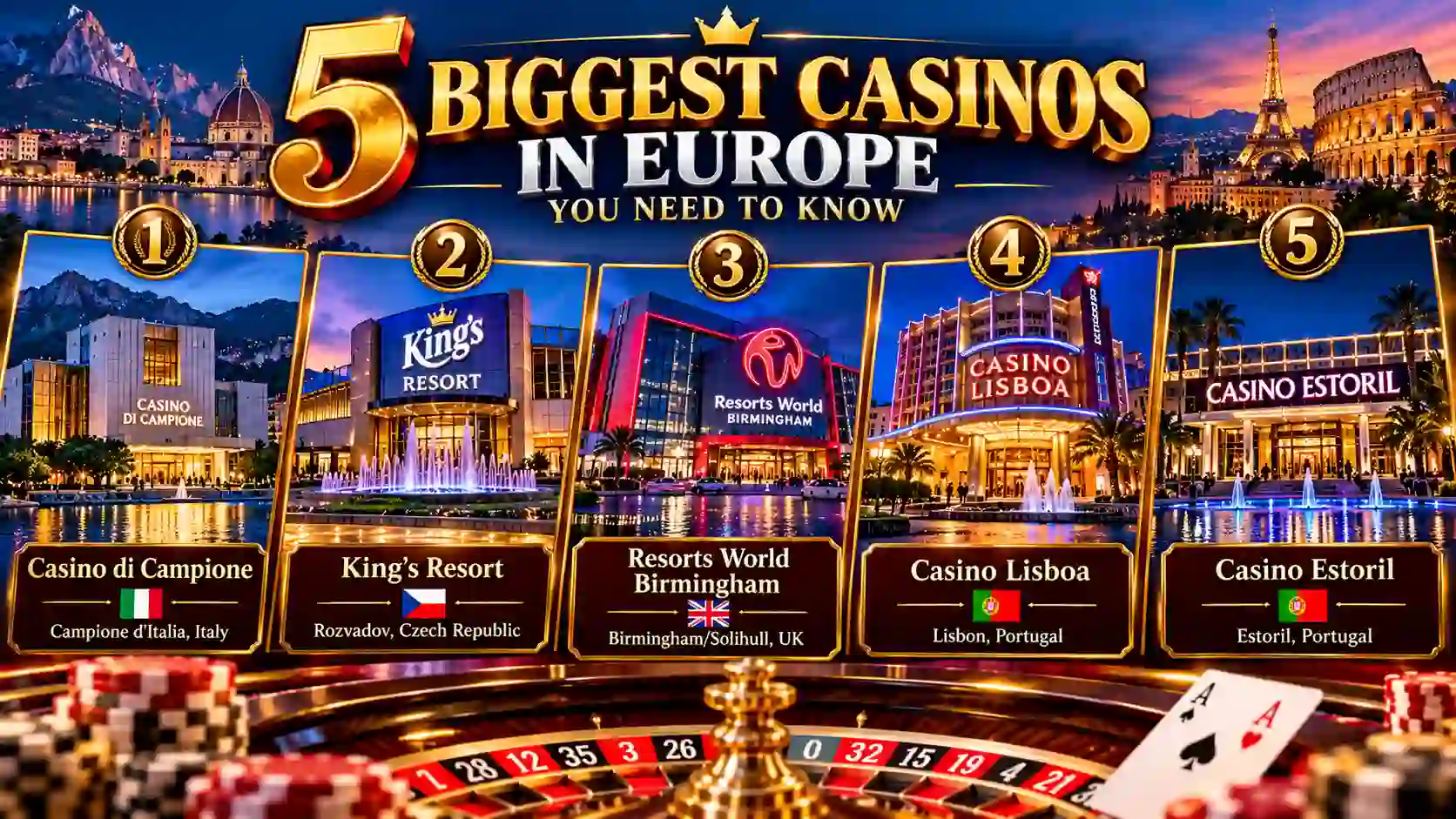
Here are five major European casinos worth knowing in 2026.
Casino di Campione – Campione d’Italia, Italy
Few European casino buildings can compete visually—or physically—with the Casinò di Campione d’Italia.
It stands in Campione d’Italia, an unusual Italian exclave surrounded by Switzerland on the shore of Lake Lugano. The location alone makes it different from almost every other casino on the continent.
The current building was designed by celebrated Swiss architect Mario Botta and opened in 2007. According to the Municipality of Campione d’Italia, the structure covers approximately 55,000 square metres, while its published technical information lists around 36,000 square metres of total walkable floor space and approximately 4,450 square metres specifically dedicated to gaming. Its gaming areas have a stated capacity of around 3,100 people.
Those numbers demonstrate why casino rankings can be confusing. Calling all 55,000 square metres “gaming space” would be inaccurate; much of the complex is made up of circulation areas, hospitality facilities, event space, parking and other functions.
A casino with an unusual history
Gaming in Campione dates back more than a century. The municipality records the first municipal casino as having been established in 1917, with a later permanent reopening in 1933.
Its more recent story has been considerably more turbulent.
The casino closed in 2018 amid serious financial difficulties. After more than three years out of operation, it reopened in January 2022 following a restructuring process. Italian news agency ANSA reported that the relaunch included 400 newly installed slot machines and a substantially reduced workforce compared with the pre-closure operation.
By 2026, the property is firmly operating again. The municipality currently lists public opening hours of noon until 4:00 a.m. daily.
What makes Casino di Campione stand out?
Its biggest attraction from an architectural perspective is simply its scale. The massive contemporary structure rises above Lake Lugano and feels closer to a major entertainment complex than a traditional European gaming salon.
Poker has also become part of its modern identity. In 2026, the casino is hosting organized PokerStars-branded live poker activity, including cash games and scheduled tournament events.
Best known for: Monumental architecture, its Italian-Swiss border location and one of Europe’s most imposing casino buildings.
King’s Resort – Rozvadov, Czech Republic
If poker is your preferred measure of casino scale, King’s Resort in Rozvadov deserves special attention.
Located in western Czechia close to the German border, King’s has developed into one of Europe’s most important live-poker destinations.
The operator currently lists 6,000 square metres of total gaming space, more than 200 poker tables, over 390 slot machines and approximately 40 live casino tables. It offers games including roulette, blackjack, craps, punto banco and several poker variants.
Those figures make King’s particularly significant because a large proportion of the operation is dedicated to poker rather than simply rows of electronic gaming machines.
Europe’s giant poker destination
King’s describes its poker room as the largest in Europe, and the venue has become particularly associated with major international poker festivals.
Unlike many city casinos that treat poker as a secondary attraction, King’s has built much of its identity around cash games and tournament poker.
The resort’s scale goes beyond the casino floor as well. It combines gaming with hotel accommodation, restaurants, wellness facilities and other amenities, giving it the feel of a self-contained casino resort rather than a conventional downtown gaming venue.
Its Rozvadov location is also unusual. This is not Prague, London, Lisbon or another major tourist capital. King’s has effectively turned a small border community into a destination for international poker players.
Why King’s Resort belongs on this list
A 6,000-square-metre published gaming area is substantial by European standards, but King’s real claim to scale comes from its gaming inventory. More than 200 poker tables is a remarkable number for a European property.
That makes it difficult to discuss the biggest casinos in Europe without including Rozvadov.
Best known for: Europe’s largest poker room, major tournaments and an unusually large poker-focused gaming operation.
Resorts World Birmingham – Birmingham/Solihull, United Kingdom
The British casino market is generally characterized by individual city casinos rather than enormous Las Vegas-style resorts. Resorts World Birmingham is one of the major exceptions.
Opened in 2015 beside the National Exhibition Centre, Resorts World was designed as an integrated leisure destination combining a casino, hotel, restaurants, retail, entertainment and conference facilities.
Project Management Institute documentation from the development describes an approximately 8,000-square-metre casino component within the wider resort and notes that the casino was designed to accommodate as many as 2,000 guests.
Meanwhile, fit-out contractor Phelan Construction documented a 4,500-square-metre main casino floor as part of its work on the development.
The difference between those two numbers is useful rather than problematic: it shows exactly why casino-size comparisons need context. One figure can describe the wider casino operation while another refers specifically to the primary gaming floor.
More than a casino
Resorts World Birmingham was created as a mixed-use destination rather than a standalone gambling venue.
Genting’s corporate reporting describes the property as a resort incorporating casino, hotel, restaurants and shops.
That integrated format sets it apart from many traditional British casinos. Visitors can combine entertainment, dining or an overnight stay without leaving the complex, while its position next to the NEC and close to Birmingham Airport gives it strong transport connections.
Why it matters in the European casino market
Resorts World Birmingham represents a different interpretation of “big.”
Rather than focusing purely on one enormous gambling hall, it uses the integrated-resort model: gaming is a major component of a much broader leisure property.
That makes it one of the most substantial casino developments built in the UK in modern times and an important inclusion in any discussion of Europe’s largest casino destinations.
Best known for: Integrated resort facilities, a large British casino operation and its location beside the NEC.
Casino Lisboa – Lisbon, Portugal
Portugal has an unusually strong presence when discussing major European casinos, and Casino Lisboa is one of the reasons why.
Opened on 19 April 2006, the casino occupies a prominent location in Lisbon’s modern Parque das Nações district near the Tagus River. The operator describes entertainment and gaming as being distributed throughout the building, alongside restaurants, bars and cultural facilities.
The current gaming lineup includes roulette, blackjack, Caribbean Stud Poker, Macau Baccarat and the Portuguese dice game Banca Francesa, in addition to electronic gaming.
Most strikingly, Casino Lisboa says it operates hundreds of slot machines distributed across three floors.
Built as an entertainment destination
Casino Lisboa is not designed solely around gambling.
The property incorporates an art gallery, the Oceanos Auditorium, restaurants and bars alongside its gaming operation. The casino’s official site currently lists two restaurants, three bars, six main game categories and one dedicated entertainment venue.
That mixture reflects a recurring theme among Europe’s larger casinos: size often comes from combining gaming with nightlife, food, live entertainment and cultural programming.
Its location is another major advantage. Unlike casino resorts built outside large cities, Casino Lisboa is within Portugal’s capital and approximately three kilometres from Humberto Delgado Airport.
A modern contrast to Europe’s historic casinos
Many of Europe’s most famous casinos lean heavily on Belle Époque architecture and 19th- or early-20th-century glamour.
Casino Lisboa is different.
Its appeal is contemporary and urban, fitting naturally into Parque das Nações, the redeveloped waterfront district that emerged from the site of Expo ’98.
For visitors researching large casinos in Europe, it provides an example of a modern metropolitan casino rather than an old-world gaming palace.
Best known for: Multi-floor gaming, hundreds of slot machines and its modern Lisbon waterfront setting.
Casino Estoril – Estoril, Portugal
Around 18 kilometres from central Lisbon sits a casino with one of the strongest claims to the title of largest casino in Europe: Casino Estoril.
The casino itself explicitly describes the property as Europe’s biggest casino, and Portugal’s official tourism portal also identifies it as the largest in Europe.
That claim needs some context.
Unlike King’s Resort, Casino Estoril does not currently publish an easily comparable figure for total gaming-floor area on its main visitor page. Because competing casinos define their measurements differently, its “largest in Europe” description should be understood as an operator and tourism-board claim rather than evidence for an exact square-metre ranking.
What is beyond dispute is that Casino Estoril is a major gaming and entertainment complex.
Gaming, shows, art and dining
The current property combines seven types of gaming, an art gallery, two show spaces, two restaurants and three bars.
The casino operates daily from 3:00 p.m. until 3:00 a.m. and is located around 20 kilometres from Lisbon’s international airport.
Its scale is therefore not simply a question of how many gaming machines fit into one room. Casino Estoril functions as a broad entertainment venue, with exhibitions, concerts, gastronomy and live performances forming part of the overall experience.
History gives Estoril another dimension
Casino Estoril’s reputation also extends far beyond its physical size.
The property has long been associated with the international atmosphere of the Portuguese Riviera. Its history during the Second World War helped give Estoril a reputation as a meeting point for diplomats, exiles and intelligence figures, and the area became associated with Ian Fleming and the world that later influenced Casino Royale.
That combination of size, culture and history makes Casino Estoril quite different from the purpose-built casino resorts that dominate newer gambling markets.
Best known for: Its claim to being Europe’s largest casino, historic reputation and combination of gaming, arts and entertainment.
Five of the Biggest Casinos in Europe
| Casino | Location | Scale Highlight | What Makes It Notable |
| Casino di Campione | Campione d’Italia, Italy | 4,450 m² stated gaming area; huge overall building | Monumental Mario Botta-designed complex |
| King’s Resort | Rozvadov, Czech Republic | 6,000 m² gaming space; 200+ poker tables | Europe’s largest poker room |
| Resorts World Birmingham | Birmingham/Solihull, UK | Project documentation describes an 8,000 m² casino component | Major UK integrated casino resort |
| Casino Lisboa | Lisbon, Portugal | Hundreds of slots across three floors | Large modern urban entertainment casino |
| Casino Estoril | Estoril, Portugal | Operator describes it as Europe’s largest casino | Historic gaming and entertainment complex |
The important point is that these figures should not be treated as a strict ranking. A 55,000-square-metre building is not the same measurement as a 6,000-square-metre gaming floor, for example.
What Does “Biggest Casino in Europe” Actually Mean?
Search for the largest casino in Europe and you will quickly find several different answers.
That does not necessarily mean one source is wrong. Usually, they are measuring different things.
A casino can be considered “big” according to:
- Total building area: including restaurants, event halls, offices and public spaces.
- Dedicated gaming floor: the area actually occupied by gambling facilities.
- Gaming inventory: number of tables, poker seats or gaming machines.
- Guest capacity: how many people the gaming areas can accommodate.
- Overall resort footprint: including hotels, spas, restaurants and entertainment facilities.
Casino di Campione is a good example. Its municipal information describes a vast overall structure but identifies a much smaller dedicated gaming area. King’s Resort, meanwhile, publishes a clear 6,000-square-metre total gaming-space figure and emphasizes more than 200 poker tables.
For readers comparing casinos, knowing what the number measures matters more than simply choosing the largest number on a webpage.
What About Casino de Monte-Carlo?
No discussion of European casinos feels complete without Monaco’s Casino de Monte-Carlo.
It is unquestionably one of Europe’s most famous casino properties, with a history stretching back to the 19th century. Monte-Carlo Société des Bains de Mer says Monaco’s casino story dates to 1863, and Casino de Monte-Carlo remains the centerpiece of the principality’s gaming tradition.
However, fame and physical size are not the same thing.
Comparable current floor-area information from the operator is less straightforward than the published measurements available for several venues above. For an article specifically focused on the biggest casinos in Europe, it is more transparent not to assign Casino de Monte-Carlo an unsupported position based on older or inconsistently defined figures.
In terms of history, architecture and international recognition, however, it remains one of Europe’s essential casino landmarks.
Things to Know Before Visiting a European Casino
Casino rules vary substantially between European countries and even between individual properties.
Identification requirements, minimum entry ages, dress codes, opening hours and access to specific gaming areas can all differ. Always check the casino’s official website shortly before visiting rather than relying on an old travel guide.
Casino Lisboa, for example, states that visitors inside gaming rooms must possess valid identification, while individual casinos elsewhere may impose additional access requirements.
It is equally important to treat gambling as paid entertainment rather than a way to generate income. Decide what you are comfortable spending before playing, do not chase losses and stop when the activity is no longer enjoyable. Casino Lisboa’s own responsible-gaming guidance similarly advises keeping play within personal financial limits.
Final Thoughts
The biggest casinos in Europe show how varied the continent’s casino industry really is.
Casino di Campione impresses through monumental architecture and sheer building scale. King’s Resort has established an extraordinary poker operation in a small Czech border town. Resorts World Birmingham brings the integrated-resort concept to the UK. Casino Lisboa offers a modern, multi-level gaming and entertainment destination in the Portuguese capital, while Casino Estoril combines substantial scale with almost a century of history and culture.
There is no perfect Europe-wide ranking because casinos do not report their dimensions according to one common standard. Claims about “the biggest” should therefore always be accompanied by a simple question: biggest by what measure?
For travelers, researchers and casino-industry readers, that distinction makes the comparison far more useful. Rather than relying on exaggerated figures, the best approach is to look at gaming-floor size, facilities, gaming inventory, overall resort scale and historical importance together.
What emerges is a picture of a European casino market that may be different from Las Vegas or Macau, but is every bit as diverse.
FAQs
What is the biggest casino in Europe?
There is no universally standardized ranking because operators measure casino size differently. Casino Estoril officially describes itself as Europe’s largest casino, while Casino di Campione occupies an exceptionally large overall structure and King’s Resort publishes 6,000 square metres of dedicated gaming space.
What is the biggest poker casino in Europe?
King’s Resort in Rozvadov describes its poker room as Europe’s largest. The resort currently advertises more than 200 poker tables within approximately 6,000 square metres of total gaming space.
Is Casino di Campione open?
Yes. After closing in 2018, Casino di Campione reopened in January 2022. Current municipal information lists the casino as operating daily.
Which country has two of the biggest casinos in Europe?
Portugal features especially prominently, with both Casino Lisboa and Casino Estoril operating in the greater Lisbon region. Their official sites document large-scale gaming alongside restaurants, bars, cultural facilities and entertainment venues.
Is Casino de Monte-Carlo the largest casino in Europe?
Casino de Monte-Carlo is one of Europe’s most historically important and internationally recognizable casinos, but current comparable measurements do not establish it unambiguously as Europe’s largest. Its significance is better understood in terms of heritage, architecture and reputation rather than size alone.
ADVERTISEMENT

18+ | Affiliate link | Terms apply | Please gamble responsibly.


