

18+ | Affiliate link | Terms apply | Please gamble responsibly.
Last Updated on September 27, 2026 by Maurya
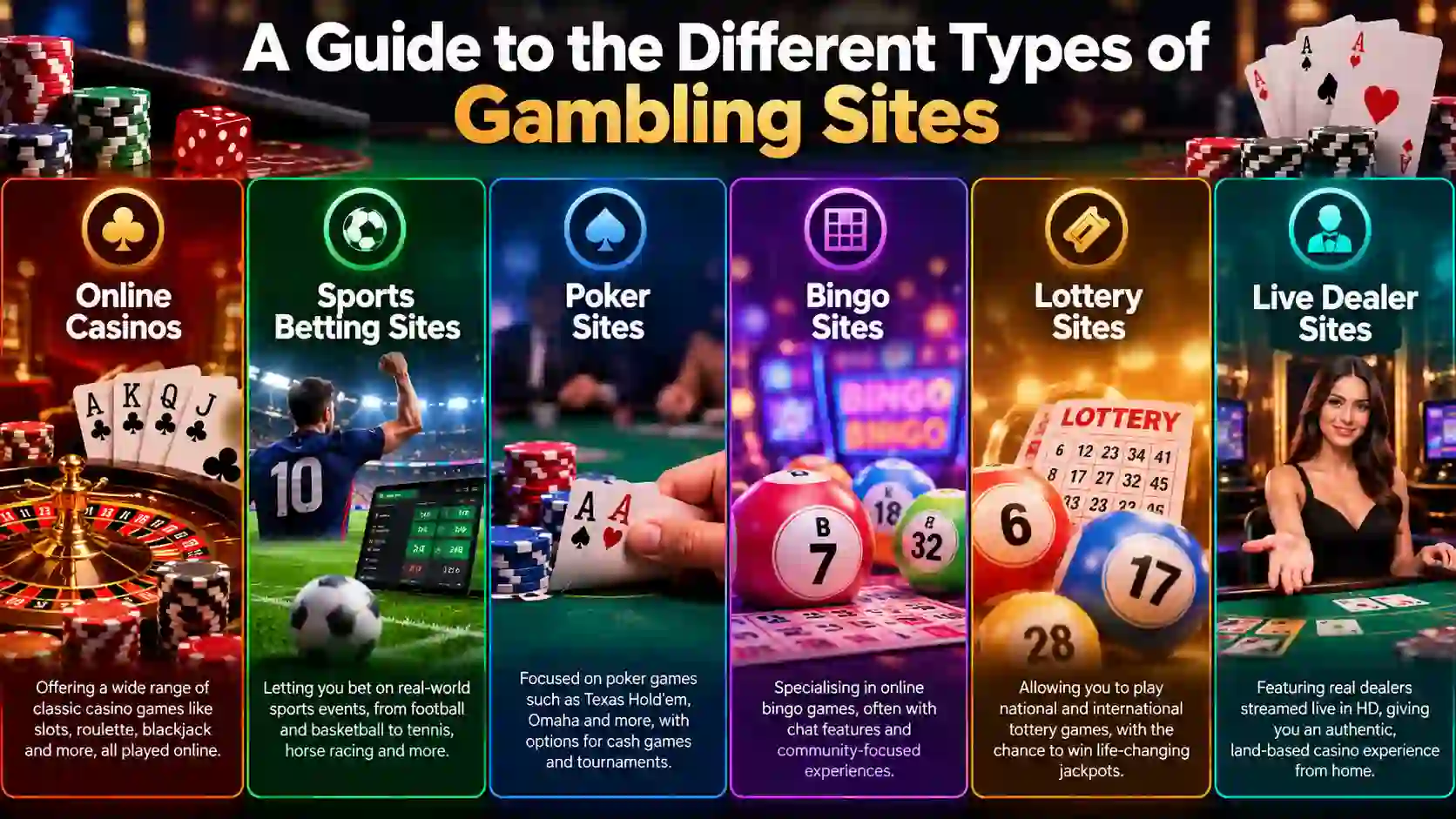
Online gambling has developed into a broad digital industry covering everything from casino games and sports betting to poker tournaments, bingo rooms, lotteries, and betting exchanges. As a result, the term “gambling site” can describe several very different types of platforms.
Understanding those differences is important. A sportsbook operates differently from an online casino, while a poker room follows a completely different model from a betting exchange. The licensing requirements, game formats, payment systems, promotions, and responsible gambling features may also differ considerably.
Gambling laws vary significantly between countries and even between states or regions within the same country. Users should therefore check whether a gambling service is legal and appropriately licensed where they live before creating an account or depositing money.
What Is an Online Gambling Site?
An online gambling site is a website or digital platform that enables eligible users to place wagers, play games involving money or prizes, or participate in other regulated gambling activities remotely.
The UK Gambling Commission defines remote gambling broadly to include gambling through the internet, mobile devices, telephone, television, radio, and other forms of remote communication. Examples include mobile betting apps, online slot games, and wagering on live or virtual events.
Although many gambling companies now combine several products under one account, most platforms can still be categorized according to their primary activity.
The main types of online gambling sites include:
- Online casino sites
- Sports betting sites
- Poker sites
- Bingo sites
- Betting exchanges
- Lottery and draw-based gambling sites
- Esports betting sites
- Virtual sports betting platforms
- Fantasy sports platforms
- Cryptocurrency gambling sites
- Multi-product gambling sites
Let’s examine each category in more detail.
Online Casino Sites
Online casinos are among the most recognizable types of gambling websites. They reproduce many of the games traditionally found inside land-based casinos while allowing users to play through computers, smartphones, or tablets.
A typical online casino may offer hundreds or even thousands of games.
Common Online Casino Games
Popular categories include:
- Online slots
- Blackjack
- Roulette
- Baccarat
- Video poker
- Craps
- Instant-win games
- Table games
- Progressive jackpot games
In Great Britain, for example, a remote casino licence can cover online poker, roulette, blackjack, slot games, and other casino products.
Online casinos usually rely on specialist gaming software providers to supply their games. Depending on the game, outcomes may be generated using approved random-number systems or determined by live physical equipment.
Live Dealer Casinos
Live dealer casino sites are an important subcategory.
Rather than relying entirely on computer-generated graphics, live casinos stream games from a studio or physical gaming floor. Human dealers operate tables while players place bets through an online interface.
Common live dealer games include:
- Live blackjack
- Live roulette
- Live baccarat
- Casino hold’em
- Game-show-style casino games
Live casino platforms are designed to provide a more interactive experience than standard digital table games, although the underlying activity remains gambling and losses are always possible.
Sports Betting Sites
Sports betting sites, commonly called online sportsbooks, allow users to wager on the outcome of sporting events.
The range of available markets depends on the operator and jurisdiction, but major sportsbooks may provide betting markets covering football, basketball, tennis, horse racing, cricket, golf, combat sports, motorsports, and many other events.
Sports betting websites generally provide two major forms of wagering.
Pre-Match Betting
Pre-match bets are placed before an event begins.
Examples might include wagers on:
- The match winner
- Total points or goals
- Correct scores
- Player statistics
- Handicaps or spreads
- Tournament outcomes
Live or In-Play Betting
Live betting allows eligible users to place wagers while an event is taking place.
Odds may change continuously according to what is happening during the game.
Regulatory systems sometimes distinguish between different categories of betting activity. The UK Gambling Commission, for example, provides different licensing categories for betting on real events, virtual events, pool betting, and betting intermediary services.
No sporting outcome is certain, however, and betting odds should not be interpreted as guarantees of winning.
Online Poker Sites
Online poker sites differ substantially from conventional casino platforms because players frequently compete against one another rather than simply playing against the operator.
The platform typically organizes games and earns revenue through tournament fees, commissions, or a portion of eligible pots, depending on the format and regulatory environment.
Popular poker formats include:
- Texas Hold’em
- Omaha
- Seven-Card Stud
- Sit-and-go tournaments
- Multi-table tournaments
- Cash games
Poker sites can cater to recreational users as well as highly experienced players.
The Malta Gaming Authority, for example, categorizes certain player-versus-player games—including peer-to-peer poker and bingo—separately from games in which participants play directly against the house.
While poker contains a significant skill component, money can still be lost, and regulatory treatment varies between jurisdictions.
Online Bingo Sites
Online bingo platforms bring the traditional bingo-room format to websites and mobile applications.
Players generally purchase tickets containing numbers. Numbers are then drawn randomly, and prizes are awarded according to the rules of the particular bingo game.
Common versions include:
- 90-ball bingo
- 75-ball bingo
- 80-ball bingo
- 30-ball bingo
- Progressive jackpot bingo
Many modern bingo sites also include chat rooms, promotions, slots, and other casino-style games.
This has resulted in considerable overlap between dedicated bingo websites and broader online casino platforms.
Betting Exchanges
A betting exchange works differently from a traditional sportsbook.
With a conventional bookmaker, customers generally bet against odds offered by the operator. Betting exchanges instead provide a marketplace through which customers can potentially take opposing sides of a wager.
This can involve two basic concepts:
Backing: Betting that an outcome will happen.
Laying: Betting against a particular outcome.
The exchange typically facilitates the transaction and charges a commission or another type of fee rather than taking the same role as a conventional bookmaker.
The UK Gambling Commission describes a remote betting intermediary—commonly known as a betting exchange—as a service that brings two or more betting parties together without the intermediary itself having liability for their bets.
Betting exchanges can be more complicated than ordinary sportsbooks, particularly for people unfamiliar with changing market prices and lay betting.
Lottery and Draw-Based Gambling Sites
Lottery websites focus on games where winners are determined through scheduled draws.
Depending on applicable law, these platforms may involve official lottery ticket sales, licensed lottery products, or other regulated draw-based games.
Products can include:
- National lottery tickets
- Regional lottery games
- Instant-win products
- Raffles
- Number draws
- Syndicate-style participation
An important distinction is that not every website referring to a lottery necessarily sells an official lottery ticket. Some services may operate using different models, including wagering on lottery results.
Consumers should therefore understand exactly what product they are purchasing and which organization regulates the service.
Esports Betting Sites
Esports betting platforms provide wagering markets involving competitive video gaming.
Popular esports titles can include games from genres such as multiplayer online battle arena games, tactical shooters, sports simulations, and strategy games.
Possible betting markets include:
- Match winners
- Tournament winners
- Individual map winners
- Correct scores
- In-game statistics
Esports gambling has increasingly become part of mainstream sportsbook offerings rather than remaining a completely separate category.
Regulators continue to pay particular attention to issues such as sporting integrity and player protection. For example, the Malta Gaming Authority listed integrity risks connected with esports markets among its supervisory priorities for 2026.
Age restrictions and gambling regulations still apply even when the underlying competition involves video games.
Virtual Sports Betting Sites
Virtual sports should not be confused with esports.
Esports involve real people competitively playing video games. Virtual sports, by contrast, generally involve computer-generated events whose outcomes are determined according to the platform’s approved gaming systems.
Examples may include:
- Virtual horse racing
- Virtual football
- Virtual greyhound racing
- Virtual basketball
- Virtual motorsports
Unlike real sporting events, virtual competitions can take place frequently because they do not depend on physical teams, venues, weather conditions, or sporting calendars.
Regulators can treat virtual betting as a separate gambling category. The UK Gambling Commission, for instance, has a specific remote betting licence covering virtual races, competitions, and other qualifying virtual events.
Fantasy Sports Platforms
Fantasy sports platforms allow users to create virtual teams based on real athletes and earn points according to those athletes’ performances in actual competitions.
Formats include:
- Season-long fantasy sports
- Daily fantasy sports
- Head-to-head contests
- Tournament-style competitions
- Free-to-play fantasy games
The legal classification of fantasy sports varies considerably between jurisdictions.
Some regions regulate certain fantasy contests separately from conventional gambling, while others may restrict or regulate particular paid formats.
For this reason, users should never assume that a fantasy sports platform is legal simply because similar services operate somewhere else.
The U.S. National Council on Problem Gambling has developed specific consumer-protection guidance for fantasy sports contests, illustrating the importance of safeguards even where fantasy products are treated differently from conventional casino or sportsbook gambling.
- Cryptocurrency Gambling Sites
Some gambling websites accept cryptocurrencies or other digital assets as a method of depositing and withdrawing funds.
These are frequently referred to as crypto casinos or Bitcoin gambling sites, although they may offer casino games, sports betting, poker, or several products simultaneously.
Cryptocurrency support does not create a separate gambling activity by itself. A crypto casino is still fundamentally an online casino; the difference concerns its payment infrastructure.
Users should pay particular attention to licensing and regulatory status because the use of cryptocurrency does not automatically make a gambling platform safe, trustworthy, anonymous, or legally available in a particular location.
Cryptocurrency transfers can also involve price volatility, network fees, processing delays, and different consumer-protection arrangements from conventional payment methods.
In 2026, the Malta Gaming Authority identified internal controls surrounding crypto assets as one area receiving increased regulatory scrutiny.
Multi-Product Gambling Sites
Many of the largest gambling platforms no longer fit neatly into one category.
A single account might provide access to:
- Sports betting
- Casino games
- Live casino tables
- Poker
- Bingo
- Virtual sports
- Esports markets
These can be described as multi-product gambling sites.
From a user’s perspective, their primary advantage is convenience: multiple gambling products are accessible from one account.
However, offering numerous products does not mean that every service necessarily falls under a single regulatory authorization. Operators may require different permissions depending on the activities they provide.
The UK Gambling Commission states that businesses may need one or a combination of operating licences, depending on the gambling facilities they offer.
How Gambling Sites Are Regulated
Licensing is one of the most important subjects to understand when discussing online gambling websites.
A genuine licence is not simply a logo placed at the bottom of a website. Licensed operators are typically subject to rules established by the regulatory authority governing their market.
Requirements can concern areas including:
- Age and identity verification
- Game standards
- Protection of customer funds
- Marketing
- Anti-money-laundering procedures
- Complaints and dispute processes
- Responsible gambling
- Consumer information
- Technical standards
Requirements differ by regulator.
For example, operators offering remote gambling to consumers in Great Britain generally require authorization from the UK Gambling Commission, including businesses located outside Great Britain that serve British consumers.
The Commission’s licensing rules include requirements relating to customer protection, identity verification, fair and open gambling, marketing, complaints, technical standards, and the protection of children and vulnerable people.
The Malta Gaming Authority similarly requires licensed websites to provide licensing details and responsible-gambling information, among other player-protection measures.
Consumers can often verify authorization through an official regulator’s public licence register rather than relying entirely on claims displayed by the gambling website itself. The MGA, for example, maintains a searchable licensee register that can be checked using information such as the licensee name, authorization status, URL, or gaming service.
What to Check Before Using an Online Gambling Site
Regardless of whether a website specializes in casinos, betting, poker, or another product, several basic checks are worth making.
Licensing
Check whether the operator is authorized by the regulator responsible for gambling services in your jurisdiction.
Where possible, verify the licence directly through the regulator’s official website.
Terms and Conditions
Read the rules covering deposits, withdrawals, account verification, promotions, bonuses, and account restrictions before depositing money.
Bonus headlines should never replace reading the underlying terms.
Payment Information
Check:
- Supported payment methods
- Deposit requirements
- Withdrawal rules
- Potential transaction fees
- Identity-verification requirements
- Processing policies
Never deposit money you cannot afford to lose.
Responsible Gambling Features
Responsible gambling tools are an important feature of regulated gambling platforms.
Depending on the regulator and jurisdiction, these may include:
- Deposit limits
- Wagering limits
- Loss limits
- Reality checks
- Session reminders
- Time-outs
- Self-exclusion
The Malta Gaming Authority, for example, requires its operators to provide self-exclusion and certain limit-setting and reality-check tools.
The National Council on Problem Gambling’s Internet Responsible Gambling Standards likewise address topics including informed decision-making, player assistance, self-exclusion, advertising, payments, and site features.
Security and Privacy
Users should also review how a gambling website handles account security and personal information.
Good security practices may include strong account passwords, multi-factor authentication where available, secure connections, and clear privacy policies.
Never provide payment or identity information to an unverified website simply because it advertises unusually large bonuses or guaranteed winnings.
Which Type of Gambling Site Is Right for You?
There is no single category that is automatically suitable for everyone.
The differences primarily come down to the activity involved.
People interested in casino-style games will encounter online casino platforms, while sports bettors use sportsbooks. Poker sites focus largely on player-versus-player card games, bingo sites specialize in draw-based bingo formats, and betting exchanges connect customers who want to take opposing sides of betting markets.
The most important consideration should not be finding a platform that supposedly offers an easy way to win. Gambling always involves financial risk, and no legitimate gambling site can guarantee profits.
Instead, anyone choosing to participate should first confirm that gambling is legal for them, verify the operator’s licence where applicable, understand the rules and costs, and set clear limits.
Responsible Gambling Matters
Gambling should be treated as entertainment rather than a method of earning income.
Licensed operators in many regulated markets are expected to provide controls designed to reduce gambling-related harm. However, those tools do not eliminate gambling risk.
Practical safeguards include establishing a spending limit before gambling, setting a time limit, avoiding chasing losses, and stopping when gambling is no longer recreational.
If gambling begins affecting finances, work, relationships, health, or everyday responsibilities, seeking specialist support is more important than trying to recover previous losses.
Responsible-gambling organizations provide confidential information and support in many jurisdictions. The National Council on Problem Gambling provides resources in the United States, while organizations such as GamCare offer gambling-harm information and support services in Great Britain.
FAQs
What are the main types of gambling sites?
The main types include online casinos, sportsbooks, poker rooms, bingo sites, betting exchanges, lottery platforms, esports betting sites, virtual sports platforms, fantasy sports services, cryptocurrency gambling sites, and multi-product gambling platforms.
What is the difference between a casino site and a betting site?
An online casino generally offers games such as slots, roulette, blackjack, and baccarat. A sports betting site focuses primarily on wagering on sporting events and related markets. Many operators now provide both products on the same platform.
Are all online gambling sites legal?
No. Gambling legislation varies by jurisdiction, and a site that is authorized in one country may not be permitted to accept customers somewhere else. Always check local regulations and verify the operator’s licensing status with the relevant authority.
What is a betting exchange?
A betting exchange is a platform that facilitates wagers between customers. Instead of simply accepting bookmaker odds, users can potentially back an outcome or take the opposite side of another user’s bet. The platform usually generates revenue through commissions or fees.
Are cryptocurrency casinos different from regular online casinos?
The underlying gambling products can be very similar. The main difference is that cryptocurrency gambling platforms accept one or more digital assets for transactions. Crypto support by itself does not prove that a gambling website is licensed, secure, fair, or legal in your jurisdiction.
What should I look for on a gambling website?
Important considerations include valid licensing, clear terms and conditions, transparent payment and withdrawal policies, account security, responsible-gambling tools, accessible customer support, and clear information about who operates the platform.
Final Thoughts
The online gambling industry covers far more than traditional casino websites.
Today’s market includes online casinos, sports betting sites, poker rooms, bingo platforms, betting exchanges, lottery services, esports betting, virtual sports, fantasy contests, crypto gambling platforms, and multi-product operators.
Each works differently and can be subject to different regulatory requirements.
Understanding those distinctions makes it easier to identify what a platform actually offers and what rules may apply. More importantly, anyone considering online gambling should verify that the operator is legally available in their jurisdiction, confirm licensing information through official sources, carefully review payment and bonus conditions, and make use of responsible-gambling controls.
Ultimately, gambling should remain optional entertainment with a predefined budget—not a financial strategy. Knowing how the different types of gambling sites operate is a useful first step toward making informed and responsible decisions online.
ADVERTISEMENT

18+ | Affiliate link | Terms apply | Please gamble responsibly.


