

18+ | Affiliate link | Terms apply | Please gamble responsibly.
Last Updated on September 29, 2026 by Maurya
Casino slots are simple to play, but that simplicity can make them easy to misunderstand. Bright graphics, bonus rounds, jackpots and fast-moving reels may create the impression that there is a hidden technique for predicting the next winning spin. In regulated random slots, there isn’t.
That does not mean every decision is irrelevant.
Understanding Return to Player (RTP), volatility, paylines, stake size, bonus rules and bankroll management can help you make more informed choices about how much you risk, which games fit your preferences and when it is time to stop.
The most useful casino slot strategies are therefore not supposed to “beat” a random number generator. They are about playing with better information and maintaining control over your money and time.
How Casino Slots Actually Work
Before discussing slot strategies, it helps to understand what determines the outcome of a spin.
Modern regulated online slots generally use a Random Number Generator (RNG) to determine game outcomes. In Great Britain, for example, the Gambling Commission requires random game outcomes to be sufficiently unpredictable and statistically random. Its technical standards also prohibit adaptive behaviour that would alter probabilities based on a player’s previous results.
In practical terms, that means previous spins do not tell you what the next spin will produce.
If a slot has gone 50 spins without a significant payout, that does not automatically make a large win more likely on spin 51. Likewise, a slot that has just paid a large prize does not necessarily become less likely to pay again.
Each eligible random game cycle is determined according to the game’s programmed mathematics.
This is why legitimate slot strategy should focus on factors you can actually control: game selection, stake size, total budget, session length and your decision to continue or stop.
Understand RTP Before Choosing a Slot
One of the first statistics to examine is Return to Player, commonly abbreviated as RTP.
RTP represents the theoretical percentage of total stakes a game is designed to return to players over a very large number of plays. The UK Gambling Commission specifically warns that RTP is an average achieved across significant numbers of games—not the amount an individual player should expect back during a single session.
For example, suppose a slot has a theoretical RTP of 96%.
It would be incorrect to assume that depositing £100 means you will receive £96 back.
Your individual result could be considerably higher or lower. You might lose your entire playing budget, finish ahead, or experience something between those extremes.
Over sufficiently large numbers of plays, however, the game’s actual return would generally be expected to move closer to its theoretical RTP.
A 96% RTP can also be viewed as implying a theoretical game margin of approximately 4% over the long run.
Is a Higher RTP Better?
All else being equal, a higher RTP means a smaller theoretical mathematical disadvantage to the player.
For example, choosing between otherwise comparable games offering 94%, 96% and 97% RTP would generally make the 97% game more favourable mathematically over an extremely large sample of spins.
But RTP should never be treated as a prediction of your next session.
Short-term results can vary dramatically because of randomness and volatility.
An important casino slot tip, therefore, is to check the game’s information or help section before playing rather than choosing exclusively by graphics, jackpots or themes.
Learn the Difference Between RTP and Volatility
RTP tells you about theoretical long-term returns. Volatility tells you more about how those returns may be distributed.
The UK Gambling Commission describes high-volatility games as tending to have larger but rarer prizes, while lower-volatility games generally produce smaller prizes more frequently.
Consider two slots with identical 96% RTP figures.
One could offer frequent modest payouts with relatively few enormous prizes. Another could deliver long stretches with limited returns but occasionally produce very large wins.
The RTP is the same, yet the playing experience can feel completely different.
Low-Volatility Slots
Lower-volatility slots may suit players who prefer relatively frequent smaller payouts and potentially smoother bankroll fluctuations.
That does not make them safer or profitable, but the distribution of prizes may make a fixed bankroll last differently than it would on a highly volatile game.
High-Volatility Slots
High-volatility games typically place more of their theoretical return into less frequent, potentially larger prizes.
This can mean sharper balance swings.
If you choose highly volatile slots, smaller stakes relative to your available entertainment budget can reduce the speed at which a losing sequence consumes that budget.
Again, this is a bankroll-management technique—not a way of changing the game’s odds.
Set Your Budget Before the First Spin
A useful slot strategy begins before you open the game.
Decide how much money you are prepared to lose during the session and treat that amount as an entertainment expense rather than an investment.
Avoid creating a budget based on how much you hope to win.
For example, “I’ll start with £50 but add another £100 if I lose because I’ll eventually recover it” is not a meaningful loss limit. A genuine budget should represent an amount you are prepared to lose without needing to replace it.
Where available, use the casino’s financial-limit tools.
Great Britain’s Gambling Commission requires regulated remote gambling systems to provide facilities allowing customers to set financial limits, and its standards emphasize helping customers maintain a gambling budget suited to their circumstances.
From 30 September 2026, updated British rules also require qualifying gambling systems to offer gross deposit limits, with daily, weekly and monthly durations among the required options. Increasing customer-led limits is subject to a cooling-off process, while reductions are intended to take effect immediately unless technical problems prevent it.
Regulations differ internationally, so always check the rules and responsible-gambling protections applicable where you live.
Size Your Bets According to Your Bankroll
Changing your stake does not turn a losing game into a winning one, but bet sizing determines how quickly your bankroll can rise or fall.
Imagine having a £50 entertainment budget.
At £5 per spin, that budget represents only ten full stakes before accounting for any returns.
At £0.50 per spin, it represents 100 stakes.
The game’s mathematical edge does not disappear at the lower stake, but the smaller wager gives you more potential game cycles for the same starting budget and limits the financial effect of any single losing spin.
A sensible approach is to choose a stake that allows you to enjoy the game without making every result financially significant.
Avoid automatically increasing your bet because you have lost several spins. Previous losses do not make the next random outcome more favourable.
Read the Paytable and Game Rules
One of the simplest casino slot tips is also one of the most commonly overlooked: read the rules before risking money.
Different slots can have dramatically different mechanics.
A modern game might include traditional paylines, ways-to-win systems, cascading symbols, multipliers, free-spin features, wild symbols, scatter symbols, bonus purchases or progressive jackpots.
Before playing, understand what creates a winning combination, what activates the bonus features and whether different bet settings affect prize eligibility.
Regulated games should provide information explaining the way the game operates and information relating to winning chances, house margin or theoretical RTP where applicable. The UK Gambling Commission’s standards, for instance, require player-facing information concerning game rules and the likelihood of winning.
Never assume two visually similar slots have identical mathematics.
Treat Bonuses as Terms and Conditions, Not Free Money
Online casinos frequently offer deposit bonuses, free spins and promotional rewards.
A bonus can affect the cost or amount of play available, but promotional credit should not automatically be treated as withdrawable cash.
Always check conditions such as wagering requirements, eligible games, maximum stakes, expiry periods, excluded payment methods, maximum conversion rules and withdrawal restrictions.
Suppose a casino advertises a £100 bonus but requires the bonus balance to be wagered many times before related winnings become withdrawable. The headline value alone does not tell you whether the promotion suits the way you intend to play.
A smarter strategy is to evaluate the entire offer, not simply the largest number displayed in the advertisement.
If the conditions are unclear, do not deposit purely to obtain the promotion.
Never Chase Losses
Chasing losses occurs when someone increases or continues gambling primarily because they want to recover money already lost.
It is one of the most dangerous habits in casino play because the money already lost has no influence over the probabilities of the next random spin.
Imagine starting with a £100 budget and losing it.
Adding another £100 does not put you “closer” to recovering the first £100. It simply places an additional £100 at risk.
Random slots do not maintain a personal debt that they eventually have to return to you.
A better stopping rule is simple: when the predetermined loss limit is reached, the session is over.
That rule may not feel exciting, but it is far more valuable than any supposed secret betting system.
Avoid the Gambler’s Fallacy
Many slot myths are variations of the gambler’s fallacy—the belief that previous random outcomes must influence upcoming ones.
You may hear claims such as “this machine hasn’t paid recently, so it is due,” “someone just won the jackpot, so avoid it,” “slots pay better at night,” or “switch machines after ten losing spins.”
For genuinely random games, none of these observations reliably predicts the next result.
Regulatory technical standards for RNG games specifically require outcomes to be unpredictable.
Historical patterns can look meaningful because the human brain naturally searches for patterns, even within random sequences.
Do not mistake a memorable sequence for a repeatable strategy.
Don’t Believe You Can Control the Reels
Another common slot myth is that pressing “stop” at exactly the right moment can turn a losing result into a winner.
For regulated RNG slots, the displayed reel animation generally represents a result determined by the game’s underlying random process rather than a reflex test you can master.
In Great Britain, regulators have specifically prohibited certain functionality that can speed up results or create an artificial illusion of control.
This distinction matters because perceived control can encourage players to believe skill is influencing an outcome that is fundamentally random.
Enjoy the animation if you like it—but do not mistake animation controls for a winning technique.
Track Time as Well as Money
A financial budget is only half of a sensible gambling plan.
Set a session duration as well.
Slots can involve repeated game cycles, and it is easy to pay attention to the balance while losing track of how long you have been playing.
Decide beforehand whether your session will last 20 minutes, 30 minutes or another period that fits your entertainment plans.
When that time expires, finish the session rather than automatically extending it because you are losing or because you feel a major win might be close.
Regulatory frameworks increasingly recognize the importance of time awareness. For example, the UK Gambling Commission requires certain remote gambling products to include facilities that help customers track the time spent gambling.
Understand That Faster Play Means More Money Wagered
Consider a simplified example.
If you stake £1 once per minute, you can place £60 in total stakes during an hour before accounting for recycled winnings.
If you stake £1 twenty times per minute, total wagering can rise dramatically.
This is why speed matters.
The UK Gambling Commission has introduced design rules intended to reduce gambling intensity, including restrictions relating to autoplay and features designed to speed up slot play. Its evaluation found that earlier online slot design changes reduced play intensity without producing the harmful unintended consequences examined by the regulator.
From the player’s perspective, slowing down creates more opportunities to notice how much has been wagered and reconsider whether continuing still makes sense.
Decide What You’ll Do With a Large Win Before You Get One
Loss limits receive most of the attention, but winning sessions can also lead to poor decisions.
A player who unexpectedly turns £50 into £400 may start treating the additional £350 as “casino money” rather than real money.
That can lead to progressively larger stakes and eventually returning most or all of the winnings.
Before playing, consider setting a personal rule for meaningful wins.
For example, you might decide that if your balance reaches a predetermined amount, you will withdraw part of it and finish the session.
The exact number is personal. The useful principle is making the decision before excitement changes your judgement.
Choose Licensed and Regulated Casinos
Game strategy is irrelevant if you are playing with an untrustworthy operator.
Before depositing, check whether the casino is licensed to provide gambling services in your jurisdiction.
A licence does not make gambling profitable, but regulated operators are generally subject to requirements involving game fairness, customer funds, advertising, identity verification and responsible-gambling protections according to their jurisdiction.
For example, operators serving consumers in Great Britain generally require a Gambling Commission licence, including overseas companies offering remote gambling to British customers.
Regulated gambling software may also be required to meet technical standards and undergo prescribed testing.
Verify the licence through the regulator itself rather than relying solely on a casino’s logo or marketing claim.
Progressive Jackpots Need Extra Perspective
Progressive jackpot slots can advertise enormous top prizes because a jackpot grows over time or across a network of participating games.
The size of the headline prize can make these games attractive, but jackpot probability may be extremely low.
Read the game rules carefully to understand exactly how jackpot eligibility works.
Some games may associate different prizes or features with particular stake conditions. If qualifying requires a larger wager, do not automatically increase your bet merely because the jackpot is large.
A jackpot is never guaranteed to arrive within your session.
If the required stake exceeds your predetermined budget, the smarter decision is to choose another game.
Free-Play Modes Are Useful for Learning Rules, Not Predicting Results
Demo or free-play modes can be helpful when available.
They let you become familiar with controls, paylines, bonus rounds and game mechanics without immediately risking cash.
However, a successful demo session does not predict what will happen when you switch to real-money play.
The purpose of free play should be to learn the game, not to discover a supposed winning sequence.
Common Slot Strategies That Don’t Work
Many popular “slot systems” sound convincing because they provide simple rules. Their problem is that they do not change the mathematics of a random game.
Martingale-style systems, for example, involve increasing stakes after losses. This does not eliminate the house advantage. Instead, it can rapidly increase the amount of money exposed during a losing sequence.
Similarly, changing machines after a fixed number of spins, playing at a certain time of day, following players who recently lost, avoiding machines after jackpots, tapping the screen in particular patterns or waiting for a “hot cycle” does not reliably predict a genuinely random outcome.
One of the most important slot machine strategies is therefore knowing which strategies to ignore.
A Smarter Slot-Play Framework
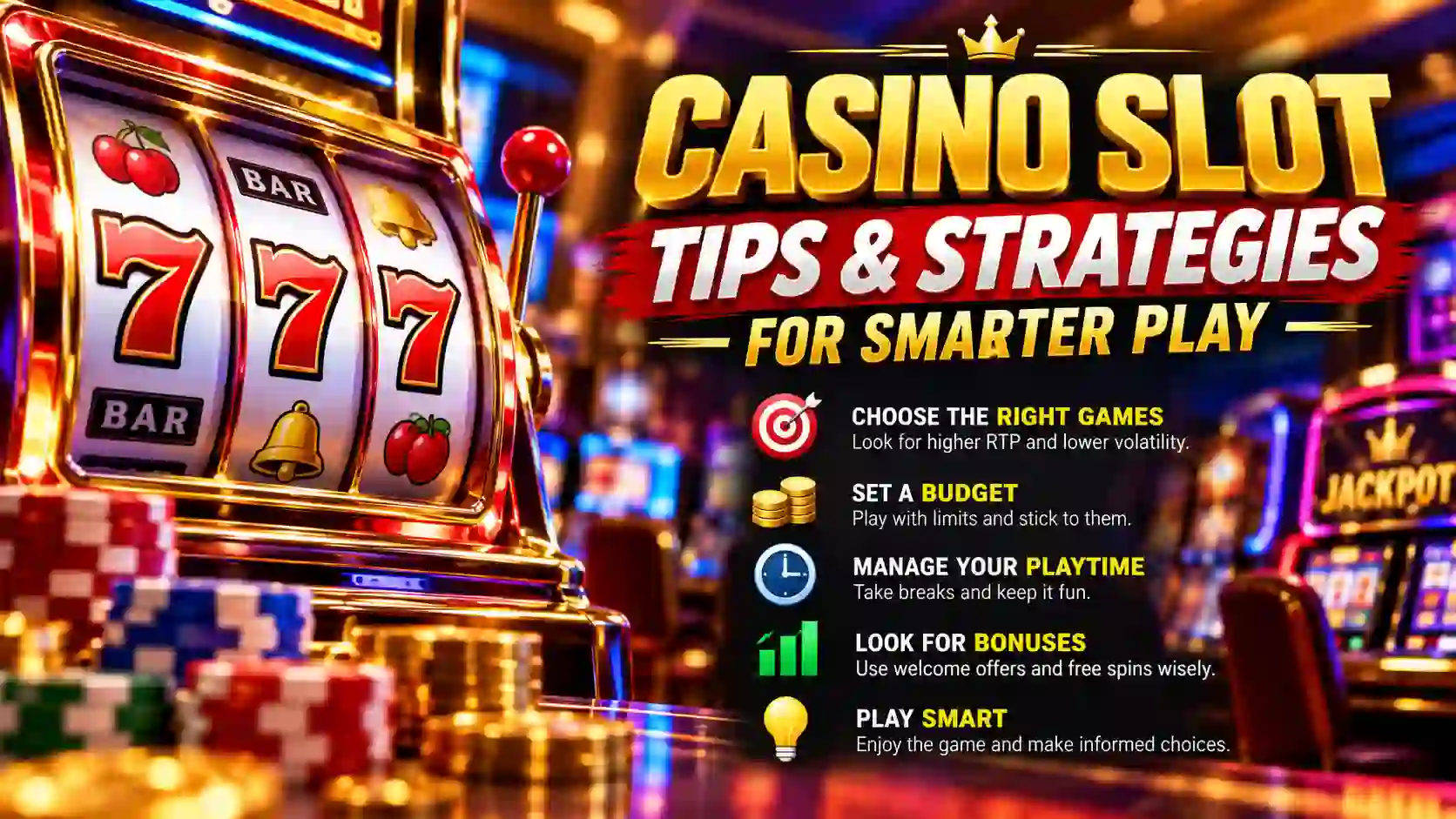
A practical approach can be summarized in ten steps:
- Choose a legal, licensed casino appropriate for your jurisdiction.
- Check the RTP and understand that it is a long-run theoretical average.
- Review volatility so the game’s prize pattern matches the type of experience you want.
- Read the paytable and rules before staking real money.
- Set a fixed loss budget before the session begins.
- Use a stake small enough that individual spins are not financially significant.
- Set a time limit as well as a money limit.
- Never increase your stake simply to recover losses.
- Ignore hot/cold machine myths and prediction systems.
- Stop when your preset money or time limit is reached.
None of these steps turns slots into a profitable investment.
What they do is replace impulsive decisions with predetermined ones.
FAQs
Is There a Strategy That Makes Slots Profitable?
There is no reliable strategy that guarantees long-term profits from random casino slots. Regulated RNG slots are designed to produce unpredictable outcomes, and their mathematics generally includes an advantage for the operator.
Strategy can help control how you play, but it cannot force winning outcomes.
What Is a Good RTP for Slots?
Higher RTP is generally preferable when comparing otherwise similar games because it represents a higher theoretical long-term return.
However, there is no RTP percentage that guarantees a profitable individual session.
Always remember that RTP is calculated across very large numbers of plays.
Are High-Volatility Slots Better?
Not necessarily.
High-volatility slots generally concentrate more value in larger, less frequent prizes, while low-volatility slots tend toward smaller, more frequent returns.
Which structure you prefer depends on the playing experience you want and the risk you are prepared to accept.
Can a Slot Be “Due” for a Win?
In a properly functioning random slot, a long losing sequence does not mean the next spin must win.
Random sequences can naturally contain long runs of similar results.
Does Increasing My Bet Improve RTP?
Not automatically.
Some games may have different rules, prize structures or jackpot eligibility at different stake levels, so read the game’s information carefully. Never assume that simply betting more improves the mathematical return.
Should I Stop After a Big Win?
There is no mathematical signal telling you exactly when to stop.
However, deciding on a withdrawal or stop-win point in advance can prevent an exciting win from turning into progressively larger gambling.
How Many Spins Should I Play?
There is no optimal number of spins that makes winning more likely.
Your session length should instead be based on your time limit, budget and stake size.
Final Thoughts
The best casino slot tips are rarely secret tricks.
They are straightforward habits based on understanding how the games actually work.
Check RTP. Understand volatility. Read the rules. Choose sensible stakes. Set money and time limits before playing. Avoid chasing losses. Ignore systems claiming to predict random outcomes.
Most importantly, remember that slots are entertainment products—not a dependable method of earning money.
A professional-looking strategy chart, an influencer’s “winning pattern” or a long losing streak cannot change the mathematics of a properly regulated random slot.
You cannot control the next spin.
You can control how much you stake, how long you play and when you walk away.
That is what smarter slot play really means.
ADVERTISEMENT

18+ | Affiliate link | Terms apply | Please gamble responsibly.


