

18+ | Affiliate link | Terms apply | Please gamble responsibly.
Last Updated on October 19, 2026 by Maurya
Online casino slots are among the most recognisable games in digital gambling. With colourful themes, interactive bonus rounds, and thousands of titles available, they attract players who enjoy straightforward gameplay and the excitement of unpredictable results.
But behind the spinning reels lies a mathematical system that every player should understand.
The difference between casual spinning and informed play is not a secret trick or a guaranteed winning formula. It comes down to understanding how slot machines work, choosing games carefully, managing money responsibly, and recognising when to stop.
That’s where practical online casino slot tips become valuable.
Although slots are games of chance, players can still make informed decisions about return to player (RTP), volatility, betting amounts, promotional offers, and gaming platforms. These choices cannot control random outcomes, but they can improve the overall decision-making process and reduce unnecessary financial exposure.
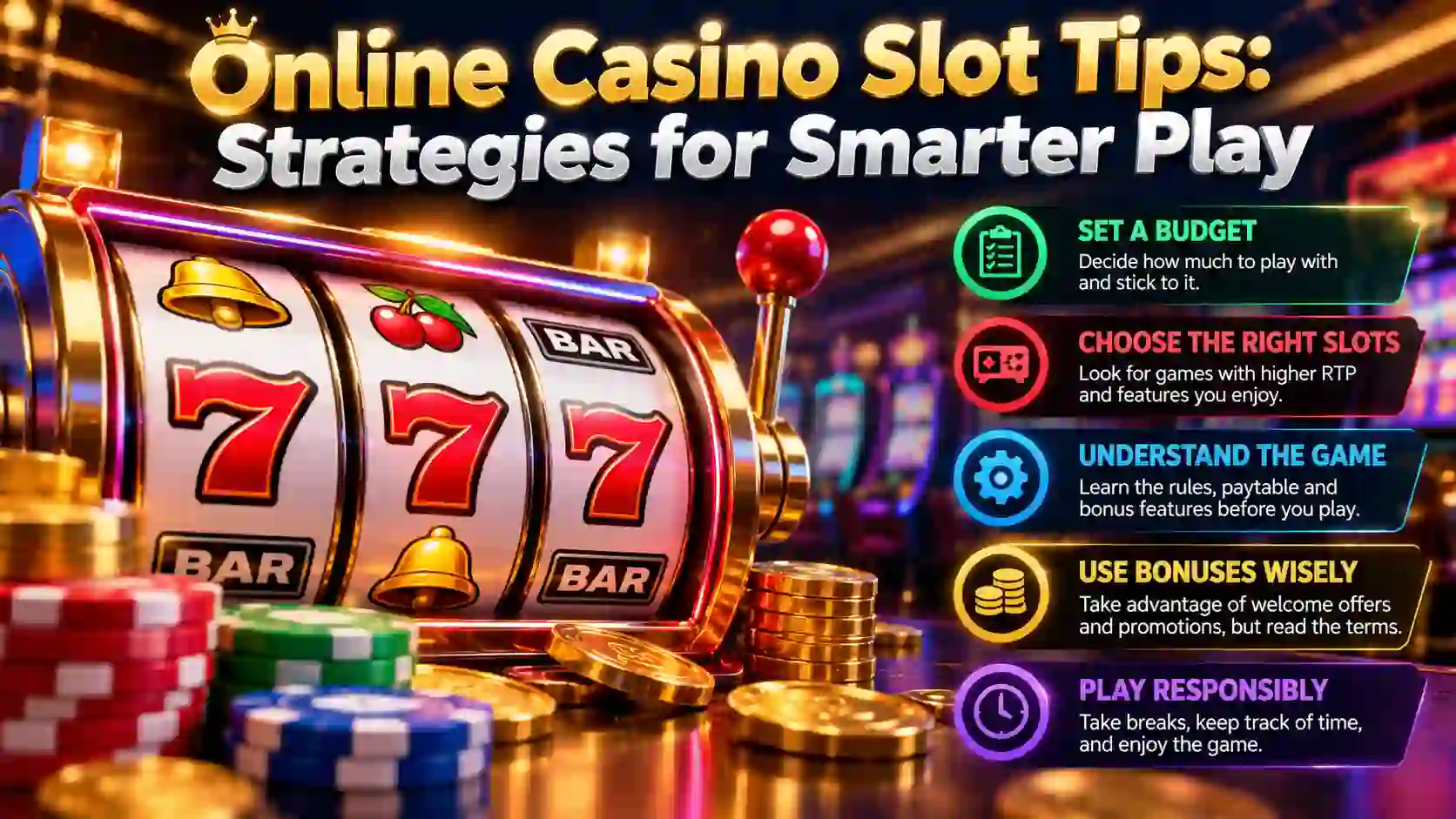
This guide explores 12 strategies for approaching online slot games more thoughtfully, whether you’re learning the basics or looking to understand the mechanics behind your favourite titles.
What Is the Best Strategy for Playing Online Casino Slots?
The best online slot strategy is to choose a properly licensed platform, understand the game’s RTP and volatility, set a strict entertainment budget, and avoid chasing losses. No betting pattern can guarantee a win on a legitimate random-number-generated slot machine.
Unlike games that involve strategic decisions, online slots do not allow players to influence the probability of individual spins through timing or betting patterns.
However, understanding the rules and costs before playing can help you make better decisions.
Understanding How Online Casino Slots Work
Before exploring specific slot tips, it helps to understand what happens when you press the spin button.
Modern online slots generally use a Random Number Generator (RNG) to determine game outcomes. This software produces unpredictable results according to the game’s programmed probabilities.
In a properly implemented RNG-based slot, each spin is independent of previous spins. A losing streak does not make a winning combination more likely, and a large payout does not mean the next spin must lose.
The UK Gambling Commission requires licensed RNG-based gambling games to meet technical standards for randomness and prohibits adaptive manipulation of outcome probabilities during play.
Generation of random outcomes
Slot games also have different structures.
A classic three-reel slot might offer a small collection of symbols and straightforward winning combinations. A modern video slot may include multiple reels, expanding wilds, scatter symbols, free spins, and elaborate bonus features.
These features shape the experience, but greater complexity does not automatically mean better chances of winning.
For players, the important distinction is between understanding a game’s mathematics and believing they can predict its results. The first is useful. The second can lead to costly mistakes.
12 Essential Online Casino Slot Tips for Smarter Play
- Choose a Licensed and Reputable Online Casino
The first step toward smarter slot play happens before you select a game.
Online gambling platforms differ in their licensing arrangements, security practices, payment policies, and consumer protections. Choosing an appropriately regulated casino is essential when assessing whether a platform meets recognised operating standards.
A trustworthy gambling platform should provide accessible information about its operating licence, terms and conditions, available payment methods, withdrawal procedures, and responsible gambling facilities.
For example, players in Great Britain can check an operator through the UK Gambling Commission’s public register. Licensed online games must also undergo appropriate testing before being offered to British consumers.
Before considering any platform, examine its licensing status and whether it can legally serve players in your location.
Also, look beyond the appearance of its website. Attractive graphics and generous promotional claims are not evidence that a gambling operator is trustworthy.
A properly regulated environment does not eliminate financial risk, but it provides important safeguards that unregulated websites may lack.
- Understand Return to Player (RTP) Before Playing
One of the most useful concepts in online slot gaming is Return to Player, commonly abbreviated as RTP.
RTP represents the theoretical percentage of total wagers that a game is designed to return to players over a very large number of plays.
For example, imagine two slot games:
| Slot game | Theoretical RTP | Theoretical house edge |
| Game A | 96% | 4% |
| Game B | 92% | 8% |
For every £1,000 wagered across a sufficiently large sample, a 96% RTP represents £960 in theoretical returns and £40 in expected losses. A 92% RTP represents £920 in returns and £80 in expected losses.
These figures describe long-term mathematical expectations, not what an individual player should expect during one session.
The Gambling Commission emphasises that RTP is an average calculated over substantial gameplay and cannot predict a player’s short-term results.
how much gaming machines payout
A higher-RTP slot generally has a lower theoretical house advantage, assuming its advertised mathematics apply to the mode being played.
However, it does not guarantee more frequent payouts or a profitable session.
Practical tip: Check the RTP shown in the game’s information or help section. Different configurations or versions of a slot title may use different theoretical returns, so verify the actual version rather than relying solely on a promotional review.
- Learn the Difference Between High- and Low-Volatility Slots
RTP tells you about a game’s theoretical long-term return. Volatility describes how unevenly that return may be distributed.
Understanding both concepts provides a clearer picture of a game’s risk characteristics.
Low-volatility slots generally distribute prizes more frequently, with smaller payouts relative to the size of the bet. Their results may feel less uneven, although losing money remains possible.
High-volatility slots tend to concentrate more of their potential returns in less frequent, larger prizes. Players may encounter extended periods without substantial payouts.
Medium-volatility games fall somewhere between these patterns.
Consider two games with identical 96% RTP figures. One might award smaller prizes regularly, while another relies heavily on rare bonus rounds and larger wins.
Their average theoretical returns may be similar, but the experience can be dramatically different.
Another useful measure is hit frequency, which describes how often a game produces a winning result. Importantly, a winning result can pay less than the amount staked, so a high hit frequency does not necessarily mean better financial outcomes.
Players should choose games based on their understanding of the risks rather than assuming that high volatility offers a better opportunity to make money.
- Read the Paytable and Understand Winning Combinations
Many players begin spinning without looking closely at the paytable.
That’s an avoidable mistake.
A slot’s paytable explains how symbols, combinations, special features, and payouts work. It can also reveal conditions that are easy to overlook during gameplay.
Traditional slots may use fixed paylines, where winning symbols must appear across specific patterns. Other games use ways-to-win systems, cluster payouts, or alternative mechanisms.
Understanding these differences matters because the number of reels or paylines alone does not determine your probability of earning a profit.
Pay attention to how wild symbols substitute for other symbols, what triggers free spins, and whether bonus features involve additional costs or conditions.
For example, a scatter symbol might activate free spins when three or more appear anywhere on the reels. In another game, only specific reel positions may count.
The UK Gambling Commission’s remote technical standards require applicable game rules, payout information, and information about the likelihood of winning to be accessible before customers commit to gambling.
Taking time to review these details helps prevent misunderstandings about how the game actually operates.
- Set a Realistic Bankroll and Treat It as an Entertainment Expense
Bankroll management is one of the most important online slot tips because it addresses something players can genuinely control: their spending.
Your bankroll is the amount of money allocated to gambling. It should consist exclusively of discretionary funds that you can afford to lose without affecting essential expenses.
Money intended for rent, food, utilities, savings commitments, or debt repayments should never form part of a gambling budget.
Suppose someone has £30 available for entertainment. That amount should be treated as the maximum potential loss for the activity, not as capital that must generate a return.
A useful approach is to decide on a spending limit before opening the casino website. Once that limit is reached, the session ends.
It is also important to distinguish between a deposit limit and a loss limit.
A deposit limit restricts the amount added to an account over a specified period. A loss limit, where available, restricts net losses according to the operator’s rules.
In Great Britain, regulated online operators have been required since 30 June 2026 to offer deposit limits based on the amount customers pay into their accounts during a chosen period.
These tools can provide additional boundaries, although they should not replace personal judgement.
Remember: Bankroll management cannot eliminate the house edge. Its purpose is to limit potential harm, not create a profitable gambling system.
- Choose Smaller Stakes and Understand Total Wagering
The amount wagered per spin has a direct effect on financial exposure.
Higher stakes mean that losses can accumulate more quickly, particularly during an extended losing streak.
Imagine playing 150 spins at £0.20 each. The total amount wagered is £30.
Increase the stake to £1, and those same 150 spins represent £150 in total wagers.
Those totals are not necessarily the amounts lost because some spins may return prizes. Nevertheless, they illustrate how betting size changes the volume of money exposed to the game’s house edge.
Smaller stakes reduce the amount risked on each individual spin.
They do not make a game more likely to produce winning symbols.
Players should also understand that betting the minimum available amount is not the same as taking no financial risk. Small bets can accumulate over a long session.
For readers in Great Britain, specific online slot limits also apply. The maximum stake per game cycle is £2 for adults aged 18–24 and £5 for those aged 25 and over. These statutory limits took effect in 2025.
Personal limits can be considerably lower than regulatory maximums.
- Explore Free Demo Modes Before Risking Real Money
Demo versions can help adults understand a slot’s design without immediately risking their own money.
Where legally available, free-play modes allow users to explore the interface, paylines, symbols, bonus mechanics, and gameplay speed.
For someone unfamiliar with a particular type of slot, this can provide useful practical knowledge.
A demo also offers an opportunity to determine whether the game is enjoyable without making a financial commitment.
However, there is an important limitation.
Demo results cannot reliably predict what will happen during real-money play. A sequence of winning spins in a free version does not indicate that the same results will follow after depositing.
Likewise, a losing sequence in practice mode does not create a greater chance of winning later.
Demo play should be treated as a learning tool rather than a forecasting method.
Access to free gambling games may also be subject to local age-verification and gambling rules.
- Evaluate Casino Bonuses and Wagering Requirements Carefully
Welcome bonuses, free spins, loyalty rewards, and promotional offers are common features of online casinos.
Their advertised value can be appealing, but the terms attached to them matter far more than the headline amount.
A bonus may include wagering requirements, maximum stake conditions, eligible game restrictions, expiry periods, or limits on withdrawable winnings.
A wagering requirement specifies how much must be staked before qualifying bonus funds become withdrawable.
For example, a £20 bonus with a 10× wagering requirement would require £200 in qualifying wagers.
Completing that wagering requirement does not guarantee that any bonus balance will remain.
Additionally, different promotions may count wagers differently, and certain slots may not contribute towards a requirement.
The regulatory landscape also matters. From 19 January 2026, UK Gambling Commission rules prohibit licensed operators from applying bonus-fund wagering requirements exceeding 10 times and from combining different gambling product categories within a single promotional incentive.
These protections are specific to the relevant regulatory jurisdiction and should not be assumed to apply worldwide.
Before accepting a casino bonus, establish whether its conditions are understandable and compatible with your planned entertainment budget.
There is no obligation to accept a promotion, particularly if it encourages additional spending or longer gambling sessions.
- Understand Progressive Jackpots Without Overestimating Their Value
Progressive jackpot slots attract attention because their advertised top prizes can grow substantially.
Unlike a fixed jackpot, which offers a predetermined prize, a progressive jackpot generally increases as qualifying wagers contribute to its prize pool.
Some progressive jackpots are linked to a single game, while others operate across multiple machines or participating platforms.
Although a large headline prize may appear exciting, it is essential to consider the likelihood of winning it.
Progressive jackpots can be extremely difficult to trigger, and their existence does not guarantee favourable overall returns.
A game may distribute much of its potential payout through rare jackpot events rather than regular wins.
Players should also check whether jackpot eligibility requires a particular bet amount, feature activation, or specific combination.
The mathematical value of a jackpot depends on both its prize size and the probability of winning it. Without reliable information about those probabilities, an impressive prize figure reveals very little about its expected value.
A progressive jackpot should never be treated as a financial plan or a reason to exceed a predetermined spending limit.
- Avoid Common Slot Myths and Misleading Betting Systems
Online discussions frequently promote techniques that supposedly predict or manipulate slot outcomes.
Some recommend playing at particular times. Others suggest changing bet sizes after losses, switching games after a jackpot, or counting spins until a bonus becomes “due.”
For properly functioning RNG-based slots, these methods do not predict future results.
Consider the belief that a slot must eventually reward a player after a prolonged losing streak.
This is an example of the gambler’s fallacy: assuming that previous random outcomes change the likelihood of future independent outcomes.
Another familiar approach is increasing bets after losses in the hope that one large win will recover everything previously lost.
This approach increases exposure and can produce substantial losses without changing the underlying mathematical advantage of the game.
Similarly, changing a bet immediately after a win does not reliably influence the next result.
A useful distinction is that not every advertised strategy is completely meaningless. Reading paytables, comparing RTP figures, and understanding game features are practical forms of preparation.
What these activities cannot do is remove the randomness of individual spins.
Be especially cautious of websites or influencers advertising guaranteed slot wins, secret algorithms, or methods that supposedly identify machines ready to pay.
Such promises should be regarded as warning signs rather than reliable gambling advice.
- Set Time Limits and Take Regular Breaks
Managing money is important, but managing time deserves equal attention.
Online slots are designed around repeated game cycles, and the transition between spins can be quick.
This makes it possible to place numerous wagers within a relatively short period.
Some players become so focused on the reels that they lose track of how long they have been gambling or how much they have wagered.
A practical safeguard is to establish a session length in advance.
For example, someone might decide that an entertainment session will last no more than 20 minutes, regardless of its outcome.
A session should end when either the time limit or the predetermined spending limit is reached.
Where available, reality-check notifications and account tools can help players monitor their activity.
In Great Britain, remote slot games must allow at least 2.5 seconds between the start of a game cycle and the point when another cycle can begin.
However, regulatory speed restrictions do not eliminate the need for personal limits.
Taking breaks can help people assess their decisions without the constant stimulation of gameplay. If the urge to continue feels difficult to resist, ending the session entirely is more appropriate than simply taking a short pause.
- Track Spending, Recognise Warning Signs, and Know When to Stop
One of the most overlooked slot strategies is reviewing actual gambling expenditure.
The balance displayed on a casino account does not necessarily show the full picture.
A person might deposit £50, win £30, and then continue playing until the account reaches zero. Seeing several winning animations during the session can make the experience feel more successful than the financial result suggests.
Keeping track of deposits, withdrawals, time spent, and net losses can provide a clearer understanding of gambling activity.
Many regulated operators offer account histories or transaction records that make this easier.
However, tracking results should not become an attempt to identify winning patterns in random outcomes.
It is a personal accountability measure, not a prediction system.
Players should be alert to warning signs such as spending beyond their means, gambling to escape stress, increasing stakes to recover losses, borrowing money, or hiding activity from family members.
The NHS identifies chasing losses, financial difficulties, anxiety, and unsuccessful attempts to control gambling as potential indicators of gambling-related harm.
If gambling begins affecting finances, relationships, or mental wellbeing, stopping and seeking support is more important than experimenting with another betting strategy.
Self-exclusion, banking blocks, and gambling-blocking software can provide additional protection when ordinary limits are not enough.
How to Build a Smarter Online Slot Play Plan
Understanding individual casino slot tips is helpful, but applying them consistently matters more.
A simple plan should establish clear boundaries before any real-money gambling begins.
Here is a practical checklist:
- Check eligibility and licensing: Confirm that online gambling is legal for you and that the operator is appropriately licensed.
- Review the game: Understand RTP, volatility, payout rules, and bonus features.
- Define your budget: Use only discretionary entertainment money that you can afford to lose.
- Choose affordable stakes: Consider how each wager contributes to total spending.
- Set a time limit: Decide when the session will end before playing.
- Read promotional conditions: Avoid offers that require uncomfortable spending or lengthy play.
- Respect your limits: Never increase your budget to recover previous losses.
- Review the outcome: Track net spending rather than focusing only on individual wins.
A plan cannot make random outcomes predictable, but it establishes boundaries that are easier to follow when decisions are made in advance.
It is equally important to recognise that the safest financial decision is not to gamble. Anyone who finds it difficult to stay within their limits should consider taking a sustained break or using self-exclusion.
Common Mistakes to Avoid When Playing Online Slots
Even experienced casino users can develop habits that interfere with rational decision-making.
One common mistake is confusing a frequent payout with a profitable result. A slot that repeatedly returns small prizes may still produce an overall loss.
Another is assuming that a higher stake automatically offers better value. Unless a game’s published rules establish a relevant difference, increasing the bet generally increases the amount at risk rather than improving the underlying odds.
Players may also misunderstand the concept of a “hot” or “cold” slot.
A game that recently awarded a substantial prize is not automatically less likely to pay again. Similarly, a game that has not produced a large win for some time is not necessarily closer to one.
Perhaps the most damaging mistake is viewing gambling as a way to replace employment income or solve financial difficulties.
Slot games are commercial gambling products with a built-in mathematical advantage for the operator.
A player can experience a profitable session, but that possibility should never be confused with a dependable method of earning money.
The most sustainable approach to understanding slots is recognising that some outcomes are outside the player’s control and that financial limits should never depend on the hope of a future win.
FAQs
What is the best strategy for winning at online slots?
There is no strategy that guarantees wins on legitimate RNG-based online slots. Comparing RTP figures, understanding volatility, and managing stakes can support more informed decisions, but they cannot predict individual spin outcomes or eliminate the house edge.
Do online slots pay more at certain times of the day?
No. Properly functioning RNG-based slots do not become more likely to award prizes simply because someone plays at night, during weekends, or at a particular hour. The timing of a spin does not provide a reliable winning advantage.
Is a 96% RTP good for an online slot?
A 96% theoretical RTP means the game is designed to return an average of £96 for every £100 wagered over a very large volume of play. This represents a 4% theoretical house edge. It is more favourable mathematically than a comparable 92% RTP, but it does not guarantee a return during an individual session.
Are high-volatility slots better than low-volatility slots?
Neither type is automatically better. High-volatility slots tend to have less frequent, larger potential payouts, while low-volatility slots generally offer smaller prizes more frequently. Both can produce substantial losses. RTP and volatility describe different aspects of a game’s mathematics.
Can changing bet sizes improve slot winning chances?
Changing bet sizes does not inherently improve the probability of a winning outcome on a standard RNG-based slot. Some games have specific bet-dependent rules, which should be explained in their paytables. Increasing stakes can also increase potential losses.
Can online slot machines be predicted?
Legitimate online slots using compliant random number generators are designed to produce unpredictable outcomes. Previous spins, losing streaks, or timing patterns do not provide a reliable way to predict future results.
Is it better to play slots with small bets?
Smaller wagers reduce the amount of money placed at risk per spin. They do not increase the probability of winning, and repeated small bets can still result in considerable cumulative spending. The appropriate stake is one that remains within a strict, affordable entertainment budget.
How can I tell whether an online slot game is fair?
Start by checking whether the operator holds an appropriate licence for your location. Look for accessible game rules, RTP information, and details about software testing. In Great Britain, licensed online gambling games must meet regulatory testing standards before becoming available to consumers.
Final Thoughts
The most useful online casino slot tips are not complicated betting formulas or promises of guaranteed success.
They are practical principles built around understanding the game, recognising financial risk, and maintaining control over personal decisions.
Knowing the difference between RTP and volatility helps players interpret game information more accurately. Reading paytables prevents confusion about winning combinations, while appropriate licensing and clear terms provide a more transparent environment.
Bankroll limits, smaller stakes, time restrictions, and realistic expectations can help reduce avoidable risks.
Most importantly, players should remember that online slots are games of chance, not reliable income opportunities.
No amount of preparation can force a random game to deliver a winning result. The real value of understanding slot strategies lies in knowing what can be controlled, accepting what cannot, and making decisions that protect financial wellbeing.
Whether someone chooses to play occasionally or avoid gambling altogether, informed decisions remain the foundation of a responsible approach.
Responsible Gambling
This article provides general educational information for adults who are legally eligible to gamble in their jurisdiction. It does not recommend gambling as an investment or promise financial returns. Regulatory information was checked against publicly available UK Gambling Commission guidance, technical standards, and licence conditions, alongside NHS and GamCare resources, as of October 2026. Rules in other jurisdictions may differ.
If gambling is becoming difficult to control, confidential support is available. In Great Britain, GamCare provides access to free support through the National Gambling Helpline on 0808 8020 133, available 24 hours a day, seven days a week. The NHS also provides guidance and information on specialist treatment services.
ADVERTISEMENT

18+ | Affiliate link | Terms apply | Please gamble responsibly.


