

18+ | Affiliate link | Terms apply | Please gamble responsibly.
Last Updated on October 8, 2026 by Maurya
The online casino industry has changed dramatically over the years. Today, players expect more than a collection of slot machines, card games, and attractive bonuses. They also look for interactive experiences, personalized rewards, and features that make a gaming platform interesting and easy to explore.
This is where casino gamification comes into play.
Casino gamification introduces game-inspired elements such as missions, achievements, loyalty points, progress bars, and leaderboards into the broader casino experience. These features create additional ways for players to interact with a platform beyond traditional casino gameplay.
For casino operators, gamification offers opportunities to improve user engagement, strengthen customer relationships, and differentiate their brands in a competitive market. For players, it can provide a more interactive experience, clearer goals, and additional entertainment value.
However, the effectiveness of gamification depends on how responsibly it is implemented. Features designed to encourage participation must not pressure players into excessive gambling or make the risks of real-money gaming less visible.
What Is Casino Gamification?
Casino gamification is the integration of game-like mechanics into an online casino’s website, mobile application, loyalty program, or customer experience.
The concept comes from gamification, a design approach that uses elements commonly associated with games in other environments.
In their influential 2011 research, Sebastian Deterding and his co-authors described gamification as the application of game design elements in non-game contexts. Their work helped establish the academic foundation for modern gamification systems.
In the casino industry, gamification typically refers to the additional interactive layer surrounding traditional gambling activities.
For example, a player might receive points for participating in eligible activities, unlock virtual badges, progress through membership levels, or complete optional challenges.
These features do not necessarily change the rules of blackjack, roulette, or online slots. Instead, they change how users interact with the surrounding casino platform.
Casino Gamification vs. Traditional Casino Gaming
Understanding the difference is important.
Traditional casino games focus primarily on the gambling activity itself. A player places a wager, participates in a game, and receives an outcome determined by the applicable rules, probabilities, and game mechanics.
Casino gamification introduces additional engagement features that sit alongside this process.
For instance, completing an achievement might unlock a profile badge or contribute toward a loyalty milestone. Some platforms may also connect eligible activities with promotional rewards, subject to licensing requirements.
The key distinction is that gamification rewards participation or progress within a broader system, while casino games determine gambling outcomes.
Receiving gamification rewards does not automatically improve a player’s chances of winning real-money games.
How Does Casino Gamification Work?
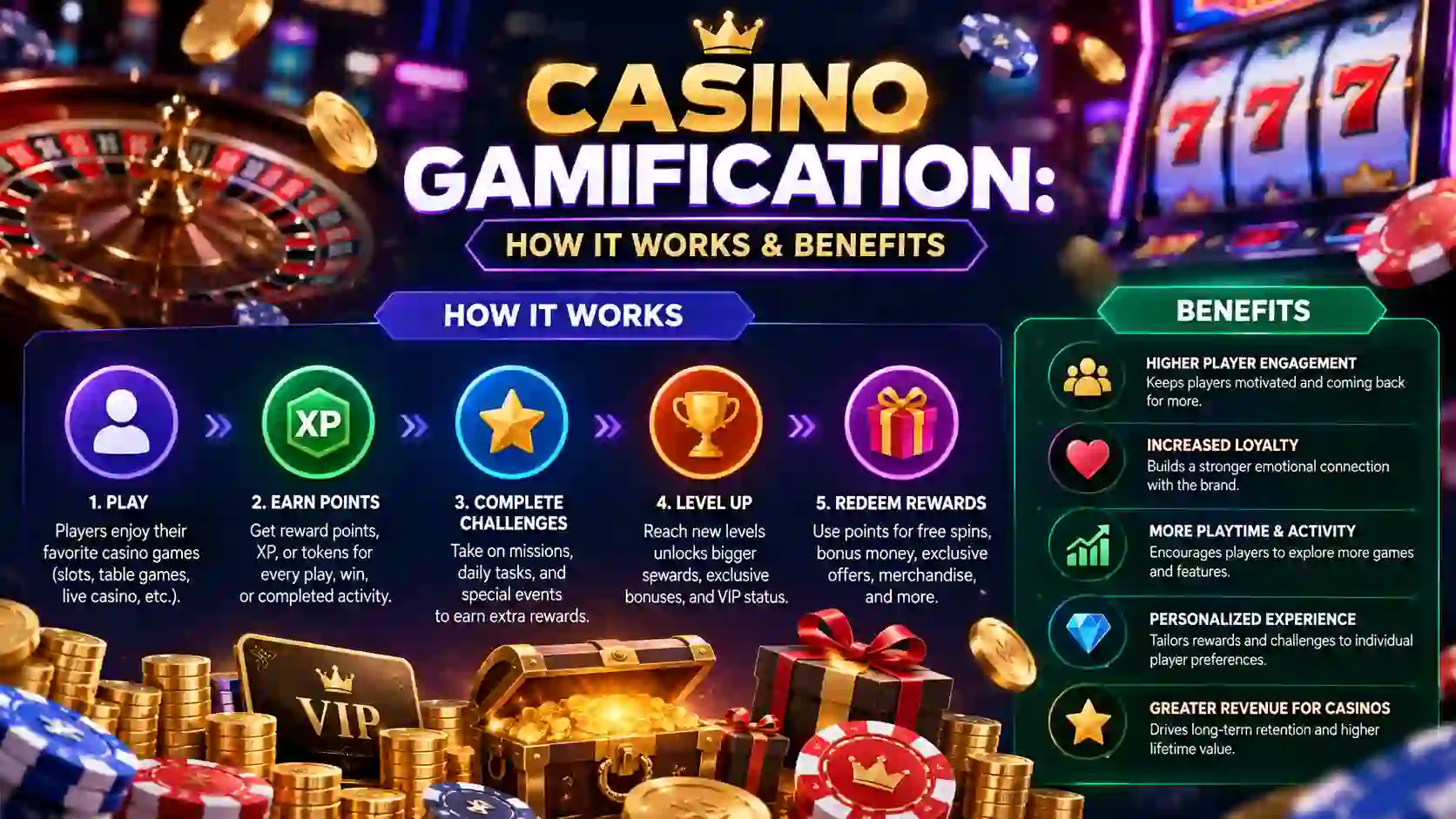
Casino gamification works by combining user activity, predefined objectives, progress tracking, and reward mechanisms.
Although specific systems differ between platforms, most follow a similar structure.
- Players Join a Gamified Experience
The process often begins when an eligible player creates an account or chooses to participate in a loyalty or rewards program.
Depending on the platform, users may have access to an achievement dashboard, membership profile, virtual points balance, or collection of available challenges.
The dashboard provides an overview of the gamification features and explains how players can participate.
For transparency, users should be able to understand which activities count toward progress, what rewards are available, and whether any conditions apply.
- Players Complete Activities or Challenges
The next stage involves completing specific tasks.
These activities might include exploring platform features, learning game rules, participating in eligible promotional events, or reaching a loyalty milestone.
Some commercial gamification systems also connect challenges to gambling activity, such as playing qualifying games. These designs require particular care because they can create incentives to spend additional money or gamble for longer.
A well-designed system distinguishes optional entertainment features from activities that involve financial risk.
- The System Tracks Progress
Gamification platforms use tracking technology to record relevant activity and determine whether a participant has completed an objective.
Progress may be displayed through:
- Percentage-based progress bars
- Virtual experience points
- Achievement counters
- Loyalty status indicators
- Completed mission histories
Visible progress helps users understand where they stand within the system.
For example, a profile might show that a player has completed three out of five educational challenges needed to unlock a virtual achievement.
This provides a sense of progression without necessarily requiring additional gambling.
- Players Receive Rewards or Recognition
When a qualifying objective is completed, the platform provides the associated reward.
Rewards can be financial or non-financial, depending on the program.
Common examples include virtual badges, loyalty recognition, profile customization options, promotional credits, and access to certain membership benefits.
Real-money or gambling-related rewards may carry eligibility conditions, wagering requirements, expiry dates, or other restrictions.
Consequently, transparent reward information is an essential part of responsible casino gamification.
- The Experience Continues Through New Objectives
Many gamification systems introduce additional challenges, seasonal activities, or achievement levels over time.
This creates an ongoing experience rather than a single promotional interaction.
Operators may update objectives based on platform improvements, user feedback, and relevant behavioral data.
However, continued participation should remain a choice. Players should not face pressure to keep gambling simply to avoid losing progress or missing a reward.
Key Features of Casino Gamification
Casino gamification combines several interactive features. Each serves a different purpose, from recognizing user achievements to organizing loyalty benefits.
Here are some of the most common gamification elements found across online casino platforms.
- Loyalty Points and Reward Programs
Loyalty programs are among the most recognizable examples of gamification in online casinos.
They allow eligible users to accumulate points or progress toward membership milestones according to predefined rules.
Depending on the program, points may be connected to account activity, qualifying participation, or promotional events.
Accumulated points might provide access to virtual recognition, selected rewards, or membership benefits.
For operators, loyalty systems provide a structured way to recognize returning customers.
For players, they make available benefits easier to understand and track.
Nevertheless, loyalty rewards should not be presented as compensation for gambling losses or as a reason to exceed a personal spending limit.
- Missions and Challenges
Casino missions introduce specific objectives that users can choose to complete.
These may include simple activities, such as exploring a new platform feature, reading a game guide, or participating in an eligible event.
Other programs feature more complex objectives with multiple stages.
For example, a casino might create a themed educational challenge in which users learn about game rules, return-to-player percentages, and responsible gambling tools.
Completing each stage could unlock a digital badge or a non-monetary collectible.
Challenges create a more structured platform experience, but gambling-linked missions can become problematic if completing them requires escalating deposits, increasing stakes, or extending playing sessions.
- Levels and Achievement Badges
Levels provide a visual representation of progression, while achievement badges recognize completed milestones.
A casino might use several membership levels, each associated with defined benefits.
Badges can represent activities such as completing tutorials, exploring new features, or participating in optional community events.
These elements appeal to users who enjoy collecting achievements and monitoring their progress.
They also allow casinos to create a distinctive identity through customized artwork, themed rewards, and recognizable profile features.
Importantly, status levels should not encourage users to gamble beyond their means to maintain or improve their ranking.
- Leaderboards and Tournaments
Leaderboards display rankings based on specified performance measures.
They are commonly associated with multiplayer video games, competitive events, and tournaments.
In casino environments, they may appear in promotional competitions or other permitted activities.
A leaderboard can introduce social interaction and competition, particularly when participants can follow standings and event outcomes.
However, competition based on wagering volume, financial losses, or spending can create considerable risks.
Responsible implementations should avoid pressuring customers to increase gambling activity to outperform others.
- Progress Bars and Visual Milestones
Progress bars show users how close they are to completing an objective.
They are simple but effective design tools because they turn an abstract goal into visible progress.
For example, a user might see:
Achievement progress: 4 of 5 learning modules completed.
This type of indicator helps people understand what remains to be done.
Progress tracking can also improve usability by reducing confusion around multi-stage activities.
However, it should not mislead users about reward eligibility or encourage unnecessary gambling to finish an almost-completed challenge.
- Personalized Rewards and Experiences
Some casino platforms use account preferences and permitted behavioral data to customize parts of the user experience.
This may involve recommending educational content, displaying relevant interface features, or presenting eligible rewards.
Personalization can make a platform easier to navigate and reduce irrelevant communications.
For operators, it can also support more relevant customer experiences.
Nevertheless, personalization raises important privacy and responsible gambling concerns.
Operators should not use behavioral insights to exploit financial vulnerability, gambling-related distress, or a user’s difficulty stopping play.
Why Is Gamification Used in Online Casinos?
The underlying appeal of gamification comes from familiar psychological concepts, including achievement, motivation, progress, and recognition.
People often enjoy seeing tangible evidence that they have completed a task or reached a milestone.
Gamification turns those experiences into visible features such as badges, levels, and progress indicators.
Research supports the idea that gamification can influence engagement in certain digital environments.
For example, a systematic review published in PLOS ONE examined gamification and engagement with online programs. Its findings were mixed: some studies reported improved engagement, while others found no significant effect.
This distinction matters.
Research into gamification in education, health, or other digital applications cannot automatically establish the same benefits in real-money gambling.
Casino operators must therefore evaluate their own systems carefully rather than assuming every gamified feature will improve the customer experience.
In particular, increasing time spent gambling should not automatically be treated as a positive outcome.
Benefits of Casino Gamification for Players
When implemented responsibly, casino gamification can offer several advantages for adult users.
- A More Interactive Experience
Traditional casino platforms generally organize the experience around selecting and playing games.
Gamification adds another layer of interaction through achievements, progress indicators, and optional activities.
This can make exploring the platform feel more structured and entertaining.
Users who enjoy collecting digital rewards or completing challenges may appreciate having additional features beyond the gambling games themselves.
- Clearer Goals and Progress Tracking
Gamified dashboards can make complicated loyalty systems easier to understand.
Instead of trying to interpret scattered promotional information, users can see available objectives, completed achievements, and reward conditions in one place.
Clear progress indicators are particularly useful when paired with straightforward explanations.
Players should always be able to distinguish between earned rewards, pending rewards, and benefits subject to additional conditions.
- Greater Recognition
Virtual achievements can recognize participation without necessarily offering financial incentives.
Badges, profile customization, and completion certificates are examples of non-cash recognition.
These features can create a sense of accomplishment while reducing reliance on gambling-related promotions.
However, recognition systems should remain optional and should not penalize customers for taking breaks.
- Additional Entertainment Options
Gamification can introduce activities that are separate from placing wagers.
Educational quizzes, themed collections, interactive tutorials, and virtual achievements are potential examples.
Such features can broaden the platform experience and offer users different ways to interact with casino-related content.
The most responsible designs avoid making real-money gambling a requirement for every form of participation.
Benefits of Casino Gamification for Operators
Casino gamification also offers potential business advantages, particularly when it forms part of a wider customer experience strategy.
- Improved Customer Engagement
Interactive features can encourage customers to explore parts of a platform they might otherwise overlook.
A clearly presented achievement system, for example, can introduce users to account tools, game information, loyalty terms, or educational resources.
This gives operators more opportunities to communicate useful information.
Importantly, meaningful engagement should be measured through factors such as usability, customer understanding, and satisfaction rather than gambling frequency alone.
- Stronger Customer Relationships
A consistent rewards experience can help operators build familiarity with their users.
When customers understand how a program works and receive the benefits they were promised, it can support trust.
Clear communication, predictable reward rules, and responsive customer service all contribute to this relationship.
Gamification may complement these qualities, but it cannot replace them.
- Better Brand Differentiation
Online casinos often compete through game libraries, website design, customer support, and promotions.
Gamification offers another way to distinguish a platform.
For instance, an operator might build an original achievement system around a fantasy theme, digital collectibles, or a personalized membership dashboard.
Distinctive visuals and carefully designed interactions can make the brand more recognizable.
However, originality should not come at the expense of transparency or player protection.
- More Effective Loyalty Program Management
Gamification allows operators to organize customer benefits into a consistent structure.
Rather than managing disconnected promotions, an operator can provide a centralized interface showing membership information, reward eligibility, and achievement histories.
This may simplify communication and reduce customer confusion.
The system can also help teams understand which features are useful, which are ignored, and which require improvement.
- Useful Customer Experience Insights
Gamification platforms can generate information about feature usage.
For example, operators may assess how often users access a rewards dashboard, whether they understand challenge instructions, or where they abandon a non-wagering tutorial.
These insights can inform product improvements.
Analytics should also identify potential harm, such as escalating spending, extended gambling sessions, or changes in behavior indicating loss of control.
Customer data should be collected and used in accordance with applicable privacy and gambling regulations.
- Opportunities for Responsible Innovation
Perhaps the most promising benefit is the opportunity to apply engaging design techniques to player protection.
Operators can use interactive experiences to explain gambling probabilities, introduce spending limits, and make responsible gambling features easier to understand.
For example, a short interactive tutorial could explain why a game’s return-to-player percentage does not predict an individual’s next result.
This approach uses gamification to support informed decision-making rather than simply encourage more gambling.
Example of Casino Gamification in Practice
Consider a hypothetical online casino introducing a themed achievement program called Explorer Rewards.
The program focuses on platform education and non-monetary achievements.
A new adult user can access several optional activities:
- Read an introductory guide explaining how online slots work.
- Complete a short quiz about game probabilities.
- Explore the account’s spending-limit settings.
- Learn how to access transaction history.
- Review the platform’s responsible gambling resources.
After completing the activities, the user receives a digital Explorer badge and unlocks a customizable profile theme.
A progress dashboard displays completed tasks and explains what remains.
No real-money wager is necessary, and the achievement does not improve gambling odds or offer cash rewards.
This example illustrates how a casino can introduce gamification while emphasizing usability, education, and player control.
Commercial casino reward programs may operate differently and involve gambling-related incentives. Those systems require additional safeguards and regulatory consideration.
Challenges and Risks of Casino Gamification
Despite its potential benefits, gamification introduces challenges that operators should not ignore.
Encouraging Excessive Gambling
One of the biggest concerns is that gamified rewards can motivate users to continue gambling beyond their planned limits.
Time-limited missions, spending-based achievements, and competitive rankings may increase pressure to participate.
This can be particularly concerning for users already experiencing difficulty controlling their gambling.
Fear of Missing Out
Some gamification systems rely on limited-time offers or exclusive rewards.
These features may encourage users to return quickly or complete an activity before a deadline.
When such incentives are connected to real-money gambling, they can create pressure to make decisions without adequate consideration.
Operators should avoid unnecessary urgency, particularly when financial spending is involved.
Misunderstanding Rewards
Complex loyalty programs can make it difficult for customers to understand the real value of rewards.
For example, a promotional credit may appear valuable but may be subject to restrictions affecting its use or withdrawal.
Clear terms are essential, including information about eligibility, wagering requirements, expiry dates, and available withdrawals.
Privacy and Data Protection
Personalized gamification often depends on collecting information about user behavior.
Without appropriate safeguards, this creates risks involving excessive data collection, unclear consent, and intrusive targeting.
Operators need transparent privacy practices, proportionate data collection, and appropriate controls over customer information.
Gambling-Related Harm
The wider risks of gambling must remain central to any evaluation.
The World Health Organization’s gambling fact sheet, published in December 2024, explains that gambling can contribute to financial distress, relationship difficulties, and serious health consequences.
These concerns make it especially important to distinguish responsible customer engagement from features designed to intensify gambling activity.
Responsible Casino Gamification: What Operators Must Consider
Successful gamification is not simply about offering attractive rewards.
It requires a balance between entertainment, regulatory compliance, transparency, and player protection.
Clear Terms and Conditions
Every reward system should explain how participation works.
Customers need to understand eligibility requirements, reward values, restrictions, and expiry conditions before deciding whether to participate.
Misleading information can undermine trust and create regulatory problems.
Compliance With Gambling Regulations
Gambling regulations differ between countries, and a gamification feature permitted in one jurisdiction may be restricted in another.
The United Kingdom provides a useful example.
Under the UK Gambling Commission’s rewards and bonuses rules, requirements effective from January 19, 2026, include a maximum wagering requirement of 10 times bonus funds and restrictions on combining different types of gambling products within a single incentive.
These requirements demonstrate why operators need to review reward mechanics before launching them.
A gamified promotion should never be assumed to be compliant simply because it resembles a familiar loyalty program.
Responsible Product Design
The UK Gambling Commission also sets responsible product design standards.
These standards prohibit certain design features that encourage behaviors such as chasing losses or continuing to gamble after deciding to stop.
The broader lesson is straightforward: game-inspired design should not override customer control.
Player Protection Tools
Gamified platforms should make responsible gambling controls accessible and easy to use.
These may include:
- Deposit and spending limits
- Session reminders and time-outs
- Account activity and transaction histories
- Self-exclusion options
- Clear access to gambling support services
Importantly, reward systems should not discourage customers from using these tools.
Identifying Customers at Risk
Operators should also monitor indicators of potential gambling harm.
The UK Gambling Commission’s customer interaction guidance requires licensed remote operators to identify, act on, and evaluate indicators of harm.
It also requires operators to prevent marketing and access to new bonus offers when strong indicators of harm are identified.
This means gamification systems should be connected to responsible gambling controls, not operate independently of them.
How Can Casino Operators Implement Gamification Successfully?
Building an effective gamification strategy requires more than adding colorful badges or reward notifications.
Operators should begin by identifying the purpose of each feature and evaluating its potential impact.
Start with clear objectives. Decide whether a gamification feature is intended to improve navigation, explain loyalty benefits, encourage educational participation, or enhance customer satisfaction.
Understand the intended audience. Design experiences that are accessible to eligible adult users and avoid features that exploit vulnerability or financial pressure.
Keep participation optional. Users should be able to decline promotional activities without losing access to essential account functions.
Use transparent reward structures. Explain how achievements are earned, whether payments are necessary, and what conditions apply.
Integrate player protection. Ensure that spending limits, self-exclusion, harm-detection systems, and marketing restrictions take precedence over gamification objectives.
Test outcomes carefully. Evaluate usability, customer satisfaction, complaints, reward understanding, and potential harm indicators.
A responsible operator should also review its gamification program regularly.
If a feature appears to encourage excessive gambling or generates frequent customer misunderstandings, it should be redesigned or withdrawn.
The Future of Casino Gamification
Casino gamification is likely to evolve as digital platforms become more sophisticated.
Emerging technologies could support more interactive interfaces, improved personalization, and more flexible achievement systems.
Artificial intelligence may help operators organize relevant information or identify patterns in customer behavior.
Mobile-first design may also make progress tracking and account tools easier to access.
However, greater technological sophistication introduces additional responsibilities.
Operators will need to consider how algorithms influence customer decisions, how personal information is protected, and whether engagement features create unnecessary pressure.
The most valuable developments may not be those that encourage users to spend more time gambling.
Instead, they may be features that improve transparency, user control, and the overall quality of the digital experience.
FAQs
What does gamification mean in an online casino?
Casino gamification refers to adding game-inspired features such as achievements, missions, progress tracking, loyalty points, and badges to an online casino platform. These elements create an additional interactive experience beyond traditional gambling games.
What are the main benefits of casino gamification?
Potential benefits include improved navigation, more engaging platform interactions, better-organized loyalty programs, greater brand differentiation, and clearer reward tracking. Actual results depend on the system’s design, and increased gambling activity should not automatically be considered a benefit.
Is casino gamification the same as a casino bonus?
No. A casino bonus is a specific promotional incentive, while gamification is a broader design approach. Bonuses may form part of a gamified system, but gamification can also include non-financial features such as virtual badges, tutorials, achievements, and profile customization.
Does casino gamification increase the chances of winning?
No. Gamification does not inherently change the mathematical probabilities of casino games. Rewards, badges, and loyalty levels do not improve a player’s chances of winning at slots, blackjack, or roulette unless a specific game rule or promotion explicitly changes the applicable conditions.
Are gamified casino rewards free?
Not always. Some gamified activities are free to participate in, while others may require qualifying gambling activity or contain promotional conditions. Players should carefully read the applicable terms before participating.
Is casino gamification safe?
Safety depends on how the system is designed and used. Educational challenges and optional non-financial achievements may present fewer gambling-related risks than spending-based missions or high-pressure tournaments. Transparent terms, accessible limits, appropriate regulation, and effective player protection measures are essential.
Why do casino operators use gamification?
Casino operators use gamification to create distinctive digital experiences, organize loyalty benefits, communicate with customers, and improve certain aspects of user engagement. Responsible implementation should balance these business objectives with consumer protection.
Conclusion
Casino gamification is changing how online casino platforms design customer experiences. By introducing missions, achievements, loyalty points, progress tracking, and interactive features, operators can create experiences that extend beyond traditional casino gameplay.
For players, well-designed gamification may make platforms easier to navigate, improve reward transparency, and provide additional entertainment options. For operators, it offers opportunities to strengthen brand identity, improve communication, and develop more organized customer experiences.
However, these benefits are not automatic.
Gamification can also create risks when rewards pressure users to gamble longer, spend more money, or make decisions based on urgency rather than personal limits.
Ultimately, the most effective approach to casino gamification combines engaging design with transparency, regulatory compliance, and meaningful responsible gambling safeguards.
The future of casino gamification should not be measured simply by how often customers return. It should also be judged by how well platforms protect users, communicate clearly, and provide an experience built on trust.
ADVERTISEMENT

18+ | Affiliate link | Terms apply | Please gamble responsibly.


