

18+ | Affiliate link | Terms apply | Please gamble responsibly.
Last Updated on October 1, 2026 by Maurya
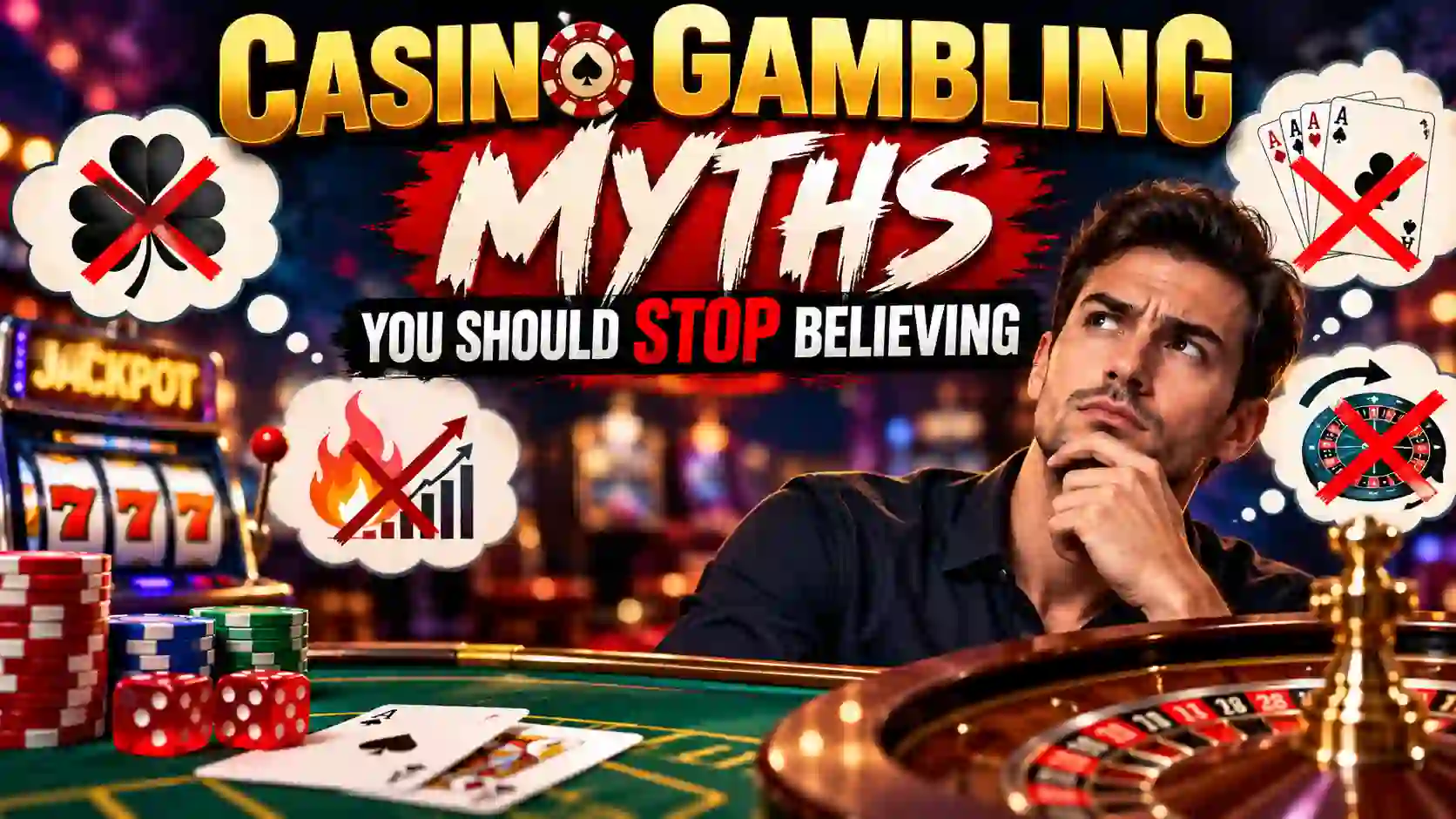
Some come from movies. Others are passed between players at blackjack tables, roulette wheels, slot machines, and online gambling forums. A player wins three times in a row and suddenly has a “system.” A slot machine goes hours without a jackpot and someone claims it must be ready to pay. Red appears six times on a roulette wheel, so surely black is next.
These ideas can sound convincing, particularly when they are backed by personal stories. The problem is that probability does not care about stories.
Understanding the most common casino gambling myths is important because false beliefs about randomness, winning streaks, losses, and control can influence how people gamble. Research into gambling psychology has repeatedly identified cognitive distortions such as the gambler’s fallacy and illusion of control. A meta-analysis of gambling-related cognitive distortions found particularly strong evidence surrounding beliefs such as the gambler’s fallacy.
Myth 1: “After Several Losses, a Win Must Be Coming”
This is perhaps the most famous gambling misconception of all.
Imagine a roulette wheel lands on red seven times consecutively. Many players instinctively believe black has become more likely on the eighth spin.
It has not.
Assuming the roulette game is operating normally, previous spins do not create a debt that the wheel must repay. Each new spin is a separate event. A sequence that looks unusual to a human observer does not necessarily change the probability of what happens next.
This mistaken belief is known as the gambler’s fallacy.
The same mental error occurs outside casinos. If a fair coin lands heads several times, people often begin believing tails is “due.” Researchers define the gambler’s fallacy precisely around this mistaken expectation that one outcome becomes more likely simply because another outcome has appeared repeatedly.
Randomness does not try to balance itself over the next few outcomes.
Large samples may move toward expected statistical proportions, but that does not mean short-term results must alternate neatly.
Reality: A losing streak does not make your next independent wager more likely to win.
Myth 2: “A Slot Machine That Hasn’t Paid Recently Is Due for a Jackpot”
This is the slot-machine version of the gambler’s fallacy.
Someone watches another player lose repeatedly on a machine and thinks:
That machine has taken enough money. Now is the perfect time to play.
On properly regulated random gaming machines, that reasoning does not work.
The UK Gambling Commission explains that, for random machines, the odds of winning on the current game remain constant and are not affected by previous wins or losses.
Modern regulated games commonly use random number generation technology to determine outcomes. UK technical requirements state that relevant RNG output must be acceptably random, unpredictable, and distributed according to the expected probabilities.
That means a machine can experience a long run without a major payout and still not be “due” in the way players sometimes imagine.
Likewise, a machine that has just produced a large win does not automatically become a bad choice because it has supposedly “used up” its winnings.
Reality: Previous outcomes on a random slot do not tell you when the next winning spin will arrive.
Myth 3: “RTP Means You Will Get That Percentage of Your Money Back”
Return to Player, or RTP, is one of the most misunderstood statistics in casino gambling.
Suppose a game has an advertised RTP of 96%. A player might assume that wagering £100 means they should receive approximately £96 back.
That is not what RTP means.
RTP is a theoretical or statistical measure calculated across a very large number of plays. It is not a promise about an individual player’s session.
The Gambling Commission specifically notes that if a machine displays an 85% RTP, a player should not expect to receive 85 pence back from every £1 wagered during an individual session. RTP averages may be calculated across tens of thousands, hundreds of thousands, or even more plays depending on the type of machine.
Short sessions can vary enormously.
One player could finish ahead. Another could lose their entire bankroll. Neither result disproves the published RTP.
Reality: RTP describes long-run theoretical performance, not what an individual player is guaranteed to receive.
Myth 4: “Casinos Need to Cheat to Make Money”
A regulated casino does not need every customer to lose every session to maintain a mathematical advantage.
Casino games are generally structured so that the rules themselves provide the operator with a statistical advantage over time, commonly described as the house edge or margin.
Individual players can and do win. Some may have remarkably successful sessions.
That does not contradict the mathematics.
The house edge becomes relevant across repeated wagering and large numbers of transactions. This is why short-term casino results can appear unpredictable while the underlying game can still favour the operator mathematically over the long run.
Regulatory frameworks also require considerable transparency around this issue. In Great Britain, for example, licensed casinos must provide information about game rules and a player’s guide to the house edge.
For remote gambling products covered by UK technical standards, information may include the house edge, RTP, margin, or probability of winning events.
This does not mean illegal or unregulated gambling operations can automatically be trusted. The distinction between regulated and unregulated operators matters.
Reality: Legitimate regulated casino games can be profitable for operators because of their built-in mathematical structure; cheating is not required for the house to have an advantage.
Myth 5: “Betting Systems Can Guarantee Roulette Profits”
Roulette has inspired countless betting systems.
They often involve increasing or decreasing wagers according to previous results. On paper, some systems can create the impression that a player has discovered a way around probability.
The critical problem is simple:
Changing the size of your next wager does not change the probability of where the ball lands.
A progression system can change the pattern and size of wins and losses. It can also dramatically change how much money is exposed during a losing sequence. But it cannot make independent random outcomes obey the player’s betting pattern.
A strategy that relies on eventually recovering every previous loss is particularly vulnerable to long losing sequences, bankroll limitations, and casino betting limits.
No staking sequence can transform a negative-expectation casino game into guaranteed long-term profit simply by rearranging wager amounts.
Reality: Betting patterns can change risk exposure, but they cannot guarantee roulette profits or alter the underlying probability of independent spins.
Myth 6: “Near Misses Mean You’re Getting Closer to Winning”
You spin a slot and two jackpot symbols land perfectly.
The third stops one position away.
It feels completely different from an obvious losing combination.
Psychologically, it may be.
Mathematically, however, an unsuccessful outcome is still an unsuccessful outcome. You are not necessarily progressing toward a future jackpot simply because the screen visually resembles a winning combination.
Research helps explain why near misses can feel unusually powerful. A systematic review examining 51 experimental studies found that near misses can motivate continued play, although their effects on emotion and betting behaviour vary.
Another neuropsychological study found that near-miss outcomes could increase motivation to continue playing relative to full misses among comparison groups.
That emotional response should not be confused with a change in probability.
Reality: “Almost winning” can feel meaningful without making the next random outcome more likely to win.
Myth 7: “Lucky Players Have Discovered Something Everyone Else Missed”
Casinos naturally produce impressive stories.
Someone wins on their first spin. Another person leaves a roulette table with several times their starting bankroll. Somebody hits a jackpot minutes after entering a casino.
We remember these stories because they are interesting.
What receives less attention are thousands of ordinary sessions where nothing extraordinary happens.
This creates fertile ground for survivorship bias and selective memory. Highly visible winners can make winning appear more common or predictable than it actually is.
Short-term luck is real in the everyday sense that random variation produces different results for different players.
But a fortunate sequence does not prove that a person possesses a special ability to predict fundamentally random outcomes.
There is an important distinction here: some casino games contain meaningful elements of player decision-making, while others are overwhelmingly or entirely determined by chance. Skill in one context should not be generalized into supernatural control over random numbers, cards, wheels, or reels.
Reality: A winning streak demonstrates that somebody experienced a favourable sequence. It does not prove that the player can control random outcomes.
Myth 8: “If You Keep Playing Long Enough, You’ll Eventually Get Your Money Back”
This belief can be especially costly.
After losing £100, a player continues because stopping would make the loss feel permanent. After losing another £100, they increase their wagers because recovering £200 now feels necessary.
The process is commonly called chasing losses.
Continuing to gamble does not turn previous losses into an amount the casino mathematically owes you.
Instead, additional wagering creates additional exposure to risk.
Loss chasing is significant enough to appear prominently in gambling research. A 2023 systematic scoping review describes it as continuing or intensifying gambling after losses and notes its importance in gambling disorder research.
UK regulatory requirements also state that gambling products must not actively encourage customers to chase losses, increase stakes, spend more than intended, or continue after indicating a wish to stop.
There is no mathematical reset button created by continuing a session.
Reality: More gambling creates more opportunities for both wins and losses; it does not guarantee recovery of money already lost.
Myth 9: “Hot and Cold Streaks Let You Predict What Happens Next”
Humans are extremely good at finding patterns.
Sometimes too good.
If a blackjack table seems unusually favourable or a roulette number appears multiple times within a short period, people naturally begin assigning meaning to the sequence.
We describe machines as “hot,” tables as “cold,” and players as being “on fire.”
These descriptions can be useful ways of talking about what has already happened.
The mistake occurs when a description of past results becomes a prediction about an independent future event.
Random sequences frequently contain clusters.
Flip a coin hundreds of times and you should expect to see runs of heads and tails. Genuine randomness does not mean perfectly alternating outcomes.
In fact, sequences that look suspiciously streaky to humans can be perfectly compatible with random processes.
Reality: A streak describes previous outcomes. By itself, it does not establish that the same pattern will continue—or reverse—on the next independent wager.
Myth 10: “Casinos Change the Odds Because You’re Winning”
A player wins several times and suddenly loses.
One explanation quickly appears:
“The casino noticed I was winning and changed the game.”
That is a serious allegation and should not be treated casually.
In properly regulated random gambling systems, standards are designed specifically to address fairness and randomness. The UK Gambling Commission’s remote gambling requirements state that RNG outcomes must be demonstrably random and unpredictable and that game outcomes should follow expected or theoretical probabilities.
Its casino equipment standards similarly require acceptable randomness for relevant RNG equipment.
Importantly, this should not be interpreted as evidence that every gambling website on the internet is trustworthy. Players should distinguish licensed, regulated operators from unlicensed or questionable platforms, and rules vary by jurisdiction.
But a normal sequence of wins followed by losses is not evidence that a regulated casino personally changed your odds.
Random variation alone can produce dramatic swings.
Reality: Winning and losing streaks are not, by themselves, evidence that a legitimate casino is manipulating an individual player’s results.
Myth 11: “Superstitions Can Influence Casino Results”
Casino culture is full of rituals.
Some players refuse to sit in particular seats. Others have lucky numbers, lucky clothes, favourite dealers, specific ways of touching cards, or rituals they perform before spinning.
There is nothing wrong with a harmless tradition if someone recognizes it as entertainment.
The problem begins when superstition is mistaken for causation.
Researchers studying gambling cognition frequently discuss the illusion of control—the tendency to perceive greater personal influence over outcomes than circumstances justify. Reviews of gambling-related cognitive distortions identify illusion of control alongside the gambler’s fallacy as a recurring theme.
Wearing a particular shirt may coincide with a winning night.
That does not establish that the shirt caused the cards, wheel, dice, or random number generator to produce favourable results.
Reality: Personal rituals may change how you feel about the experience, but they do not alter the mathematics of a random casino game.
Myth 12: “Winning at Casino Games Is a Reliable Way to Make Money”
Perhaps the most important casino myth is the idea that gambling can be treated like dependable income.
Casino results are uncertain by definition.
Short-term winnings are possible, and sometimes they are substantial. But possibility should not be confused with reliability.
For games with a house edge, repeated wagering means repeatedly exposing money to a mathematical disadvantage. Even in games involving skill or strategic decisions, variance and uncertainty remain.
This is why gambling should not be treated like a salary, savings account, or investment plan.
Financial decisions are particularly vulnerable when gambling shifts from entertainment toward recovering debt, covering essential expenses, or producing required income.
The potential consequences extend beyond money. The Gambling Commission describes gambling harm as potentially affecting finances, employment, relationships, and physical and mental wellbeing.
Reality: Casino gambling involves financial risk and uncertain outcomes. It should never be considered guaranteed or reliable income.
Why Casino Gambling Myths Are So Convincing
If these myths are mathematically questionable, why do they survive?
Because human intuition did not evolve specifically to understand random number generators and probability tables.
Our brains search for patterns, explanations, and cause-and-effect relationships. When something memorable happens immediately after an action, it is natural to connect the two.
Gambling environments can make those instincts particularly noticeable.
A dramatic near miss feels significant.
Three wins feel like momentum.
Eight losses feel like something must change.
A personal ritual followed by a jackpot feels causal.
Research suggests these beliefs are more than harmless intellectual mistakes. A study examining gambling fallacies found relationships between false gambling beliefs and behaviours including loss chasing and overspending, while longitudinal evidence linked earlier fallacy measures with later gambling problems.
Understanding randomness therefore matters for more than winning an argument about roulette.
It helps players separate what they can actually control from what they cannot.
What Can You Actually Control When Gambling?
You cannot command the next roulette number, force a random slot to produce a jackpot, or make previous losses change the probability of an independent future event.
You can control your own decisions.
That includes deciding whether to gamble at all, choosing how much money you are prepared to risk, understanding a game’s rules before playing, checking published information such as RTP or house edge where available, limiting the length of a session, and stopping rather than treating losses as money that must immediately be recovered.
This distinction is fundamental.
Knowledge does not make gambling risk-free. Understanding probability simply makes it easier to recognize when a decision is being driven by mathematics and when it is being driven by a myth.
FAQs
Do slot machines become “due” after a long losing streak?
For regulated random machines, previous wins and losses do not make the next independent game more likely to win. The Gambling Commission explicitly states that on random machines the odds of a win in the current game remain constant and are unaffected by earlier wins or losses.
Can casinos control who wins?
Licensed gambling operators are subject to the regulatory requirements of their jurisdictions. In Great Britain, relevant RNG systems must meet standards for randomness and unpredictability. Players should still verify that an operator is properly licensed rather than assuming every gambling website is regulated.
Is roulette black more likely after several reds?
Not simply because several reds occurred beforehand. Believing that the opposite outcome becomes “due” after a streak is the classic gambler’s fallacy.
Does a near miss mean a slot is close to paying?
No. A near miss can have a strong psychological effect, but it does not prove that a future jackpot is approaching. Research has found that near misses can encourage continued play, which helps explain why they feel meaningful.
Can a casino betting system guarantee a profit?
No staking progression can guarantee profits from independent casino outcomes. Changing wager sizes changes financial exposure; it does not change the underlying probability of the roulette ball, dice, cards, or random number generator producing a particular outcome.
Is RTP guaranteed for every gambling session?
No. RTP is a long-term theoretical or statistical percentage measured across very large numbers of plays. Individual sessions can produce results far above or below the published percentage.
Final Thoughts
The most persistent casino gambling myths usually contain the same underlying mistake: treating random outcomes as though they remember the past, reward persistence, recognize patterns, or respond to a player’s emotions.
They do not.
A roulette wheel does not know that you lost your previous five bets. A random slot does not know that you are frustrated. A near miss does not promise that the next spin will be better. An RTP figure does not guarantee the result of tonight’s session.
Understanding those facts will not turn gambling into a guaranteed way to win.
That is precisely the point.
The most useful gambling knowledge is not a supposed secret capable of defeating randomness. It is an accurate understanding of probability, house edge, RTP, randomness, cognitive bias, and financial risk.
Casino games can produce winning sessions, losing sessions, astonishing streaks, and improbable-looking sequences. None of those outcomes changes the basic rule:
Randomness does not owe anyone a win.
Treat casino gambling as paid entertainment with uncertain financial outcomes—not as a system that can be forced to repay losses or provide dependable income. If gambling stops feeling recreational or begins affecting finances, relationships, work, or wellbeing, stepping away and seeking appropriate support is more important than finding another betting strategy.
ADVERTISEMENT

18+ | Affiliate link | Terms apply | Please gamble responsibly.


