

18+ | Affiliate link | Terms apply | Please gamble responsibly.
Last Updated on October 17, 2026 by Maurya
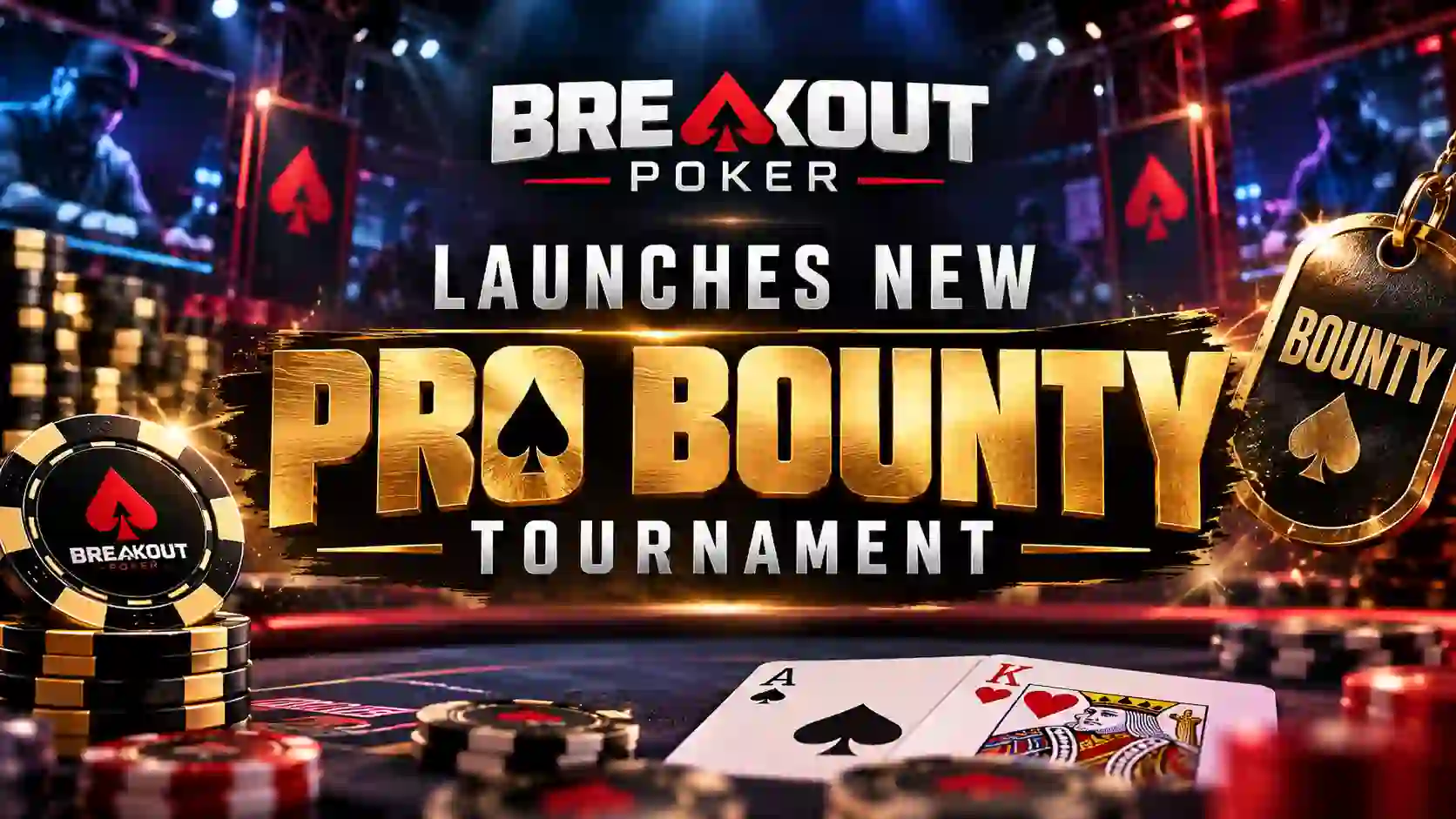
Breakout Poker Launches New Pro Bounty Tournament: Poker Legends, BRK Rewards, and an Innovative Freeroll Format
Breakout Poker introduced its Pro Bounty Tournament in March 2018, offering registered players an opportunity to compete against established poker professionals without paying an entry fee. The tournament combined a $2,000 prize allocation in BRK cryptocurrency with special knockout bounties worth $50 in BRK for eliminating participating professional players.
For recreational poker enthusiasts, facing a World Series of Poker champion usually requires entering a competitive tournament or securing a seat at a high-stakes table. Breakout Poker introduced a different opportunity through its Pro Bounty Tournament, bringing well-known poker professionals and everyday players together in a monthly online competition.
The announcement attracted attention for several reasons. There was no tournament buy-in, recognised professionals were involved, and prizes were distributed using Breakout Coin (BRK), the cryptocurrency associated with the Breakout Gaming ecosystem.
The event also reflected two important developments in online gaming at the time: growing interest in knockout poker tournaments and experimentation with cryptocurrency-based payments.
Although the original promotion dates back to 2018, its structure remains an interesting example of how online poker operators have combined professional sponsorships, accessible tournaments, and digital assets to engage players.
What Was the Breakout Poker Pro Bounty Tournament?
The Breakout Poker Pro Bounty Tournament was a monthly online poker freeroll designed to give eligible registered players the opportunity to compete against professional poker ambassadors.
Unlike conventional tournaments, where participants concentrate primarily on reaching paid positions, this event offered additional rewards for eliminating designated professional players.
According to the March 2018 launch announcement, the tournament featured a prize allocation valued at $2,000 in Breakout Coin (BRK), alongside individual professional knockout bounties valued at $50 in BRK.
The format combined three appealing features: free tournament entry, competition against accomplished poker players, and cryptocurrency-denominated rewards.
Participants did not need to defeat the entire field to have a chance at earning a professional bounty. Eliminating an eligible featured professional could provide a separate reward under the tournament’s rules.
This created an additional objective beyond simply surviving until the final table.
The event formed part of Breakout Poker’s broader promotional strategy following its involvement with the GG Network, an online poker network that supplied shared player liquidity and tournament infrastructure.
Breakout Poker Pro Bounty Tournament
The following information reflects the original 2018 announcement and contemporary coverage.
| Tournament Feature | Announced Details |
| Tournament name | Breakout Pro Bounty Tournament |
| Launch period | March 2018 |
| Operator | Breakout Poker |
| Tournament format | Online poker freeroll with professional knockout bounties |
| Entry fee | Free for eligible registered players |
| Advertised prizes | $2,000 worth of BRK |
| Professional bounty | $50 worth of BRK per eligible knockout |
| Frequency | Monthly |
| Announced start time | 20:05 UTC |
| Prize currency | Breakout Coin (BRK) |
| Featured participants | Selected Breakout Poker professional ambassadors |
There was a minor discrepancy in contemporary scheduling information. The original press release described the event as taking place on the last Thursday of each month, while a subsequent sponsored PokerNews article identified the fourth Thursday.
Both publications reported the same 20:05 UTC starting time. Players therefore needed to consult the official tournament lobby for the specific event date.
What Made the Pro Bounty Tournament Different?
The distinguishing feature was the opportunity to collect rewards by eliminating professional players.
Traditional multi-table poker tournaments distribute winnings according to finishing positions. Players generally need to survive long enough to reach the money before receiving a payout.
Bounty events introduce another financial incentive.
In a standard knockout tournament, designated eliminations carry a predetermined reward. In progressive knockout tournaments, bounty values increase as players eliminate opponents. Mystery bounty tournaments introduce an element of uncertainty by revealing rewards after qualifying eliminations.
Breakout Poker’s original promotion followed a more specific approach: selected professional players carried fixed-value bounties.
This difference matters because the original announcement did not describe the tournament as a progressive knockout or mystery bounty event.
Instead, its appeal came from allowing recreational players to test their abilities against established professionals while competing for the additional BRK rewards.
The presence of experienced opponents could also influence gameplay.
A player might normally avoid unnecessary confrontations with a skilled opponent. However, the possibility of collecting a bounty introduces another consideration when evaluating a potential elimination.
That does not make every aggressive decision profitable, but it creates strategic situations that are less common in ordinary freerolls.
Famous Poker Professionals Associated With Breakout Poker
One of the strongest attractions of the promotion was Breakout Poker’s roster of professional ambassadors.
The company assembled a team featuring recognised tournament champions, experienced high-stakes competitors, and World Series of Poker bracelet winners.
The professionals identified in the original announcement included:
- Jennifer Harman: A respected high-stakes cash-game specialist, Poker Hall of Fame member, and two-time WSOP bracelet winner.
- Todd Brunson: A Poker Hall of Fame inductee and WSOP bracelet winner with extensive experience in high-stakes poker.
- Huck Seed: The 1996 WSOP Main Event champion, known for his tournament achievements and unconventional playing style.
- Layne Flack: A multiple WSOP bracelet winner recognised for his aggressive approach to tournament poker.
- Ted Forrest: An accomplished tournament and cash-game professional with multiple WSOP bracelets.
- Jeff Lisandro: A highly successful tournament player with several WSOP titles, particularly in mixed-game formats.
- David Benyamine: A French poker professional known for high-stakes cash games and tournament success.
- Toto Leonidas: A veteran poker professional with a WSOP bracelet and experience across multiple poker formats.
- Vladimir Shchemelev: A skilled poker professional known for tournament achievements and success in mixed games.
These names gave the promotion credibility among players familiar with professional poker.
However, the promotional roster should not be confused with a confirmed participant list for every tournament. The announcement stated that a selection of professional ambassadors would appear in individual events.
For recreational players, that arrangement created an unusual opportunity: competing directly against players whose tournament results and strategies were already familiar to poker audiences.
How Did the $50 Professional Knockout Bounty Work?
The advertised professional bounty was straightforward in principle.
When a qualifying player eliminated a participating Breakout Poker professional, that elimination carried a reward worth $50 in BRK cryptocurrency.
For example, imagine a recreational player reaching the middle stages of a tournament and finding themselves seated against a featured professional.
If the professional moved all-in and the recreational player won the hand while holding sufficient chips to eliminate them, the result could qualify for the announced bounty.
The player would still retain the chips won through the hand, but the elimination could also earn the separate BRK reward.
The important distinction is that the reward was attached to the professional knockout rather than simply winning a pot against that player.
The exact conditions governing split pots, simultaneous eliminations, and bounty distribution were not fully detailed in the publicly accessible launch coverage.
Likewise, the historical announcement did not clearly establish whether the $2,000 advertised prize allocation included all professional bounties or whether those bounties were accounted for separately.
Those details would have depended on the official tournament rules.
Why Breakout Poker Used BRK Cryptocurrency for Tournament Rewards
The use of Breakout Coin was a significant part of the announcement.
In 2018, cryptocurrency payments were still an emerging feature within mainstream online gaming. Operators were exploring how digital assets could support deposits, withdrawals, and player promotions.
Breakout Gaming had developed BRK as part of its wider blockchain initiative, and Breakout Poker used the currency to connect its gaming products with that ecosystem.
Rather than awarding all tournament prizes in traditional fiat currency, the Pro Bounty Tournament offered BRK-denominated rewards.
According to the launch announcement, qualifying tournament winnings could be credited to players’ accounts or transferred to BRK wallets.
The company also stated that its poker platform accepted BRK deposits and withdrawals alongside conventional payment methods and other cryptocurrencies, including Bitcoin and Ethereum.
What Were the Potential Advantages?
Cryptocurrency-based prizes offered several possible benefits within the platform’s operating model.
They gave players exposure to a digital payment option and allowed Breakout Gaming to demonstrate practical uses for its proprietary token.
For the operator, using BRK also connected a popular poker promotion with its wider cryptocurrency project.
However, the potential benefits came with important considerations.
A prize advertised as $50 worth of BRK was not necessarily equivalent to receiving $50 in cash. Cryptocurrency prices fluctuate, and the amount a player could eventually convert into another currency would depend on market conditions, exchange access, transaction costs, and liquidity.
That distinction remains important when reviewing historical cryptocurrency promotions.
The fact that BRK was used for tournament payouts does not establish that its value remained stable or that it is currently supported by exchanges or gaming platforms.
How the Tournament Could Appeal to Recreational Poker Players
For many recreational players, the appeal of poker tournaments goes beyond the amount of money available.
Competition, decision-making, and the possibility of testing one’s abilities against strong opponents are important parts of the experience.
Breakout Poker’s Pro Bounty Tournament brought these elements together.
A Chance to Face Recognised Professionals
Most casual players are unlikely to encounter celebrated tournament champions during ordinary low-stakes games.
An organised freeroll featuring professional ambassadors created a more accessible competitive environment.
Even without winning a bounty, playing hands against experienced opponents could offer useful learning opportunities.
Players could observe betting patterns, positional decisions, and the ways more experienced competitors approached tournament situations.
Competition Without an Entry Fee
The absence of a buy-in removed the direct entry cost associated with participating in the original event.
That made the promotion more accessible to eligible players who did not want to commit money to a tournament.
Nevertheless, free entry did not eliminate every practical consideration. Participants still needed to meet the operator’s registration requirements, comply with eligibility restrictions, and understand the conditions attached to cryptocurrency rewards.
More Than One Tournament Objective
The presence of professional bounties introduced a second competitive target.
A player could aim to progress through the tournament while also looking for suitable opportunities to eliminate a featured professional.
The additional objective had the potential to create interesting table dynamics, especially when multiple players were competing for the same knockout reward.
Poker Strategy: Approaching a Professional Bounty Tournament
A bounty tournament rewards players who can identify profitable elimination opportunities, but it also punishes poor decisions.
The most useful approach is to combine standard tournament fundamentals with an understanding of how bounty rewards affect the value of a hand.
Understand Effective Stack Sizes
Effective stack size refers to the smaller stack involved in a hand.
Suppose a featured professional has 12 big blinds remaining while another player holds 40 big blinds.
The larger stack may have enough chips to survive an unsuccessful confrontation, but the decision should still be based on hand strength, opponent tendencies, and the number of chips at risk.
The bounty creates additional value, but it does not eliminate the importance of choosing profitable situations.
Avoid Chasing Every Professional Knockout
A common mistake in bounty formats is assigning too much importance to the potential reward.
Players may call large bets with weak hands simply because a bounty is available.
Although a knockout prize can influence the mathematical value of a decision, the possibility of losing a substantial portion of one’s stack must also be considered.
A disciplined player should evaluate the full situation rather than treating every opportunity to eliminate a professional as an automatic call.
Pay Attention to Position
Position remains one of the most important factors in tournament poker.
Acting later in a betting round provides additional information about opponents’ decisions.
When a professional bounty is available, strong positional awareness may help a player identify better opportunities without unnecessarily exposing their entire stack.
Balance Aggression With Tournament Survival
Aggression can be useful in knockout tournaments because accumulating chips increases the number of opponents a player can potentially eliminate.
However, unnecessary confrontations can quickly destroy a promising tournament position.
The objective should be to create profitable opportunities rather than force action.
This strategic distinction is consistent with broader knockout-tournament guidance, although the precise mathematics of progressive bounty formats should not be automatically applied to Breakout Poker’s fixed professional bounties.
Breakout Poker’s Connection With the GG Network
At the time of the 2018 announcement, Breakout Poker operated within the GG Network.
An online poker network allows participating poker brands to share player liquidity, helping support a larger collection of cash games and tournament events than many smaller standalone operators could maintain independently.
For an emerging poker brand, network membership could make it easier to provide consistent tournament activity while concentrating on marketing, promotions, and community development.
Breakout Poker’s approach combined that network infrastructure with a distinct identity built around professional ambassadors and cryptocurrency integration.
The Pro Bounty Tournament was particularly well suited to this strategy.
It offered a recognisable promotion that players could associate specifically with Breakout Poker rather than with the underlying network alone.
In a competitive online poker market, creating that distinction was an important marketing objective.
Why Professional Bounty Tournaments Matter in Online Poker
Bounty tournaments have become an established part of the online poker experience because they change the relationship between survival and reward.
In a conventional tournament, a player may spend several hours competing without receiving a payout.
A knockout format offers additional opportunities for rewards before the final finishing positions are determined.
That can alter how players evaluate risk, particularly when a short-stacked opponent carries a valuable bounty.
Professional bounty events add another dimension by connecting financial incentives with player recognition.
Eliminating a well-known poker professional has a different appeal from eliminating an anonymous opponent, even if the underlying poker rules remain unchanged.
Breakout Poker used this connection to bring attention to its monthly promotion.
The concept also provided a natural talking point for poker communities. A successful professional knockout could become an achievement worth discussing independently of the player’s final tournament position.
Nevertheless, no publicly verified participation statistics or tournament return-on-investment data were identified in the historical sources reviewed for this article. Claims that the promotion generated exceptional player growth or consistently profitable results would therefore go beyond the available evidence.
Was the Breakout Poker Pro Bounty Tournament Available Worldwide?
No. The original promotion was subject to geographic and regulatory restrictions.
The 2018 announcement stated that Breakout Poker did not accept players from the United States, the United Kingdom, or certain other jurisdictions.
This is an important qualification because online poker availability depends on local laws, operator licensing, and the conditions governing individual accounts.
A tournament being accessible through the internet does not mean it is legally available to every player.
The company’s original promotional materials described its gaming operations and licensing arrangements, but those historical statements should not be treated as evidence of current regulatory approval.
Anyone researching a poker operator should verify its present licensing status through the relevant regulator, examine its terms, and confirm whether its services are authorised in their jurisdiction.
This is particularly important when cryptocurrency transactions are involved, as digital-asset payment support does not replace gambling regulation or consumer protections.
Is the Breakout Poker Pro Bounty Tournament Still Running?
The original tournament announcement dates to March 2018, and there is no verified current schedule for that specific promotion in the sources reviewed.
A subsequent industry review published by WorldPokerDeals, updated in February 2022, stated that the Breakout Poker community had merged with GGPoker and that players were being redirected to the GGPoker platform.
That development is relevant to understanding why the original Breakout-branded tournament should not be presented as an active new event.
The historical promotion remains noteworthy, but its advertised terms cannot be assumed to apply today.
In particular, the original $2,000 BRK prize allocation, $50 professional knockout bounties, eligibility rules, and monthly schedule should all be understood as part of the 2018 offering.
There is no reliable basis for claiming that these exact prizes or participating professional ambassadors are available in an active Breakout Poker tournament in 2026.
What Did the Launch Mean for Cryptocurrency Poker?
Breakout Poker’s announcement illustrated how some gaming companies were experimenting with blockchain-related products beyond simply accepting cryptocurrency deposits.
By distributing prizes through BRK, the operator connected tournament activity with a digital asset associated with its own gaming ecosystem.
From a business perspective, that provided an additional use case for the token.
From a player’s perspective, it introduced a form of reward that differed from ordinary cash tournament winnings.
The concept also highlighted a potential challenge for cryptocurrency gaming promotions: a reward’s advertised dollar value and its eventual real-world purchasing power are not necessarily the same.
For that reason, transparency around conversion rates, withdrawal procedures, liquidity, and payment restrictions is especially important.
The Breakout Poker event should be viewed as an example of early cryptocurrency integration into online poker rather than proof that cryptocurrency-based rewards offer financial advantages over traditional payouts.
FAQs
What was the Breakout Poker Pro Bounty Tournament?
The Breakout Poker Pro Bounty Tournament was a monthly online poker freeroll introduced in March 2018. It allowed eligible registered players to compete against selected professional poker ambassadors and offered BRK cryptocurrency prizes, including rewards for eliminating featured professionals.
How much was the Breakout Poker tournament prize pool?
The original announcement advertised $2,000 worth of Breakout Coin (BRK) for tournament finishers. It also specified professional knockout bounties worth $50 in BRK. The available announcement did not clearly explain whether all bounty payments were included within the advertised $2,000 allocation.
Was the Breakout Poker Pro Bounty Tournament free?
Yes. Contemporary promotional coverage described the original tournament as free to enter for eligible registered players. However, players were still subject to registration, geographic eligibility, and platform rules.
Which professional poker players were associated with Breakout Poker?
The original ambassador roster included Jennifer Harman, Todd Brunson, Huck Seed, Layne Flack, Ted Forrest, Jeff Lisandro, David Benyamine, Toto Leonidas, and Vladimir Shchemelev. Not every ambassador was necessarily scheduled to participate in every tournament.
What was BRK cryptocurrency?
BRK was the ticker symbol for Breakout Coin, a cryptocurrency developed within the Breakout Gaming ecosystem. The company used BRK for certain gaming transactions and tournament rewards. Its historical use does not establish current availability, trading liquidity, or market value.
How could players win a professional bounty?
A qualifying player could earn a bounty by eliminating a designated professional participant from the tournament. The original promotional materials advertised $50 worth of BRK for each eligible professional knockout.
When did the Pro Bounty Tournament take place?
The event was advertised as monthly, starting at 20:05 UTC. Historical promotional sources differed on whether it was scheduled for the fourth Thursday or the last Thursday of each month.
Can players enter the original tournament today?
There is no verified active schedule for the original Breakout Poker Pro Bounty Tournament. A 2022 industry review reported that Breakout Poker’s community had been merged into GGPoker, so the original promotional terms should be treated as historical rather than current entry information.
Final Thoughts
The launch of the Breakout Poker Pro Bounty Tournament demonstrated an inventive approach to online poker promotions in 2018.
By combining free registration, well-known professional ambassadors, fixed knockout rewards, and BRK cryptocurrency prizes, the operator created a tournament format with several points of interest for recreational players.
The most memorable feature was the opportunity to earn an additional reward by eliminating a recognised poker professional, turning an ordinary tournament confrontation into a potential bounty-winning moment.
The event also provided an early example of how cryptocurrency could be incorporated into tournament prize distribution, although digital-asset rewards introduced financial and practical considerations of their own.
While Breakout Poker’s original promotion belongs to an earlier chapter of online poker history, its structure remains relevant to discussions about player engagement, specialist tournament formats, and cryptocurrency gaming.
Ultimately, the Pro Bounty Tournament showed how an operator could build a distinctive event around a simple idea: giving everyday players the chance to compete against accomplished professionals while offering an additional incentive for a successful knockout.
ADVERTISEMENT

18+ | Affiliate link | Terms apply | Please gamble responsibly.


