

18+ | Affiliate link | Terms apply | Please gamble responsibly.
Last Updated on October 22, 2026 by Maurya
Blackjack looks simple enough. You receive two cards, try to beat the dealer, and avoid going over 21. Yet anyone who has spent time at a blackjack table knows that the real challenge begins when you have to decide whether to hit, stand, double down, or split.
Imagine holding a 16 while the dealer shows a 10. Your instinct might tell you to stand because another card could make you bust. Unfortunately, standing isn’t necessarily the better decision. This is where understanding blackjack rules and strategies makes a genuine difference.
Unlike casino games where players have little influence over the outcome, blackjack gives you meaningful choices on nearly every hand. Making mathematically informed decisions can reduce avoidable mistakes and lower the casino’s advantage.
However, there’s an important distinction between improving your chances and guaranteeing a profit. No blackjack strategy can promise consistent winnings, and standard basic strategy does not eliminate the house edge.
What Is Blackjack and How Does It Work?
Blackjack, also known as 21, is a casino card game in which players compete against the dealer rather than against one another.
The objective of blackjack is to beat the dealer without exceeding 21 points. You win when your hand is worth more than the dealer’s final hand, provided your total stays at 21 or below. You can also win when the dealer goes over 21 and your hand hasn’t already busted.
A standard blackjack game uses one or more 52-card decks. Depending on the casino, the dealer may use between one and eight decks, although the exact number varies by game.
The best possible starting hand is a natural blackjack: an ace combined with a 10, jack, queen, or king. These two cards total 21 and normally receive a special payout.
Blackjack is popular because its core rules are accessible to beginners, while its strategy offers considerable depth for experienced players.
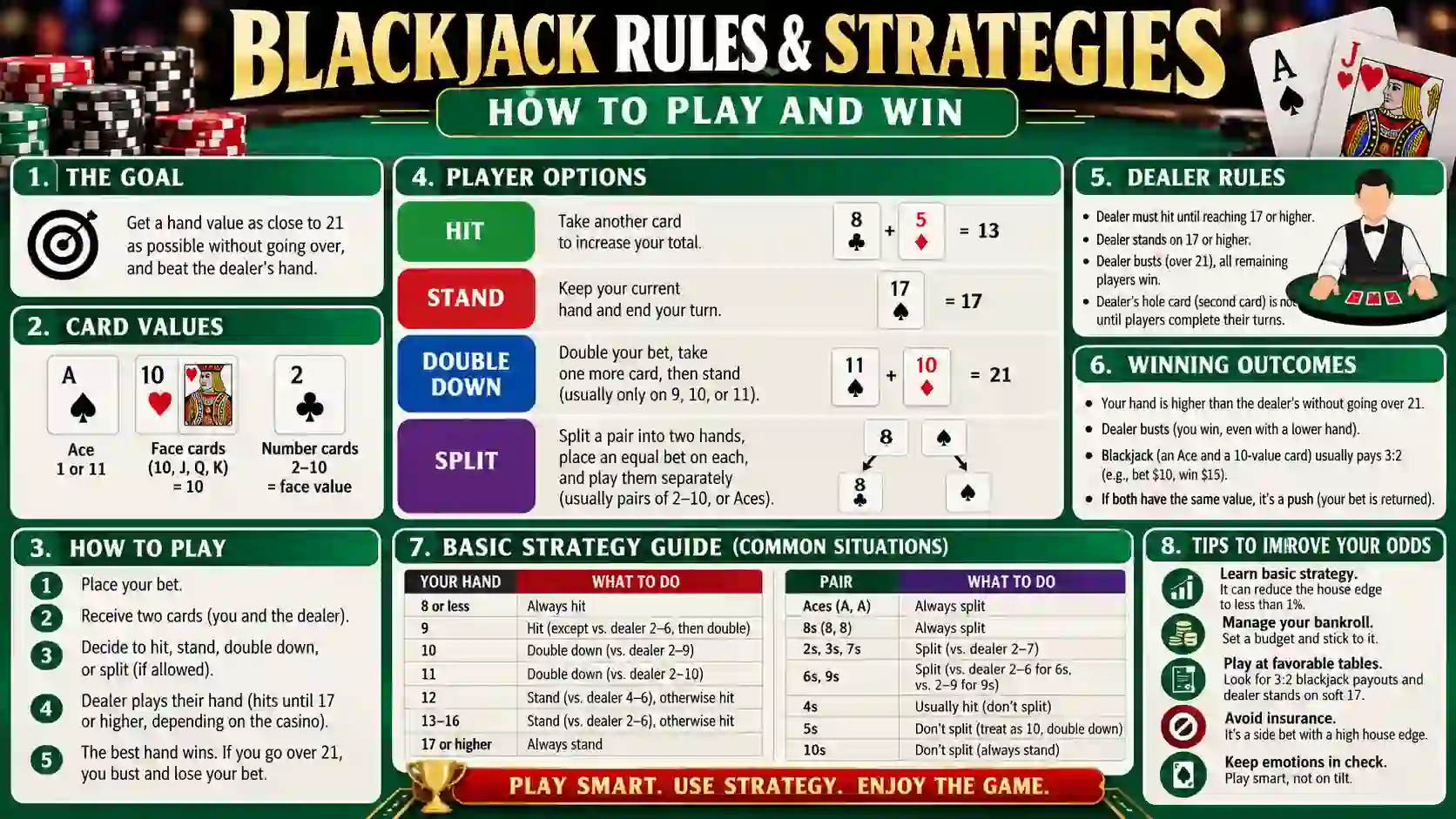
Blackjack Card Values Explained
Before learning blackjack strategies, you need to know how the cards are counted.
| Card | Blackjack Value |
| 2 through 9 | Face value |
| 10 | 10 points |
| Jack, Queen, King | 10 points |
| Ace | 1 or 11 points |
An ace is particularly valuable because its value adjusts according to the hand.
For example:
- Ace + 7 = soft 18
- King + 6 = hard 16
- Ace + King = natural blackjack
- Ace + 5 + 9 = 15, because the ace must count as 1
Hard Hands vs. Soft Hands
Understanding the difference between hard and soft hands is essential for using a blackjack strategy chart correctly.
Hard hand: A hand without an ace valued at 11. For example, 10 + 6 is a hard 16.
Soft hand: A hand containing an ace that can still count as 11 without exceeding 21. For example, ace + 6 is a soft 17.
Soft hands are generally more flexible because drawing another card cannot immediately bust a two-card soft hand. If necessary, the ace changes from 11 to 1.
This flexibility often makes hitting or doubling more attractive than it would be with an equivalent hard total.
How to Play Blackjack: Step-by-Step Guide for Beginners
The following walkthrough explains a typical round of blackjack.
Step 1: Choose a Blackjack Table
Before placing money on the table, examine its rules.
Look for the minimum and maximum bets, blackjack payout, number of decks, and whether the dealer hits or stands on soft 17.
These details matter because not every blackjack table offers the same mathematical advantage.
Step 2: Place Your Bet
At the beginning of each round, players place their wagers in designated betting areas.
For example, you might place a $10 bet. That amount becomes your original stake for the hand.
Once betting closes, the dealer begins distributing cards.
Step 3: Receive Your First Two Cards
Each player receives two cards. The dealer also receives two cards, although the dealing procedure depends on the blackjack variation.
In a typical American-style game, the dealer has one face-up card and one face-down card, known as the hole card.
The dealer’s visible card is especially important because it helps determine your best strategy.
Step 4: Decide Whether to Hit, Stand, Double, Split, or Surrender
After receiving your initial cards, you make a playing decision.
Your available choices depend on your hand and the table rules.
For instance, suppose you receive a 9 and a 7, giving you a hard 16, while the dealer shows a 10.
Although hitting risks busting, basic strategy generally recommends hitting if surrender is unavailable.
The correct move is not always the one that feels safest. It’s the decision with the strongest mathematical expected value.
Step 5: The Dealer Plays Their Hand
Once the players finish their turns, the dealer completes their hand according to predetermined rules.
In most standard games:
- The dealer must hit on totals of 16 or less.
- The dealer must stand on hard 17 or higher.
- The treatment of soft 17 depends on the table rules.
Unlike players, dealers cannot freely choose how to play based on instinct.
Step 6: Determine the Winner
After the dealer finishes drawing, the hands are compared.
You win if your non-busted hand beats the dealer’s total or the dealer busts.
You lose if your total exceeds 21 or the dealer has a higher valid total.
When both hands have the same value, the result is usually a push, meaning your original bet is returned. A natural blackjack has special precedence over an ordinary 21.
Understanding the Main Blackjack Rules
Knowing when and how to use each available action is the foundation of effective blackjack play.
- Hit
Hitting means requesting another card.
You can continue hitting until you decide to stand or your total exceeds 21.
For example, if you hold a 7 and a 5, your total is 12. Depending on the dealer’s visible card, hitting may be the correct decision.
- Stand
Standing means keeping your current hand and taking no additional cards.
Players commonly stand with strong hard totals, particularly 17 through 21.
However, whether you should stand also depends on whether your hand is hard or soft and which card the dealer is showing.
- Double Down
Doubling down allows you to increase your original wager, usually by an equal amount, in exchange for receiving exactly one additional card.
Suppose you bet $10 and receive a 6 and a 5, totaling 11. If you double down, you add another $10 and receive one final card.
Doubling can be valuable when the expected return from increasing the stake is favorable.
However, it also increases the amount of money at risk.
- Split
Splitting is available when your first two cards form an eligible pair.
For example, if you receive two 8s, you may separate them into two hands by placing an additional wager equal to the original bet.
Each hand is then played independently, subject to the casino’s restrictions.
Splitting aces often has special limitations, such as receiving only one additional card per ace.
- Surrender
Some blackjack tables offer surrender, which allows you to abandon your initial hand and recover half your original wager.
If you bet $20 and surrender, you receive $10 back.
Late surrender is generally available only after the dealer has checked for blackjack, or under equivalent conditions specified by the game.
Although surrender means accepting a partial loss, it can be mathematically preferable to continuing with certain weak hands.
- Insurance
Insurance is an optional side bet typically offered when the dealer’s visible card is an ace.
It pays 2:1 if the dealer has a natural blackjack.
Despite its appealing name, insurance is generally unfavorable for recreational players who are not using advanced information about the cards remaining in the deck.
Blackjack Payouts: How Much Can You Win?
Understanding payouts is just as important as knowing how to play.
Many blackjack games use the following settlement rules:
| Outcome | Typical Payout |
| Regular winning hand | 1:1 |
| Natural blackjack | 3:2 |
| Losing hand | Original wager lost |
| Push | Original wager returned |
| Winning insurance bet | 2:1 |
Consider a $10 starting wager.
If you win a regular hand, you earn $10 in profit. If you receive a natural blackjack at a 3:2 table, you earn $15 in profit.
But some tables pay just 6:5 for a natural blackjack. On the same $10 wager, that produces only $12 in profit.
That $3 difference might appear small, but repeated over many rounds, lower blackjack payouts significantly affect expected returns.
According to the mathematical comparisons published by Wizard of Odds, changing the blackjack payout from 3:2 to 6:5 increases the house advantage by approximately 1.39 percentage points, assuming otherwise identical rules.
Practical takeaway: When other rules are comparable, a 3:2 blackjack table is generally preferable to a 6:5 table.
Blackjack Basic Strategy: How to Make Better Decisions
Blackjack basic strategy is a mathematically developed system that identifies the highest-expected-value decision for different combinations of player hands and dealer upcards.
It isn’t based on intuition, lucky streaks, or guessing which card will appear next.
Instead, basic strategy evaluates possible outcomes and recommends the decision that produces the best average financial result over time.
The exact strategy depends on the game rules, including deck count, whether the dealer hits soft 17, and whether doubling after splitting is permitted.
The following guidelines describe common decisions for a four-to-eight-deck game in which the dealer stands on soft 17, with standard doubling rules.
Blackjack Basic Strategy Reference
| Your Hand | Dealer’s Upcard | Recommended Action |
| Hard 8 or less | Any | Hit, unless a pair rule applies |
| Hard 9 | 3–6 | Double if allowed |
| Hard 10 | 2–9 | Double if allowed |
| Hard 11 | 2–10 | Double if allowed |
| Hard 12 | 4–6 | Stand |
| Hard 13–16 | 2–6 | Stand, unless surrender applies |
| Hard 17 or higher | Any | Stand |
| Soft 17 (A,6) | 3–6 | Double if allowed |
| Soft 18 (A,7) | 3–6 | Double if allowed |
| Soft 18 (A,7) | 9, 10, Ace | Hit |
| Soft 19 or higher | Any | Usually stand |
When a recommended double is unavailable, the alternative is usually to hit, although some soft-hand situations require standing.
This table is a learning reference, not a substitute for a complete rule-specific chart. Pair decisions, surrender options, and other exceptions should also be considered.
Why the Dealer’s Upcard Matters
A dealer showing a 4, 5, or 6 is generally in a weaker position than one showing a 9, 10, or ace.
That does not guarantee the dealer will bust. It simply changes the probabilities.
For example, holding a hard 13 against a dealer’s 6 is different from holding the same hand against a dealer’s 10.
Against the 6, standing is usually preferable because the dealer has a greater risk of exceeding 21 while completing their hand.
Against the 10, hitting is generally better because standing with 13 is unlikely to beat a strong dealer total.
This is why effective blackjack strategy always considers both hands rather than focusing on the player’s cards alone.
When Should You Hit or Stand in Blackjack?
The hit-or-stand decision is one of the most frequent choices you will make.
A beginner-friendly way to remember the general approach is to divide hands into three groups.
Low totals: Hard totals of 8 or less generally need another card.
Middle totals: Hands between 12 and 16 require more careful decisions because the dealer’s upcard becomes critical.
Strong totals: Hard 17 or higher should normally stand.
Soft hands require separate treatment.
For example, soft 17 is not equivalent to hard 17. With ace + 6, you can draw a card without immediately busting, making hitting or doubling potentially preferable.
One of the most common beginner mistakes is treating every 17 as an automatic stand.
When Should You Split Pairs in Blackjack?
Splitting can turn an awkward starting hand into two separate opportunities.
However, splitting is not always beneficial.
Always Split Aces and Eights Under Standard Basic Strategy
Two aces form a soft 12, which is relatively weak as a combined hand. Splitting gives each ace an opportunity to form a stronger hand.
Likewise, two 8s total a hard 16, one of the least comfortable starting hands in blackjack.
Splitting them creates two hands beginning with 8 rather than forcing you to play a single hard 16.
Never Split Tens or Fives Under Standard Basic Strategy
Two 10-value cards give you 20, an excellent total.
Splitting them sacrifices a strong hand in exchange for two uncertain outcomes.
Two 5s, meanwhile, total 10. That makes them more suitable for hitting or doubling, depending on the dealer’s upcard.
Other pairs, such as 2s, 3s, 6s, 7s, and 9s, require more specific decisions based on the dealer’s card and the table rules.
Remember: Splitting requires another wager. Even a strategically sound split can lose both hands.
When Is Doubling Down a Good Blackjack Strategy?
Doubling down is most useful when you have a favorable opportunity to increase your wager.
A classic example is holding 11 against a dealer’s 6.
Your hand has a strong chance of improving substantially with one additional card, while the dealer faces a comparatively difficult starting position.
Under common multi-deck, stand-on-soft-17 rules, doubling hard 11 is recommended against dealer upcards from 2 through 10.
Hard 10 is commonly doubled against 2 through 9, while hard 9 is doubled against 3 through 6.
Certain soft totals also benefit from doubling.
The essential lesson is that doubling should be based on expected value, not excitement or the desire to recover previous losses.
Blackjack Odds and House Edge Explained
The house edge describes the casino’s theoretical average advantage over players across a very large number of wagers.
Blackjack’s house edge varies with the table rules and the strategy being used.
Under favorable conditions, mathematically correct basic strategy can reduce the house edge to approximately 0.5% or sometimes lower.
For example, mathematical analysis published by Wizard of Odds gives a house edge of approximately 0.41% for a six-deck game in which the dealer stands on soft 17 under its specified favorable rules.
However, actual games may have less favorable conditions.
Example: Understanding a 0.5% House Edge
Imagine that your total betting volume over many sessions reaches $1,000.
At a theoretical house edge of 0.5%, the expected loss is approximately $5.
This does not mean you will lose exactly $5 or that every session will follow the average.
You could win hundreds of dollars in a short session or lose far more than the theoretical expectation.
The house edge describes a long-term average, not a prediction of individual outcomes.
What Changes the Blackjack House Edge?
Several table conditions influence the expected return:
- Blackjack payout: A 3:2 payout is more favorable than 6:5.
- Dealer soft 17 rule: A dealer who stands on soft 17 generally offers a better game than one who hits.
- Number of decks: Fewer decks can be beneficial when other rules remain identical.
- Doubling after splitting: Allowing this option generally helps the player.
- Surrender: The availability of favorable surrender decisions can reduce expected losses.
These differences explain why choosing a good blackjack table is part of sound strategy.
Practical Blackjack Tips for Beginners
Learning the rules is only the beginning. Applying them consistently is what matters.
- Learn Basic Strategy Before Playing for Money
Don’t rely on instinct when a mathematical strategy already exists.
Use a reputable blackjack strategy chart for the exact game you intend to play.
Practice until common decisions become familiar.
- Avoid Poor Blackjack Payouts
Check whether natural blackjack pays 3:2 or 6:5.
This is one of the easiest table-rule differences to identify and one of the most consequential.
- Don’t Automatically Take Insurance
Insurance may appear to protect your original bet, but it is a separate wager.
For players using ordinary basic strategy without card-counting information, declining insurance is generally the better decision.
- Practice With Free Blackjack Games
Free-play blackjack can help you learn the order of play, card values, and available actions without risking money.
Use practice sessions to focus on making correct decisions rather than measuring imaginary profits.
- Set a Spending and Time Limit
Choose an amount you can afford to lose before you begin.
A fixed session budget can help prevent emotional decisions, although it doesn’t change the game’s mathematical advantage.
- Don’t Chase Your Losses
Losing several hands does not make a winning hand more likely.
Increasing your wagers simply because you’re behind can expose you to much larger losses.
- Focus on Decisions, Not Individual Results
A mathematically correct decision can still lose.
For example, doubling an 11 against a weak dealer upcard may be appropriate even if the next card turns out badly.
Judge your play by whether you followed the right strategy, not by whether one particular hand won.
Common Blackjack Mistakes You Should Avoid
Many new players lose more than necessary because they misunderstand how blackjack works.
Mistake 1: Always Standing on 16
Standing with a hard 16 might seem safer than taking another card.
However, against a dealer’s 7, 8, 9, 10, or ace, basic strategy generally recommends hitting when surrender isn’t the preferred available option.
Mistake 2: Refusing to Split Eights
Two 8s make a difficult hard 16.
Splitting them is usually the mathematically preferable option, even against a strong dealer card under standard rules.
Mistake 3: Assuming the Dealer Is Due to Bust
A dealer who has completed several strong hands is not necessarily more likely to bust on the next one.
Short-term streaks do not create reliable predictions.
Mistake 4: Using Progressive Betting Systems as a Guarantee
Systems such as Martingale involve increasing wagers after losses.
While they change the pattern and size of bets, they do not remove blackjack’s underlying house edge.
A long losing sequence, insufficient bankroll, or table betting limit can produce substantial losses.
Mistake 5: Ignoring Game Variations
A strategy designed for a dealer who stands on soft 17 will not always produce the optimal decisions in a game where the dealer hits soft 17.
Similarly, European-style blackjack may involve different dealer-card procedures and doubling restrictions.
Always check the rules before applying a strategy.
Online Blackjack vs. Live Dealer Blackjack
Both online and live dealer blackjack follow the same general objective, but the playing experience can differ.
Online Blackjack
Standard digital blackjack typically uses software to generate and display hands.
These games can be convenient for learning because decisions and hand totals are clearly presented.
However, individual versions may use different rules, payouts, or optional side bets.
Live Dealer Blackjack
Live dealer blackjack streams gameplay conducted by a human dealer.
The experience is closer to a physical casino table, with cards dealt in real time.
Players should still check the payout structure, table limits, and rules.
Which version offers better winning chances?
Neither format is automatically superior.
The actual house edge depends primarily on the specific game’s rules, payouts, and decision options, not simply whether a human dealer or software conducts the game.
Is Card Counting a Reliable Blackjack Winning Strategy?
Card counting is an advanced technique that tracks the changing composition of cards remaining in a shoe.
A well-known example is the Hi-Lo system, which assigns values to different card groups and uses the running count to estimate when the remaining cards may be more favorable.
Under suitable game conditions, skilled advantage players may be able to identify situations with a positive expected return.
However, card counting is not a beginner shortcut or a guarantee of winning.
Its effectiveness depends on accurate tracking, game rules, deck penetration, betting adjustments, and practical casino conditions.
Online games that effectively reshuffle after each hand offer little opportunity for traditional card counting.
For most beginners, mastering basic strategy is a more appropriate first goal than attempting advanced advantage play.
Responsible Blackjack Play
Blackjack should be treated as entertainment rather than an income source.
Even when your decisions are mathematically correct, losing sessions remain possible.
Before playing with real money:
- Set a spending limit you can comfortably afford.
- Decide how much time you want to spend playing.
- Avoid borrowing money to gamble.
- Never increase your bets solely to recover losses.
- Stop when gambling no longer feels enjoyable or controlled.
- Use available deposit limits, breaks, or self-exclusion tools when needed.
These precautions are consistent with guidance from GambleAware.
If gambling is affecting your finances, relationships, or wellbeing, consider seeking support from an appropriate gambling-help organization.
FAQs
What are the basic rules of blackjack?
Blackjack is played against the dealer. Your objective is to finish with a higher valid total than the dealer without exceeding 21. Cards 2 through 10 count at face value, face cards count as 10, and aces count as 1 or 11. Players can typically hit, stand, double down, or split according to the table rules.
What is the best strategy to win at blackjack?
The most effective general approach for recreational players is to use mathematically correct basic strategy, choose favorable table rules, and avoid unnecessary side bets. Basic strategy reduces the house advantage but does not guarantee a profit.
Should you always hit on 16 in blackjack?
No. The correct action depends on the dealer’s upcard, the composition of your hand, and whether surrender is available. Under common rules, hard 16 generally stands against dealer cards 2 through 6 and hits against stronger cards when surrender is not appropriate.
Should you hit or stand on 17?
You should generally stand on a hard 17. However, a soft 17, such as ace + 6, is usually played differently and may call for hitting or doubling depending on the dealer’s card.
Is blackjack based on luck or skill?
Blackjack involves both chance and decision-making skill. Players cannot control which cards are dealt, but strategic decisions influence expected returns. Correct play can reduce the casino’s advantage without eliminating the randomness of individual hands.
Is it better to play single-deck blackjack?
Not necessarily. Fewer decks can improve the player’s expected return when other rules are identical, but single-deck tables sometimes have unfavorable payouts or restrictions. A good multi-deck game can be preferable to a poorly structured single-deck game.
What does 3:2 mean in blackjack?
A 3:2 payout means that a winning natural blackjack earns $3 in profit for every $2 wagered. For example, a $20 blackjack bet produces $30 in profit, plus the return of the original $20 stake.
Can you consistently win money at blackjack?
There is no reliable guarantee of making money through blackjack. Players may experience winning streaks, and advanced advantage techniques can sometimes change expected returns under particular conditions. However, ordinary blackjack played with basic strategy generally retains a casino advantage.
What is the easiest blackjack strategy for beginners?
Start by learning when to hit and stand, understand the difference between hard and soft hands, memorize the basic rules for splitting aces and eights, and practice doubling decisions. A complete basic-strategy chart is more accurate than simplified memorization rules.
Does betting more after a loss improve your chances?
No. Increasing your wager does not change the probability of receiving favorable cards. Progressive betting systems can increase financial exposure, particularly during long losing streaks.
Final Thoughts
Blackjack rewards careful decision-making, but it doesn’t reward wishful thinking.
Learning the game begins with understanding card values and the objective of beating the dealer. From there, mastering hitting, standing, doubling, splitting, and surrender gives you the tools to approach each hand more confidently.
The most important lesson is that good blackjack strategy is about maximizing expected value, not predicting the next card.
Choose tables with favorable payouts, use a strategy chart that matches the rules, avoid emotionally driven betting, and maintain firm spending limits.
You cannot control whether the next hand will win or lose. What you can control is whether your decisions are informed, consistent, and appropriate for the game you are playing.
That’s the difference between simply knowing how blackjack works and understanding how to play it well.
ADVERTISEMENT

18+ | Affiliate link | Terms apply | Please gamble responsibly.


